
Learn how dental crown manufacturing supports prosthodontics through material selection, digital workflow, precise fit, and laboratory quality control.
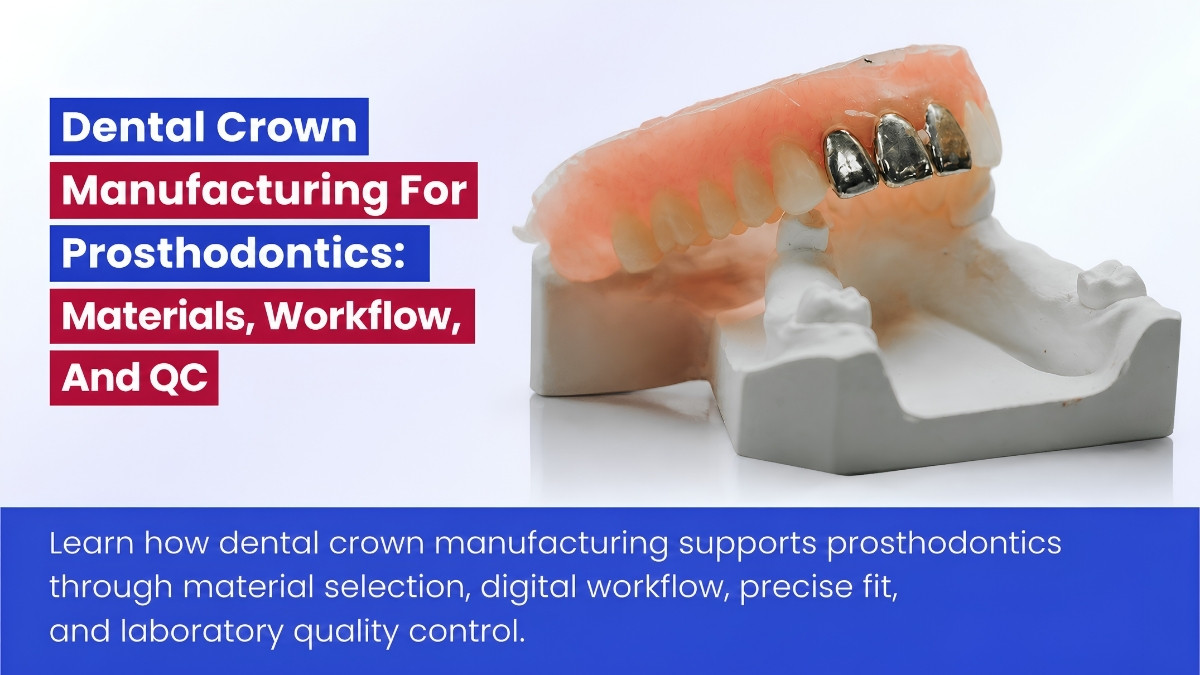
Table of contents [Show]
- What a crown means in prosthodontics
- Main indications for dental crowns
- Crown types by coverage
- Crown types by material
- Zirconia crowns
- Lithium disilicate crowns
- Zirconia-reinforced lithium silicate crowns
- Porcelain-fused-to-metal crowns
- Full cast metal crowns
- Crown preparation principles
- Crown fabrication workflows
- CAD/CAM crowns
- Implant-supported crowns
- Crown cementation and bonding
- Laboratory quality control for crowns
- Crown complications
- Crowns and periodontal health
- Crowns in full-mouth rehabilitation
- Crown material selection guide
- International standards and crown manufacturing
- Why crowns matter in dental lab outsourcing
- Key takeaways
Crowns are one of the most important restorations in fixed prosthodontics. From a dental laboratory perspective, a crown is not merely a cap placed over a tooth. It is a precisely engineered indirect restoration designed to restore tooth structure, function, occlusion, esthetics, protection, and long-term biological stability. Modern crowns can be produced through conventional pressing or casting, CAD/CAM milling, provisional 3D printing, or hybrid workflows that combine digital and analog steps.
For dental practices and laboratories, crowns sit at the intersection of clinical planning, material science, laboratory precision, and long-term tissue health. A successful crown must not only look natural, but also seat accurately, maintain margins, function in occlusion, support hygiene, and resist fracture under real oral conditions.
What a crown means in prosthodontics
A dental crown is an indirect restoration that covers all or part of the clinical crown of a tooth or an implant abutment. It restores external tooth form while protecting the remaining structure.
Where crowns are used
- Natural teeth
- Endodontically treated teeth
- Implant abutments
- Teeth with large restorations
- Structurally cracked teeth
- Worn dentition
- Esthetic rehabilitation cases
- Bridge abutments
- Full-mouth rehabilitation cases
What a crown restores
- Function
- Esthetics
- Occlusion
- Vertical dimension
- Tooth morphology
- Phonetics
- Protection of weakened tooth structure
- Implant-supported tooth replacement
In practical terms, a crown must solve more than one problem at once. If it only looks good, that is decoration. If it only survives, that is engineering with poor social skills.
Main indications for dental crowns
Crowns are indicated when a tooth needs more protection, coverage, or reconstruction than a direct restoration can reliably provide.
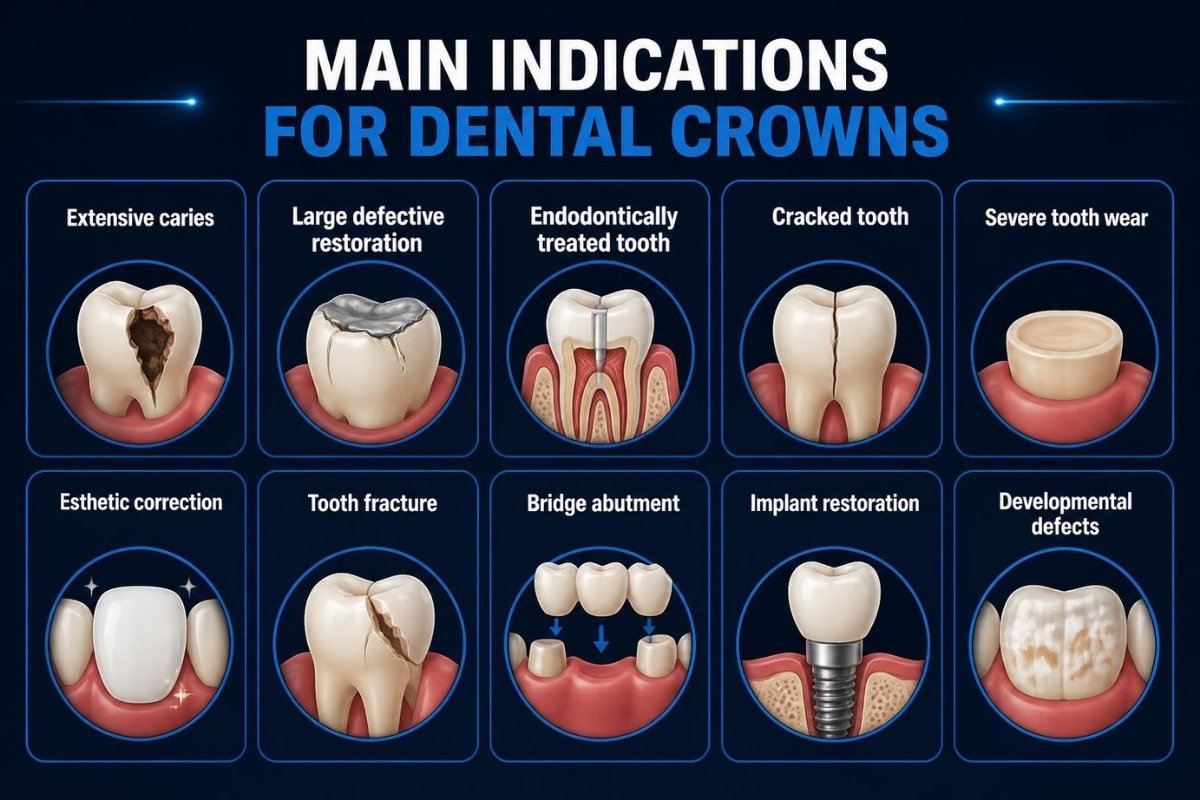
Common clinical indications
| Indication | Why a crown may be needed |
|---|---|
| Extensive caries | Remaining tooth structure is too weak for direct restoration |
| Large defective restoration | Existing restoration compromises tooth strength |
| Endodontically treated tooth | Tooth may need cuspal coverage and fracture protection |
| Cracked tooth | Crown may help bind and protect remaining structure |
| Severe tooth wear | Restores anatomy and vertical dimension |
| Esthetic correction | Improves shape, shade, alignment, and symmetry |
| Tooth fracture | Rebuilds lost coronal structure |
| Bridge abutment | Supports fixed partial denture |
| Implant restoration | Replaces a missing tooth with an implant-supported crown |
| Developmental defects | Restores malformed or hypoplastic teeth |
When a crown may not be ideal
- Caries is uncontrolled
- Periodontal disease is active
- The tooth has poor prognosis
- Ferrule is inadequate
- Oral hygiene is poor
- Occlusal forces are uncontrolled
- A more conservative onlay or veneer is sufficient
- The patient cannot maintain the restoration properly
Good prosthodontics is not about crowning every tired tooth. It is about choosing the least invasive restoration that can survive function and protect biology.
Crown types by coverage
Crowns can be classified by how much tooth structure they cover.
Full-coverage crowns
A full-coverage crown covers nearly all axial walls and the occlusal or incisal surface.
Common examples include:
- Full zirconia crown
- Lithium disilicate crown
- Porcelain-fused-to-metal crown
- Full cast gold crown
- Metal-ceramic crown
- Implant crown
These are commonly used when significant protection, retention, or structural reinforcement is required.
Partial-coverage crowns
Partial-coverage restorations preserve more tooth structure.
Examples include:
- 3/4 crown
- 7/8 crown
- Onlay
- Overlay
- Endocrown
- Veneer crown in selected cases
These may be preferred when adhesive bonding is possible and enough enamel remains.
Endocrowns
An endocrown is a bonded restoration, often used for endodontically treated posterior teeth, that uses the pulp chamber for retention instead of a post.
Advantages
- Conservative preparation
- No post space preparation
- Effective use of adhesive dentistry
- Suitable for selected molars
Limitations
- Requires adequate bonding substrate
- Not ideal with poor isolation
- Not ideal in high parafunction without careful planning
- Requires appropriate case selection
Crown types by material
Material selection is one of the most important decisions in crown prosthodontics.
Major crown materials
| Material | Strengths | Limitations | Common use |
|---|---|---|---|
| Monolithic zirconia | High strength, strong fracture resistance | Esthetics vary by generation | Posterior crowns, bruxism, implants |
| Layered zirconia | Better esthetics than opaque zirconia | Veneering ceramic chipping risk | Esthetic anterior and posterior cases |
| Lithium disilicate | Excellent esthetics, bondable | Lower strength than zirconia | Anterior crowns, premolars, veneers |
| Zirconia-reinforced lithium silicate | Good esthetics and CAD/CAM compatibility | Product-specific indication limits | Single crowns, esthetic restorations |
| Feldspathic porcelain | Excellent esthetics | Brittle and technique-sensitive | Veneers, selected anterior cases |
| Porcelain-fused-to-metal | Long clinical history, strong framework | More opaque, possible chipping | Crowns and bridges |
| Full cast metal or gold | Excellent longevity, conservative prep | Poor esthetics | Posterior crowns |
| Resin composite or hybrid ceramic | Easy milling and repair | Wear and discoloration concerns | Provisionals, selected definitive cases |
| PMMA | Fast and economical | Not definitive long-term | Provisionals |
| 3D printed resin | Efficient provisional production | Material-specific limitations | Provisionals, try-ins |
The right material depends on esthetics, load, space, margin design, bonding conditions, and long-term risk.
Zirconia crowns
Zirconia is one of the most widely used materials in modern crown fabrication.
Why zirconia is popular
- High flexural strength
- Strong fracture resistance
- CAD/CAM efficiency
- Good biocompatibility
- Suitability for posterior crowns
- Suitability for implant crowns
- Reduced chipping when monolithic
- Improved esthetics in newer translucent generations
Zirconia crown categories
| Zirconia type | Main feature | Typical crown use |
|---|---|---|
| 3Y-TZP | Highest strength, more opaque | Posterior crowns, bridges, implant cases |
| 4Y zirconia | Balance of strength and translucency | Posterior and some anterior crowns |
| 5Y zirconia | Higher translucency, lower strength | Anterior esthetic crowns |
| Multilayer zirconia | Shade and translucency gradient | Esthetic monolithic crowns |
| High-translucency zirconia | Improved esthetics | Anterior and premolar crowns |
Laboratory considerations for zirconia
- CAD design parameters
- Minimum occlusal thickness
- Margin thickness
- Cement space
- Nesting position
- Sprue placement
- Milling bur condition
- Sintering temperature
- Sintering holding time
- Cooling protocol
- Stain and glaze compatibility
- Final polish quality
Zirconia is strong, but it is not magic armor. Thin design, rough adjustment, or poor sintering can still create failure.
Lithium disilicate crowns
Lithium disilicate is a major glass-ceramic material valued for esthetics and adhesive potential.
Advantages
- High translucency
- Excellent esthetics
- Good strength for many single-unit crowns
- Adhesive bonding potential
- Conservative preparation options
- Press or CAD/CAM fabrication
- Good marginal adaptation when processed properly
Common indications
- Anterior crowns
- Premolar crowns
- Veneers
- Inlays and onlays
- Overlays
- Esthetic single crowns
- Selected molar crowns with proper thickness and occlusal control
Limitations
- Long-span bridges
- Severe bruxism without protection
- Limited occlusal clearance
- Poor bonding conditions
- Thin posterior crowns under high load
- Very high-load implant situations depending on design
It is a beautiful material, but beauty still needs thickness and case selection.
Zirconia-reinforced lithium silicate crowns
Zirconia-reinforced lithium silicate, often shortened to ZLS, is a CAD/CAM glass-ceramic material designed to blend esthetics with improved mechanical behavior.
Characteristics
- Good translucency
- CAD/CAM compatibility
- Glass-ceramic bonding protocols
- Esthetic single-unit restoration potential
- Efficient chairside or labside workflow
Laboratory notes
- Correct milling strategy
- Material-specific crystallization or firing
- Manufacturer-approved etching and bonding protocols
- Careful polishing or glazing
- Adequate thickness
These materials can perform well, but only when the workflow follows the manufacturer’s system rather than creative improvisation.
PFM crowns remain clinically relevant even in a highly ceramic market.
Advantages
- Long clinical history
- Strong metal substructure
- Good versatility
- Use in crowns and bridges
- Functional reliability in posterior areas
- Ability to mask dark tooth structure
Limitations
- Lower translucency than all-ceramics
- Opaque appearance if poorly designed
- Gray margin risk
- Porcelain chipping
- Need for greater tooth reduction
- Metal allergy concerns in selected patients
- Esthetic limits in high-smile-line cases
Laboratory requirements
- Metal framework design
- Opaque application
- Ceramic layering
- Firing compatibility
- Thermal expansion matching
- Porcelain support
- Metal finishing and polishing
- Margin design
PFM is still useful when strength and masking ability matter more than maximum translucency.
Full cast crowns, especially high noble gold, remain among the most durable crown options.
Advantages
- Excellent longevity
- Excellent marginal adaptation
- Favorable wear against opposing teeth
- Less reduction than many ceramics
- Strong performance in thin sections
- Good for heavy occlusion
- Useful in posterior molars
Disadvantages
- Poor esthetics
- Higher alloy cost
- Lower patient acceptance in visible areas
- Technique-sensitive casting process
Best uses
- Posterior molars
- Bruxism patients
- Limited interocclusal clearance
- Patients prioritizing function over esthetics
- Short clinical crowns where retention is difficult
Gold may not win beauty contests, but it has quietly won many longevity competitions.
Crown preparation principles
Proper tooth preparation is essential for crown success.
Objectives of crown preparation
- Adequate restorative space
- Retention
- Resistance form
- Marginal clarity
- Preservation of tooth structure
- Smooth transitions
- Defined path of insertion
- Ferrule when needed
- Periodontal compatibility
- Material-specific thickness
Key preparation factors
| Preparation factor | Clinical and lab importance |
|---|---|
| Occlusal reduction | Provides material thickness |
| Axial reduction | Allows contour and esthetics |
| Total occlusal convergence | Affects retention and seating |
| Finish line | Determines margin fit and material support |
| Rounded internal angles | Reduces stress concentration |
| Ferrule | Improves prognosis for endodontically treated teeth |
| Margin location | Affects scan, cementation, and hygiene |
| Surface smoothness | Improves fit, scan accuracy, and impression quality |
| Finish line | Common use |
|---|---|
| Chamfer | Zirconia, metal, PFM |
| Deep chamfer | Zirconia and lithium disilicate |
| Shoulder | All-ceramic crowns, esthetic margins |
| Shoulder with rounded internal angle | Glass ceramics and zirconia |
| Knife-edge or feather-edge | Selected zirconia or periodontally compromised cases; technique-sensitive |
A preparation that is clear, smooth, and material-appropriate makes the lab’s work possible. A vague margin is not a minimalist design philosophy.
Crown fabrication workflows
Crowns may be fabricated through conventional, digital, or hybrid workflows.
Conventional workflow
- Receive impression and prescription
- Disinfect impression
- Pour working cast
- Fabricate die
- Mount models
- Apply die spacer
- Wax crown
- Invest pattern
- Cast metal or press ceramic
- Divest and fit
- Layer ceramic if needed
- Finish and polish
- Quality control
- Deliver to clinic
This remains important for PFMs, full cast crowns, pressed ceramics, and layered ceramic work.
Digital workflow
- Receive STL, PLY, OBJ, or native scan file
- Review margin clarity
- Check occlusion and contacts
- Design crown in CAD software
- Set cement space and anatomy
- Nest restoration
- Mill or print
- Sinter, crystallize, or cure
- Characterize
- Polish or glaze
- Verify fit if model is used
- Final QC
- Deliver
Hybrid workflow
A hybrid workflow combines analog and digital steps.
Physical impression → Stone model → Lab scan → CAD design → CAM milling → Sintering or crystallization → Staining or glazing → Final QCHybrid workflows are common when clinics still send conventional impressions but the laboratory manufactures digitally.
CAD/CAM crowns
CAD/CAM crowns are now standard in modern dental labs.
CAD/CAM workflow
Scan → Design → Nest → Mill → Post-process → Finish → QC → DeliverCAD/CAM benefits
- Faster production
- Reproducible design
- Digital case storage
- Efficient remakes
- Consistent cement space
- Better material optimization
- Less manual waxing
- Integration with implant libraries
- Efficient monolithic restorations
CAD/CAM limitations
- Dependence on scan quality
- Margin interpretation errors
- Software library mismatch
- Milling bur wear
- Sintering shrinkage errors
- Inadequate finishing
- Over-reliance on auto-design
- Material thickness limitations
Crown design parameters
- Margin line
- Insertion path
- Cement gap
- Contact strength
- Occlusal contact
- Minimum thickness
- Emergence profile
- Surface anatomy
- Proximal contour
- Material-specific limitations
Digital dentistry is fast, but fast does not mean forgiving. A bad CAD margin is still a bad margin wearing modern clothes.
Implant-supported crowns
An implant-supported crown replaces a missing tooth using a dental implant for support.
Types
- Screw-retained
- Cement-retained
- Screwmentable
- Custom abutment-supported
- Ti-base supported
- Zirconia abutment-supported
Screw-retained implant crowns
Advantages
- Retrievable
- No residual cement risk
- Easier maintenance
- Helpful for peri-implant management
Limitations
- Screw access may compromise esthetics
- Access hole may weaken ceramic if poorly placed
- Requires proper implant angulation
Cement-retained implant crowns
Advantages
- Better esthetics when screw access would be facial
- Simpler occlusal anatomy
- Can compensate for implant angulation
Limitations
- Residual cement risk
- More difficult retrievability
- Cement-related peri-implant inflammation risk
Laboratory QC for implant crowns
- Scan body accuracy
- Implant platform
- CAD library selection
- Emergence profile
- Screw access position
- Abutment seating
- Ti-base bonding
- Occlusal load
- Contact strength
- Surface polish
- Cleanability
Implant crowns require special respect. They do not have periodontal ligament cushioning, so occlusion and emergence profile must be controlled carefully.
Crown cementation and bonding
Cement selection depends on crown material, preparation geometry, moisture control, and retention.
Common cement categories
| Cement type | Typical use |
|---|---|
| Resin-modified glass ionomer | Zirconia, PFM, metal crowns with good retention |
| Glass ionomer | Metal and zirconia crowns in retentive preparations |
| Resin cement | Lithium disilicate, veneers, short preparations, bonded crowns |
| Self-adhesive resin cement | Zirconia and selected ceramic crowns |
| Temporary cement | Provisionals or retrievable restorations |
Material-specific surface treatment
| Crown material | Typical internal surface treatment |
|---|---|
| Zirconia | Air abrasion and MDP primer or resin cement |
| Lithium disilicate | Hydrofluoric acid etch, silane, resin cement |
| Feldspathic porcelain | Hydrofluoric acid etch and silane |
| Metal | Air abrasion and metal primer if needed |
| Resin or hybrid ceramic | Manufacturer-specific abrasion, etch, or primer |
| PMMA provisional | Mechanical retention or temporary cement protocol |
The laboratory should communicate surface treatment status and cementation recommendations when relevant. Seating appointments should confirm precision, not reveal avoidable discrepancies.
Laboratory quality control for crowns
Crown QC is the final safety gate before delivery.
Critical crown checks
| QC check | What to verify |
|---|---|
| Marginal integrity | Closed margin, no chips, no overextension |
| Internal fit | Full seating, no rocking, no internal nodules |
| Proximal contact | Correct tightness and position |
| Occlusal contact | No heavy contact, correct anatomy |
| Anatomy | Natural contour and functional morphology |
| Shade | Matches prescription and photos |
| Surface texture | Smooth, natural, plaque-resistant |
| Emergence profile | Supports tissue, not over-contoured |
| Cleanability | Patient can clean margins and embrasures |
| Material thickness | Meets manufacturer minimums |
| Cement space | Appropriate for cement type |
| Implant interface | Correct platform and screw access if applicable |
Common crown defects
| Defect | Likely cause |
|---|---|
| Open margin | Poor scan or impression, distortion, wrong margin line |
| Crown does not seat | Internal interference, tight contact, inadequate spacer |
| High occlusion | Bite error, mounting error, CAD contact too strong |
| Shade mismatch | Poor shade records, wrong opacity, wrong thickness |
| Ceramic chipping | Unsupported porcelain or occlusal overload |
| Food impaction | Open contact or poor contour |
| Gingival irritation | Rough margin, over-contour, poor emergence profile |
| Fracture | Insufficient thickness, wrong material, high load |
The crown may look beautiful on the bench, but the mouth is an unforgiving quality inspector.
Crown complications
Crowns can fail biologically, mechanically, or esthetically.
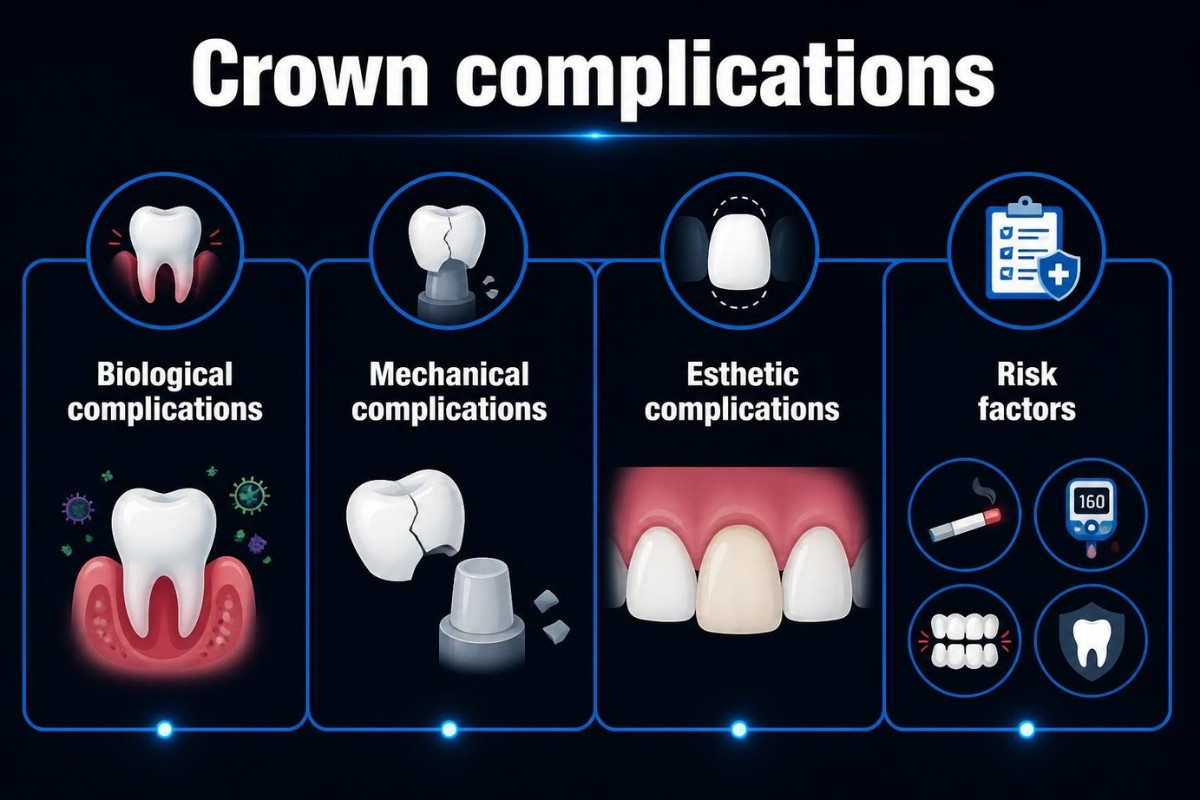
Biological complications
- Secondary caries
- Pulpitis
- Need for root canal treatment
- Gingival inflammation
- Periodontal pocketing
- Recession
- Peri-implant mucositis
- Peri-implantitis
- Root fracture
Mechanical complications
- Crown fracture
- Veneering ceramic chipping
- Loss of retention
- Debonding
- Occlusal wear
- Screw loosening in implant crowns
- Screw fracture
- Abutment fracture
Esthetic complications
- Shade mismatch
- Low value or gray appearance
- Opaque crown
- Poor translucency
- Poor shape
- Gingival discoloration
- Visible margin
- Surface texture mismatch
Risk factors
- Bruxism
- Poor oral hygiene
- Inadequate preparation
- Insufficient material thickness
- Poor bonding isolation
- Short clinical crown
- Poor ferrule
- High caries risk
- Periodontal disease
- Poorly controlled occlusion
- Inadequate lab QC
Crowns and periodontal health
A crown must be biologically compatible with surrounding tissues.
Periodontal design factors
- Smooth margins
- Accurate marginal fit
- Proper emergence profile
- No overhanging contour
- Cleanable embrasures
- Polished surfaces
- Correct proximal contact
- Proper margin location
- No excess cement
Poor crown contour or margin design can increase plaque retention and gingival inflammation. This is especially important in subgingival margins and implant restorations.
Margin location
| Margin location | Advantages | Risks |
|---|---|---|
| Supragingival | Easy to scan, clean, finish, and cement | May be less esthetic |
| Equigingival | Balance between esthetics and access | Technique-sensitive |
| Subgingival | Better esthetics, hides margin | Harder to scan, clean, and cement; higher tissue risk |
Whenever possible, biologically friendly margins should be preferred.
Crowns in full-mouth rehabilitation
Crowns are often part of full-mouth rehabilitation in complex cases.
Common reasons
- Severe wear
- Erosion
- Attrition
- Collapsed vertical dimension
- Multiple failing restorations
- Esthetic reconstruction
- Occlusal plane correction
- Functional rehabilitation
Planning requirements
- Diagnostic wax-up
- Occlusal analysis
- Vertical dimension assessment
- Provisional phase
- Phonetic evaluation
- Esthetic evaluation
- Periodontal stabilization
- Material selection
- Splint or nightguard planning
- Long-term maintenance strategy
These cases demand system-level planning. One crown in a full-mouth case is never really “just one crown.”
Crown material selection guide
Material selection should match biomechanics, esthetics, and maintenance needs.
Posterior crown selection
| Clinical situation | Preferred options |
|---|---|
| Heavy occlusion or bruxism | Monolithic zirconia, full metal |
| High-esthetic posterior | Translucent zirconia, lithium disilicate |
| Limited clearance | Zirconia or full metal |
| Implant molar crown | Monolithic zirconia, metal-ceramic, carefully designed lithium disilicate in selected cases |
| High caries risk | Crown only after caries control; cement choice matters |
Anterior crown selection
| Clinical situation | Preferred options |
|---|---|
| High esthetic demand | Lithium disilicate, layered zirconia, feldspathic ceramic |
| Dark stump | Zirconia or opaque lithium disilicate ingot |
| Thin biotype | Careful contour and translucency control |
| Single central incisor | Custom shade, layered ceramic, high characterization |
| Anterior implant crown | Custom abutment with carefully managed emergence profile |
Endodontically treated tooth
| Condition | Recommended thinking |
|---|---|
| Adequate ferrule | Crown with or without post depending on core retention |
| Minimal coronal structure | Post-core or crown lengthening may be needed |
| Posterior molar | Full coverage or endocrown may be considered |
| High load | Stronger material and stricter occlusal control needed |
International standards and crown manufacturing
Dental crowns are patient-specific dental devices and should be made with controlled materials and documented workflows.
Relevant standards
| Standard or framework | Relevance to crowns |
|---|---|
| ISO 13485 | Quality management system for medical devices |
| ISO 6872 | Dental ceramic materials |
| ISO 22674 | Metallic materials for fixed and removable restorations |
| ISO 10993 series | Biological evaluation of medical devices |
| ISO 7405 | Biocompatibility evaluation of dental materials |
| FDA, MDR, or local regulation | Device classification and custom-device obligations |
| Manufacturer IFU | Processing, sintering, crystallization, and bonding instructions |
Crown documentation should include
- Patient or case ID
- Dentist prescription
- Material type
- Material manufacturer
- Lot or batch number
- Shade
- CAD file or design version
- CAM machine or pressing or casting batch
- Sintering, crystallization, or firing cycle
- Technician name
- Final QC record
- Delivery date
Quality records are not paperwork for its own sake. They are how a lab proves the crown was made with controlled, traceable materials and processes.
Why crowns matter in dental lab outsourcing
For practices working with a lab partner, crown quality is one of the clearest measures of reliability. Crowns involve fit, margin accuracy, occlusion, esthetics, material science, and traceability all at once. If a lab can manage crowns consistently, it often reflects maturity across the broader workflow.
What dental practices should expect
- Accurate fit and marginal integrity
- Consistent material selection
- Reliable shade communication
- Controlled digital workflows
- Strong implant crown protocols
- Final QC before delivery
- Documentation and traceability
- Clear turnaround expectations
XDENT LAB positioning
- Consistent fit
- Predictable occlusion
- Controlled esthetics
- Cleanable contours
- Documented materials
- Reliable communication
That is where outsourcing stops being about price alone and starts being about repeatable restorative confidence.
Key takeaways
Crowns are foundational restorations in prosthodontics. They restore tooth structure, function, esthetics, and protection when direct restorations are no longer enough. Their success depends on correct indication, proper preparation, thoughtful material selection, controlled workflow, occlusal management, biological compatibility, and precise laboratory quality control.
The most important crown principles are:
- Use a crown only when coverage is justified
- Match the material to esthetics, load, and space
- Design preparations with clear margins and sufficient thickness
- Control the workflow whether conventional, digital, or hybrid
- Manage occlusion carefully, especially in bruxism and implants
- Protect tissues with cleanable contour and smooth margins
- Verify fit, contacts, shade, anatomy, and surface finish before delivery
- Document materials and processing under quality-system thinking
A crown succeeds when it does five things at once: seats accurately, protects the tooth, functions in occlusion, satisfies esthetics, and remains cleanable over time.
About XDENT LAB:
We are experts in Lab-to-Lab Full Service from Vietnam, with the signature services of Removable, meet U.S. market standards, FDA-registered, ISO 13485-certified. Founded in 2017, from local root to global reach, we scale with 2 Factories with over 100+ employees.
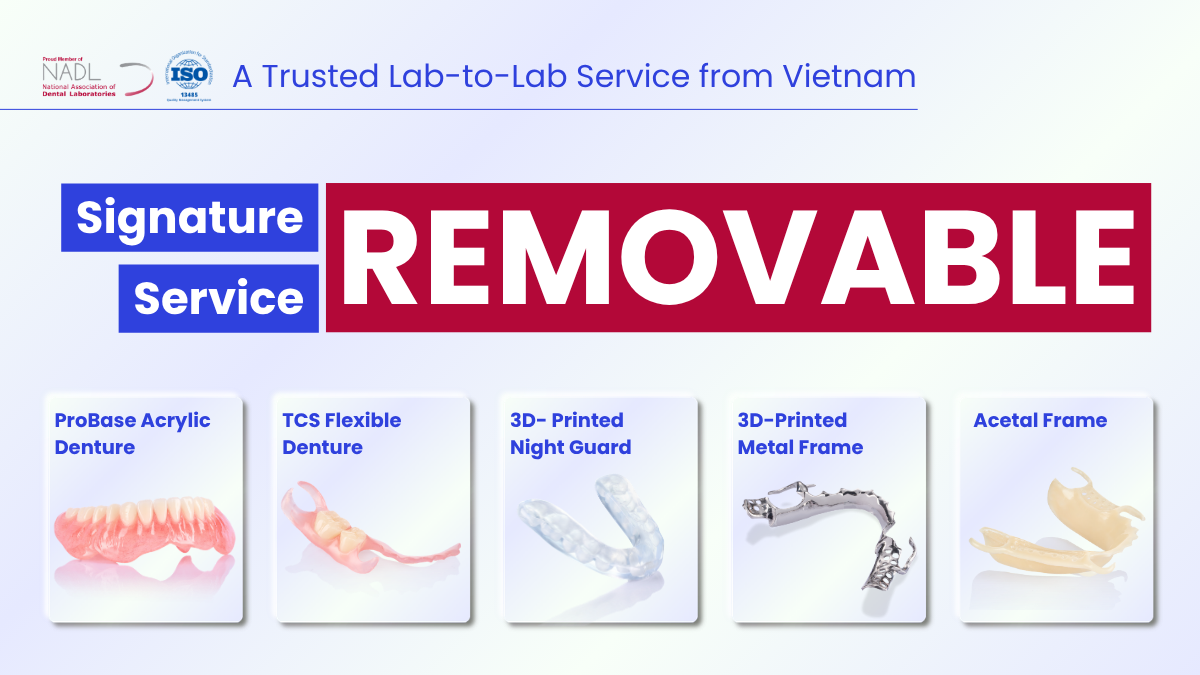
Our Commitments Built on “Trusted. Commitment. Quality”
- Commit to Large-Scale Manufacturing, high volume, remake rate < 1%.
- Commit to 5-Year Warranty
- Commit to Competitive Price
XDENT LAB | A Trusted Lab-to-Lab Service from Vietnam
Share this post:
Related Posts
A practical guide to implant crowns, bridges and overdentures, covering materials, component compatibility and laboratory workflow.
Explore the types, materials, retention methods and lab workflows for maxillofacial removable prostheses, with practical guidance for dental practices.
Explore precision attachment denture types, benefits and limitations, plus key considerations for design, fabrication and maintenance in dental practices.

