
Discover how Shape Memory Effect (SME) works in RPD resin, including structure, mechanisms, and classifications of smart polymer materials.
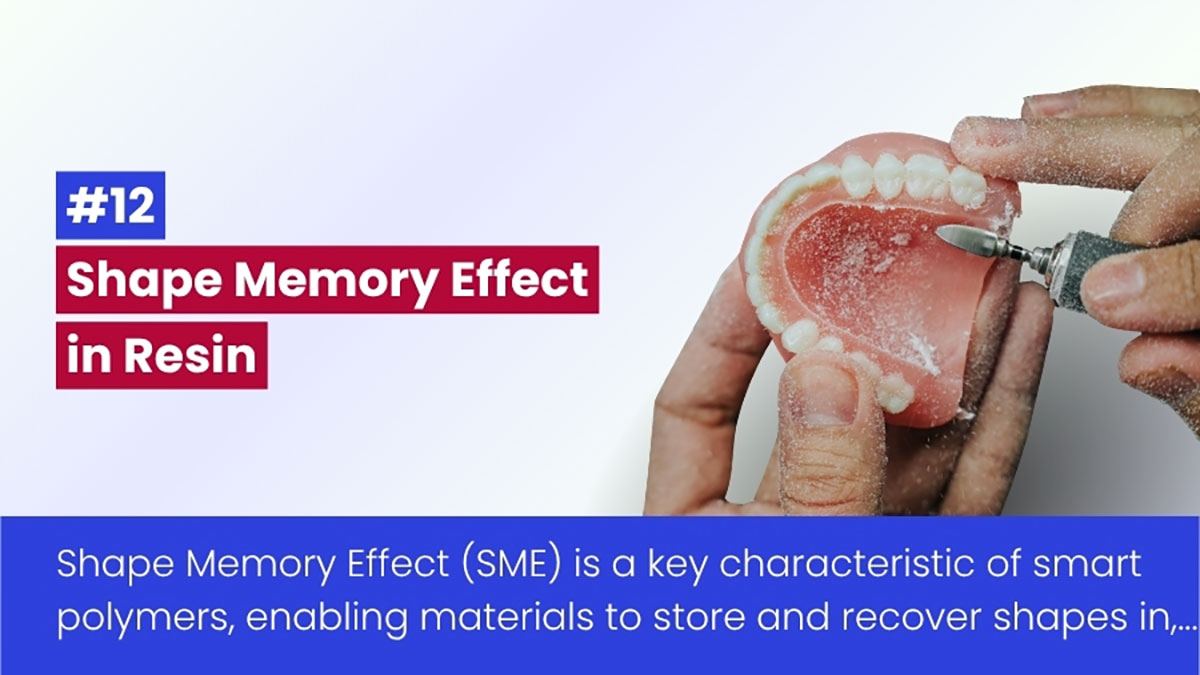
Table of contents [Show]
1. Introduction to Shape Memory Effect (SME)
Shape Memory Effect (SME) is a property of certain polymeric materials that enables them to deform into a temporary shape and subsequently recover their original shape upon exposure to an external stimulus. This effect is commonly observed in shape memory polymers (SMPs), a class of smart materials capable of responding to environmental factors such as temperature, light, electricity, magnetic field, or pH.
In most cases, temperature is the primary triggering factor, associated with parameters such as:
- Glass transition temperature (Tg)
- Melting temperature (Tm)
These temperatures are collectively referred to as the transition temperature (T_trans).

2. Mechanism of SME in Polymers
The SME in polymers is explained based on a molecular structure consisting of two key components:
Netpoints
These define and maintain the permanent shape of the material. Netpoints can be chemical (covalent crosslinks) or physical (crystallites, hydrogen bonding).
Switching segments
These are polymer chain segments that respond to external stimuli, allowing deformation and subsequent recovery.
3. Shape Memory Cycle
A typical SME cycle consists of four steps:
Heating (T > T_trans)
The material softens, enabling deformation.
Deformation
An external force is applied to change the shape.
Cooling (T < T_trans)
The temporary shape is fixed by “freezing” the molecular structure.
Reheating (T > T_trans)
The material recovers its original shape.
4. Classification of Shape Memory Polymers (SMPs)
SMPs can be classified based on several criteria:
4.1. Based on Polymer Structure
Homopolymers
Single polymer systems containing both amorphous and crystalline regions.
Block copolymers
Consist of distinct polymer segments, where one phase determines shape fixation and the other governs switching behavior.
Polymer blends and IPNs (Interpenetrating Polymer Networks)
Combinations of multiple polymers designed to enhance mechanical and thermal properties.
4.2. Based on Crosslinking Mechanism
Chemical cross-linking
Provides stable covalent bonds, resulting in high shape recovery and structural stability.
Physical cross-linking
Based on weaker interactions such as hydrogen bonding or crystallization, allowing reprocessability.
4.3. Based on Number of Stored Shapes
One-way shape memory effect (1W-SMP)
The material recovers its original shape only upon stimulation.
Two-way shape memory effect (2W-SMP)
The material can reversibly switch between two shapes under changing conditions.
Triple-shape and multi-shape memory effect
Enable storage and recovery of multiple intermediate shapes.
4.4. Based on Type of Stimulus
SMPs can be activated by various stimuli:
- Thermal (heat)
- Light (photo-responsive)
- Electrical stimulus
- Magnetic field
- Chemical stimulus (pH or solvent)
5. Common Polymer Systems Exhibiting SME
SME has been observed in a wide range of polymer systems, including:
- Polyurethanes (PU)
- Polyesters (e.g., polycaprolactone – PCL)
- Epoxy-based systems
- (Meth)acrylate systems
- Polyethylene-based materials
These systems can also be engineered as:
- Copolymers
- Polymer blends
- Nanocomposites
to tailor transition temperatures and mechanical properties.
6. Molecular Mechanism of Shape Memory Effect
At the molecular level, SME can be described as an entropy-driven process:
- In the original state, polymer chains are in a thermodynamically stable, high-entropy configuration.
- Upon deformation, the chains are forced into a lower entropy state.
- When reheated, thermal energy increases molecular mobility, allowing the chains to return to their original configuration.
This process depends on:
- Chain mobility
- Network structure
- Transition temperature
7. Applications of Shape Memory Polymers
SMPs have been studied and applied across various fields:
- Biomedical devices
- Smart textiles
- Aerospace structures
- Electronics and sensors
- Packaging and heat-shrink materials
These applications leverage the material’s ability to:
- Undergo large deformation
- Maintain low density
- Offer cost-effective processing
- Enable tunable properties
8. Conclusion
Shape Memory Effect (SME) is a key characteristic of smart polymers, enabling materials to store and recover shapes in response to external stimuli. This behavior is governed by the interplay between polymer network structure and stimulus-responsive switching segments.
The diversity in material design, activation mechanisms, and functional performance has positioned SMPs as an important area of development in modern materials science.
Primary Reference:
- Maiti, S., & Raichur, A. M. (Eds.). (2020). Shape Memory Polymers, Blends and Composites: Advances and Applications. Springer.
Additional References:
- Lendlein, A., & Kelch, S. (2002). Shape-memory polymers. Angewandte Chemie International Edition, 41(12), 2034–2057.
- Behl, M., & Lendlein, A. (2007). Shape-memory polymers. Materials Today, 10(4), 20–28.
- Liu, C., Qin, H., & Mather, P. T. (2007). Review of progress in shape-memory polymers. Journal of Materials Chemistry, 17(16), 1543–1558.
- Meng, H., & Li, G. (2013). A review of stimuli-responsive shape memory polymer composites. Polymer, 54(9), 2199–2221.
About XDENT LAB:
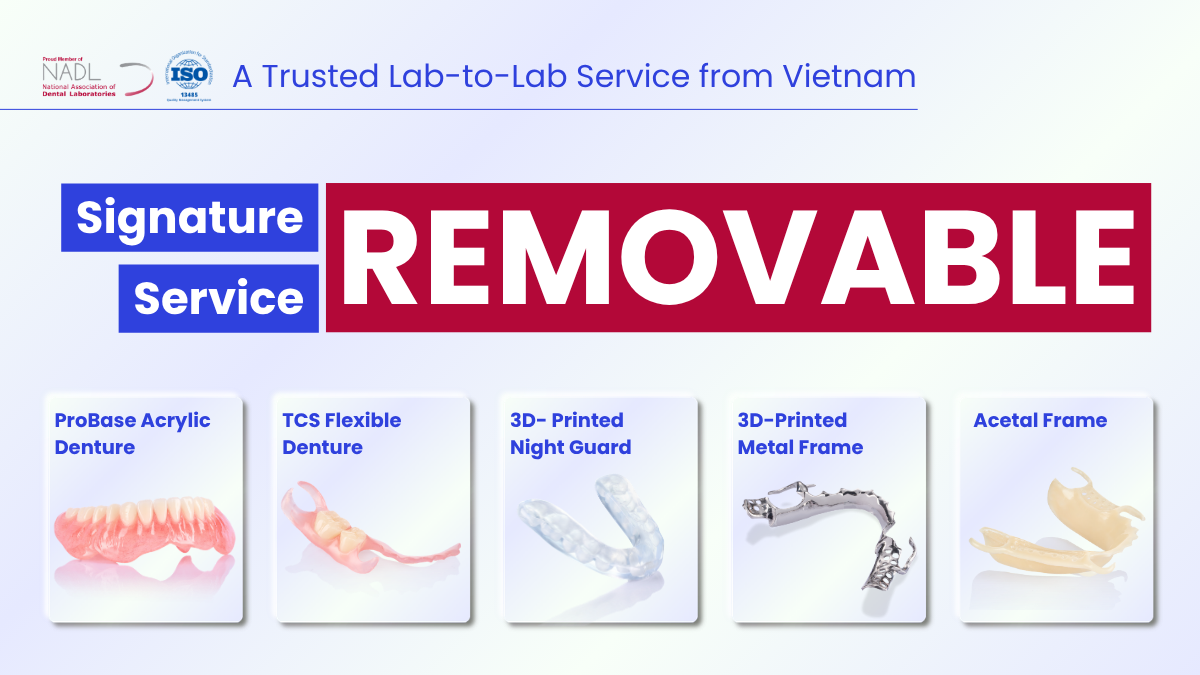
We are experts in Lab-to-Lab Full Service from Vietnam, with the signature services of Removable, meet U.S. market standards, FDA-registered, ISO 13485-certified. Founded in 2017, from local root to global reach, we scale with 2 Factories with over 100+ employees.
Our Commitments Built on “Trusted. Commitment. Quality”
- Commit to Large-Scale Manufacturing, high volume, remake rate < 1%.
- Commit to 5-Year Warranty
- Commit to Competitive Price
XDENT LAB | A Trusted Lab-to-Lab Service from Vietnam
Share this post:
Related Posts
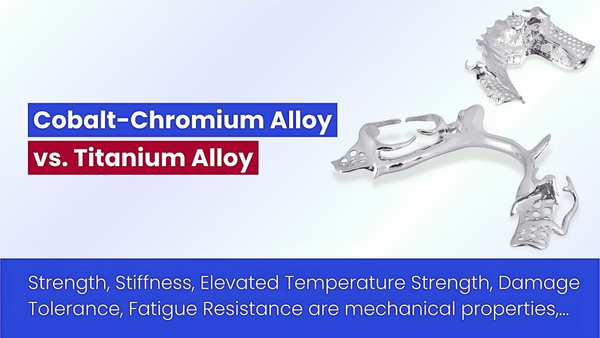
Learn the key differences between titanium and cobalt-chromium alloys used in removable partial denture frameworks, from mechanical properties to production requirements.
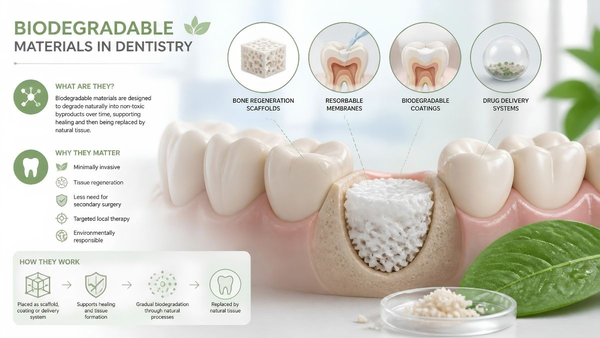
Explore biodegradable materials in dentistry, including their applications, benefits, limitations, and future potential in regenerative and sustainable dental care.
Learn how polyamide dental materials support flexible dentures and removable prosthetics through biocompatibility, aesthetics, comfort, and lightweight performance.

