
Learn how lab quality affects fixed partial dentures and bridges through fit, materials, connector design, occlusion, and long-term clinical performance.

Table of contents [Show]
- What are fixed partial dentures and bridges
- Main types of fixed partial dentures and bridges
- Indications for fixed partial dentures
- Contraindications and caution cases
- Biomechanical principles of bridge design
- Ante’s law and modern interpretation
- Pontic design in fixed partial dentures
- Connector design and dimensions
- Materials for fixed partial dentures and bridges
- Tooth-supported vs implant-supported bridges
- Conventional laboratory workflow for bridges
- Digital laboratory workflow for bridges
- Implant bridge laboratory considerations
- Occlusion in bridges
- Periodontal health and bridge design
- Bridge preparation principles
- Bridge cementation and bonding
- Provisional bridges
- Common complications of fixed partial dentures
- Laboratory quality control for bridges
- Fixed partial dentures in full-mouth rehabilitation
- International standards and regulatory considerations
- Why fixed partial dentures matter in dental lab outsourcing
- Key takeaways
Fixed partial dentures and bridges are core restorations in fixed prosthodontics. They replace one or more missing teeth by connecting artificial teeth, called pontics, to supporting abutment teeth or dental implants. From a dental laboratory perspective, a bridge is not simply several crowns joined together. It is a biomechanical structure that must balance fit, strength, occlusion, esthetics, hygiene access, periodontal compatibility, material behavior, and long-term maintenance.
For dental practices, prosthodontists, and dental laboratories, bridge success depends on much more than replacing a space. A well-made bridge must distribute force properly, protect supporting structures, maintain cleanable contours, and function predictably over time. That is why bridge design is both a clinical decision and a manufacturing discipline.
What are fixed partial dentures and bridges
A fixed partial denture, often called a bridge, is a fixed prosthetic restoration that replaces missing teeth and is permanently attached to natural teeth or implants.
Unlike removable partial dentures, a fixed partial denture is not removed by the patient. It is cemented, bonded, screwed, or otherwise fixed in place.
Core components of a bridge
| Component | Meaning | Function |
|---|---|---|
| Abutment | Supporting tooth or implant | Provides retention and support |
| Retainer | Crown or restoration attached to abutment | Connects abutment to prosthesis |
| Pontic | Artificial replacement tooth | Replaces the missing tooth |
| Connector | Junction between pontic and retainer | Transfers load through the bridge |
| Framework | Structural substructure | Provides strength and support |
| Veneering material | Ceramic or composite layer if used | Provides esthetics and anatomy |
In fixed prosthodontics, these components must work together as one system. If one part fails, the bridge rarely sends a polite warning letter first.
Main types of fixed partial dentures and bridges
Bridges can be classified by support, design, retention method, material, and clinical indication.

Conventional tooth-supported bridge
This is the classic fixed partial denture design. A missing tooth is replaced by a pontic connected to crowns on adjacent abutment teeth.
Crown — Pontic — CrownCommon uses
- One missing posterior tooth
- One or more missing anterior teeth
- Cases where adjacent teeth already need crowns
- Patients who are not candidates for implants
- Patients who prefer fixed treatment without surgery
Advantages
- Fixed and comfortable
- Good function
- Good esthetics when designed well
- No surgery required
- Long clinical history
Limitations
- Requires preparation of abutment teeth
- Abutments carry additional load
- Risk of secondary caries around retainers
- Hygiene under pontics is critical
- Failure may involve multiple units
Cantilever bridge
A cantilever bridge has a pontic supported from only one side.
Crown — PonticCommon uses
- Selected anterior cases
- Replacement of lateral incisors
- Cases with limited occlusal load
- Situations where preparing both adjacent teeth is undesirable
Advantages
- More conservative than preparing two abutments
- Useful in selected esthetic zones
- Can reduce biological cost
Limitations
- Higher leverage forces
- Risk of debonding or abutment overload
- Not ideal in heavy posterior occlusion
- Requires careful occlusal design
Cantilever bridges must be designed with respect for physics. Levers are very honest creatures.
Resin-bonded bridge
A resin-bonded bridge, often called a Maryland bridge, uses metal, ceramic, or fiber-reinforced wings bonded to enamel.
Wing — Pontic — WingOr:
Wing — PonticCommon uses
- Missing maxillary lateral incisor
- Young patients
- Interim treatment before implant placement
- Conservative anterior replacement
- Cases where adjacent teeth are intact
Advantages
- Minimally invasive
- Preserves tooth structure
- Good esthetics when properly designed
- Lower biological cost
- Useful as a transitional restoration
Limitations
- Bonding-dependent
- Risk of debonding
- Limited posterior use
- Occlusion-sensitive
- Requires adequate enamel
Single-retainer designs are often preferred in some anterior cases because they reduce stress from differential tooth movement.
Implant-supported bridge
An implant-supported bridge uses dental implants rather than natural teeth as abutments.
Implant — Pontic — ImplantCommon uses
- Multiple missing teeth
- Free-end edentulous spaces
- Patients with sufficient bone and implant eligibility
- Cases where adjacent teeth should not be prepared
- Full-arch fixed implant prostheses
Advantages
- Preserves adjacent natural teeth
- Good support
- Fixed solution
- Useful for posterior edentulous spaces
- Can restore long-span edentulism
Limitations
- Requires surgery
- Requires bone volume
- Higher cost
- Requires careful implant planning
- Passive fit is critical
- Hygiene around implants is essential
Fixed-fixed bridge
A fixed-fixed bridge has rigid retainers at both ends.
Characteristics
- Rigid connection between abutments
- Good stability
- Requires compatible paths of insertion
- Requires adequate periodontal support
- Useful for many short-span cases
Fixed-movable bridge
A fixed-movable bridge has one rigid connector and one non-rigid connector.
Common uses
- Divergent abutment paths
- Pier abutment situations
- Long-span bridges
- Cases where stress distribution needs modification
Limitation
- More complex design
- Requires careful laboratory and clinical planning
Indications for fixed partial dentures
A fixed partial denture may be indicated when one or more teeth are missing and the patient wants a fixed replacement.
Common indications
- One missing tooth
- Multiple missing teeth in a bounded edentulous space
- Adjacent teeth already require crowns
- Patient cannot tolerate a removable prosthesis
- Implant treatment is contraindicated or declined
- Esthetic replacement in the anterior region
- Functional replacement in the posterior region
- Need to prevent tooth migration
- Need to restore occlusal stability
Clinical situations where bridges are useful
| Clinical situation | Bridge usefulness |
|---|---|
| Missing first molar with crowned adjacent teeth | Conventional bridge may be efficient |
| Missing lateral incisor in a young patient | Resin-bonded bridge may be conservative |
| Multiple missing posterior teeth | Implant-supported bridge may be preferred |
| Patient declines implant surgery | Tooth-supported bridge may be considered |
| Existing failed bridge | Redesign after evaluating abutments and occlusion |
| Full-mouth rehabilitation | Bridges may be part of occlusal reconstruction |
Contraindications and caution cases
Bridges are not suitable for every patient.
High-risk conditions
- Poor oral hygiene
- High caries risk
- Active periodontal disease
- Mobile abutment teeth
- Short clinical crowns
- Poor crown-root ratio
- Insufficient abutment tooth structure
- Long edentulous span
- Severe bruxism without control
- Unfavorable occlusion
- Poor patient compliance
- Inadequate interocclusal space
- Poor ridge anatomy for esthetics
- Uncontrolled systemic disease affecting periodontal or implant prognosis
When a bridge may not be ideal
- Adjacent teeth are completely healthy and unprepared
- Implant therapy would preserve tooth structure better
- The span is too long for the selected material
- Abutment teeth have questionable prognosis
- The patient cannot clean under pontics
- Occlusal load exceeds prosthetic design capacity
Choosing a bridge in the wrong case can turn a restoration into a group project with no stable team members.
Biomechanical principles of bridge design
Bridge success depends heavily on biomechanics.
Key biomechanical factors
- Number of missing teeth
- Span length
- Abutment tooth quality
- Periodontal support
- Crown-root ratio
- Root shape and surface area
- Occlusal force
- Parafunction
- Connector size
- Material strength
- Pontic design
- Framework rigidity
- Path of insertion
Abutment evaluation
- Pulpal status
- Periodontal status
- Mobility
- Remaining tooth structure
- Ferrule
- Root length
- Root morphology
- Crown-root ratio
- Existing restorations
- Endodontic treatment
- Caries risk
- Alignment and path of insertion
A bridge is only as reliable as its abutments. Strong pontics cannot rescue weak foundations.
Ante’s law and modern interpretation
Historically, Ante’s Law suggested that the root surface area of abutment teeth should be equal to or greater than that of the teeth being replaced.
Modern view
- Periodontal support
- Bone level
- Occlusal force
- Implant availability
- Material strength
- Connector design
- Span length
- Patient hygiene
- Parafunction
- Type of opposing dentition
The principle still matters: abutments must be capable of supporting the functional load of the bridge.
Pontic design in fixed partial dentures
The pontic is the artificial tooth that replaces the missing tooth. Its design affects esthetics, phonetics, hygiene, tissue health, and patient comfort.
Ideal pontic requirements
- Esthetic
- Functional
- Smooth
- Convex on the tissue surface
- Easy to clean
- Biologically compatible
- Properly contoured
- Strong enough for function
- Harmonious with ridge anatomy
Common pontic designs
| Pontic type | Description | Typical use |
|---|---|---|
| Modified ridge lap | Contacts ridge facially, open lingually | Common anterior and posterior esthetic bridge |
| Ovate pontic | Emerges from soft tissue depression | High-esthetic anterior cases |
| Hygienic or sanitary pontic | No tissue contact, space under pontic | Mandibular posterior, hygiene priority |
| Conical pontic | Small rounded tissue contact | Thin mandibular ridge |
| Ridge lap pontic | Broad tissue contact | Historically used, less favored due to hygiene |
| Bullet pontic | Rounded form for narrow ridge | Selected posterior cases |
Pontic tissue surface
- Highly polished
- Convex
- Free of concavities
- Easy to clean with floss or interdental aids
- Lightly contacting or appropriately adapted to tissue
- Designed according to ridge shape and esthetic needs
Poor pontic design can lead to plaque accumulation, inflammation, food trapping, halitosis, and patient dissatisfaction.
Connector design and dimensions
The connector joins pontics and retainers. It is one of the most important structural areas of a bridge.
Why connectors matter
- Framework fracture
- Ceramic chipping
- Bridge failure
- Distortion under load
- Remake
Connector design principles
- Adequate height
- Adequate width
- Smooth transitions
- Rounded internal line angles
- Material-specific dimensions
- Proper gingival embrasure shape
- No sharp stress concentrators
Connector considerations by material
| Material | Connector consideration |
|---|---|
| Zirconia | Requires material-specific connector cross-section, especially in posterior bridges |
| Lithium disilicate | Limited bridge indications; connector dimensions are critical |
| PFM | Metal framework must provide rigidity and ceramic support |
| Full metal | Strong in thin sections but still requires proper design |
| PMMA provisional | Requires generous connector bulk |
| Fiber-reinforced composite | Fiber position and bonding design are critical |
| Implant bridge zirconia | Connector and framework design must consider passive fit and occlusal load |
Connector design is engineering disguised as tooth anatomy.
Materials for fixed partial dentures and bridges
Material selection depends on span length, esthetics, occlusion, abutment type, available restorative space, and laboratory workflow.
Major bridge materials
| Material | Strengths | Limitations | Common use |
|---|---|---|---|
| Monolithic zirconia | High strength, CAD/CAM efficient | Esthetics vary by generation | Posterior bridges, implant bridges |
| Layered zirconia | Better esthetics | Veneering ceramic chipping risk | Anterior and posterior esthetic bridges |
| Porcelain-fused-to-metal | Long clinical history, strong framework | Metal opacity, chipping risk | Conventional crown and bridge |
| Full cast metal | Excellent durability | Poor esthetics | Posterior bridges |
| Lithium disilicate | High esthetics, bondable | Limited bridge indication | Short-span anterior or premolar selected cases |
| Fiber-reinforced composite | Conservative, repairable | Technique-sensitive | Resin-bonded and provisional bridges |
| PMMA | Fast, esthetic, low cost | Provisional only | Temporary bridges |
| Printed resin | Efficient digital provisionals | Material-specific limitations | Provisional bridges, try-ins |
Zirconia bridges
Zirconia is now one of the most common materials for fixed partial dentures because of its strength and CAD/CAM compatibility.
Advantages
- High flexural strength
- Good fracture resistance
- Useful for posterior bridges
- Efficient digital workflow
- Suitable for monolithic design
- Reduced veneering chipping when monolithic
- Can be multilayered for improved esthetics
Laboratory requirements
- Correct connector dimensions
- Adequate pontic thickness
- Proper nesting
- Correct sintering protocol
- Avoidance of sharp transitions
- Proper finishing and polishing
- Surface characterization without weakening the structure
PFM bridges
Porcelain-fused-to-metal bridges remain reliable when framework design and porcelain support are correct.
Advantages
- Long clinical track record
- Strong metal substructure
- Good for long-span cases
- Can mask discolored abutments
- Useful in high-load situations
Limitations
- Less translucent than all-ceramic options
- Possible gray margin
- Ceramic chipping risk
- More tooth reduction may be needed
- Metal allergies in selected patients
Lithium disilicate bridges
Lithium disilicate is highly esthetic, but bridge indications are limited compared with zirconia or PFM.
Best uses
- Selected anterior short-span bridges
- Premolar region in controlled cases
- Resin-bonded restorations in selected designs
Caution
Lithium disilicate should not be used beyond manufacturer indications. Connector dimensions, span length, and occlusal load are critical.
Tooth-supported vs implant-supported bridges
Both are fixed options, but their biomechanics differ.
| Factor | Tooth-supported bridge | Implant-supported bridge |
|---|---|---|
| Support | Natural teeth | Dental implants |
| Mobility | Periodontal ligament allows slight movement | Implants are rigid |
| Preparation | Requires tooth preparation | No adjacent tooth preparation |
| Occlusal load | Distributed through teeth and periodontal ligament | Direct to implant-bone interface |
| Hygiene risk | Caries and periodontal issues | Peri-implant mucositis and peri-implantitis |
| Retention | Cemented or bonded | Screw-retained or cement-retained |
| Maintenance | Depends on abutment health | Screw access and peri-implant hygiene are important |
| Failure impact | May damage abutment teeth | May involve implant components or bone support |
Mixed tooth-implant bridges
Connecting natural teeth and implants in the same bridge is generally approached with caution because teeth and implants move differently under load. If considered, it requires careful case selection and prosthodontic planning.
Conventional laboratory workflow for bridges
Traditional fixed partial denture fabrication follows a detailed analog workflow.
Conventional workflow
- Receive impression and prescription
- Disinfect impression
- Pour working cast
- Fabricate dies
- Mount models
- Evaluate path of insertion
- Apply die spacer
- Wax retainers, pontics, and connectors
- Verify occlusion and contours
- Sprue and invest
- Cast metal or press ceramic
- Divest and fit framework
- Layer ceramic or finish monolithic form
- Adjust contacts and occlusion
- Finish and polish
- Final quality control
- Return to clinic
Critical conventional checks
- Margins on each abutment
- Common path of insertion
- Bridge seating without rocking
- Connector size
- Pontic-ridge relationship
- Framework support
- Occlusal contacts
- Proximal contacts
- Surface polish
- Cleanability
Digital laboratory workflow for bridges
Digital workflows are now common for zirconia, PMMA, printed provisional, and implant-supported bridges.
Digital workflow
- Receive STL, PLY, OBJ, or scanner-native file
- Review margins and edentulous span
- Verify opposing arch and bite
- Mark margins in CAD
- Design retainers, pontics, and connectors
- Check minimum thickness
- Check connector dimensions
- Check occlusion
- Nest in disc, puck, or build platform
- Mill or print
- Sinter, crystallize, or cure
- Characterize
- Polish or glaze
- Verify fit on model if required
- Final QC
- Deliver
Digital bridge advantages
- Efficient production
- Reproducible design
- Digital file storage
- Material optimization
- Consistent connector evaluation
- Faster remakes
- Better integration with implant libraries
- Easier design communication
Digital bridge risks
- Scan distortion over long spans
- Bite misalignment
- Incorrect margin marking
- Undersized connectors
- Wrong implant library
- Poor nesting orientation
- Sintering distortion
- Over-reliance on auto-design
- Inadequate post-milling polish
Digital does not remove bridge biomechanics. It simply gives us more precise ways to respect them.
Implant bridge laboratory considerations
Implant-supported bridges require special quality control because the prosthesis must fit passively and protect peri-implant tissues.
Key laboratory checks
- Correct implant system
- Correct implant platform
- Accurate scan body capture
- Correct CAD implant library
- Passive fit on model or verification jig
- Screw access positions
- Ti-base bonding protocol
- Emergence profile
- Inter-implant distance
- Occlusal scheme
- Framework strength
- Cleanability
- Screw channel accessibility
Screw-retained vs cement-retained implant bridges
| Feature | Screw-retained | Cement-retained |
|---|---|---|
| Retrievability | Excellent | Limited |
| Residual cement risk | None | Present |
| Maintenance | Easier | More difficult |
| Esthetics | Depends on screw access | Often favorable |
| Passive fit verification | Critical | Critical |
| Biological risk | Lower cement-related risk | Cement-related peri-implant risk |
For many implant bridges, screw retention is preferred because maintenance and retrievability are easier.
Occlusion in bridges
Occlusion is critical for bridge longevity.
Occlusal factors to check
- Maximum intercuspation contacts
- Working-side contacts
- Non-working interferences
- Protrusive contacts
- Occlusal load distribution
- Cantilever loading
- Opposing material
- Parafunction
- Implant occlusion
- Pontic loading
- Connector stress areas
High-risk occlusal situations
- Bruxism
- Deep bite
- Long-span bridge
- Cantilever bridge
- Implant-supported bridge
- Opposing zirconia
- Limited restorative space
- Endodontically treated abutments
- Periodontally compromised abutments
Practical occlusal design principles
- Avoid heavy contacts on pontics when possible
- Avoid lateral overload on cantilevers
- Keep implant bridge occlusion controlled
- Reduce non-working interferences
- Use night guards in bruxism cases
- Maintain adequate material thickness
Periodontal health and bridge design
A bridge must support hygiene and periodontal health.
Periodontal design requirements
- Smooth margins
- Accurate fit
- Proper emergence profile
- No over-contoured retainers
- Cleanable pontic underside
- Accessible embrasures
- Polished tissue surfaces
- Proper proximal contacts
- No overhanging connectors
- No tissue compression
Poorly designed fixed prostheses may contribute to plaque retention, gingival inflammation, caries, and periodontal breakdown.
Hygiene aids for bridge patients
- Super floss
- Floss threaders
- Interdental brushes
- Water flossers
- Implant-specific hygiene aids
- Professional maintenance visits
A bridge that cannot be cleaned is not a finished prosthesis. It is a future inflammation project.
Bridge preparation principles
For tooth-supported bridges, preparation design is crucial.
Preparation objectives
- Adequate reduction for material
- Retention and resistance
- Common path of insertion
- Clear finish lines
- Smooth line angles
- Ferrule when needed
- Parallelism without over-tapering
- Periodontal compatibility
- Preservation of tooth structure
Bridge-specific preparation concerns
| Concern | Why it matters |
|---|---|
| Path of insertion | All retainers must seat together |
| Abutment taper | Excess taper reduces retention |
| Margin clarity | Affects fit and seal |
| Occlusal reduction | Provides material thickness |
| Axial reduction | Allows proper contour |
| Draw between abutments | Prevents seating problems |
| Abutment alignment | May require modified preparation or non-rigid connector |
When abutments are misaligned, the lab may need special design strategies. Still, poor preparation geometry cannot always be rescued in CAD.
Bridge cementation and bonding
Retention depends on preparation design, material, and cement selection.
Common cement types
| Cement type | Common use |
|---|---|
| Resin-modified glass ionomer | Zirconia, PFM, metal bridges with retentive preparations |
| Glass ionomer | Metal or zirconia in selected cases |
| Resin cement | Resin-bonded bridges, lithium disilicate, short preparations |
| Self-adhesive resin cement | Zirconia and selected ceramic bridges |
| Temporary cement | Provisional bridges or retrievable cases |
Surface treatment by material
| Material | Typical surface treatment |
|---|---|
| Zirconia | Air abrasion and MDP primer or resin cement |
| Lithium disilicate | Hydrofluoric acid etch and silane |
| Metal | Air abrasion and metal primer when indicated |
| PFM | Depends on internal metal or ceramic surface |
| Resin-bonded metal wing | Air abrasion and metal primer |
| Composite or fiber-reinforced | Manufacturer-specific bonding protocol |
For bridges, complete seating is more challenging than for single crowns because all retainers must seat simultaneously.
Provisional bridges
Provisional bridges are important in treatment planning and tissue management.
Functions of provisional bridges
- Protect prepared teeth
- Maintain tooth position
- Maintain occlusion
- Test pontic design
- Shape soft tissue
- Evaluate esthetics
- Evaluate phonetics
- Assess vertical dimension
- Provide patient comfort
- Guide final restoration design
Materials
- PMMA
- Bis-acryl resin
- Milled PMMA
- 3D-printed resin
- Fiber-reinforced composite
When they are especially useful
- Anterior esthetic cases
- Full-mouth rehabilitation
- Ovate pontic development
- Implant temporization
- Vertical dimension changes
- Long-span restorations
Common complications of fixed partial dentures
Bridge complications may be biological, mechanical, esthetic, or technical.
Biological complications
- Secondary caries
- Gingival inflammation
- Periodontal pocketing
- Pulpal complications
- Root fracture
- Abutment mobility
- Peri-implant mucositis
- Peri-implantitis
Mechanical complications
- Connector fracture
- Pontic fracture
- Ceramic chipping
- Framework fracture
- Loss of retention
- Debonding
- Screw loosening
- Screw fracture
- Occlusal wear
Esthetic complications
- Poor shade match
- Gray gingival margin
- Poor pontic emergence
- Black triangles
- Unnatural contour
- Ridge defect visibility
- Surface texture mismatch
Technical and laboratory complications
- Open margins
- Poor seating
- Tight or open contacts
- High occlusion
- Poor connector dimensions
- Inaccurate pontic design
- Wrong implant library
- Inadequate polishing
- Incorrect shade or translucency
Laboratory quality control for bridges
Bridge QC must be more rigorous than single-crown QC because a bridge has multiple units, multiple margins, connectors, pontics, and a larger biomechanical footprint.

Final bridge QC checklist
| QC area | What to verify |
|---|---|
| Case identity | Patient, dentist, tooth numbers |
| Prescription | Material, shade, design, pontic type |
| Margins | Closed on all abutments |
| Internal fit | Full seating, no rocking |
| Path of insertion | Bridge seats completely |
| Proximal contacts | Correct tightness and position |
| Occlusion | No heavy contacts or interferences |
| Connector dimensions | Adequate for material and span |
| Pontic design | Smooth, convex, esthetic, cleanable |
| Emergence profile | Tissue-friendly |
| Surface texture | Smooth and polished |
| Shade | Matches prescription and photos |
| Implant interface | Correct platform and passive fit |
| Screw access | Accessible and correctly positioned |
| Cleanability | Patient can clean under pontics and connectors |
| Documentation | Material lot, technician, QC record |
Common laboratory tools
- Magnification
- Fit checker
- Shimstock
- Dental floss
- Articulating paper
- Contact spray
- Calipers
- Thickness gauge
- CAD inspection tools
- Printed or stone model
- Implant verification model
- Torque driver
Fixed partial dentures in full-mouth rehabilitation
Bridges may be part of complex restorative treatment.
Uses in full-mouth cases
- Replacing missing teeth
- Restoring posterior support
- Re-establishing occlusal plane
- Increasing vertical dimension
- Splinting selected teeth
- Restoring esthetic zones
- Supporting provisional reconstruction
- Combining with implants
Planning requirements
- Diagnostic wax-up
- Occlusal analysis
- Periodontal evaluation
- Endodontic evaluation
- Implant planning if needed
- Smile design
- Provisional phase
- Material selection
- Long-term maintenance plan
International standards and regulatory considerations
Fixed partial dentures and bridges are patient-specific medical devices. They should be fabricated with controlled materials, validated workflows, and traceable documentation.
Relevant standards and frameworks
| Standard or framework | Relevance to bridges |
|---|---|
| ISO 13485 | Medical device quality management |
| ISO 6872 | Dental ceramic materials |
| ISO 22674 | Metallic materials for fixed and removable restorations |
| ISO 10993 series | Biological evaluation of medical devices |
| ISO 7405 | Biocompatibility evaluation for dental materials |
| FDA, MDR, or local rules | Custom device documentation and compliance |
| Manufacturer IFU | Processing, sintering, bonding, and polishing requirements |
Documentation should include
- Patient or case ID
- Dentist prescription
- Tooth numbers
- Material type
- Manufacturer
- Lot or batch number
- CAD file version
- CAM disc or block ID
- Sintering, firing, or casting records
- Technician name
- Final QC checklist
- Delivery date
For dental laboratories serving international markets, traceability is not optional. It is part of professional manufacturing responsibility.
Why fixed partial dentures matter in dental lab outsourcing
For dental practices, bridges are one of the clearest indicators of a laboratory’s real capability. A bridge demands coordinated control of margins, connector strength, pontic design, occlusion, esthetics, cleanability, and material processing. If a lab can produce consistent fixed partial dentures, it usually reflects maturity across its broader fixed-restorative workflow.

What practices should expect from a bridge partner
- Accurate fit across multiple abutments
- Strong connector and framework design
- Tissue-friendly pontic contours
- Controlled occlusion
- Reliable material selection
- Consistent finishing and polish
- Implant compatibility when needed
- Traceable production records
XDENT LAB positioning
- Functional load control
- Biological compatibility
- Esthetic consistency
- Cross-unit fit
- Documentation and traceability
- Communication and remake control
That is the difference between simply making bridges and manufacturing bridges that can be trusted clinically.
Key takeaways
Fixed partial dentures and bridges remain essential restorations in prosthodontics. They replace missing teeth with fixed prostheses supported by natural teeth, implants, or a carefully designed combination of components. Their success depends on case selection, abutment quality, pontic design, connector dimensions, occlusion, material behavior, periodontal compatibility, and rigorous laboratory quality control.
The most important principles are:
- Case selection determines prognosis
- Pontic design must be esthetic and cleanable
- Connectors are structural weak points and must be dimensioned properly
- Material selection must match span, load, and esthetic need
- Occlusion must be carefully controlled, especially in cantilevers and implants
- Implant bridges require passive fit and strong hygiene planning
- Laboratory QC must verify fit, margins, contacts, connector size, and cleanability
- Traceability supports international quality standards and patient safety
A successful bridge does more than fill a space. It restores function, protects tissues, distributes force, supports esthetics, and remains maintainable over time.
About XDENT LAB:
We are experts in Lab-to-Lab Full Service from Vietnam, with the signature services of Removable, meet U.S. market standards, FDA-registered, ISO 13485-certified. Founded in 2017, from local root to global reach, we scale with 2 Factories with over 100+ employees.
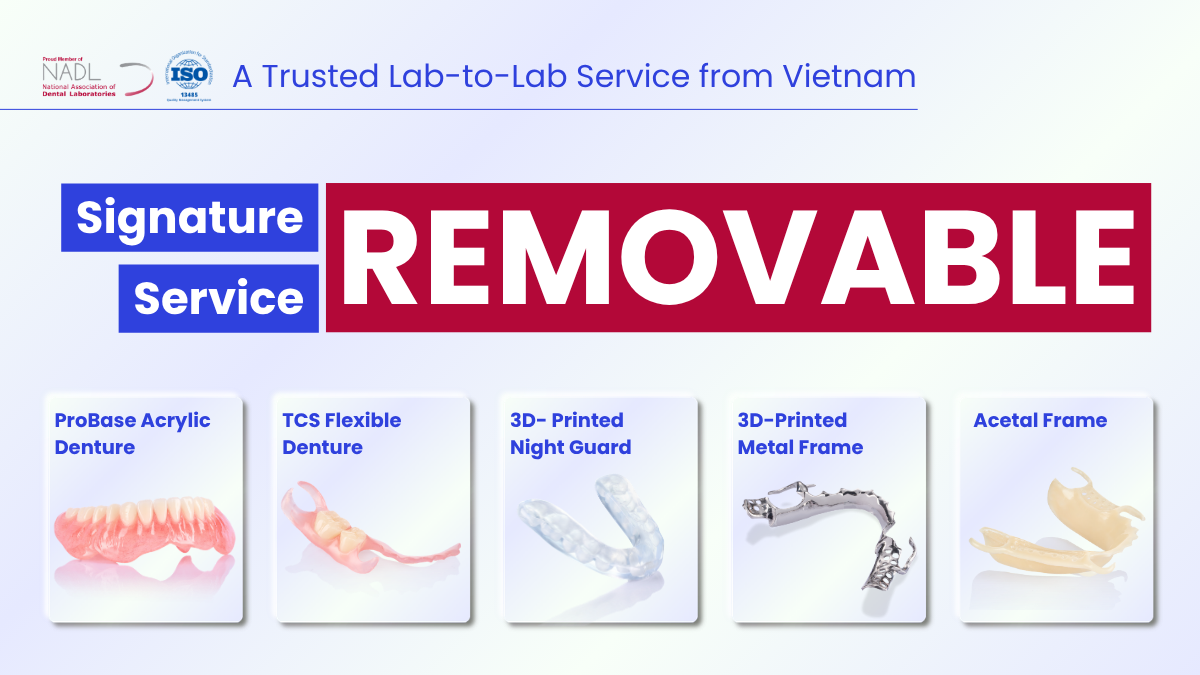
Our Commitments Built on “Trusted. Commitment. Quality”
- Commit to Large-Scale Manufacturing, high volume, remake rate < 1%.
- Commit to 5-Year Warranty
- Commit to Competitive Price
XDENT LAB | A Trusted Lab-to-Lab Service from Vietnam
Share this post:
Related Posts
A practical guide to single implant crowns, covering abutments, Ti-bases, crown materials, common complications and ongoing care.
A practical guide to implant crowns, bridges and overdentures, covering materials, component compatibility and laboratory workflow.
Explore the types, materials, retention methods and lab workflows for maxillofacial removable prostheses, with practical guidance for dental practices.

