
Rests in removable partial dentures prevent settling, protect soft tissue, and keep clasps functional. Here is how they work and why their design matters.
Table of contents [Show]
Introduction
After learning about mandibular major connectors, maxillary major connectors, and minor connectors, we continue to dive into exploring rests and rest seats in removable partial dentures. A RPD that settles into the tissue looks fine on delivery. The patient leaves without complaints. But over the next few months, the clasp arms drift away from the tooth surface, occlusion shifts, and soft tissue starts showing signs of chronic compression. By the time any of this is visible, the framework has been doing the wrong thing for a while. Most of that failure traces back to one component: the rest.
This article covers what rests are, what they actually do, and how they interact with clasps, and what happens to that relationship in distal extension where the arch provides no posterior support.
Why The Supporting Tissues Is Never The First Choice
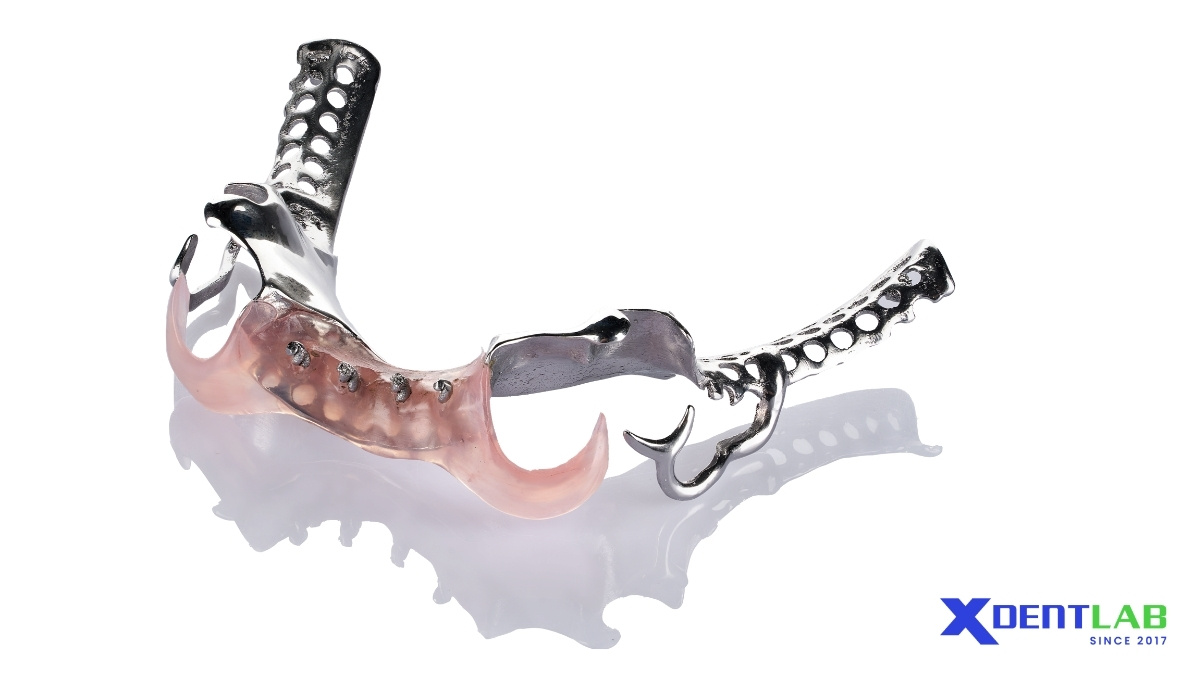
Before getting into rests specifically, it helps to understand why they exist in the first place. When an RPD sits in the mouth and a patient bites down, the occlusal force generated by the artificial teeth has to go somewhere. In a tooth-supported case, that force travels through the framework into the abutment teeth via the rests. In a case where no rests are present, or where they are not functioning correctly, the force travels downward into the denture base and then into the soft tissue beneath it.
The problem is that soft tissue is not designed to absorb repeated occlusal loading. Natural teeth, by contrast, have a periodontal ligament that acts as a shock absorber and allows the tooth to displace slightly under load and then recover. Studies comparing displacement and recovery between natural teeth and oral mucosa consistently show that the teeth handle loading far better. Mucosa compresses more under load and recovers less predictably over time.
This is the biological case for rests. If the goal is a prosthesis that performs well over years rather than months, the occlusal load needs to be directed toward the teeth, not the tissue. Rests are the mechanism that makes that possible.
What A Rest Is, And What It Is Not
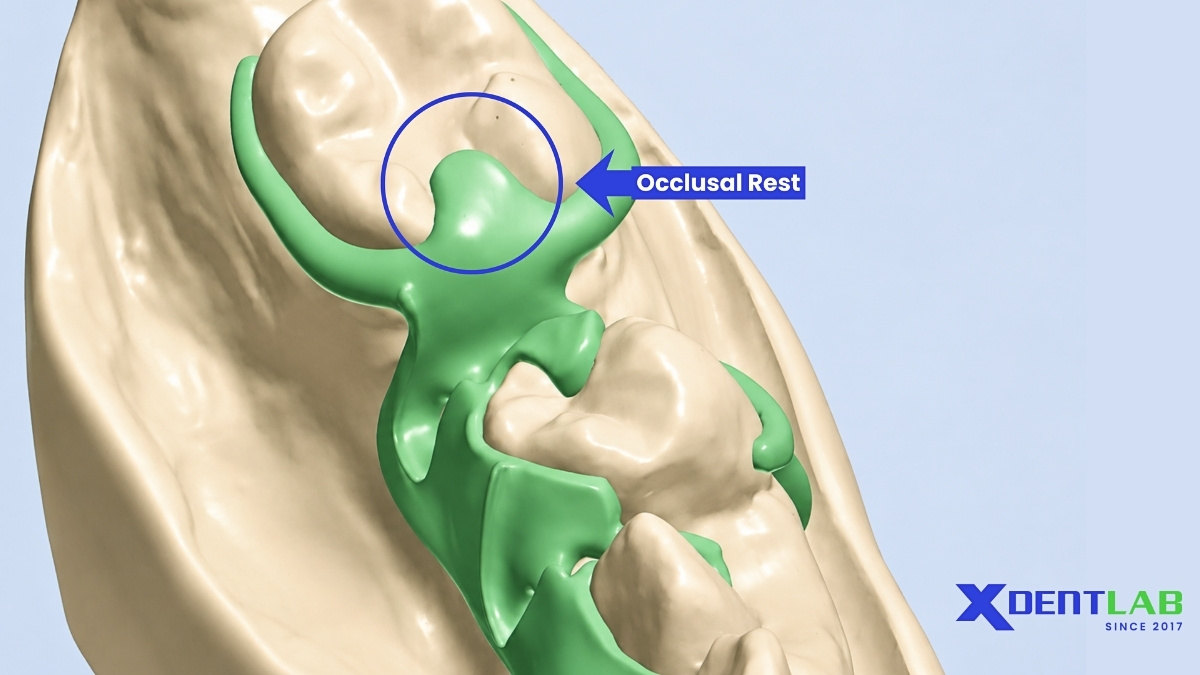
A rest is any component of the partial denture framework that contacts a tooth surface and provides vertical support to the prosthesis. That definition is function, not positional. It does not describe a specific shape or location. It emphasizes the role: a rest stops the denture from moving toward the tissue.
The prepared area on the tooth that receives the rest is called the rest seat. The rest seat is not a byproduct of placing the rest. It is a deliberate preparation that determines how the rest will perform. Without a properly prepared rest seat, the rest cannot sit in a stable position, cannot direct load along the tooth’s long axis, and cannot resist the lateral slippage that causes abutment stress over time.
Rests are named by the surface of the tooth they occupy. An occlusal rest sits on the occlusal surface of a posterior tooth. A lingual rest sits on the lingual surface, typically on a canine or incisor. An incisal rest sits at the incisal edge of an anterior tooth.
One design principle applies to all of them: the finished rest should restore the tooth’s original surface contour. After the rest seat is prepared and the metal rest sits in place, the tooth should look and feel as close as possible to what it was before the preparation. The metal fills the space that was removed, nothing more.
What Rests Do Inside The Framework
1. Rests provide vertical support
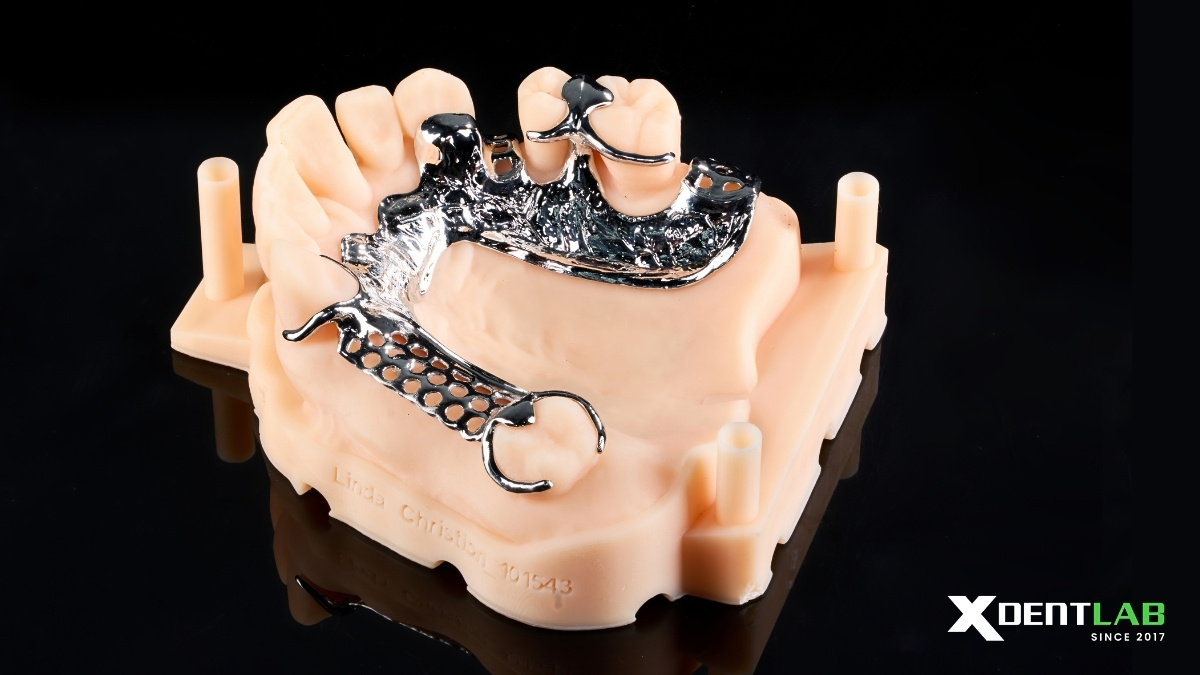
Providing vertical support is the primary function of rests
2. Rest keep components in their planned positions
Every part of the RPD framework is positioned in relation to the abutment teeth. The clasp arm, the minor connector, the major connector: all of them are designed to sit at a specific height and angle. If the denture settles even a few tenths of a millimeter, every component shifts with it.
3. Rests prevent soft tissue impingement
A denture that sinks into the tissue does not just cause discomfort. It creates chronic compression of the mucosa and underlying bone, accelerating ridge resorption over time. Rests keep the framework suspended at the correct height so the tissue beneath it is not continuously loaded.
4. Rests direct force along the long axis of the abutment tooth
This is the biomechanical goal that the rest seat preparation is designed to achieve. When force travels along the tooth’s long axis, the periodontal ligament distributes it evenly and the tooth remains stable. When force arrives at an angle, one side of the ligament is compressed while the other is stretched, and over time the tooth moves. A correctly designed rest seat ensures the force goes in the right direction.
5. Rests maintain occlusal relationships
The vertical dimension and occlusal contacts established at delivery depend on the denture staying at the height where those contacts were set. A denture that settles changes the occlusion.
How Rests And Clasps Depend On Each Other
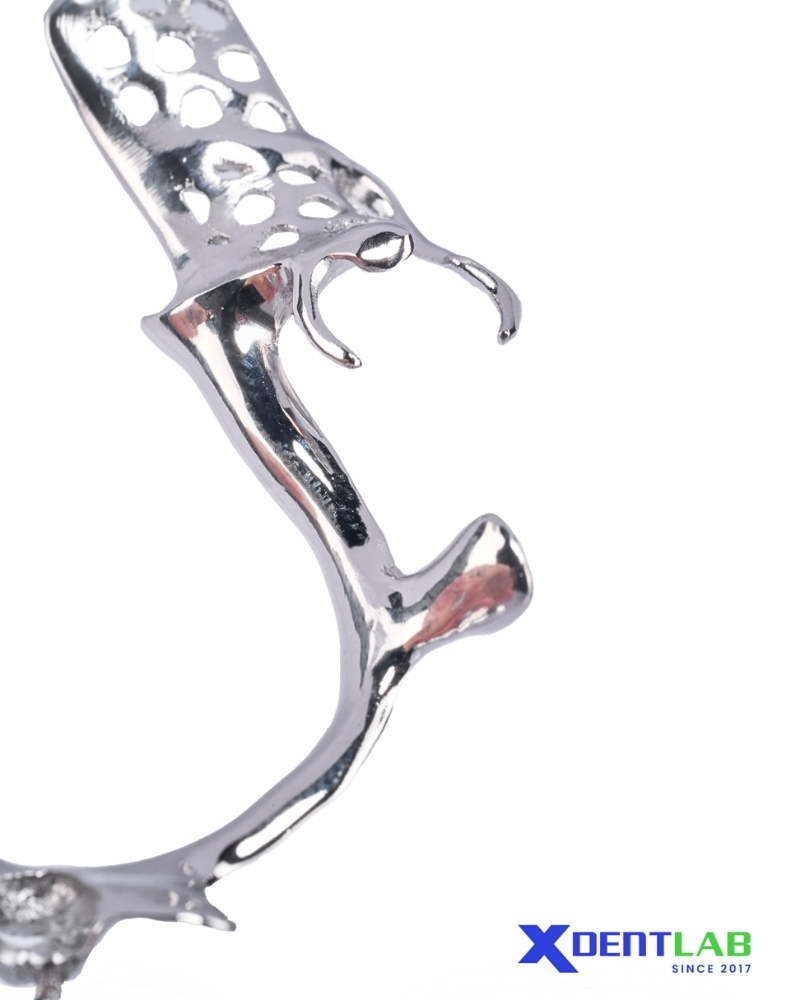
This relationship is often described separately, but it is worth understanding as a single system. A clasp arm has two states. When the denture is seated and no dislodging force is applied, the retentive tip of the clasp arm sits passively in the tooth undercut, in light contact with the tooth surface. When a force tries to lift the denture, the clasp arm engages that undercut actively and resists the displacement.
The clasp can only do this if the denture is sitting at exactly the right height. The retentive tip is positioned to engage the undercut at a specific vertical coordinate on the tooth. If the denture drops below that coordinate, the tip moves out of position, away from the tooth surface or below the undercut zone. When a dislodging force then arrives, the denture has to travel upward through that gap before the clasp tip re-engages. During that gap, nothing is holding the denture.
The rest prevents the denture from dropping in the first place. By maintaining the framework as its designed position, the rest keeps the clasp tip exactly where it was positioned to be. The clasp engages immediately when needed, with no delay and no free movement.
A rest that fails or was never correctly prepared does not look like a clasp problem. But it produces one.
Rests In Distal Extension Cases
A tooth-bounded partial denture has abutments on both sides of each edentulous space. The framework is supported at both ends, and occlusal load distributes predictably between the abutment teeth and the ridge tissue.
A distal extension case is different. The edentulous space extends to the back of the arch with no terminal abutment. One end of the denture base connects to the last standing through a rest. The other end rests on soft tissue with nothing beneath it but the residual ridge.
When the patient bites down, the load does not distribute evenly. At the abutment end, the rest transmits a significant portion of the force into the tooth. Moving posteriorly away from the abutment, the framework has no more rigid contact points. The load transitions progressively onto the ridge tissue. By the time you reach the distal end of the base, the tissue is bearing essentially all of the load in that region.
This gradient is inherent to the design and cannot be fully eliminated. What it means practically is that the rest on the terminal abutment carries more functional significance in a distal extension case than in a tooth-bounded case. It is the only point in the framework where load can be transferred to a hard tissue support. If that rest is undersized, incorrectly angled, or seated on a poorly prepared rest seat, the entire load shifts onto the ridge tissue, accelerating resorption and destabilizing the prosthesis faster than the clinical situation would otherwise warrant.
The rest also influences how the denture base moves under load. In a distal extension case, the base rotates slightly around the abutment when pressed down. The rest acts as the fulcrum of that rotation. Its position and rigidity determine how much rotation occurs and how the load is distributed between the abutment tooth and the tissue.
Using An Implant As A Rest
In some clinical situations, an implant can serve the same role that a tooth-borne rest would otherwise fill.
When an implant is used as a rest, it eliminates the soft tissue compression that occurs at that location. The implant transmits vertical load directly into bone, bypassing the mucosa entirely. This changes the load distribution pattern of the prosthesis in that region and reduces the biological cost of supporting the denture base.
Beyond load distribution, an implant rest also changes the fulcrum line geometry of the RPD. In a distal extension case, placing an implant at the posterior end of the edentulous ridge converts what was a tissue-supported distal end into a rigidly supported one. The fulcrum line shifts, the rotation pattern changes, and the stress on the terminal abutment tooth is reduced.
This application requires coordination between the restorative plan and the implant placement. But where it is appropriate, it addresses one of the fundamental limitations of the conventional distal extension in RPD: the inability to provide hard tissue support at the posterior end of the base.
Conclusion
Every rest in an RPD framework depends on a rest seat that was prepared correctly before the impression was taken. The lab works from what the preparation gives them. If the rest seat is too shallow, the rest will be too thin and risk fracture. If the floor angle is wrong, the rest will transmit force laterally rather than axially. If the marginal ridge was not lowered adequately, the rest will sit high and interfere with occlusion.
Part 2 of this series covers the specific form requirement for occlusal rest.
References
- Carr AB, Brown DT. McCracken's Removable Partial Prosthodontics. 12th ed. St. Louis: Mosby/Elsevier; 2011.
- Stewart KL, Rudd KD, Kuebker WA. Clinical Removable Partial Prosthodontics. 2nd ed. Ishiyaku EuroAmerica; 1992
About XDENT LAB:
We are experts in Lab-to-Lab Full Service from Vietnam, with the signature services of Removable, meet U.S. market standards, FDA-registered, ISO 13485-certified. Founded in 2017, from local root to global reach, we scale with 2 Factories with over 100+ employees.
Our Commitments Built on “Trusted. Commitment. Quality”
- Commit to Large-Scale Manufacturing, high volume, remake rate < 1%.
- Commit to 5-Year Warranty
- Commit to Competitive Price
XDENT LAB | A Trusted Lab-to-Lab Service from Vietnam
Share this post:
Related Posts

Learn how lab quality affects fixed partial dentures and bridges through fit, materials, connector design, occlusion, and long-term clinical performance.
Learn how dental crown manufacturing supports prosthodontics through material selection, digital workflow, precise fit, and laboratory quality control.
See a real case produced by XDENT LAB, a dental lab outsourcing in Vietnam that serves US customers with high quality and optimized cost.

