
A design breakdown of the single palatal strap connector: when it works, when it doesn't, and the width thresholds that determine its rigidity.
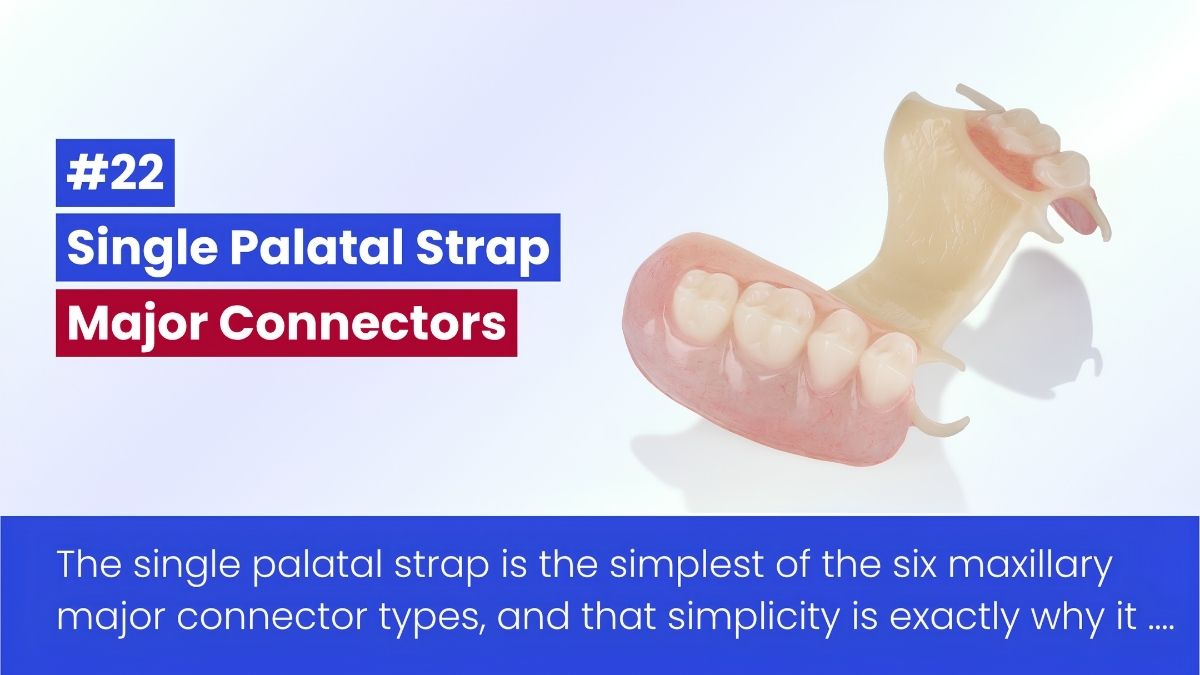
Table of contents [Show]
The single palatal strap is the simplest of the six maxillary major connector types, and that simplicity is exactly why it gets misused. A narrow band of metal running across the palate looks like a safe, conservative default for almost any case. It isn't. It performs well within a fairly narrow set of conditions and performs poorly, sometimes badly enough to compromise abutment teeth, outside of them.
This article covers what the single palatal strap actually is, where it's indicated, where it's contraindicated and why, its design specifications, and what the research says about the relationship between strap width and rigidity.
Key Points
- A single metal band, typically 8-12mm wide, crossing the palate.
- Indicated for short, bilateral, posterior edentulous spans with good tooth support, and for unilateral cases using extracoronal attachments for cross-arch stabilization.
- Contraindicated for distal extension cases, palatal tori, and long edentulous spans.
- Never use it to connect anterior tooth replacements to a distal extension base. The bulk required for adequate rigidity there interferes directly with speech.
What the Single Palatal Strap Is
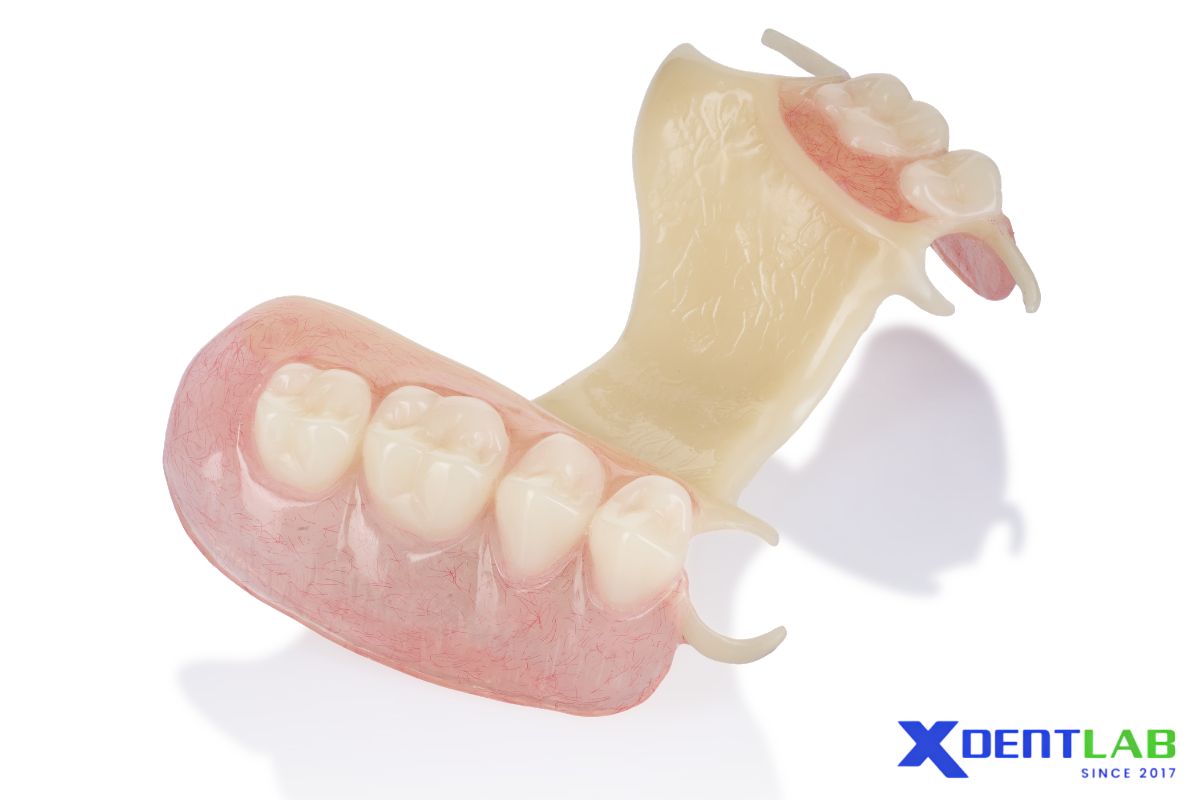
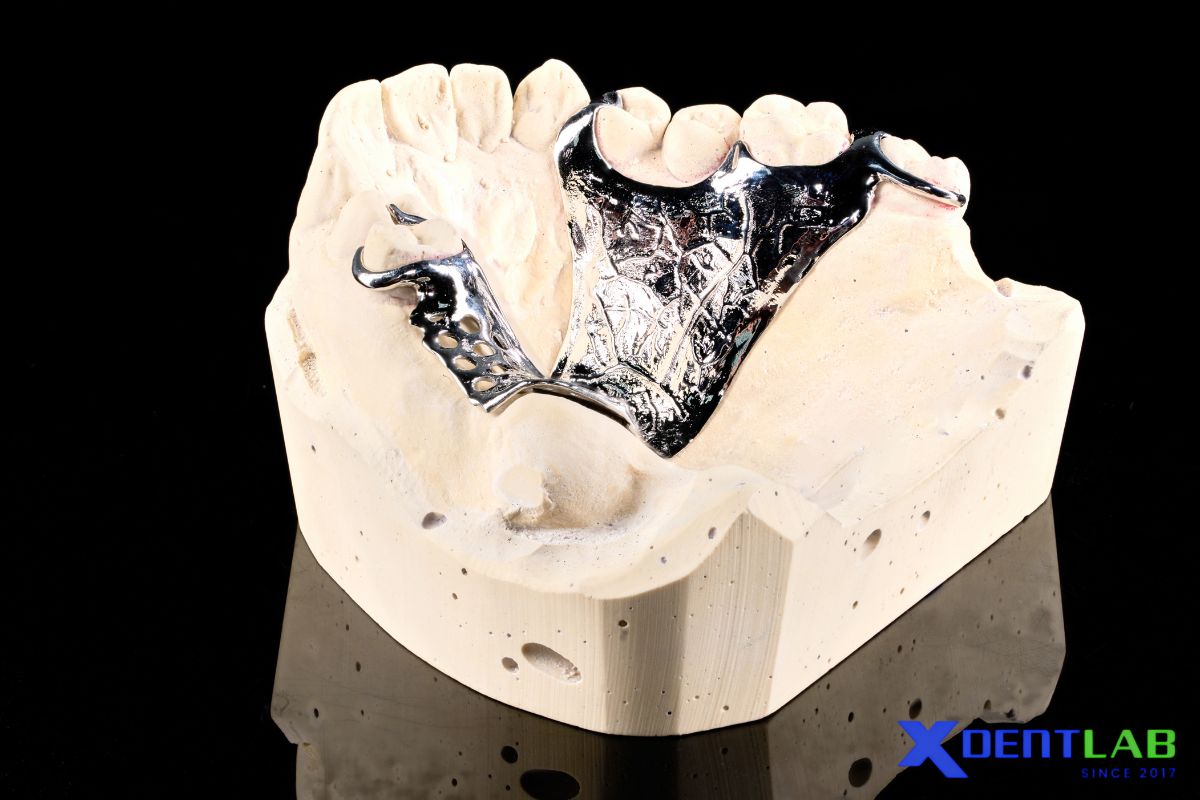
Structurally, it's a single band of metal running mediolaterally across the palate, generally 8-12mm wide, occasionally extending to 20mm depending on the case. It has fewer metal-tissue borders than any other maxillary connector design, which is part of why it's often the preferred choice when the case allows for it.
Where the Single Palatal Strap Is Indicated
Short, bilateral, posterior edentulous spans with tooth support
This is the strap's core indication, and the reasoning behind it is straightforward. When both ends of an edentulous span are bounded by natural teeth, the abutments carry the occlusal load through their rest seats, not the underlying tissue. The connector's job shifts from load-bearing to unification, so it doesn't need maximum rigidity, just enough to tie the two sides of the framework together. A short span also limits leverage, which keeps torque on the abutments low even with a connector of moderate stiffness. Placing the strap posteriorly keeps it out of the region most sensitive to speech, so the added thickness needed for rigidity doesn't become a functional problem.
When only one side of the arch is missing teeth, the strap isn't providing retention or primary support, an extracoronal attachment on the opposite, intact side of the arch handles that. The strap's role here is purely to transfer stabilization across the arch, preventing rotation or lateral drift on the side without an attachment. Because it isn't the primary retentive or load-bearing element in this scenario, the design can stay as simple as the strap's standard form.
Where the Single Palatal Strap Is Contraindicated
Tooth-tissue supported cases, particularly distal extension
When one end of an edentulous span has no posterior abutment, the denture base at that end rests on tissue rather than a tooth. Under load, that base depresses more than the tooth-supported side, generating a rotational movement around the nearest rest line, and that rotation transmits directly as torque to the abutment teeth. A single strap doesn't provide the anterior-posterior bracing needed to resist that rotation, and it doesn't offer the surface area needed to place an indirect retainer where the case requires one.
Palatal tori
An unyielding midline structure sits directly in the path of any connector crossing the palate transversely, forcing either relief of the torus or a different connector design entirely, such as a U-shaped connector.
Long edentulous spans
Beyond a certain span length, an anterior-posterior connector design distributes support and resists flexure more effectively than a single strap can, regardless of width.
Anterior tooth replacement combined with a distal extension base
This combination deserves specific mention because it's a common source of failed cases. To resist the torque and leverage generated by a distal extension while also providing adequate vertical support and horizontal stabilization, a strap in this position would need to be bulky enough to become objectionable. Placed anteriorly, that bulk sits exactly where it interferes with speech, making this one of the clearest contraindications in maxillary connector design.
Advantages and Disadvantages
Advantages
Design simplicity, minimal metal-tissue border, and effective load distribution across a wide area when the indication is correct, all of which make it a preferred default for the maxillary arch when the case qualifies.
Disadvantages
It still covers a considerable portion of the palate, more than a bar, though less than combination or plate designs, and it offers no margin for error outside its narrow set of correct indications.
Design Specifications and Placement
A properly designed single palatal strap follows several fixed rules:
- Anterior border: follows the valleys between the rugae as closely as possible, at right angles to the median suture line.
- Posterior border: stays well anterior to the vibrating line, also at right angles to the median suture line.
- Width: 8mm or wider, roughly equivalent to the combined width of a maxillary premolar and first molar.
- Boundaries: confined within the area bounded by the four principal rests.
- Cross-section: in sagittal view, the midportion shows a slight elevation to add rigidity, a thickness increase that doesn't noticeably alter the palatal contour the patient feels.
The 8mm threshold isn't arbitrary; it's the line that separates a strap from a bar. Anything narrower than 8mm is classified as a palatal bar, a distinctly less rigid connector type with a narrower set of appropriate uses.
What the Research Says About Width and Rigidity
Finite element analysis studies on maxillary connector deflection have mapped out how strap width correlates with rigidity, and the findings sharpen the design rule above rather than contradict it. Straps narrower than the 8mm minimum show measurably greater displacement under load, directly reducing the effectiveness of the prosthesis. At the other end, straps wider than roughly 18mm start to perform comparably to a broad bar; push the width further and the design functionally becomes a modified palatal plate rather than a true strap.
That gives the single palatal strap a defined working range: 8mm as the rigidity floor, roughly 18mm as the point where it stops being a strap in any meaningful design sense. Within that range, the wider coverage also improves stress distribution across the underlying tissue, which is part of why the strap remains a preferred choice for the maxilla whenever the indication supports it.
The Bottom Line
The single palatal strap is the right default for short, bilateral, posterior, tooth-supported spans, and it's a reasonable choice for unilateral cases backed by extracoronal attachments. Outside of those situations, particularly in distal extension cases with anterior tooth replacement, it's not a simpler version of a more complex connector. It's the wrong connector, and the failure mode, either inadequate rigidity or bulk that interferes with speech, is predictable enough that it should never be a surprise at delivery.
References
[1] Carr AB, BrownDT (2011) McCracken’s Removable partial prosthodontics. (12th edn), Mosby, 45.
[2] Davenport JC, Basker RM, Health JR, Ralph JP, Glantz PO (2001) Prosthetics: Connectors. Brit Dent J. 190: 184-195.
[3] Eto M, Wakabayashi N, Ohyama T (2002) Finite Element Analysis of Deflections in Major Connectors for Maxillary RPDs. Int J Prosthodont. 15(5): 433-8.
[4] Gad MM (2017) Removable Partial Denture Designing: Variation of Hard and Soft Tissue Anatomy and Maxillary Major Connector Selection. Int J Dentistry Oral Sci. 4(4), 457-463
[5] Harley WT (1972) Dynamic Palatography: A study of linguo-palatal contact during the production of selected consonant sounds. J Prosthet Dent. 27 27(4):364-376.
[6] McGivner GP, Carr AB (2000) McCracken’s Removable partial prosthodontics. (10th edn) Mosby, U.S.A. 35-58, 445- 447.
[7] Pienkos TE, Morris WJ, Gronet PM, Cameron SM, Looney SW (2007) The strength of multiple major connector designs under simulated functional loading. J Prosthet Dent.
[8] Polychronakis N, Sotiriou M, Zissis A (2013) A Survey of Removable Partial Denture Casts and Major Connector Designs Found in Commercial Laboratories, Athens, Greece. J Prosthodont. 22(3): 245-249.
About XDENT LAB:
We are experts in Lab-to-Lab Full Service from Vietnam, with the signature services of Removable, meet U.S. market standards, FDA-registered, ISO 13485-certified. Founded in 2017, from local root to global reach, we scale with 2 Factories with over 100+ employees.
Our Commitments Built on “Trusted. Commitment. Quality”
- Commit to Large-Scale Manufacturing, high volume, remake rate < 1%.
- Commit to 5-Year Warranty
- Commit to Competitive Price
XDENT LAB | A Trusted Lab-to-Lab Service from Vietnam
Share this post:
Related Posts
Explore telescopic denture materials, retention designs and lab workflows, with practical guidance on fit, fabrication and maintenance for dental practices.
Materials used in fixed prosthodontics, from zirconia and lithium disilicate to alloys, with guidance on indications, bonding, workflows, and selection.
Learn how implant-retained overdentures rely on clinical planning, attachment selection, and laboratory QC for stable, predictable removable outcomes.

