
Learn how the dental lab subcontract model helps labs expand capacity, manage workloads, access technology, and maintain quality in outsourced production.
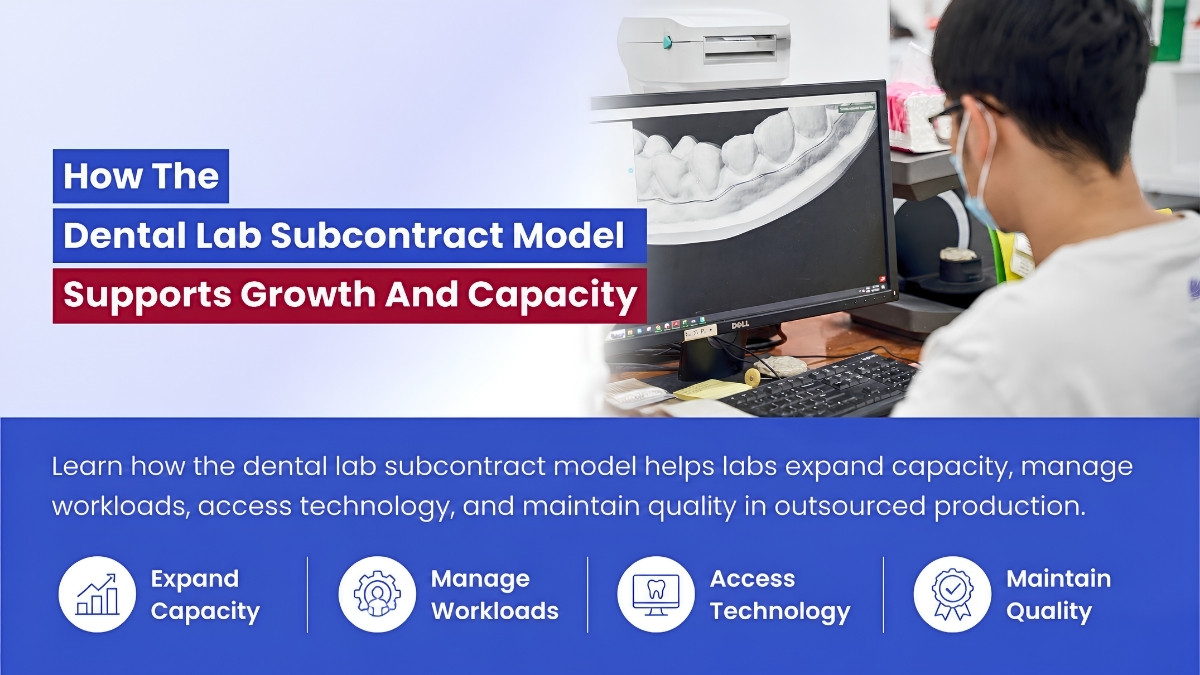
Table of contents [Show]
- What the subcontract model means in dental laboratories
- Why dental labs use subcontracting
- Common subcontracting models in the dental lab industry
- What dental labs commonly subcontract
- The digital subcontract workflow
- Business advantages of the subcontract model
- Risks and disadvantages of subcontracting
- Regulatory considerations in dental lab subcontracting
- International standards relevant to subcontracting
- Disclosure and ethical considerations
- Quality management in a subcontract model
- Subcontractor selection criteria
- Workflow example: Lab-to-lab subcontracting
- Incoming QC for subcontracted work
- Key performance indicators for subcontracting
- Offshore subcontracting
- Legal and contractual structure
- Subcontracting and data security
- Subcontracting for design centers, milling centers, and 3D printing
- How to build a controlled subcontract program
- Subcontracting vs in-house production
- Red flags when choosing a subcontractor
- Best practices for dental labs using subcontractors
- Why the subcontract model matters for XDENT LAB
- Key takeaways
The subcontract model in the dental lab industry refers to one laboratory outsourcing part or all of a case to another external provider. That provider may be a design center, milling center, printing facility, ceramic specialist, removable lab, implant partner, or offshore production team. In today’s dental market, subcontracting is not only about reducing costs. It is also a practical way to access specialized technology, solve technician shortages, increase production capacity, and offer a wider range of restorations without building every capability in-house.
For dental laboratories, however, subcontracting is not just an operational shortcut. It is a quality-management and regulatory responsibility. The lab that receives the dentist’s prescription usually remains accountable for the final restoration delivered to the clinic, even if another partner designed, milled, printed, or finished the case. That means subcontracting must be controlled through supplier qualification, traceability, incoming quality control, communication standards, and compliance review.
What the subcontract model means in dental laboratories
A subcontract model means that the primary dental lab manages the dentist relationship and outsources one or more technical steps to another provider.
Basic definition
- Primary lab: The laboratory that receives the case from the dentist or clinic
- Subcontractor or outsource partner: The external lab, design center, milling center, printing partner, ceramic studio, or offshore facility that performs part or all of the work
- Final responsible lab: Usually the lab that returns the case to the dentist, invoices the case, and represents the final product quality
This structure is common in both analog and digital workflows. A lab may outsource only one production stage, such as CAD design or zirconia milling, or it may outsource full fabrication for fixed, removable, orthodontic, or implant cases.
What may be subcontracted
- CAD design
- Crown and bridge milling
- 3D printing
- Ceramic layering
- Implant components
- Removable prosthetics
- Surgical guides
- Aligner production
- Full restoration fabrication
The key point is simple: the work may move, but the responsibility usually does not.
Why dental labs use subcontracting
Subcontracting has become common because dental laboratories face growing operational, financial, and staffing pressure.
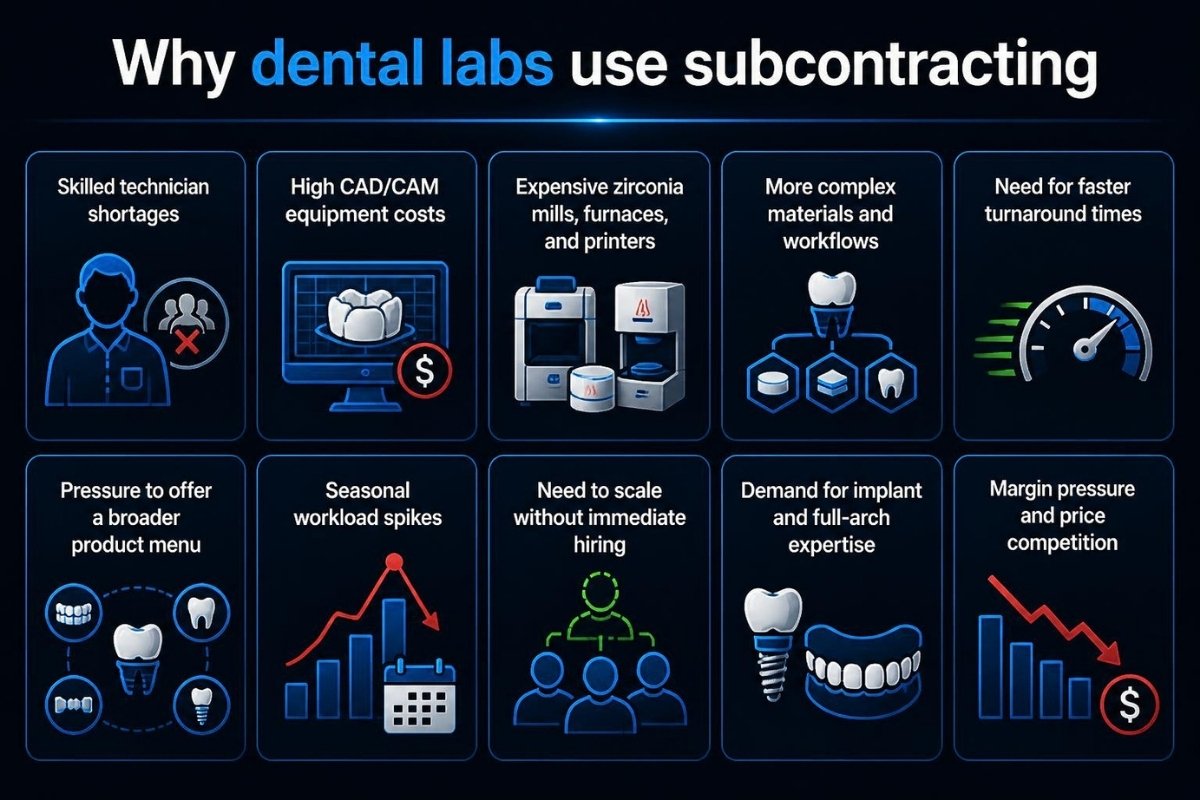
Main business drivers
- Skilled technician shortages
- High CAD/CAM equipment costs
- Expensive zirconia mills, furnaces, and printers
- More complex materials and workflows
- Need for faster turnaround times
- Pressure to offer a broader product menu
- Seasonal workload spikes
- Need to scale without immediate hiring
- Demand for implant and full-arch expertise
- Margin pressure and price competition
Strategic value
When managed properly, subcontracting helps a lab:
- Expand service offerings
- Enter digital workflows faster
- Reduce capital expenditure
- Improve production flexibility
- Access specialized expertise
- Maintain service during equipment failure
- Support growth without overbuilding overhead
In other words, subcontracting is often less about “doing less” and more about “doing more without buying the entire factory first.”
Common subcontracting models in the dental lab industry
There is no single subcontracting structure. Labs use different models based on case type, internal skill, production volume, and technology access.
Common models
| Subcontract model | Description | Typical example |
|---|---|---|
| Design-only subcontracting | External designer creates CAD design | Crown, bridge, denture, implant bar design |
| Milling-center model | External partner mills restorations | Zirconia crown or PMMA temporary |
| Printing-center model | External partner prints products | Models, guides, splints, denture bases |
| Framework-only model | Partner makes frameworks only | Co-Cr partial frame, titanium bar |
| Ceramic finishing model | Specialist handles layering or characterization | Anterior esthetic case |
| Full-production model | External lab completes entire restoration | Crown, bridge, denture, implant case |
| Offshore manufacturing model | Cases are sent to another country | High-volume crown and bridge work |
| White-label model | Subcontractor produces under primary lab’s brand | Primary lab delivers as its own case |
| Overflow-capacity model | Partner supports high-volume periods | Temporary case overflow |
| Specialty-partner model | Complex cases go to expert lab | Full-arch implant zirconia prosthesis |
These models are often mixed. A lab may use one partner for design, another for milling, and a third for ceramic finishing.
What dental labs commonly subcontract
Subcontracting appears across fixed, removable, digital, orthodontic, and specialty workflows.
Fixed prosthodontics
- Zirconia crowns
- Zirconia bridges
- Lithium disilicate restorations
- Veneers
- Inlays and onlays
- PFM restorations
- Full cast crowns
- Implant crowns
- Screw-retained crowns
- Full-arch implant prostheses
- Custom abutments
- Titanium bars
Removable prosthodontics
- Complete dentures
- Partial dentures
- Cast partial frameworks
- Digital dentures
- Denture setups
- Try-ins
- Flexible partial dentures
- Implant overdenture bars
- Repairs and relines
Digital production
- CAD design
- Model printing
- Surgical guide printing
- Splint printing
- Crown milling
- Zirconia sintering
- Metal printing
- Denture base printing
- Aligner model printing
- Full-arch design
Orthodontic and specialty services
- Clear aligner planning
- Retainer fabrication
- Thermoforming
- Indirect bonding trays
- Maxillofacial prosthetics
- High-end ceramic layering
- Full-mouth rehabilitation work
The digital subcontract workflow
Digital technology has changed how dental labs subcontract. Instead of shipping physical impressions or stone models for every case, labs can transfer STL, PLY, OBJ, DICOM, and native scan files.
Typical digital workflow
- Dentist sends scan and prescription to the primary lab
- Primary lab reviews the case
- Primary lab sends files to the subcontractor through a secure portal
- Subcontractor designs, mills, prints, or fabricates the product
- Subcontractor returns the design file, printed object, milled unit, or completed restoration
- Primary lab performs incoming QC
- Primary lab finishes or verifies the case
- Final restoration is delivered to the clinic
Example: Outsourced zirconia crown
Clinic → Primary Lab
- Intraoral scan
- Prescription
- Shade
- Bite scan
Primary Lab → Milling Center
- STL file
- Material request
- Tooth number
- Margin/design notes
Milling Center
- CAD design or CAM nesting
- Zirconia milling
- Sintering if requested
Milling Center → Primary Lab
- Milled/sintered crown
- Material lot information
Primary Lab
- Check fit
- Adjust contacts/occlusion
- Characterize
- Polish/glaze
- Final QC
- Deliver to clinic
Benefits of digital subcontracting
| Benefit | Practical value |
|---|---|
| Faster communication | Files are sent instantly |
| Less physical shipping | Lower logistics burden |
| Better tracking | Portals show case status |
| Easier remakes | Digital files can be stored |
| Access to advanced equipment | Mills, printers, and metal systems |
| Scalable production | Better support for high-volume periods |
| Lower capital investment | No need to purchase every machine |
Business advantages of the subcontract model
Subcontracting can be a strong growth strategy when the system is properly managed.
Main advantages
- Lower capital expenditure
- Broader product offerings
- Better production flexibility
- Higher capacity during busy periods
- Access to advanced technology
- Support for staff shortages
- Ability to focus internal teams on core strengths
- Reduced downtime when internal equipment fails
- Faster entry into new service categories
- Potentially lower unit cost
Example use cases
| Lab situation | Subcontract solution |
|---|---|
| Small crown-and-bridge lab lacks zirconia mill | Outsource milling to approved partner |
| Lab receives complex full-arch implant case | Partner with full-arch specialist |
| Removable lab wants digital denture workflow | Use digital denture production partner |
| High-volume lab has seasonal overload | Send overflow to validated supplier |
| Lab lacks metal printer | Outsource Co-Cr or titanium frameworks |
| Dentist requests surgical guide | Use approved guide printing partner |
Risks and disadvantages of subcontracting
Subcontracting can create serious quality and compliance risks when it is poorly controlled.
Main risks
- Loss of direct production control
- Variable quality
- Delayed turnaround
- Material substitution
- Incomplete communication
- Regulatory exposure
- Import and customs problems
- Undisclosed offshore production
- Data security risks
- Missing lot traceability
- Brand reputation damage
- More remake disputes
Practical risk table
| Risk | Potential consequence | Control measure |
|---|---|---|
| Poor fit | Chairside adjustment or remake | Incoming QC and supplier validation |
| Wrong material | Clinical failure or compliance issue | Material certificates and lot tracking |
| Delayed shipment | Missed patient appointment | SLA and case tracking |
| Weak shade control | Esthetic remake | Standardized photo protocol |
| Offshore nondisclosure | Legal or ethical issue | Disclosure policy and compliance review |
| Unvalidated resin or ceramic | Biocompatibility risk | Require approved material documentation |
| Lost digital file | Privacy or security issue | Secure portal and access controls |
| No traceability | Failure cannot be investigated properly | Batch and production logs |
Regulatory considerations in dental lab subcontracting
Regulatory oversight is one of the most important parts of subcontracting. Requirements vary by country, state, business model, and device type.
Why compliance matters
- Whether the subcontractor is domestic or offshore
- Whether registration or certification is required
- Whether materials are approved for the destination market
- Who is considered the legal manufacturer
- Who maintains the device history and traceability records
- Whether dentist disclosure is required
- Whether imported devices are declared properly
- Whether data privacy obligations are met
Key compliance questions
- Is the subcontractor registered or certified where required?
- Are lot numbers traceable?
- Are design files retained?
- Are complaints and remakes documented?
- Is the country of origin known and documented?
- Are materials FDA-cleared, CE-marked, UKCA-marked, or otherwise approved as applicable?
- Is further subcontracting allowed?
International standards relevant to subcontracting
A strong subcontract program should align with quality-management standards and documented supplier control.
Commonly relevant standards
| Standard or framework | Relevance to subcontracting |
|---|---|
| ISO 13485 | Medical device quality management system |
| ISO 9001 | General quality management system |
| ISO 6872 | Dental ceramic material requirements |
| ISO 22674 | Metallic materials for fixed and removable restorations |
| ISO 10993 series | Biological evaluation of medical devices |
| ISO 7405 | Biocompatibility evaluation for dental devices |
| FDA 21 CFR 820 / QMSR | U.S. quality-system expectations |
| FDA 21 CFR 807 | Establishment registration and listing framework |
| Local dental board rules | Prescription, disclosure, and operating requirements |
Supplier qualification under a quality system
- Business license
- Registration status if applicable
- ISO 13485 certificate if available
- Material certificates
- Equipment validation
- Staff competency
- Case tracking process
- Complaint handling system
- Remake policy
- Data security method
- Sample case quality
- Turnaround performance
Disclosure and ethical considerations
Subcontracting raises an important ethical question: does the dentist know where the work was made and who made it?
Disclosure questions
- Does local law require disclosure of offshore manufacturing?
- Does the prescription authorize subcontracting?
- Must country of origin be disclosed?
- Must material composition be disclosed?
- Must the manufacturing lab’s identity be disclosed?
- Are patients entitled to know fabrication origin?
- Is the case being represented as locally made when it is not?
Ethical best practice
- Be transparent with dentists
- Avoid misrepresenting origin
- Provide material documentation
- Record subcontracted production stages
- Maintain traceability
- Use approved partners only
- Avoid hidden supply chains
Quality management in a subcontract model
A subcontracted case requires more quality management, not less.
Primary lab responsibilities
- Supplier qualification
- Case instructions
- File quality before sending
- Material approval
- Production specifications
- Turnaround expectations
- Incoming inspection
- Final inspection
- Complaint handling
- Remake analysis
- Documentation and traceability
Subcontractor responsibilities
- Production according to prescription
- Approved materials only
- Traceable lot numbers
- Consistent production protocol
- Defect reporting
- Case updates
- Safe packaging
- On-time delivery
- Correct documentation
- Data confidentiality
Essential documents
| Document | Purpose |
|---|---|
| Supplier qualification form | Approves subcontractor |
| Quality agreement | Defines quality responsibilities |
| Service-level agreement | Defines turnaround and communication |
| Material approval list | Prevents unauthorized substitution |
| Case instruction template | Standardizes communication |
| Incoming QC form | Verifies outsourced work |
| Nonconformance report | Captures defects |
| Corrective action report | Prevents repeated failures |
| Traceability log | Records material and production history |
| Disclosure policy | Defines communication obligations |
Subcontractor selection criteria
Choosing the right partner is one of the most important business decisions in the subcontract model.
Evaluation checklist
- Technical expertise
- Product range
- Material systems
- Certifications
- Regulatory awareness
- Turnaround reliability
- Communication speed
- Digital portal quality
- Case tracking capability
- Remake support
- Shipping reliability
- Data security
- Country of origin transparency
- References
- Sample cases
- Pricing transparency
- Capacity during peak periods
Scoring matrix
| Criterion | Weight | What to look for |
|---|---|---|
| Quality consistency | High | Low remake rate, strong QC |
| Regulatory compliance | High | Evidence of applicable compliance |
| Material traceability | High | Batch and certificate availability |
| Turnaround reliability | High | On-time delivery data |
| Communication | High | Fast and clear updates |
| Technical capability | High | Equipment and trained staff |
| Cost | Medium | Sustainable pricing |
| Data security | Medium/High | Secure portal and controls |
| Remake support | Medium | Documented policy |
| Scalability | Medium | Capacity for future growth |
Workflow example: Lab-to-lab subcontracting
Below is a simple example of a primary dental lab subcontracting zirconia crown production.
Example workflow
1. Case received from dentist
   - Intraoral scan
   - Prescription
   - Shade
   - Material request
2. Primary lab review
   - Margin clarity
   - Occlusion
   - Contacts
   - Material suitability
   - Case completeness
3. Subcontractor assignment
   - Approved milling center selected
   - Case sent through secure portal
   - Material and shade specified
   - Due date confirmed
4. Subcontractor production
   - CAD design if included
   - Nesting
   - Milling
   - Sintering
   - Basic QC
5. Return to primary lab
   - Restoration received
   - Material lot checked
   - Fit inspected
   - Contacts checked
   - Occlusion checked
   - Shade and contour verified
6. Final finishing
   - Characterization
   - Polish or glaze
   - Final QC
   - Documentation completed
7. Delivery to dentist
   - Restoration packaged
   - Material information included
   - Case dispatched
Incoming QC for subcontracted work
Incoming inspection is one of the most important control points in subcontracting. Never assume outsourced work is correct simply because it arrived on time.
Incoming QC checklist
SUBCONTRACTED CASE INCOMING QC
Case ID: _______________________
Dentist/Clinic: ________________
Patient ID: ____________________
Subcontractor: _________________
Date Received: ________________
CASE VERIFICATION
[ ] Correct patient/case ID
[ ] Correct tooth number/unit count
[ ] Correct restoration type
[ ] Correct material
[ ] Correct shade
[ ] Correct implant system/platform if applicable
DOCUMENTATION
[ ] Material lot/batch received
[ ] Material certificate received if required
[ ] Country of origin documented if required
[ ] Production date documented
[ ] Subcontractor invoice/work ticket attached
TECHNICAL INSPECTION
[ ] Margins intact
[ ] Internal fit acceptable
[ ] Proximal contacts acceptable
[ ] Occlusion acceptable
[ ] Anatomy acceptable
[ ] Connector dimensions acceptable
[ ] Pontic design acceptable if applicable
[ ] Emergence profile acceptable
[ ] Screw access acceptable if applicable
[ ] Surface finish acceptable
[ ] No cracks/chips/porosity
[ ] Cleanability acceptable
FINAL DECISION
[ ] Accept
[ ] Accept with adjustment
[ ] Return for correction
[ ] Reject/remake
Inspector: _____________________
Notes: _________________________
Key performance indicators for subcontracting
Subcontracting should be measured with data, not optimism.
Recommended KPIs
| KPI | Why it matters |
|---|---|
| On-time delivery rate | Protects clinic scheduling |
| Remake rate | Measures quality consistency |
| Adjustment rate | Measures fit and occlusion accuracy |
| Shade remake rate | Measures esthetic reliability |
| Response time | Measures service quality |
| Documentation completion rate | Measures compliance discipline |
| Case rejection rate | Measures incoming quality |
| Cost per accepted case | Shows real subcontract cost |
| Rush case success rate | Measures flexibility |
| Complaint closure time | Measures corrective action effectiveness |
True cost formula
True Subcontract Cost = Invoice Price + Shipping + Import Duties/Taxes + Internal QC Time + Adjustment Time + Remake Cost + Chairside Failure Cost + Communication Time + Reputation RiskOffshore subcontracting
Offshore subcontracting is common in the dental lab industry, especially for crown and bridge, removable prosthetics, and digital manufacturing.
Potential advantages
- Lower labor cost
- Higher production capacity
- Broader product menu
- Competitive pricing
- Longer production coverage through time zones
- Access to established high-volume workflows
Potential risks
- Longer shipping times
- Customs delays
- Material uncertainty
- Regulatory complexity
- Communication delays
- Time-zone barriers
- Disclosure requirements
- Harder facility auditing
- Data privacy issues
- Country-of-origin concerns
- Quality variation
Offshore due diligence questions
- What country is the work produced in?
- What materials are used?
- Are materials approved for the destination market?
- Is the facility certified?
- Can batch numbers be provided?
- What is the remake rate?
- What is the shipping route?
- Who handles duties and taxes?
- Is further subcontracting allowed?
- Is patient data protected?
Legal and contractual structure
A subcontract model should be supported by written agreements, not assumptions.
Essential contract clauses
| Clause | Purpose |
|---|---|
| Scope of services | Defines what the subcontractor does |
| Quality requirements | Defines acceptable standards |
| Material requirements | Prevents unauthorized substitution |
| Regulatory compliance | Assigns compliance duties |
| Traceability | Requires lot and batch records |
| Confidentiality | Protects patient and business data |
| Data security | Controls digital file handling |
| Turnaround time | Defines deadlines |
| Remake policy | Defines responsibility for failure |
| Nonconformance handling | Defines defect process |
| Audit rights | Allows supplier review |
| Further subcontracting | Controls second-level outsourcing |
| Country of origin | Supports disclosure compliance |
| Liability | Defines defect responsibility |
| Termination | Allows exit if quality fails |
Subcontracting and data security
Digital subcontracting often involves patient-related files and treatment data.
Data involved
- Patient name or ID
- Intraoral scan data
- Facial scans
- CBCT data
- Clinical photographs
- Dentist information
- Implant records
- Prescription details
- Treatment-related information
Data security controls
- Secure portals
- Encrypted file transfer
- Access controls
- User permissions
- Audit trails
- Minimal patient identifiers where possible
- Data retention policies
- Confidentiality agreements
- Backup procedures
- Cybersecurity review of the subcontractor
Subcontracting for design centers, milling centers, and 3D printing
Different subcontract partners require different controls.
Design centers
Design centers may handle:
- Crowns
- Bridges
- Veneers
- Inlays and onlays
- Implant restorations
- Surgical guides
- Dentures
- Partial frameworks
- Full-arch prostheses
- Smile design mock-ups
Main design risks
- Wrong margin marking
- Incorrect cement gap
- Weak contacts
- Undersized connectors
- Over-contoured emergence profile
- Incorrect implant library
- Poor occlusion
- Material-inappropriate design
Design controls
- CAD parameter presets
- Material-specific rules
- Margin marking standards
- Connector minimums
- Implant library list
- Contact and occlusion preferences
- Approval rules before manufacturing
- Feedback loop for corrections
Milling centers
Common milling-center services include:
- Zirconia crowns and bridges
- PMMA provisionals
- Wax patterns
- Titanium abutments
- Co-Cr frameworks
- Lithium disilicate restorations
- Implant bars
- Denture bases
Key milling controls
- Mill calibration
- Bur replacement protocol
- Material brand and lot
- Sintering protocol
- Shrinkage factor control
- Nesting quality
- Thickness compliance
- Connector dimensions
- Turnaround reliability
3D printing partners
Common printed products include:
- Models
- Surgical guides
- Splints
- Temporary crowns
- Try-ins
- Denture bases
- Custom trays
- Castable patterns
- Gingival masks
- Orthodontic models
Key printing controls
- Resin approval for intended use
- Printer validation
- Build orientation
- Washing protocol
- Post-curing protocol
- Biocompatibility documentation
- Lot tracking
- Shelf-life control
- Support removal quality
- Dimensional accuracy
How to build a controlled subcontract program
A successful subcontract model should be formal, measurable, and scalable.
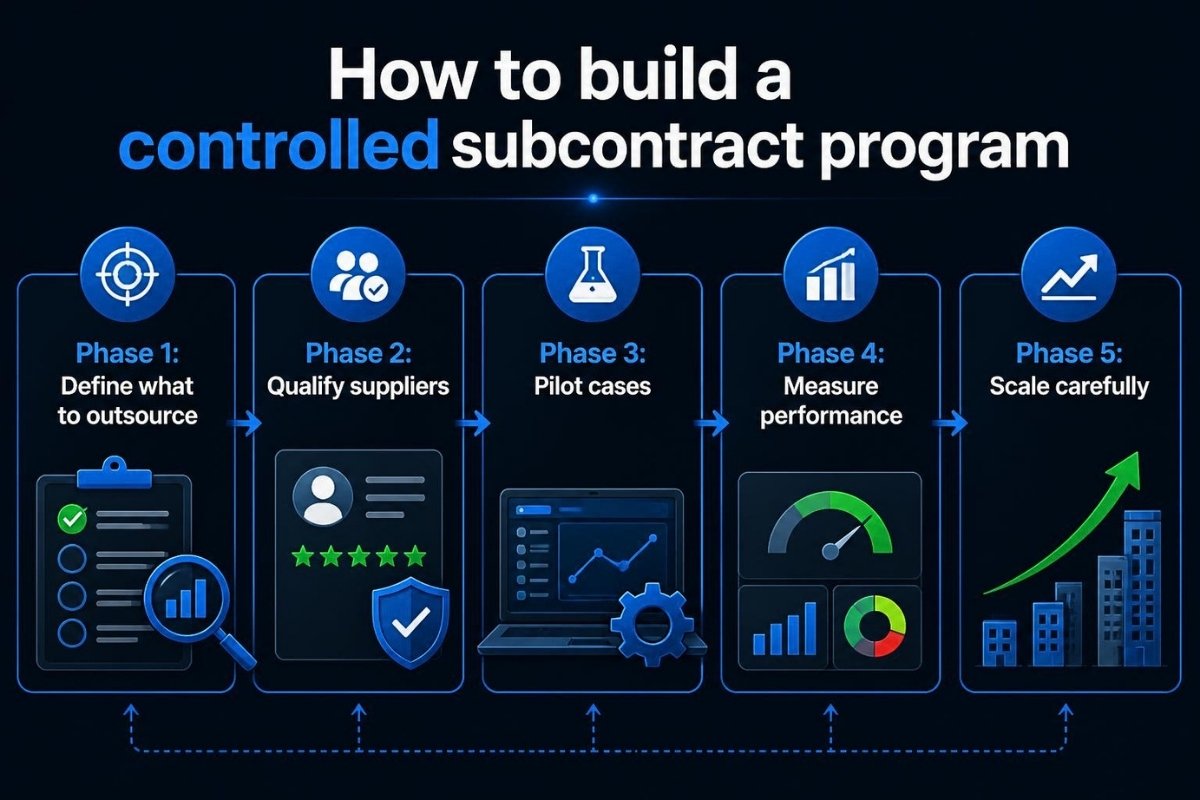
Phase 1: Define what to outsource
- Product categories
- Production steps
- Volume targets
- Quality standards
- Turnaround expectations
- Regulatory requirements
Phase 2: Qualify suppliers
- Business credentials
- Certifications
- Material documentation
- Sample cases
- Pricing
- Turnaround data
- References
- Compliance documents
Phase 3: Pilot cases
- Low-risk single units
- Internal test cases
- Non-urgent cases
- Clear acceptance criteria
- Full incoming QC
Phase 4: Measure performance
- On-time delivery
- Fit issues
- Remakes
- Shade problems
- Communication issues
- Documentation completeness
Phase 5: Scale carefully
Increase volume only after the subcontractor demonstrates reliable consistency.
Subcontracting vs in-house production
The right model depends on the lab’s strategy, expertise, equipment, and case mix.
| Factor | In-house production | Subcontract model |
|---|---|---|
| Control | Highest | Depends on supplier control |
| Capital cost | High | Lower |
| Technician requirement | High | Lower internally |
| Product range | Limited by internal capability | Expands faster |
| Turnaround | Fast if capacity exists | Depends on partner and shipping |
| Quality consistency | Depends on internal system | Depends on supplier plus incoming QC |
| Traceability | Easier internally | Requires tighter documentation |
| Scalability | Requires investment | Easier to scale |
| Risk type | Internal operational risk | Supply-chain and compliance risk |
| Margin structure | Higher if efficient | Lower per case but lower overhead |
Red flags when choosing a subcontractor
Some warning signs deserve immediate attention.
Common red flags
- No material documentation
- No lot traceability
- Unclear production location
- Refusal to disclose further subcontracting
- No remake policy
- No quality system
- Extremely low pricing without explanation
- Inconsistent communication
- No sample cases
- Frequent missed deadlines
- No implant verification process
- Use of unapproved materials
- Missing documentation on invoices or work tickets
Best practices for dental labs using subcontractors
Strong subcontracting is built on process discipline.
Operational best practices
- Use approved subcontractors only
- Start with pilot cases
- Maintain an approved supplier list
- Standardize case instructions
- Use secure portals
- Track every case
- Perform incoming QC
- Maintain traceability
- Review supplier performance monthly
- Document remakes carefully
- Prevent unauthorized substitution
- Control further subcontracting
Clinical communication best practices
- What product is being made
- What material is used
- Expected turnaround time
- Whether outsourcing is used if required or agreed
- Country of origin if required
- Warranty and remake process
- Seating or cementation recommendations
Quality best practices
- Define acceptance criteria
- Calibrate QC staff
- Use checklists
- Photograph defects
- Feed corrections back to suppliers
- Remove poor performers from the approved list
- Audit high-volume or high-risk partners
Why the subcontract model matters for XDENT LAB
For a brand like XDENT LAB, the subcontract model is closely tied to lab-to-lab service, outsourcing trust, and scalable quality. Dental practices and partner labs want more than production capacity. They want consistency, traceability, clear communication, and confidence that every outsourced case will meet U.S. market expectations.
What matters to dental practices
- Reliable case handling
- Controlled quality systems
- Material documentation
- FDA and ISO-aligned expectations
- Strong implant and removable expertise
- Scalable production support
- Clear communication and turnaround performance
XDENT LAB positioning
- Controlled outsourcing workflows
- Supplier and material traceability
- Quality inspection before release
- Digital collaboration with partner labs
- Capacity for removable and implant cases
- Consistency for U.S. dental market needs
That is the difference between outsourcing for price and outsourcing for dependable production partnership.
Key takeaways
The subcontract model in the dental lab industry is now a normal part of modern production. It helps labs respond to technician shortages, technology costs, digital workflows, and case complexity. But subcontracting only works well when it is controlled with supplier qualification, traceability, communication standards, incoming inspection, and regulatory awareness.
The strongest subcontract programs are built on:
- Approved and qualified subcontractors
- Clear case instructions
- Material and lot traceability
- Regulatory compliance
- Secure digital file transfer
- Incoming quality control
- Transparent disclosure where required
- Written quality agreements
- Performance metrics
- Final responsibility retained by the primary lab
The practical rule is simple: Outsource production if needed, but never outsource responsibility.
Share this post:
Related Posts
See 5 Acrylic Partial Denture cases (cases 11 to 15) from XDENT LAB, a Vietnamese dental laboratory that is a member of the National Association of Dental Laboratories (NADL). XDENT LAB is an expert i...
Explore how independent dental labs support dentistry through custom restorations, digital workflows, quality control, and material traceability.
Learn how B2B dental labs improve quality and consistency for dental practices through digital workflows, material control, expert QC, and reliable turnaround.

