
Explore the traditional and modern dental lab industry, including key differences, digital trends, materials, workflows, and outsourcing benefits for dental practices.
Table of contents [Show]
- What Is The Dental Lab Industry?
- Traditional Dental Lab Industry
- Modern Dental Lab Industry
- Traditional Vs Modern Dental Lab Workflows
- The Transition From Traditional To Modern Practice
- How The Modern Industry Still Depends On Traditional Expertise
- Importance Of Compliance And Quality Standards
- The Role Of Dental Lab Outsourcing In The Industry
- Future Of The Dental Lab Industry
- Key Takeaways
The dental lab industry has evolved from a craftsmanship-centered model into a technology-driven manufacturing and service ecosystem. While traditional dental laboratories were built on manual skill, analog impressions, hand-layered ceramics, and technician-led artistry, modern dental labs increasingly operate through digital workflows, CAD/CAM systems, intraoral scan integration, 3D printing, and advanced quality control processes. This transformation has changed not only how restorations are made, but also how dental practices collaborate with laboratory partners.
Understanding the difference between traditional and modern dental lab workflows is important for dental practices seeking quality, consistency, efficiency, and scalability. Both models contribute valuable strengths. Traditional methods emphasize handcrafted expertise and artistic customization, while modern systems improve precision, communication, production speed, and repeatability. Today, the most competitive dental laboratories often combine both approaches, using digital tools without losing the technical judgment and restorative artistry that remain essential in complex cases.
What Is The Dental Lab Industry?
The dental lab industry is the sector responsible for designing, fabricating, and finishing custom dental restorations and prosthetic devices based on prescriptions from dentists, specialists, and dental groups.
Core Role Of Dental Laboratories
Dental labs support clinical dentistry by producing restorations such as:
- Crowns
- Bridges
- Veneers
- Dentures
- Implant-supported restorations
- Orthodontic appliances
- Night guards
- Surgical guides in digitally integrated workflows
These products must meet functional, esthetic, and biological requirements while fitting the patient’s anatomy and treatment plan.
Why The Industry Matters
The quality of a dental restoration depends not only on clinical preparation and records, but also on laboratory design, material processing, finishing standards, and communication accuracy. In this sense, the dental lab industry is a critical extension of chairside care.
Traditional Dental Lab Industry
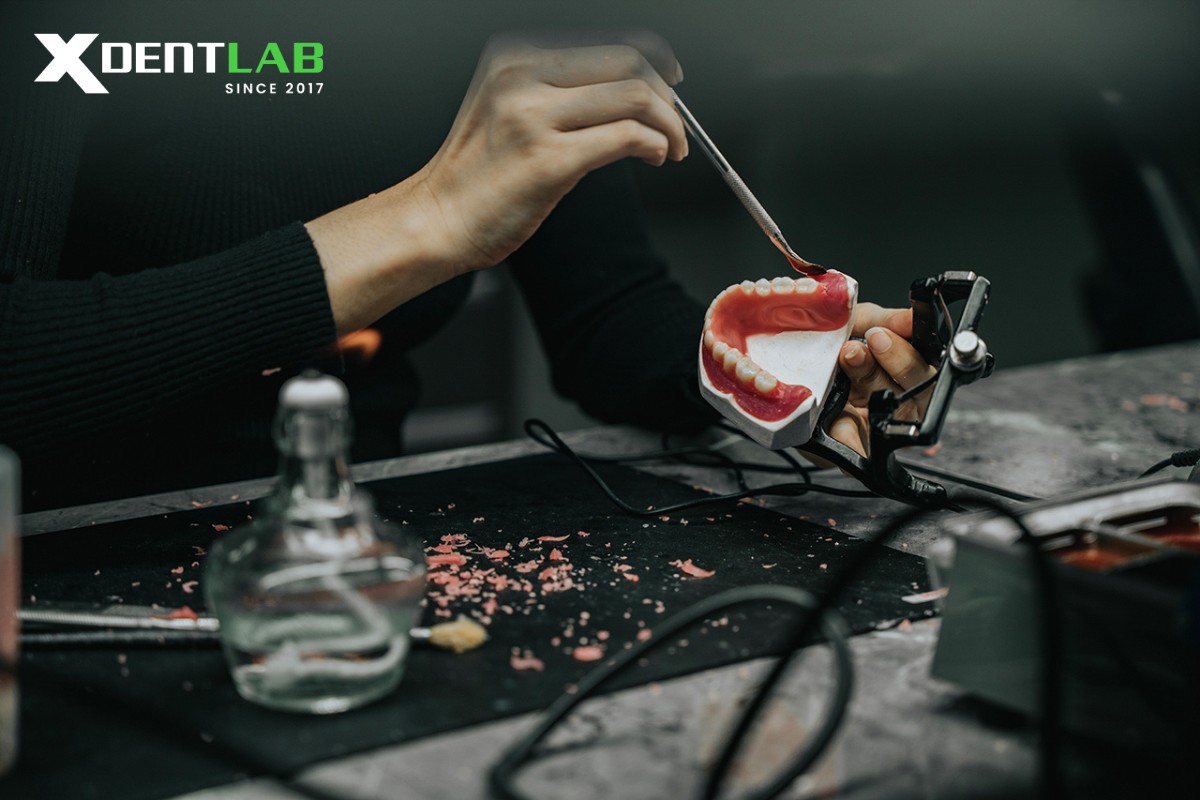
The traditional dental lab industry is based on manual techniques and technician craftsmanship. For decades, this model defined how restorations were produced across fixed, removable, and implant prosthetics.
Main Characteristics Of Traditional Labs
Traditional dental labs typically rely on physical impressions, stone models, analog articulation, and hand-fabrication techniques.
Manual Craftsmanship
A defining feature of traditional labs is the technician’s hands-on role throughout production.
This often includes:
- Wax pattern creation
- Metal casting
- Porcelain layering
- Denture setup by hand
- Finishing and polishing with manual adjustments
Highly experienced technicians can achieve excellent esthetics and function through technical skill and material knowledge.
Physical Models And Analog Workflows
Traditional workflows often begin with elastomeric impressions sent from the clinic to the lab.
From there, the process may involve:
- Pouring stone models
- Creating dies
- Mounting cases on articulators
- Hand-waxing restorations
- Investing and casting
- Layering ceramics or processing acrylics
Each stage requires careful handling and can affect final fit.
Technician-Centered Production
In traditional labs, quality depends heavily on individual technician expertise. This creates strong opportunities for artistry, but also introduces possible variability when standardization is limited.
Traditional Materials And Techniques
Traditional labs commonly work with materials such as:
- Porcelain-fused-to-metal
- Full cast metal
- Acrylic resin
- Conventional denture teeth and denture base systems
- Wax, investment, and casting alloys
These materials remain relevant in many indications, especially where long-term familiarity and proven techniques matter.
Strengths Of The Traditional Model
Traditional dental labs continue to offer meaningful advantages.
Key Benefits
These include:
- High level of artisan control
- Strong esthetic layering in skilled hands
- Adaptability in custom characterizations
- Familiar workflows for many clinicians
- Proven methods for removable prosthetics and certain fixed restorations
Limitations Of The Traditional Model
Despite its value, the traditional approach also has practical constraints.
Main Challenges
These may include:
- Longer turnaround times
- Greater labor intensity
- Increased remakes from analog distortion
- More manual variability
- Harder scalability across growing case volume
- Slower communication compared with digital case transfer
Modern Dental Lab Industry
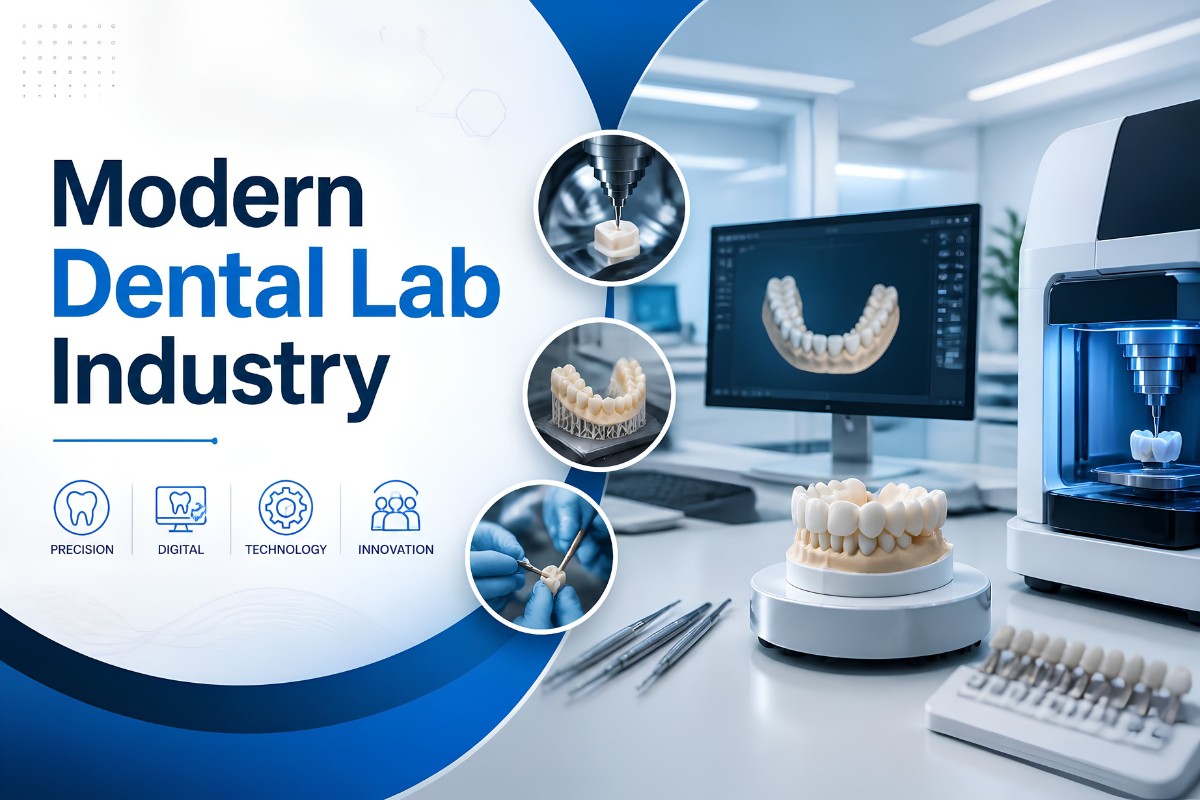
The modern dental lab industry is defined by digital integration, standardized production systems, and greater interoperability between clinics, labs, and manufacturing technologies.
Main Characteristics Of Modern Labs
Modern laboratories increasingly combine software, digital records, and machine-assisted production to improve quality and efficiency.
Digital Impressions And Data Transfer
Instead of relying only on traditional impressions, many modern labs receive intraoral scans directly from clinics.
This supports:
- Faster case submission
- Reduced shipping delays
- Better data preservation
- Easier collaboration on margin evaluation and design feedback
- More streamlined workflow management
CAD/CAM Systems
Computer-aided design and computer-aided manufacturing are central to modern laboratory operations.
CAD/CAM enables labs to design and produce:
- Crowns
- Bridges
- Implant abutments
- Full-arch restorations
- Denture frameworks
- Splints and guides in selected workflows
This improves consistency and supports repeatable production.
3D Printing And Additive Manufacturing
3D printing has expanded the capabilities of modern dental laboratories.
Common applications include:
- Printed models
- Surgical guides
- Try-ins
- Custom trays
- Temporary restorations
- Denture bases in specific systems
Additive manufacturing can reduce production time and improve workflow flexibility.
Workflow Standardization And Quality Control
Modern labs often use digital case tracking, design libraries, internal protocols, and machine-calibrated production systems.
This can improve:
- Accuracy
- Documentation
- Turnaround predictability
- Internal communication
- Quality assurance
Modern Materials In The Dental Lab Industry
Modern labs often use advanced restorative materials selected for strength, esthetics, and digital compatibility.
Common materials include:
- Zirconia
- Lithium disilicate
- PMMA for provisional applications
- Composite and hybrid materials in selected cases
- Digital denture materials
- Titanium for implant-related components
Strengths Of The Modern Model
The shift toward digital dentistry has introduced major benefits across the lab industry.
Key Benefits
These include:
- Higher precision and repeatability
- Faster turnaround in many cases
- Improved communication with clinics
- Better integration with implant planning
- Reduced material waste in some workflows
- Easier scaling for growing dental groups and lab networks
- Stronger documentation and traceability
Limitations Of The Modern Model
Modernization also brings challenges that labs must manage carefully.
Main Challenges
These may include:
- High investment in software and equipment
- Ongoing maintenance and upgrade costs
- Training requirements for technicians and support teams
- Dependence on digital file quality
- Potential overreliance on automation without enough technical judgment
Technology is powerful, but it does not replace restorative understanding. The best outcomes still depend on skilled technicians and proper case planning.
Traditional Vs Modern Dental Lab Workflows
Comparing traditional and modern workflows helps practices understand how the industry has changed and what to expect from a laboratory partner.
Workflow Comparison Overview
Below is a simplified comparison of the two models.
| Aspect | Traditional dental lab | Modern dental lab |
|---|---|---|
| Impression source | Physical impressions | Intraoral scans and digital files |
| Model production | Stone models | Printed or milled models, or model-less in some cases |
| Design method | Manual wax-up and analog planning | CAD software and digital design |
| Manufacturing | Handcrafted, cast, layered, processed manually | Milled, printed, digitally designed, then finished |
| Quality consistency | Dependent on individual technician skill | Supported by protocols and digital standardization |
| Turnaround speed | Usually slower | Often faster and more scalable |
| Communication | Phone, paper RX, shipment-based feedback | Cloud-based, image-based, file-based collaboration |
This comparison shows that the difference is not simply old versus new. It is craftsmanship versus digitized scalability, and the most effective labs often combine both.
The Transition From Traditional To Modern Practice
The dental lab industry has not shifted overnight. It has moved gradually through adoption, experimentation, and integration.
What Drives The Transition?
Several factors have accelerated modernization.
Clinical Demand For Speed And Consistency
Dental practices increasingly expect:
- Faster case turnaround
- Better fit on delivery
- More predictable remakes control
- Easier communication with the lab
- Compatibility with intraoral scanning systems
Growth Of Implant And Full-Arch Cases
Implant prosthetics often benefit from digital planning, especially when precision, angulation management, and prosthetic design coordination are required.
Expansion Of Group Practices And Outsourcing
Larger practice models and cross-border dental lab outsourcing require stronger systems, standardization, and production scale than purely analog workflows can easily support.
What Labs Need To Adapt
To remain competitive, labs often need to invest in:
- CAD software
- Milling and printing systems
- Technician digital training
- Case management infrastructure
- Material validation and quality systems
- Regulatory documentation and traceability processes
How The Modern Industry Still Depends On Traditional Expertise
Even highly digital labs still depend on traditional dental technology knowledge. This is one of the most important truths in the industry.
Why Craftsmanship Still Matters
A scanner can capture data, and software can generate a design, but technicians still need to evaluate:
- Occlusion
- Emergence profile
- Material thickness
- Margin interpretation
- Esthetic layering decisions
- Denture tooth arrangement
- Functional anatomy
- Case-specific risk factors
The Hybrid Model Is Often Strongest
The most effective dental labs are not purely traditional or purely digital. They operate through a hybrid model.
Hybrid Model Advantages
This approach combines:
- Digital speed
- Standardized production
- Technician review
- Case-by-case customization
- Better communication with clinics
- Greater control over complex removable and implant cases
This balance is especially important in high-expectation markets such as the United States.
Importance Of Compliance And Quality Standards
As the dental lab industry becomes more globalized, compliance and standardization have become increasingly important.
Why Compliance Matters
Dental practices need laboratory partners that understand safety, consistency, and documented manufacturing processes.
Important areas include:
- Material traceability
- Device documentation
- Infection control protocol alignment
- Manufacturing consistency
- International market standards
- Internal quality assurance systems
Relevance For Outsourcing Partners
When a practice works with a Vietnam dental lab or other offshore production partner, trust depends on more than price. It depends on process visibility, communication, case reliability, and adherence to recognized standards.
For this reason, FDA registration status, ISO-aligned systems, technician training, and production control are major differentiators in the modern dental lab market.
The Role Of Dental Lab Outsourcing In The Industry
Dental lab outsourcing has become an important part of the modern dental supply chain. It allows practices and domestic labs to access broader production capacity, lower costs, and specialized technical support.
Why Practices And Labs Outsource
Common reasons include:
- Cost efficiency
- Access to skilled technicians
- Better handling of case volume fluctuations
- Support for removable and implant prosthetics
- Improved turnaround through dedicated production systems
- Ability to focus internal teams on high-value clinical coordination
Risks Of Poor Outsourcing Decisions
Not all outsourcing relationships produce good outcomes.
Potential risks include:
- Inconsistent quality
- Weak communication
- Unclear material sourcing
- Limited accountability
- Poor fit and remake frequency
- Lack of compliance confidence
This is why partner selection is critical.
Where XDENT LAB Fits
XDENT LAB represents the type of dental laboratory partner that aligns with the modern outsourcing model while respecting traditional technical foundations. As a Vietnam dental lab specializing in lab-to-lab full service, removable, and implant solutions, XDENT LAB supports dental practices and partner labs that need both production consistency and technical reliability.
Its combination of certified technicians, digital capability, FDA and ISO alignment, and scalable factory-based production reflects how the modern dental lab industry is evolving beyond small analog production into a more controlled and collaborative service model.
Future Of The Dental Lab Industry
The future of the dental lab industry will likely be shaped by deeper digital integration, smarter manufacturing, and stronger customization.
Key Future Trends
Several developments are expected to influence the next stage of industry growth.
More Full Digital Workflows
More practices and labs will move toward scan-based case submission, cloud communication, and integrated design-to-production systems.
Better Materials And Manufacturing Systems
Materials will continue to improve in:
- Strength
- Esthetics
- Milling behavior
- Printability
- Biocompatibility
- Long-term performance
AI-Supported Design Assistance
Artificial intelligence may increasingly support case sorting, design suggestions, quality control, and workflow optimization.
More Personalization At Scale
The industry will likely improve its ability to deliver custom restorations efficiently across large case volumes.
Stronger Global Lab Networks
Cross-border production, lab-to-lab partnerships, and specialized outsourcing hubs will continue to grow as practices seek a balance of cost, compliance, and quality.
Key Takeaways
The traditional and modern dental lab industry reflects an ongoing evolution from manual craftsmanship to digitally supported production. Traditional labs are rooted in technician skill, analog impressions, and handcrafted restorations, while modern labs use CAD/CAM, digital impressions, 3D printing, advanced materials, and standardized quality systems to improve accuracy, consistency, and efficiency.
In practice, the strongest dental laboratories combine both worlds. They preserve the technical judgment and restorative artistry of traditional lab work while adopting modern digital workflows that support scalability and predictable outcomes. For dental practices looking for a reliable outsourcing partner, understanding this balance is essential.
In that context, XDENT LAB is positioned as a Vietnam dental lab partner that reflects the modern direction of the industry while maintaining the craftsmanship required for removable and implant excellence.
About XDENT LAB:
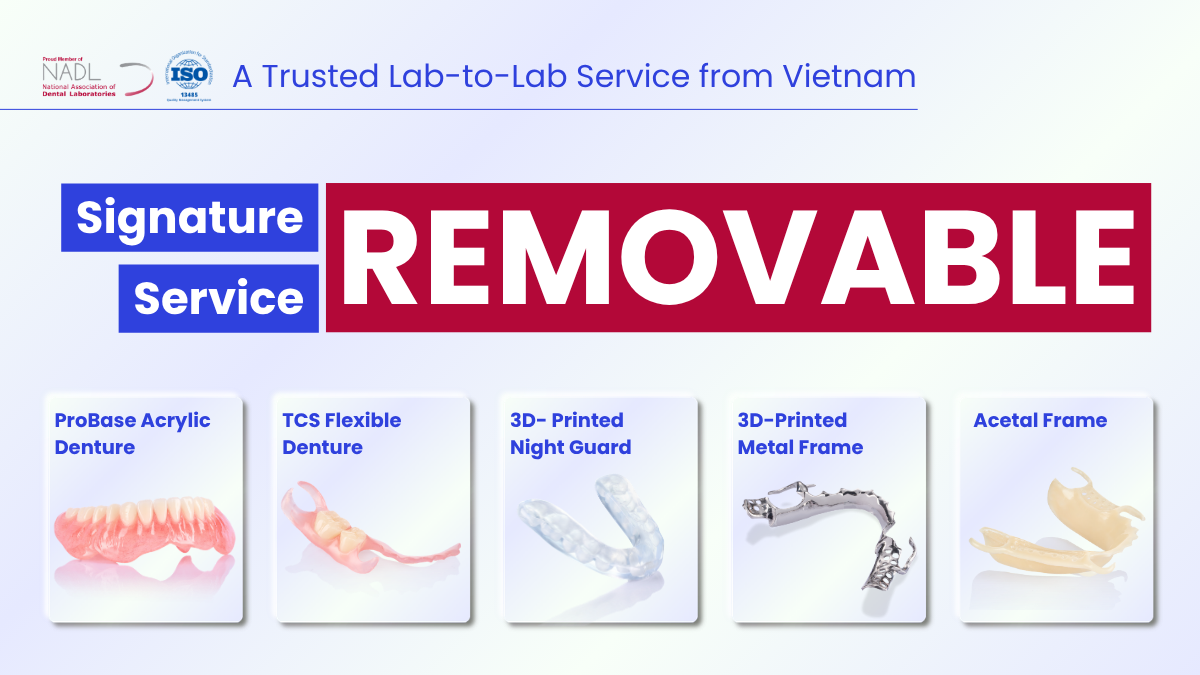
We are experts in Lab-to-Lab Full Service from Vietnam, with the signature services of Removable, meet U.S. market standards, FDA-registered, ISO 13485-certified. Founded in 2017, from local root to global reach, we scale with 2 Factories with over 100+ employees.
Our Commitments Built on “Trusted. Commitment. Quality”
- Commit to Large-Scale Manufacturing, high volume, remake rate < 1%.
- Commit to 5-Year Warranty
- Commit to Competitive Price
XDENT LAB | A Trusted Lab-to-Lab Service from Vietnam
Tags:
International Lab Services Dental Industry Traditional Dental Lab Industry Modern Dental Lab IndustryShare this post:
Related Posts
Explore how independent dental labs support dentistry through custom restorations, digital workflows, quality control, and material traceability.
Learn how B2B dental labs improve quality and consistency for dental practices through digital workflows, material control, expert QC, and reliable turnaround.
Learn how the dental lab subcontract model helps labs expand capacity, manage workloads, access technology, and maintain quality in outsourced production.

