
Learn about the VITA Classical shade system, an overview of the 16 VITA shades, and how XDENT LAB and its partners communicate shade technically.
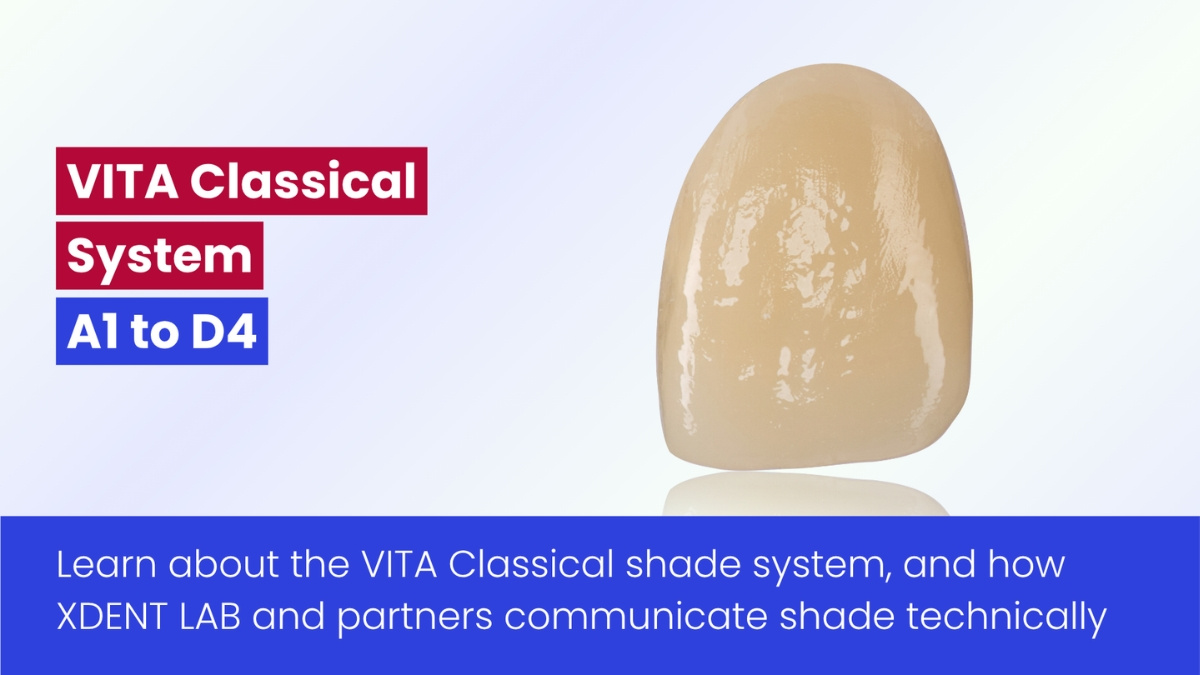
Table of contents [Show]
The VITA Classical A1 to D4 System
In restorative dentistry, choosing the wrong tooth shade is one of the most common reasons patients are unhappy, even when the restoration meets functional requirements. So that everyone can "speak the same color language," the dental industry worldwide uses the VITA Classical shade guide, commonly known as the A1 to D4 system.
This article provides practical knowledge about the VITA Classical A1 to D4 system, from distinguishing the shade groups to using shade information when communicating between clinics and dental labs. It focuses on the factors that affect shade determination, the limitations of a reference shade guide, and the information needed to convey aesthetic requirements in restorative dentistry.
What is VITA Classical?
VITA Classical is a tooth shade guide developed by VITA Zahnfabrik (Germany) and has been the most widely used reference standard in dentistry for decades. The guide contains 16 shades, each a small tooth sample attached to a handle, allowing dentists and technicians to compare directly with the patient's natural teeth.
The system's strength is its universality. Most manufacturers of denture teeth, ceramics and resins match their product shades to VITA Classical codes, so when a clinic sends the code "A2" to the lab, both sides understand the same target shade.
The 4 shade groups: A, B, C, D
The system divides the 16 shades into 4 groups by hue:
Group A: reddish brown tone. Includes A1, A2, A3, A3.5 and A4. This is the most commonly used group because it is close to the natural tooth color of most Asian and European people.
Group B: reddish yellow tone. Includes B1, B2, B3 and B4. Suitable for teeth with a slight, bright yellow tint.
Group C: gray tone. Includes C1, C2, C3 and C4. For teeth that tend toward gray, often seen in older adults or in teeth that have discolored over time.
Group D: reddish gray tone. Includes D2, D3 and D4. Note that this group has no D1.
In total: 5 shades in group A, 4 in group B, 4 in group C and 3 in group D, making 16 shades.
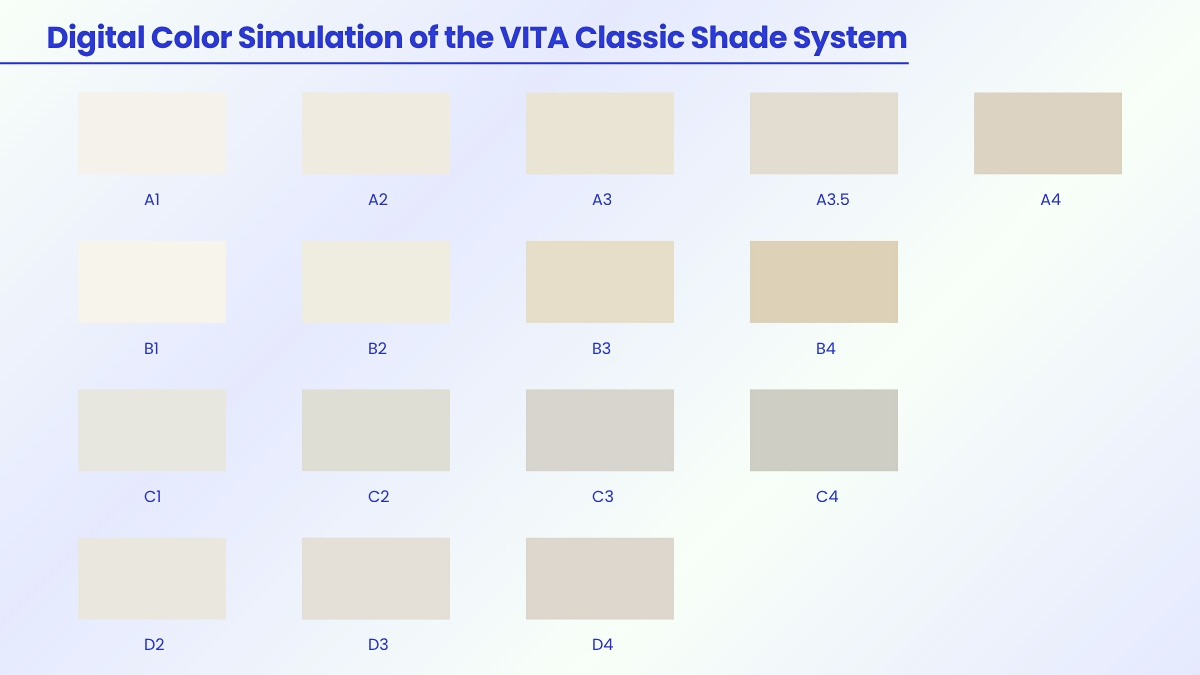
Below is a digital simulation of the VITA Classical A1 to D4 shade system, built from color data in experimental studies in digital dentistry.
The color values are referenced from real tooth color measurement data in the CIELAB (Lab*) color space and converted to RGB/HEX using standard algorithms for display on digital screens.
Note: VITA Zahnfabrik does not publish official HEX/RGB color codes for the VITA Classical A1 to D4 system. The digital simulation below is intended to illustrate the relative differences between shades in the system. The colors shown on screen are for reference only and do not represent official digital color codes published by VITA Zahnfabrik. Due to differences in screens, display conditions and color calibration, the image does not replace the physical shade guide or the shade determination process in dental practice.
How to read the notation: letter and number
Each code has two parts:
The letter (A, B, C, D) indicates the hue, meaning whether the tooth leans reddish brown, reddish yellow, gray or reddish gray.
The number (1 to 4) indicates the color saturation (chroma). The higher the number, the deeper and more intense the color. For example, A1 is lighter than A2, A2 is lighter than A3, and A4 is the deepest shade in group A.
A3.5 is an intermediate level between A3 and A4, added to meet the practical needs of teeth with a moderately deep color.
Value order: the secret to choosing shades quickly and accurately
One point beginners often overlook is that the shade guide is usually arranged by letter group, but value (brightness) is the factor the human eye is most sensitive to. For this reason, experienced technicians often rearrange the shade tabs from lightest to darkest as follows:
B1, A1, B2, D2, A2, C1, C2, D4, A3, D3, B3, A3.5, B4, C3, A4, C4
An effective shade selection process usually has two steps. Step one: choose the most suitable value by comparing the tabs in the order above. Step two: fine tune the hue and chroma within the chosen shade group. This approach reduces errors compared with choosing directly by letter group.
Points to note when selecting shades with VITA Classical
Lighting: Select shades under neutral daylight or a standard lamp with a color temperature of about 5500K. Yellow light or fluorescent lighting can distort color perception.
Viewing time: The eyes tire of color quickly. Look at the sample for no more than 5 seconds at a time, then look at a neutral gray color to rest the eyes.
Surroundings: Dark lipstick, brightly colored clothing or the surrounding background can affect how tooth color is perceived. Wipe off lipstick and use a neutral background when selecting shades.
Reference photos: Photographing the patient's teeth with the shade tab placed right next to them helps the lab capture the color more accurately, especially in long distance collaboration between clinic and lab.
Limitations of the system: VITA Classical has only 16 shades, while natural teeth have a much wider color spectrum. For cases requiring high accuracy, many dentists also use the VITA Toothguide 3D Master or the manufacturer's own shade guide.
These limitations are most apparent in patients with stained teeth or tetracycline discoloration. In such cases, the color on the tooth surface is uneven: there are darker and lighter areas, horizontal streaks, or different color accents at different locations. A single shade tab such as A2 or B3 can only describe an average hue, so it cannot accurately match all of this color variation.
Such cases usually demand high aesthetics and precise communication between dentist and lab. Instead of writing only one shade code on the prescription form, it is advisable to also include:
Standardized photographs: Take photos from multiple angles, with the shade tab placed next to the tooth, under the same lighting conditions. Polarized photos are also recommended to clearly show the color structure and surface characteristics of the tooth.
Shade mapping diagram: Draw or mark directly on the prescription form the cervical, body and incisal areas, with a shade code for each area.
Advanced shade measurement tools: Digital spectrophotometers or camera based shade matching systems record color more objectively than the naked eye.
Direct communication: For difficult cases, discuss by video or photos so the lab understands the aesthetic wishes of the patient and the dentist.
This approach helps the lab reproduce the individual characteristics of each tooth, limit color deviations and reduce the number of remakes.
Professional references
The content of this article refers to the VITA Classical A1 to D4 shade system developed by VITA Zahnfabrik, combined with professional principles of tooth shade selection and color communication in restorative dentistry. In practice, the information from the shade guide should be considered together with lighting conditions, the characteristics of the natural teeth and the specific requirements of each restorative case.
To ensure accuracy, readers should cross check the parameters and instructions against the manufacturer's official documents and consult a qualified professional when handling cases that require high color accuracy.
How does XDENT LAB communicate shade with partners for full zirconia restorations?
Full zirconia restorations are fabricated from a single solid block of zirconia, with no hand layered porcelain to fine tune the color. Therefore, the shade must be determined accurately from the start. At XDENT LAB, we use VITA Classical as the common color language with partner labs and clinics, then add photos and detailed prescription information so that the finished color matches the expectations of the dentist and the patient.
1. Agree on the shade code on the prescription form
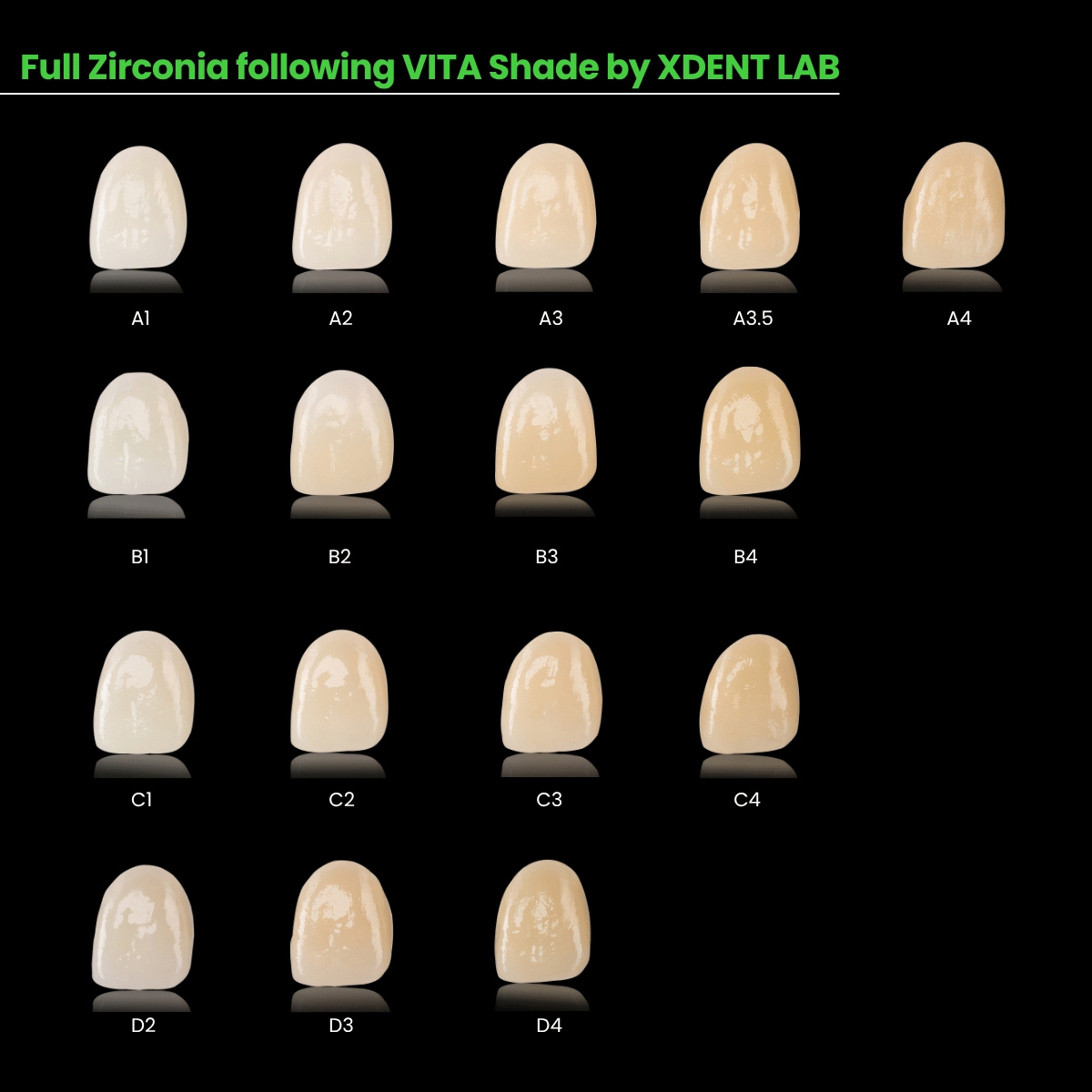
The partner clearly writes the desired VITA Classical shade code (for example A2, B1) and the tooth position on the prescription form. Most zirconia discs today convert their shades to VITA Classical, so this code helps us choose the right disc or the right staining formula. Below is a reference image of shades produced by XDENT LAB using Argen Z zirconia blanks.
2. Standard photos with a shade tab
We encourage partners to send photos of the patient's teeth with a VITA Classical shade tab placed right next to them, taken under the same lighting conditions and from multiple angles. Photos taken before preparation and photos of the prepared abutment help us evaluate both the target tooth shade and how much of the underlying color may show through the restoration. The more accurate the initial data, the higher the success rate of the case, and the smoother the working process.
3. Abutment shade information
For discolored abutments, we encourage partners to state the abutment shade clearly. Based on this information and the planned thickness of the restoration, we adjust the material type, add opaque color, or adjust translucency to limit the underlying color showing through.
4. Separate discussion for difficult cases
For cases with high aesthetic requirements, or with stained teeth, tetracycline discolored teeth, or uneven color with many color accents, a single VITA Classical code is not enough to describe the shade. In these cases, we encourage partners to also send:
Shade mapping notes for the cervical, body and incisal areas.
Polarized photos or data from a digital shade measuring device, if available.
Notes on features to be reproduced, such as horizontal streaks, spots or translucent areas.
5. Choosing the zirconia type and translucency
Depending on the tooth position and aesthetic requirements, XDENT LAB selects the appropriate zirconia type based on the translucency parameters provided by the zirconia manufacturer.
6. Confirmation before production and feedback after completion
For cases with high aesthetic requirements, we confirm the expectations through photos before production. After sintering, surface staining and glazing, we send photos of the finished restoration for the partner to check if requested. All color feedback is recorded for adjustment.
Thanks to this communication process, XDENT LAB reduces remakes and ensures stable aesthetic results.
The information in this article is provided for reference and to support shade communication in restorative dentistry. Decisions on material selection, technical specifications and restoration plans should be based on the specific condition of each case, professional indications and the manufacturer's instructions. XDENT LAB encourages partners to provide complete photos, shade information and technical requirements to support coordination between clinic and lab.
Conclusion
The VITA Classical A1 to D4 shade system is a common language that helps dentists, lab technicians and patients agree on restoration shade. When you understand the structure of the 4 shade groups, the meaning of the letters and numbers, and the value order, you can determine shade more efficiently and consistently. This contributes to higher fabrication accuracy, better coordination between clinic and lab, and lower risk of adjustments or remakes.
Your Trusted Partner for Dental Lab Outsourcing
Founded in 2017 in Ho Chi Minh City, Vietnam, XDENT LAB is a full service dental laboratory with two production facilities and a team of more than 100 staff. We offer a wide range of bridge and crown solutions, from PFM, e.max and layered zirconia to full contour zirconia, meeting many technical and aesthetic requirements of our partners.
For dental lab owners looking for outsourcing solutions, partnering with XDENT LAB is an opportunity to optimize operating costs, improve production efficiency and expand case capacity without a corresponding investment in staff or facilities. With a well organized production process and a dedicated customer service orientation (see also the XDENT LAB company culture), we aim to be a reliable manufacturing partner that helps your business grow sustainably.
As a member of the National Association of Dental Laboratories (NADL), XDENT LAB is proud to have served more than 50 B2B corporate clients in the United States. We understand that a good outsourcing partner does more than supply products; it also helps you control costs, maintain quality and grow your business with confidence.
Looking to scale your dental laboratory business with a reliable outsourcing partner?
Contact XDENT LAB today to discuss your production needs, explore suitable solutions and discover how we can support the growth of your business.
About XDENT LAB:
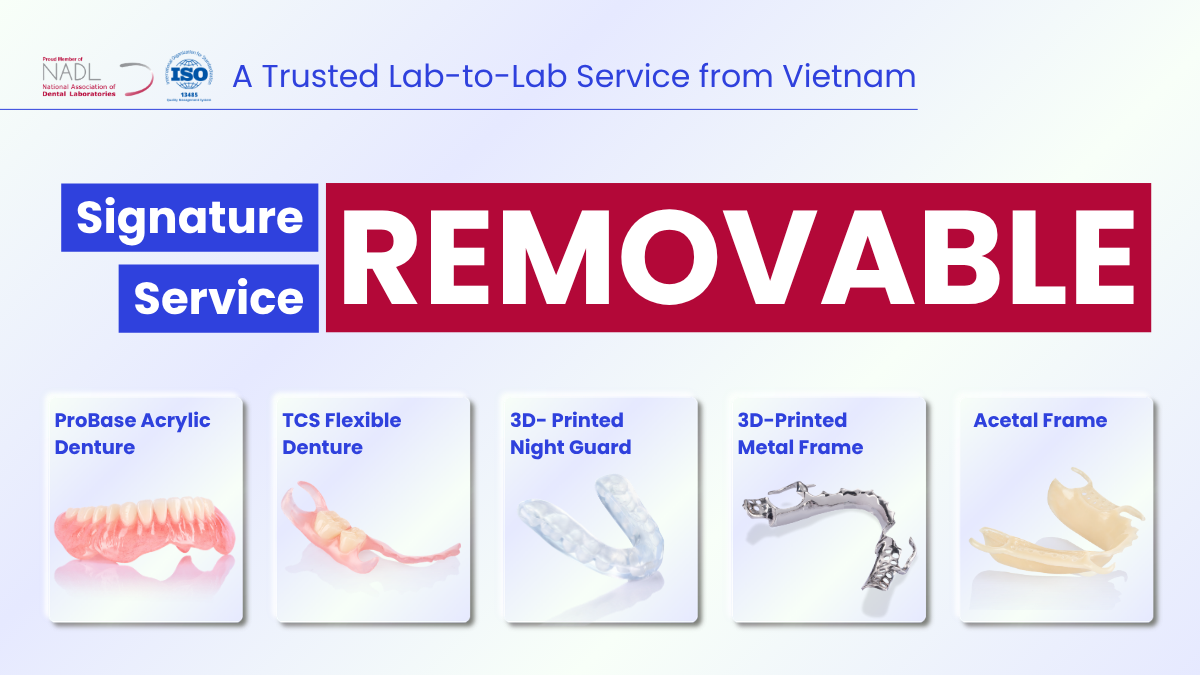
We are experts in Lab-to-Lab Full Service from Vietnam, with the signature services of Removable, meet U.S. market standards, FDA-registered, ISO 13485-certified. Founded in 2017, from local root to global reach, we scale with 2 Factories with over 100+ employees.
Our Commitments Built on “Trusted. Commitment. Quality”
- Commit to Large-Scale Manufacturing, high volume, remake rate < 1%.
- Commit to 5-Year Warranty
- Commit to Competitive Price
XDENT LAB | A Trusted Lab-to-Lab Service from Vietnam
Share this post:
Related Posts
See 5 Acrylic Partial Denture cases (cases 11 to 15) from XDENT LAB, a Vietnamese dental laboratory that is a member of the National Association of Dental Laboratories (NADL). XDENT LAB is an expert i...
Explore how independent dental labs support dentistry through custom restorations, digital workflows, quality control, and material traceability.
Learn how B2B dental labs improve quality and consistency for dental practices through digital workflows, material control, expert QC, and reliable turnaround.

