
Learn how B2B dental labs improve quality and consistency for dental practices through digital workflows, material control, expert QC, and reliable turnaround.
Table of contents [Show]
- What is a B2B dental lab
- B2B dental lab vs B2C dental provider
- Main B2B dental lab business models
- Products and services in the B2B dental lab industry
- Why dental practices use B2B dental labs
- Why dental labs outsource to other B2B labs
- Dental lab industry structure
- Digital transformation in B2B dental labs
- Materials used in B2B dental labs
- Quality management in B2B dental labs
- FDA considerations for dental laboratories serving the U.S.
- ISO 13485 in B2B dental laboratories
- Infection control and case handling
- Case communication between dentist and lab
- Logistics and turnaround time in B2B dental labs
- Pricing and cost structure in B2B dental labs
- White-label dental lab services
- Dental service organizations and B2B labs
- Technology stack of a modern B2B dental lab
- Quality control by product type
- Remake management in B2B dental labs
- International outsourcing in the B2B dental lab industry
- Vietnam as a B2B dental lab outsourcing destination
- Choosing a B2B dental lab partner
- Red flags when evaluating a B2B dental lab
- Data security in digital dental lab workflows
- B2B dental lab service level agreements
- Key performance indicators for B2B dental labs
- B2B dental lab market trends
- Future of the B2B dental lab industry
- Why this matters for XDENT LAB
- Key takeaways
A B2B dental lab is not simply a place where crowns or dentures are made. It is a technical manufacturing partner that supports dental practices, DSOs, implant centers, prosthodontic offices, orthodontic providers, and even other dental laboratories. In today’s dental industry, B2B dental labs operate at the intersection of clinical dentistry, CAD/CAM, materials science, compliance, digital workflows, logistics, and quality management.
For dental practices looking to ensure quality and consistency, the right B2B dental lab can directly influence remake rates, turnaround reliability, chairside adjustment time, case complexity management, and long-term restorative outcomes. That is why understanding the structure, role, and standards of a B2B dental lab matters far beyond price alone.
What is a B2B dental lab
A B2B dental laboratory provides dental prosthetic and orthodontic products to professional clients rather than directly to patients.
Its customers may include
- General dental practices
- Prosthodontists
- Oral surgeons
- Periodontists
- Implant clinics
- Orthodontic practices
- Dental service organizations
- Other dental laboratories
- Milling centers
- Digital design centers
- Clear aligner providers
- University dental clinics
- Hospital dental departments
The lab receives a prescription or digital case from a licensed clinician or partner laboratory, fabricates the device, performs quality control, and returns the restoration or appliance for clinical delivery.
In most markets, the dental laboratory does not diagnose or prescribe treatment. The dentist remains responsible for diagnosis, treatment planning, preparation design, impression or scan quality, final insertion, adjustment, and patient care.
B2B dental lab vs B2C dental provider
A B2B dental lab differs from a dental clinic because it functions as a manufacturing and technical support partner rather than a direct patient-care provider.
| Factor | B2B dental lab | Dental clinic / B2C provider |
|---|---|---|
| Primary customer | Dentists, clinics, DSOs, other labs | Patients |
| Main role | Fabrication of dental devices | Diagnosis and treatment |
| Patient contact | Usually none or limited | Direct |
| Prescription authority | Follows dentist prescription | Creates treatment plan |
| Core competency | Materials, CAD/CAM, fabrication, QC | Clinical care |
| Revenue model | Case-based, volume-based, contract-based | Patient treatment fees |
| Regulation focus | Medical-device manufacturing, traceability, lab standards | Clinical licensing, patient care, infection control |
A strong B2B dental lab does not replace the dentist. It extends the dentist’s technical capacity.
Main B2B dental lab business models
B2B dental labs can operate under several business models, and many modern labs combine more than one.
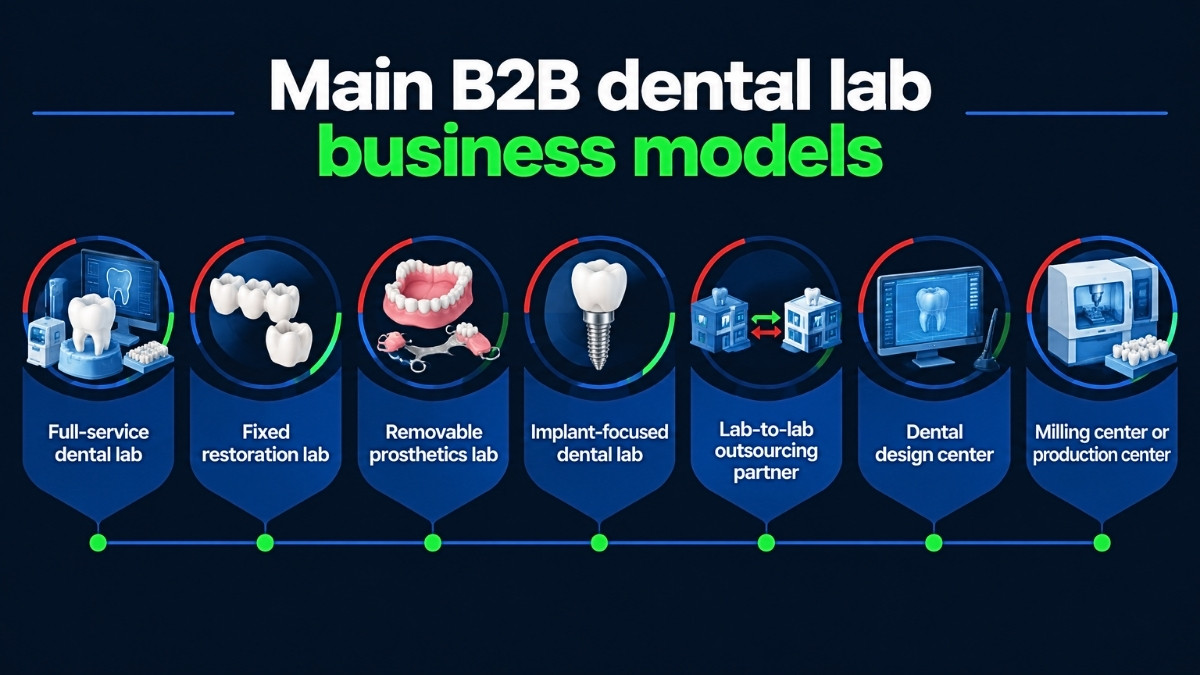
Full-service dental lab
A full-service dental lab offers a broad range of restorations and appliances.
Common services include
- Crowns and bridges
- Veneers
- Implant crowns
- Implant bridges
- Full-arch zirconia restorations
- Dentures
- Partial dentures
- Surgical guides
- Night guards
- Orthodontic appliances
- Clear aligner support
- Digital design
- Model printing
- Custom abutments
Fixed restoration lab
A fixed lab focuses on restorations such as crowns, bridges, veneers, inlays, onlays, and implant restorations.
Typical products include
- Monolithic zirconia crowns
- Layered zirconia crowns
- Lithium disilicate crowns
- PFM crowns
- Full-cast metal crowns
- Zirconia bridges
- Implant-supported crowns
- Screw-retained implant crowns
- Custom abutments
- Full-arch implant prostheses
Removable prosthetics lab
A removable lab specializes in removable prosthetic solutions.
Typical products include
- Complete dentures
- Immediate dentures
- Digital dentures
- Acrylic partial dentures
- Cast metal partial dentures
- Flexible partial dentures
- Implant overdentures
- Denture repairs
- Relines
- Duplicate dentures
Implant-focused dental lab
An implant-focused B2B lab handles implant prosthetics and related components.
Products include
- Custom titanium abutments
- Custom zirconia abutments
- Ti-base crowns
- Screw-retained crowns
- Implant bridges
- Hybrid dentures
- Full-arch zirconia bridges
- All-on-X prostheses
- Verification jigs
- Surgical guides
- Implant bars
Implant work requires careful control of
- Implant platform compatibility
- Scan body accuracy
- CAD library matching
- Screw channel design
- Passive fit
- Emergence profile
- Occlusal load
- Cleanability
- Screw and torque protocols
Lab-to-lab outsourcing partner
A lab-to-lab provider manufactures cases for other dental laboratories. This helps local or regional labs expand capacity, reduce production pressure, or offer products they do not make in-house.
Common outsourced services include
- CAD design
- Zirconia milling
- Metal framework production
- Removable fabrication
- Denture setup
- Implant components
- Full-arch production
- Night guards
- 3D printed models
- Surgical guides
- Finishing and staining
- Digital case planning
Dental design center
A design center may provide digital CAD design without full physical manufacturing.
Typical services include
- Crown design
- Bridge design
- Implant crown design
- Full-arch design
- Denture design
- Partial framework design
- Night guard design
- Surgical guide design
- Smile design support
Milling center or production center
A milling center focuses on manufacturing from digital files.
Products may include
- Zirconia crowns and bridges
- PMMA provisionals
- Wax patterns
- Titanium bars
- Custom abutments
- Ceramic units
- Metal frameworks
- Printed models and surgical guides
Products and services in the B2B dental lab industry
B2B dental labs support almost every major area of restorative and prosthetic dentistry.
Main product categories
| Category | Examples |
|---|---|
| Fixed prosthodontics | Crowns, bridges, veneers, inlays, onlays |
| Implant prosthetics | Implant crowns, abutments, bars, full-arch restorations |
| Removable prosthetics | Complete dentures, partial dentures, overdentures |
| Orthodontics | Retainers, expanders, aligner models, appliances |
| Occlusal appliances | Night guards, splints, sports guards |
| Digital services | CAD design, model printing, digital wax-ups |
| Surgical support | Surgical guides, diagnostic models |
| Provisional restorations | PMMA crowns, temporary bridges, printed provisionals |
| Repair services | Denture repair, additions, relines, remake support |
High-value B2B services
- Case planning support
- Digital file review
- Material recommendations
- Implant component verification
- Shade consultation
- Smile design support
- Rush case management
- Remake analysis
- Quality documentation
- Technical support for dentists
- Continuing education support
- Large-volume DSO workflows
For practices, the best lab partner is not just a supplier. It is a clinical-technical extension of the restorative workflow.
Why dental practices use B2B dental labs
Dental practices rely on dental labs because high-quality prosthetic fabrication requires specialized materials, equipment, and technical skill.
Main reasons
- Access to advanced CAD/CAM technology
- Consistent restoration quality
- Reduced in-house equipment costs
- Better material variety
- Specialized implant expertise
- Efficient turnaround times
- Support for complex cases
- Scalability for growing practices
- Reduced chairside adjustment time
- Reliable remake and warranty processes
Practice pain points solved by labs
| Practice challenge | How a B2B lab helps |
|---|---|
| Limited in-house production | Lab provides fabrication capacity |
| Complex implant cases | Lab supports digital planning and component matching |
| Inconsistent crown fit | Lab improves design, milling, and QC |
| Shade mismatch | Lab provides ceramic expertise and custom characterization |
| Delayed delivery | Lab offers predictable turnaround workflows |
| High remake rate | Lab identifies preparation, scan, and design issues |
| DSO growth | Lab supports volume and standardization |
Why dental labs outsource to other B2B labs
Many dental laboratories outsource part of their production to another lab. This is often a strategic capacity decision.
Reasons for lab-to-lab outsourcing
- Increase production capacity
- Reduce labor shortage pressure
- Access advanced technologies
- Offer products not made in-house
- Lower equipment investment
- Improve turnaround time
- Handle peak volume
- Support night-shift or overseas production
- Reduce unit cost
- Maintain customer relationships without refusing cases
Common outsourced work
- CAD design
- Zirconia crowns and bridges
- Implant custom abutments
- Denture processing
- Partial framework design
- Flexible partials
- Full-arch zirconia
- Surgical guides
- Night guards
- Model printing
- Wax-ups and temporaries
Dental lab industry structure
The dental lab industry includes multiple types of organizations with different capabilities, margins, and operating models.
| Participant | Role |
|---|---|
| Small local labs | Personalized service, local relationships |
| Regional labs | Broader capacity and product range |
| National labs | Large-scale production and logistics |
| Offshore labs | Cost-effective manufacturing and scalability |
| Milling centers | Digital production specialists |
| Design centers | CAD outsourcing partners |
| DSO-aligned labs | Standardized production for large dental groups |
| In-house clinic labs | Chairside or same-day restorations |
| Material manufacturers | Zirconia, ceramics, resins, alloys |
| Equipment suppliers | Scanners, mills, printers, furnaces |
| Software companies | CAD, CAM, case management, portals |
The industry has evolved from artisanal bench work into a hybrid model of craftsmanship plus digital manufacturing.
Digital transformation in B2B dental labs
Digital dentistry has fundamentally changed how B2B labs receive, design, manufacture, track, and remake cases.
Core digital technologies
- Intraoral scanners
- Desktop lab scanners
- CAD software
- CAM software
- 5-axis milling machines
- 3D printers
- Sintering furnaces
- Crystallization furnaces
- Implant planning software
- Cloud-based case portals
- Digital shade systems
- AI-supported design tools
- Manufacturing management software
Typical digital workflow
Digital prescription
→ Intraoral scan upload
→ File review
→ CAD design
→ Dentist approval if needed
→ CAM nesting
→ Milling or printing
→ Sintering / curing / crystallization
→ Finishing / staining / glazing
→ Quality control
→ Packaging
→ Delivery
Benefits of digital workflows
- Faster case intake
- Fewer physical shipping steps
- Digital file traceability
- Repeatable design parameters
- Easier remakes
- Better production scheduling
- Improved scalability
- Reduced model dependency
- Efficient implant library integration
- Better communication with clinicians
Digital workflow risks
- Poor scan quality
- Incomplete margin capture
- Bite registration errors
- Incorrect case prescription
- Wrong implant library
- Data security issues
- Software compatibility problems
- File distortion or version errors
- Over-reliance on automated design
- Insufficient human QC
Digital dentistry improves speed and reproducibility, but skilled technicians and disciplined QC still decide whether the final result works clinically.
Materials used in B2B dental labs
Dental labs must understand material behavior because each material responds differently during design, processing, finishing, and clinical function.
| Material | Common uses | Key considerations |
|---|---|---|
| Zirconia | Crowns, bridges, implant restorations | Sintering, thickness, connector design, polishing |
| Lithium disilicate | Crowns, veneers, onlays | Etching, bonding, thickness, crystallization |
| Feldspathic porcelain | Veneers, layering ceramics | Esthetics, technique sensitivity |
| PMMA | Provisionals, denture bases | Temporary use, polish, fracture risk |
| Denture acrylic resin | Complete and partial dentures | Polymerization, fit, esthetics |
| Cobalt-chromium alloy | Partial frameworks, metal frameworks | Casting or milling, polishing, biocompatibility |
| Titanium | Implant bars, abutments | Milling, passivity, surface control |
| PEEK / PEKK | Frameworks, implant prosthetics | Indication-specific, bonding challenges |
| Flexible nylon resin | Flexible partial dentures | Fit, repair limitations |
| Composite resin | Temporary restorations, repair | Wear, polish, bonding |
| 3D printing resin | Models, guides, temporaries, dentures | Validation, curing, biocompatibility |
| Wax | Patterns, try-ins | Burnout behavior, dimensional stability |
Material selection factors
- Indication
- Esthetic demand
- Occlusal force
- Span length
- Implant or tooth support
- Available restorative space
- Bonding conditions
- Dentist preference
- Patient allergies
- Regulatory approval
- Manufacturer instructions for use
Quality management in B2B dental labs
Quality management is one of the clearest differences between a basic production lab and a truly competitive B2B dental lab.
Why quality systems matter
- Safe
- Biocompatible
- Fit for intended use
- Traceable
- Manufactured from approved materials
- Made according to prescription
- Inspected before release
- Properly documented
Common quality management elements
- Written SOPs
- Case intake verification
- Prescription review
- Material lot tracking
- Equipment calibration
- Technician training records
- In-process inspections
- Final QC checklist
- Nonconformance reporting
- Remake tracking
- Corrective and preventive action
- Supplier qualification
- Infection-control procedures
- Documentation retention
- Complaint handling
Important international standards
| Standard / framework | Relevance to dental labs |
|---|---|
| ISO 13485 | Quality management system for medical devices |
| ISO 14971 | Risk management for medical devices |
| ISO 10993 series | Biological evaluation of medical devices |
| ISO 7405 | Biocompatibility evaluation of dental materials |
| ISO 6872 | Dental ceramic materials |
| ISO 22674 | Metallic materials for fixed and removable restorations |
| ISO 22112 | Artificial teeth for dental prostheses |
| ISO 20795 series | Denture base polymers and orthodontic base polymers |
| FDA 21 CFR requirements | U.S. medical device regulatory framework |
| EU MDR | European medical device regulation |
| Manufacturer IFU | Required processing instructions |
A lab serving international clients must treat documentation as part of the product, not as paperwork floating around after lunch.
FDA considerations for dental laboratories serving the U.S.
For the U.S. market, dental laboratories may fall under FDA medical device regulations depending on their products and activities.

Important concepts
Dental prostheses such as crowns, bridges, dentures, and orthodontic appliances are generally considered medical devices. Many are custom-made or prescription devices produced for a specific patient.
Key regulatory considerations
- Use of FDA-cleared or legally marketed materials
- Compliance with applicable device requirements
- Proper labeling
- Traceability
- Medical device reporting when applicable
- Quality system expectations
- Import requirements for foreign manufacturers
- Registration and listing where applicable
- Good documentation practices
FDA-relevant documentation
- Dentist prescription
- Patient or case identifier
- Device type
- Material name
- Material manufacturer
- Lot or batch number
- Manufacturing date
- Technician or production record
- Final inspection record
- Shipping record
- Complaint or remake record
- Cleaning or disinfection protocol
- Device labeling where required
ISO 13485 in B2B dental laboratories
ISO 13485 helps formalize how a medical device organization controls quality across documentation, production, traceability, and improvement.
Areas formalized by ISO 13485
- Document control
- Record control
- Management responsibility
- Resource management
- Production control
- Supplier control
- Risk management
- Product identification
- Traceability
- Customer communication
- Complaint handling
- Corrective actions
- Preventive actions
- Internal audits
- Continual improvement
Benefits for B2B clients
- Consistency
- Lower remake rates
- Better accountability
- Clearer traceability
- More predictable delivery
- Safer material handling
- Better compliance readiness
ISO certification does not guarantee perfection, but it strongly supports repeatable processes and disciplined quality control.
Infection control and case handling
Dental labs handle impressions, models, appliances, and prostheses that may be contaminated. Infection-control protocols are a basic operational requirement.
Infection-control requirements
- Receiving and disinfecting impressions
- Handling intraoral appliances
- Separating clean and contaminated areas
- PPE use
- Surface disinfection
- Equipment cleaning
- Packaging outbound restorations
- Communication with clinics
- Handling returned cases
- Waste management
Digital workflow advantage
Digital scans reduce handling of contaminated impressions and physical models, which can lower infection-control risk. Physical appliances, dentures, and try-ins still require controlled handling.
Case communication between dentist and lab
Many lab errors begin as communication gaps rather than manufacturing defects.
Essential case information
- Patient identifier
- Dentist name and practice
- Tooth numbers
- Restoration type
- Material
- Shade
- Stump shade if relevant
- Margin design
- Occlusal scheme
- Contact preference
- Pontic design
- Implant system and platform
- Abutment type
- Screw-retained or cement-retained preference
- Photos for anterior cases
- Desired turnaround time
- Special instructions
Digital case files may include
- STL files
- PLY files with color
- OBJ files
- DICOM files for implant planning
- Smile design files
- Photos
- Bite scans
- Face scans
- Jaw motion data
- CAD preview
- Lab communication notes
Communication practices that reduce remakes
- Standardized prescription forms
- Photos for esthetic cases
- Implant platform confirmation before design
- Early margin review
- Design previews for complex cases
- Remake reason tracking
- Dentist-specific preferences
- Digital case history
Logistics and turnaround time in B2B dental labs
B2B dental labs must manage manufacturing and logistics together. A beautiful restoration arriving late still causes a problem.
Key operational metrics
- Case intake time
- Design turnaround time
- Production time
- Remake rate
- On-time delivery rate
- Rush case capacity
- Shipping damage rate
- Communication response time
- Material inventory accuracy
- Case rejection rate due to poor records
- Chairside adjustment feedback
Turnaround depends on
- Product type
- Case complexity
- Material
- Digital versus physical impression
- Need for model
- Try-in steps
- Implant component availability
- Shipping distance
- QC procedures
- Dentist approval delays
Typical workflow complexity
| Case type | Typical workflow complexity |
|---|---|
| Single zirconia crown | Low to moderate |
| Three-unit bridge | Moderate |
| Anterior layered crown | Moderate to high |
| Implant crown | Moderate to high |
| Full denture | High |
| Cast partial | High |
| Full-arch implant restoration | Very high |
| Surgical guide | High planning sensitivity |
Speed matters, but speed without control is just a faster remake.
Pricing and cost structure in B2B dental labs
Dental lab pricing depends on far more than material alone.
Cost drivers
- Technician labor
- CAD design time
- Material cost
- Milling machine time
- 3D printer time
- Furnace cycles
- Implant components
- Quality control
- Remake allowance
- Packaging
- Shipping
- Regulatory documentation
- Software licenses
- Equipment maintenance
- Training
- Overhead
Pricing models
| Pricing model | Description |
|---|---|
| Per-unit pricing | Common for crowns, bridges, implant units |
| Case-based pricing | Used for full dentures, full-arch cases |
| Tiered pricing | Different rates by volume or product level |
| Subscription design services | Monthly CAD design support |
| DSO contract pricing | Negotiated based on volume |
| Rush surcharge | Faster production at added cost |
| Component pass-through | Implant parts billed separately |
| White-label pricing | Used in lab-to-lab partnerships |
A low unit price is not always a low total cost. Remakes, delays, and chairside adjustment can make cheap work surprisingly expensive.
White-label dental lab services
White-label work means one lab manufactures products that another lab sells under its own brand.
Common white-label services
- Crown and bridge production
- Zirconia milling
- Denture fabrication
- Implant restorations
- CAD design
- Surgical guides
- Night guards
- Orthodontic appliances
Benefits
- Expands services without new equipment
- Supports scaling
- Reduces staffing pressure
- Helps manage seasonal volume
- Provides access to specialized skills
- Maintains client relationships
Risks
- Inconsistent quality if standards are unclear
- Communication gaps
- Hidden remake costs
- IP or design ownership confusion
- Material substitution risk
- Shipping delays
- Regulatory documentation gaps
- Brand reputation risk
Dental service organizations and B2B labs
DSOs are major buyers in the dental lab industry and typically require consistency at scale.
What DSOs need from labs
- Scalable production
- Standardized quality
- Fast turnaround
- Digital case portals
- Multi-location support
- Centralized billing
- Performance reporting
- Remake analytics
- Consistent product menus
- Training for doctors and staff
- Support for new doctors
Lab requirements for DSO contracts
- High production capacity
- Strong customer service
- Clear SLAs
- Quality reporting
- Digital workflow support
- Standardized RX protocols
- Reliable logistics
- Account management
- Compliance documentation
- Ability to handle high-volume revisions or remakes
DSO work rewards repeatability. One excellent case is nice. One thousand consistent cases is the real test.
Technology stack of a modern B2B dental lab
A competitive B2B lab usually runs on an integrated technology ecosystem.
Hardware
- Desktop scanners
- Intraoral scanner integrations
- CAD workstations
- Milling machines
- 3D printers
- Sintering furnaces
- Porcelain furnaces
- Curing units
- Laser welders
- Steam cleaners
- Microscopes
- Articulators
- Shade-matching devices
Software
- CAD design software
- CAM nesting software
- Implant planning software
- Case management software
- CRM
- ERP or production management system
- Digital prescription portal
- File storage system
- QC documentation system
- Shipping and tracking integration
Digital capabilities
- STL, PLY, OBJ handling
- Intraoral scan intake
- Cloud case review
- Digital wax-up
- AI-assisted margin detection
- Design approval workflows
- Digital denture design
- Surgical guide planning
- Full-arch verification workflow
The modern lab is part dental studio, part precision factory, and part software operation.
Quality control by product type
Different product categories require different QC priorities.
Crowns and bridges
- Marginal fit
- Internal fit
- Contact strength
- Occlusion
- Anatomy
- Shade
- Surface polish
- Material thickness
- Connector dimensions
- Cement space
Dentures
- Base adaptation
- Occlusion
- Vertical dimension
- Tooth arrangement
- Esthetics
- Phonetics
- Polish
- Border extension
- Tissue surface quality
- Midline and smile line
Implant restorations
- Platform accuracy
- Scan body match
- CAD library selection
- Passive fit
- Screw access
- Emergence profile
- Ti-base bonding
- Screw seating
- Occlusion
- Cleanability
Surgical guides
- DICOM/STL alignment
- Sleeve position
- Guide seating
- Offset parameters
- Drill system compatibility
- Material curing
- Sterilization compatibility
- Case labeling
Remake management in B2B dental labs
Remakes are one of the most useful indicators of partnership performance.
Common causes of remakes
- Poor impression or scan
- Margin not visible
- Incorrect shade
- Bite registration error
- Wrong material selected
- Wrong tooth number
- Incorrect implant component
- Contact too tight or open
- Crown does not seat
- Fracture
- Patient dissatisfaction
- Lab production error
- Communication gap
Remake prevention methods
- Clear RX forms
- Digital file review before production
- Dentist-specific preferences
- Case photos
- Standardized margin feedback
- Implant verification protocols
- Pre-production design approval for complex cases
- QC before shipping
- Root-cause analysis
Remake tracking categories
| Category | Examples |
|---|---|
| Clinical input issue | Poor scan, unclear margin, wrong bite |
| Prescription issue | Wrong material, missing shade, unclear instructions |
| Lab production issue | Fit, shade, fracture, contact problem |
| Logistics issue | Damage, delay, lost case |
| Patient factor | New shade request, changed treatment plan |
A mature B2B lab does not just remake cases. It studies why they happened and adjusts the system.
International outsourcing in the B2B dental lab industry
International outsourcing is common, especially for design, milling, removable prosthetics, and high-volume production.
Why outsource internationally
- Lower labor cost
- Access to skilled technicians
- Scalable production capacity
- Extended production hours
- Specialized product lines
- Competitive pricing
- Support for overflow cases
Common outsourcing destinations
- Vietnam
- China
- Philippines
- Thailand
- India
- Eastern Europe
- Mexico
Key success factors
- FDA and ISO compliance
- Material traceability
- Clear communication
- Case portal
- English-speaking technical support
- Consistent turnaround
- Secure file transfer
- Strong QC system
- Transparent remake policy
- Reliable shipping
- Stable production capacity
For U.S. practices and labs, an offshore partner should be evaluated on compliance, quality, communication, and consistency, not price alone.
Vietnam as a B2B dental lab outsourcing destination
Vietnam has become an increasingly attractive destination for dental lab outsourcing because of its technical workforce, competitive production cost, and growing adoption of digital workflows.
Advantages of Vietnam dental labs
- Competitive production cost
- Skilled manual technicians
- Growing CAD/CAM capability
- Strong removable and implant prosthetic production
- Scalable labor force
- Favorable time-zone workflow for overnight production
- Increasing focus on international standards
- Experience serving U.S., Australian, and European markets
Important evaluation criteria
- FDA registration or relevant U.S. compliance status where applicable
- ISO certification
- Material brands and lot traceability
- Production capacity
- Technician training
- QC procedures
- Digital workflow compatibility
- Implant system support
- Remake policy
- Turnaround time
- Data security
- Shipping process
- Communication quality
Vietnam dental labs can be strong B2B partners when they combine cost efficiency with documented quality systems and international-standard production.
Choosing a B2B dental lab partner
The best B2B dental lab partner supports both clinical outcomes and business efficiency.
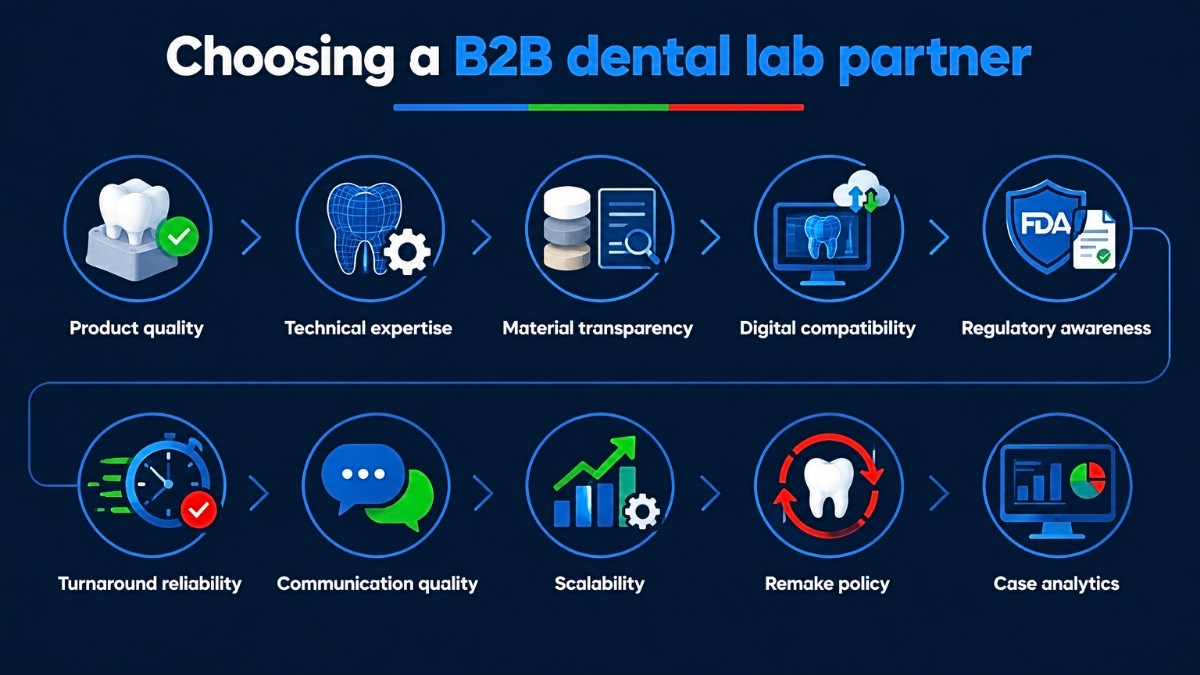
Key selection criteria
Product quality
Accurate fit, proper contacts, occlusion, esthetic morphology, smooth surfaces, and material-appropriate strength.
Technical expertise
Knowledge of fixed prosthodontics, removable prosthetics, implant systems, digital workflows, occlusion, and material limitations.
Material transparency
Clear disclosure of material brands, manufacturers, indications, lot numbers, and processing protocols.
Digital compatibility
Support for STL, PLY, OBJ, DICOM, clinical photos, bite scans, and scanner workflows.
Regulatory awareness
Understanding of FDA expectations, ISO systems, traceability, documentation, and import-export responsibilities.
Turnaround reliability
Predictable schedules and early communication when delays arise.
Communication quality
Fast, technically competent response when margins, bites, implant platforms, or prescriptions are unclear.
Scalability
Ability to increase volume without quality collapse.
Remake policy
Clear definitions for responsibility, timing, shipping, and documentation.
Case analytics
Reporting on remake causes, volume, on-time delivery, material usage, and dentist-specific preferences.
Red flags when evaluating a B2B dental lab
Not every low-cost or high-volume lab is a reliable long-term partner.
| Red flag | Why it matters |
|---|---|
| No material traceability | Difficult to verify safety, compliance, or remake causes |
| No clear QC process | Quality becomes technician-dependent and inconsistent |
| Unclear remake policy | Disputes increase and accountability decreases |
| Frequent shade mismatch | Weak communication or ceramic workflow |
| Poor implant component knowledge | High risk of wrong platform or poor fit |
| No documented disinfection protocol | Infection-control risk |
| Inconsistent turnaround | Disrupts patient scheduling |
| Unwillingness to share material brands | Possible substitution risk |
| No digital file review | Poor scans may proceed without warning |
| Weak customer support | Small issues become repeated failures |
| No certification or quality framework | Harder to trust international production |
| Overpromising all product lines | May outsource without transparency |
A serious B2B lab should welcome technical questions. If every answer sounds too smooth, inspect the details more closely.
Data security in digital dental lab workflows
Digital dentistry has made case transfer faster, but it also created new responsibilities around privacy and file control.
Data often shared with labs
- Patient name or identifier
- Tooth numbers
- Clinical photographs
- Intraoral scans
- CBCT or DICOM files
- Implant planning files
- Bite records
- Treatment notes
- Dentist preferences
- Billing and shipping details
Data security best practices
- Secure case portal
- Role-based access control
- Encrypted file transfer
- Restricted download permissions
- Regular data backups
- Case version control
- Audit trail
- Staff confidentiality training
- Limited patient-identifiable information
- Defined data retention policy
For international outsourcing, data security should be treated as part of lab quality, not just an IT side quest.
B2B dental lab service level agreements
An SLA helps dental practices, DSOs, and partner labs define expectations clearly.
SLA elements
- Product menu
- Turnaround time by product
- Digital file acceptance rules
- Physical case shipping rules
- Rush case policy
- Cut-off times
- Remake policy
- Warranty policy
- Material brands
- Communication channels
- QC documentation
- Billing terms
- Packaging standards
- Confidentiality terms
- Outsourcing disclosure
- Escalation process
Example SLA table
| Service area | Standard expectation |
|---|---|
| Digital case acknowledgment | Same business day |
| Case issue notification | Before production |
| Single crown turnaround | Defined by lab workflow and shipping route |
| Implant case verification | Required before design or manufacture |
| Complex case approval | Design preview before production |
| Remake review | Root-cause category assigned |
| Material traceability | Available upon request |
| Shipping tracking | Provided for outbound cases |
| Technical support | Defined business hours and response time |
An SLA does not create quality by itself, but it makes performance measurable.
Key performance indicators for B2B dental labs
B2B dental labs should measure performance using practical operational KPIs.
| KPI | What it measures |
|---|---|
| On-time delivery rate | Reliability of production and logistics |
| Remake rate | Overall quality and communication performance |
| Adjustment feedback rate | Chairside efficiency |
| Case rejection rate | Quality of incoming records and lab screening |
| Average turnaround time | Production efficiency |
| Rush case completion rate | Flexibility under pressure |
| Material nonconformance rate | Material control |
| Equipment downtime | Production stability |
| Complaint resolution time | Customer service quality |
| Digital case percentage | Workflow adoption |
| Implant component error rate | Implant workflow accuracy |
| Shade remake rate | Esthetic workflow quality |
Without measurement, labs depend on opinions. With measurement, they can improve workflows, training, material selection, and communication systematically.
B2B dental lab market trends
The dental lab industry is changing quickly, and the labs that grow are adapting to stronger digital, operational, and compliance expectations.
Major trends
Digital case submission growth
Intraoral scanning continues to reduce reliance on physical impressions.
CAD/CAM standardization
Labs increasingly rely on design libraries, validated parameters, and template-based production.
Zirconia dominance
Monolithic and multilayer zirconia remain major materials for crowns, bridges, and implant prosthetics.
Growth of digital dentures
Denture workflows are moving toward CAD design, milled bases, printed try-ins, and digital record storage.
3D printing expansion
Printing is increasingly used for models, guides, splints, denture workflows, and temporaries.
DSO-driven standardization
Larger buyers require portals, reporting, scalable production, and consistent product menus.
Lab consolidation
Larger groups acquire smaller labs to gain market share, technology, and logistics reach.
Offshore and nearshore outsourcing
Labs continue using external partners for design, milling, removable work, and overflow production.
AI-assisted design
AI tools are increasingly used for margin detection, crown proposals, occlusal suggestions, and production triage.
Compliance pressure
Documentation, traceability, data security, and validated materials are under stronger scrutiny.
Future of the B2B dental lab industry
The future B2B dental lab will be more digital, more standardized, and more integrated with clinical workflows.
Likely future directions
- More cloud-based lab portals
- More AI-assisted CAD design
- More automated nesting and manufacturing
- More validated 3D-printed definitive materials
- More digital denture adoption
- More full-arch implant workflows
- More DSO-lab integration
- More chairside-lab hybrid workflows
- More compliance documentation demand
- More traceability at case and material level
- More technician specialization
- More international lab-to-lab partnerships
What will still require human expertise
- Esthetic judgment
- Complex occlusion
- Full-arch design
- Implant emergence profile
- Denture tooth arrangement
- Gingival characterization
- Material-specific finishing
- Solving unclear clinical data
- Communication with dentists
- Final QC decisions
Technology changes tools. It does not remove the need for judgment.
Why this matters for XDENT LAB
This topic aligns directly with XDENT LAB’s role as a Vietnam dental lab and lab-to-lab outsourcing partner serving professional clients who need quality, consistency, and compliance.
Strategic relevance for XDENT LAB
- Lab-to-lab full service for growing practices and partner labs
- Strength in removable and implant workflows
- Support for U.S. market standards
- Value through FDA and ISO-aligned quality expectations
- Capacity through multiple factories and over 100 employees
- Technical support for scalable outsourcing relationships
For dental practices and partner labs, this matters because the choice of lab partner affects not only restoration cost, but also clinical consistency, remake frequency, case acceptance confidence, delivery reliability, documentation readiness, and long-term partnership value.
A strong B2B dental lab does more than fabricate restorations. It protects the reputation and efficiency of the clinics and labs that depend on it.
Key takeaways
A B2B dental lab is a professional manufacturing and technical service partner that serves dentists, DSOs, clinics, and other dental laboratories rather than individual patients. Its role extends across fixed restorations, removable prosthetics, implant solutions, digital design, materials science, logistics, compliance, and quality management.
The most important principles are
- B2B dental labs manufacture prescription dental devices, not treatment plans
- Digital dentistry has transformed how cases are received, designed, produced, and tracked
- Quality systems such as traceability, SOPs, and final QC are essential
- Compliance matters, especially for international and U.S.-focused partnerships
- Lab-to-lab outsourcing is a major strategic model in the industry
- Material science directly affects clinical performance and manufacturing reliability
- Communication prevents remakes and improves chairside efficiency
- Data security is now part of lab quality
- The best B2B labs combine craftsmanship, technology, service, and documentation
- Future-ready labs are scalable, digital, quality-driven, and clinically collaborative
A successful B2B dental lab does more than make restorations. It delivers consistent, traceable, clinically usable products that help partner practices and laboratories perform with greater confidence.
About XDENT LAB:
We are experts in Lab-to-Lab Full Service from Vietnam, with the signature services of Removable, meet U.S. market standards, FDA-registered, ISO 13485-certified. Founded in 2017, from local root to global reach, we scale with 2 Factories with over 100+ employees.
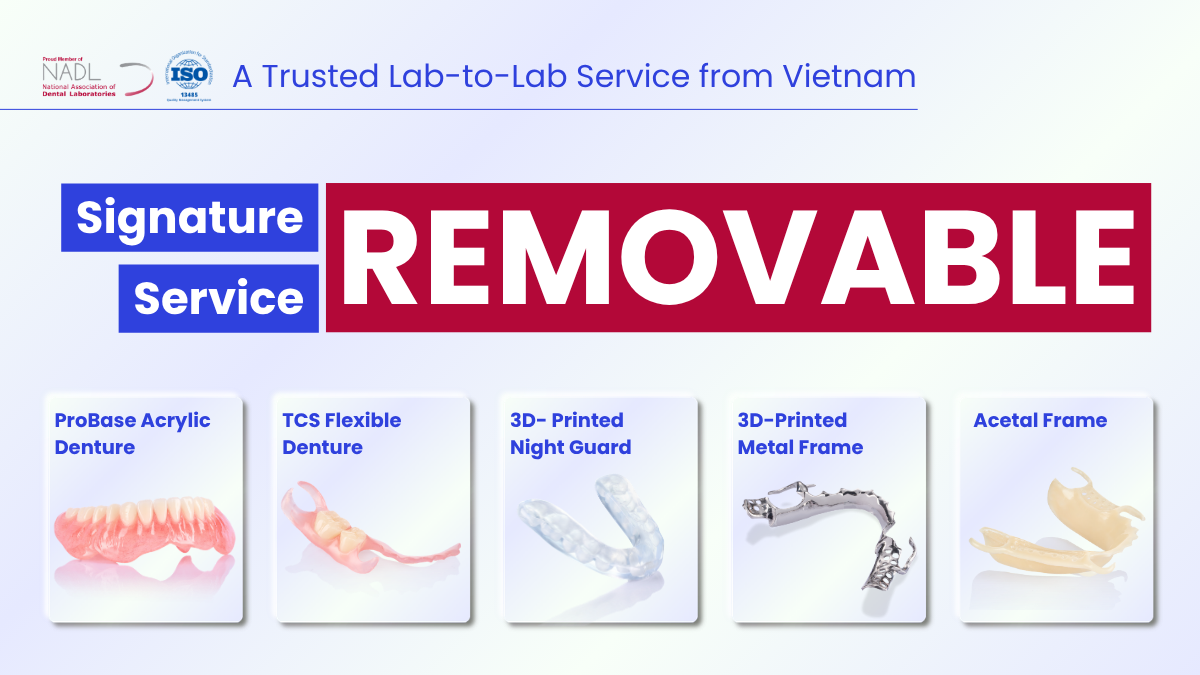
Our Commitments Built on “Trusted. Commitment. Quality”
- Commit to Large-Scale Manufacturing, high volume, remake rate < 1%.
- Commit to 5-Year Warranty
- Commit to Competitive Price
XDENT LAB | A Trusted Lab-to-Lab Service from Vietnam
Share this post:
Related Posts
Learn how the dental lab subcontract model helps labs expand capacity, manage workloads, access technology, and maintain quality in outsourced production.
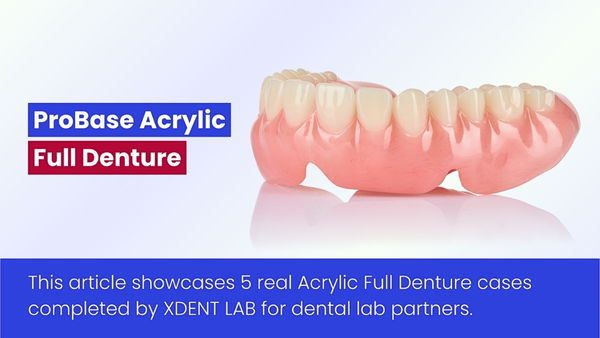
See 5 completed Acrylic Full Denture cases from XDENT LAB, a Vietnamese dental laboratory serving worldwide, especially US, Europe, and Australia. Trusted oversea outsourcing dental laboratory partner...
Explore the complete digital lab workflow for modern dental laboratories, from scan intake and CAD design to milling, finishing, quality control, and delivery.

