
True cost of dental labs: benchmark prices, remake rates, chairside time, and regulatory impacts. Use a risk‑adjusted framework to improve profitability.

Table of contents [Show]
- Overview
- Economic Framework and Pricing
- Quality, Fit, and Hidden Costs
- Operations: Time, Logistics, and Communication
- Regulatory and Compliance
- Financial Risk and Continuity
- Technology and Quality Control Investments
- Labor Markets and Productivity
- Total Cost of Ownership (TCO) and ROI
- Case Patterns: Small vs Large Practices
- Market Trends and Projections
- Strategic Decision Framework
- Best Practices for Cost Optimization
- XDENT LAB Perspective
- Recommendations
Overview
Globalization has expanded sourcing options for dental laboratories, but true economics hinge on total cost of ownership, not unit price alone. Domestic labs often deliver advantages in quality consistency, turnaround speed, and regulatory compliance. Offshore labs typically win on headline price and volume scalability. A risk-adjusted hybrid sourcing model with clear quality assurance and vendor governance helps practices optimize cost without compromising clinical outcomes.
Economic Framework and Pricing
This section outlines cost structures and benchmark prices so practices can compare models consistently.
Cost Structure Analysis
Domestic laboratory components: Labor 40–60%; Materials 20–30%; Overhead 15–25%; Equipment depreciation 5–10%; Regulatory compliance 3–5%; Profit margins 10–20%.
Offshore laboratory components: Labor 15–25%; Materials 25–35%; Shipping/logistics 10–15%; Import duties 5–10%; Currency exchange variable; Communication 2–3%.
Comparative Pricing (Per Unit)
Crown and Bridge: US $150–350; Europe €120–280; Asia $50–120; Latin America $60–140.
Removable Prosthetics: Full denture domestic $200–400; Offshore $80–150. Partial denture domestic $250–450; Offshore $100–200.
Key takeaway: Offshore pricing averages 40–60% lower, but downstream quality and logistics costs can erode savings.
Quality, Fit, and Hidden Costs
Quality drives remake rates, chairside time, and patient experience—major multipliers in real cost.

Quality Metrics
Fit and accuracy: Domestic first-fit success 95–98%; Offshore 85–92%. Remake rates: Domestic 2–5%; Offshore 8–15%.
Material standards: Domestic ensures FDA-approved materials, full traceability, and comprehensive biocompatibility documentation; Offshore varies by provider.
Hidden Cost Drivers
Remake expenses: additional lab fees and clinician time.
Chairside adjustments: typically $100–300/hour.
Patient dissatisfaction: reappointments and potential churn.
Reputation damage: reduced referrals and long-term impact.
Legal liability: device/material nonconformance risks.
Additional quality control: incoming inspection and documentation reviews.
In practice, a 10% increase in remakes can erase most offshore savings for premium or time-sensitive cases.
Operations: Time, Logistics, and Communication
Operational friction increases real costs and clinical risk, especially across borders.
Turnaround Time
Domestic standard: 5–10 business days; rush: 2–3 business days.
Offshore standard: 10–20 business days; express: 7–10 business days.
Shipping delays: international transit can add 2–5 days.
Logistics Costs
Domestic shipping: $10–30 per case.
International shipping: $40–100 per case.
Customs clearance, insurance, tracking: higher and more complex offshore.
Communication Factors
Time zone differences: 8–12 hour lag common.
Language and terminology: misinterpretation risk.
Design modifications: slower cycles and delayed responses.
Emergency cases: limited immediate availability offshore.
Operational takeaway: Domestic labs reduce latency and variability; offshore efficiency depends on mature workflows and clear protocols.
Regulatory and Compliance
Compliance protects patients and practices and carries direct and indirect costs.

Domestic Requirements
FDA registration, state licensing, OSHA, HIPAA.
ISO/CDT certifications; professional liability insurance.
Annual compliance costs: $5,000–15,000; certification maintenance: $3,000–8,000; training: $2,000–5,000; documentation systems: $1,000–3,000; audit preparation: $2,000–4,000.
Offshore Challenges
Variable standards enforcement and oversight.
Certification authenticity verification.
Import and medical device regulation complexity.
Cross-border liability and jurisdiction risks.
Provider note: FDA/ISO alignment and documentation discipline mitigate compliance risks while enabling predictable audits and traceability.
Financial Risk and Continuity
International sourcing introduces currency, payment, and continuity risks that must be priced in.
Currency and Economic Risks
Exchange rate fluctuations: ±10–20% annually.
Payment processing fees: 2–4%; international wire transfers: $25–50 per transaction.
Currency hedging: optional cost for protection.
Economic instability: country-specific risks.
Business Continuity Risks
Supply chain disruptions: disasters, strikes, pandemics, political instability, trade disputes.
Financial risks: vendor insolvency, payment disputes, contract violations, insurance gaps, legal jurisdiction issues.
Mitigation: Multi-vendor strategies, SLAs, escrow/payment terms, and contingency inventory buffers.
Technology and Quality Control Investments
Digital maturity and QC tools lower total cost and reduce defects.
Digital Workflow Integration
CAD/CAM compatibility, secure file transfer, design licenses, training, and always-on technical support.
Domestic labs: higher technology adoption, predictable upgrades and integration costs.
Offshore labs: variable levels; integration speed and reliability can vary.
Quality Control Technology
Digital scanners for accuracy verification.
Measurement systems for precision checking.
Documentation platforms for traceability.
Communication tools and tracking systems for real-time case management.
Bottom line: Better tech reduces rework and speeds approvals—critical for orthodontics and implant guides.
Labor Markets and Productivity
Skill levels and specialization influence quality-adjusted output and true cost per unit.
Skilled Labor Availability
Domestic technician wages: $40,000–80,000/year; offshore: $5,000–15,000/year.
Training standards: certified vs. variable; retention rates higher domestically.
Productivity Metrics
Units per technician/day: Domestic 8–12; Offshore 10–15.
Quality-adjusted output: Domestic often higher due to lower rework.
Specialization and automation: advantage domestic for complex/aesthetic cases.
Total Cost of Ownership (TCO) and ROI
True cost requires accounting for direct, indirect, and risk components, not just unit prices.
TCO Components
Direct costs: unit price, shipping, duties, payment processing, currency conversion.
Indirect costs: quality issues, communication time, remakes, patient dissatisfaction, administrative overhead.
Risk costs: insurance premiums, legal provisions, business interruption, reputation management, contingency planning.
ROI Insights
Initial offshore savings: 40–60% on unit price.
Quality-adjusted savings: often 20–30% after hidden costs.
Long-term value: relationship quality, digital integration, and patient outcomes drive sustainable ROI.
Case Patterns: Small vs Large Practices
Different volumes demand different sourcing approaches and risk tolerances.
Small Practice (20–50 units/month)
Preference: ~65% domestic.
Short-term savings: offshore ~40%.
Long-term costs: often higher offshore due to remakes/adjustments.
Efficiency and satisfaction: higher domestic.
Overall profitability: mixed; risk tolerance critical.
Large Group Practice (200+ units/month)
Mixed sourcing common (~60%).
Volume discounts available in both models.
Consistency and integration: domestic advantage.
Cost predictability: domestic superior.
Strategic flexibility: hybrid approaches win.
Market Trends and Projections
The outsourcing landscape is converging around quality and integration, with cost advantages narrowing.

Current Trends
Nearshoring growth ~15% annually.
Accelerating digital integration and automation.
Increasing focus on quality and compliance.
Hybrid sourcing models expanding.
Cost Projections
Offshore wage inflation: 5–10% annually.
Technology equalization: narrowing gaps.
Quality standardization: improving globally.
Shipping costs: upward pressure.
Regulatory harmonization: gradual progress.
Strategic Decision Framework
A practical matrix to align sourcing with volume, quality, and risk objectives.
Key Decision Factors
Volume requirements: Low volume domestic; high volume offshore viable; specialty work domestic; routine cases offshore option.
Quality standards: Premium practices domestic; cost-conscious mixed; specialty domestic; basic services offshore with QC.
Risk-Adjusted Weighting
Quality risk: 30–40%.
Delivery risk: 20–30%.
Financial risk: 15–20%.
Regulatory risk: 10–15%.
Reputation risk: 15–25%.
Best Practices for Cost Optimization
Adopt hybrid sourcing with disciplined vendor management and continuous improvement.
Hybrid Strategy
Categorize procedures by complexity and aesthetics.
Set quality thresholds and acceptance criteria (CTQs).
Establish multi-vendor relationships.
Monitor KPIs: first-fit %, remake rate, turnaround, complaint rate.
Adjust the mix quarterly.
Vendor Management
Clear specifications and material standards (FDA/ISO, traceability).
Regular performance reviews and audits.
Structured communication protocols and cut-off times.
Contingency planning and buffer capacity.
CAPA processes and continuous improvement.
XDENT LAB Perspective
XDENT LAB delivers Lab-to-Lab full service from Vietnam with FDA/ISO alignment, certified technicians, and digital-first workflows. We combine offshore cost efficiency with domestic-grade compliance: documented materials, traceable batches, SPC-driven QA, and predictable turnaround. This hybrid value proposition helps practices lower total cost of ownership without sacrificing fit, aesthetics, or patient experience.
Recommendations
Use offshore partners for routine, high-volume cases with tight QC; keep complex, aesthetic, or urgent cases domestic or nearshore.
Calculate TCO with quality-adjusted metrics: track first-fit %, remake/adjustment time, and patient outcomes.
Prioritize vendors with FDA/ISO documentation, digital integration, and reproducible QA.
Implement a hybrid model with clear CTQs, SLAs, and quarterly KPI reviews to maintain savings without quality drift.
Key takeaway: Offshore pricing can cut headline costs, but only a risk-adjusted, quality-controlled hybrid strategy consistently improves profitability and patient outcomes.
About XDENT LAB:
We are experts in Lab-to-Lab Full Service from Vietnam, with the signature services of Removable, meet U.S. market standards, FDA-registered, ISO 13485-certified. Founded in 2017, from local root to global reach, we scale with 2 Factories with over 100+ employees.
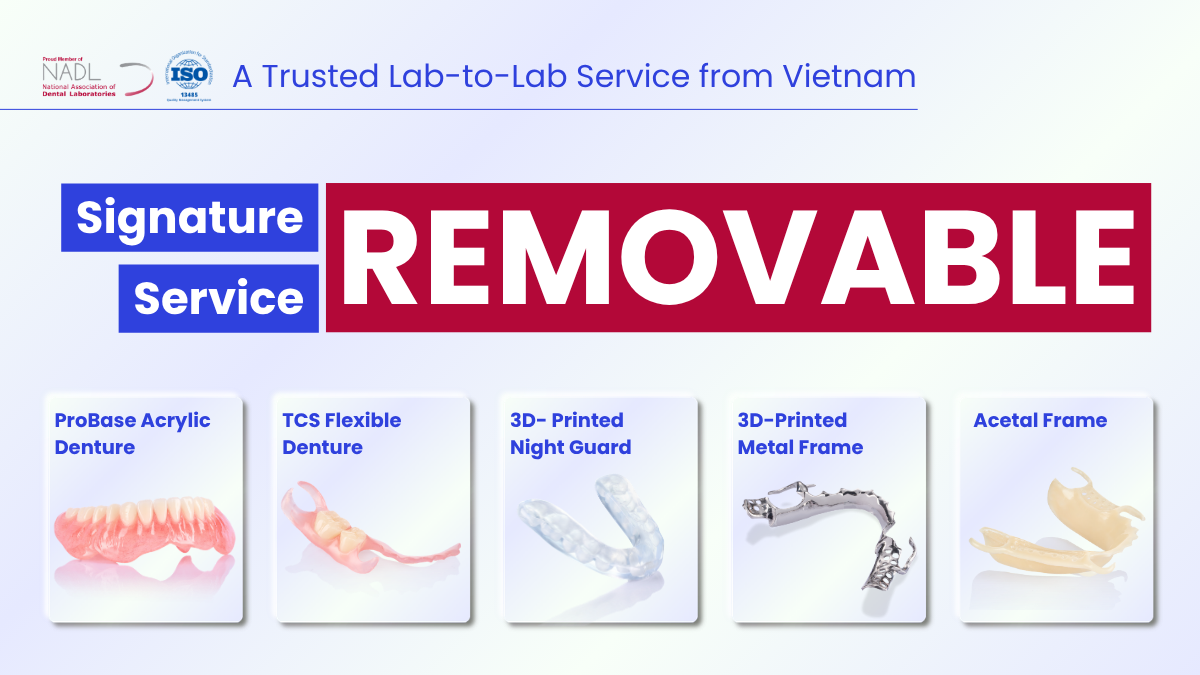
Our Commitments Built on “Trusted. Commitment. Quality”
- Commit to Large-Scale Manufacturing, high volume, remake rate < 1%.
- Commit to 5-Year Warranty
- Commit to Competitive Price
XDENT LAB | A Trusted Lab-to-Lab Service from Vietnam
Share this post:
Related Posts
Explore how independent dental labs support dentistry through custom restorations, digital workflows, quality control, and material traceability.
Learn how B2B dental labs improve quality and consistency for dental practices through digital workflows, material control, expert QC, and reliable turnaround.
Learn how the dental lab subcontract model helps labs expand capacity, manage workloads, access technology, and maintain quality in outsourced production.

