
Learn about digital dentistry, including scanners, CAD/CAM, 3D printing, AI, workflows, benefits, challenges, and dental lab applications.
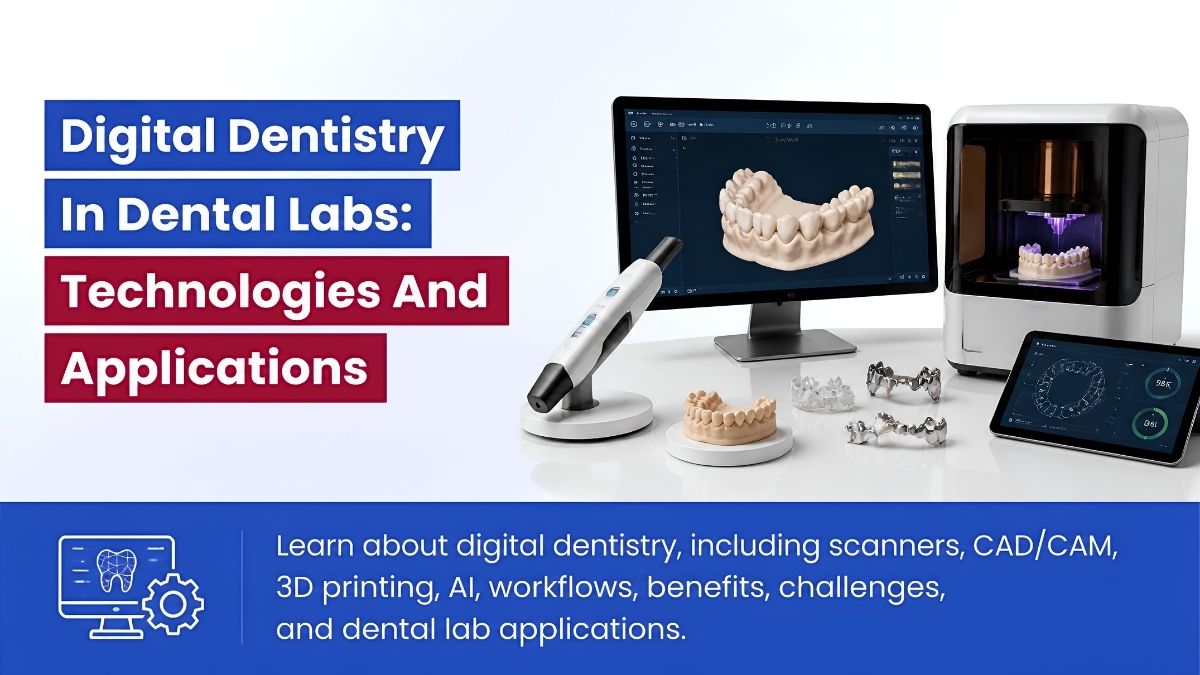
Table of contents [Show]
Digital dentistry has changed how dental professionals diagnose, plan, communicate, and manufacture restorative solutions. Instead of relying only on conventional manual methods, modern practices and laboratories now use interconnected digital tools to capture data, design restorations, improve production accuracy, and streamline treatment workflows. This shift affects nearly every area of dentistry, from restorative and removable prosthetics to implants, orthodontics, diagnostics, and patient communication.
For dental practices focused on quality, efficiency, and consistency, digital dentistry is not simply about using scanners or software. It is a broader clinical and laboratory ecosystem that links intraoral data capture, imaging, CAD/CAM design, 3D printing, milling, and case communication into a more predictable workflow. This article explains what digital dentistry is, the technologies behind it, its clinical and laboratory applications, major benefits and limitations, future trends, and why it matters in dental lab outsourcing.
What is digital dentistry?
Digital dentistry refers to the use of computer-based and digitally connected technologies in dental diagnosis, treatment planning, production, and communication.
Core definition
It includes the capture, storage, analysis, design, and manufacturing of dental data and prosthetic solutions through digital tools rather than relying solely on traditional analog processes.
In practice, digital dentistry may involve:
- Intraoral scanning
- Digital radiography
- Cone beam imaging
- CAD/CAM systems
- 3D printing
- Milling
- Digital smile design
- Artificial intelligence tools
- Cloud-based case communication
Why digital dentistry matters
Digital workflows support greater consistency in treatment planning and laboratory production. They also improve communication among dentists, specialists, and labs while reducing many of the inefficiencies associated with traditional workflows.
For modern dental practices, this means:
- Faster information transfer
- Better case traceability
- Improved manufacturing precision
- More predictable restorative outcomes
- Enhanced patient communication
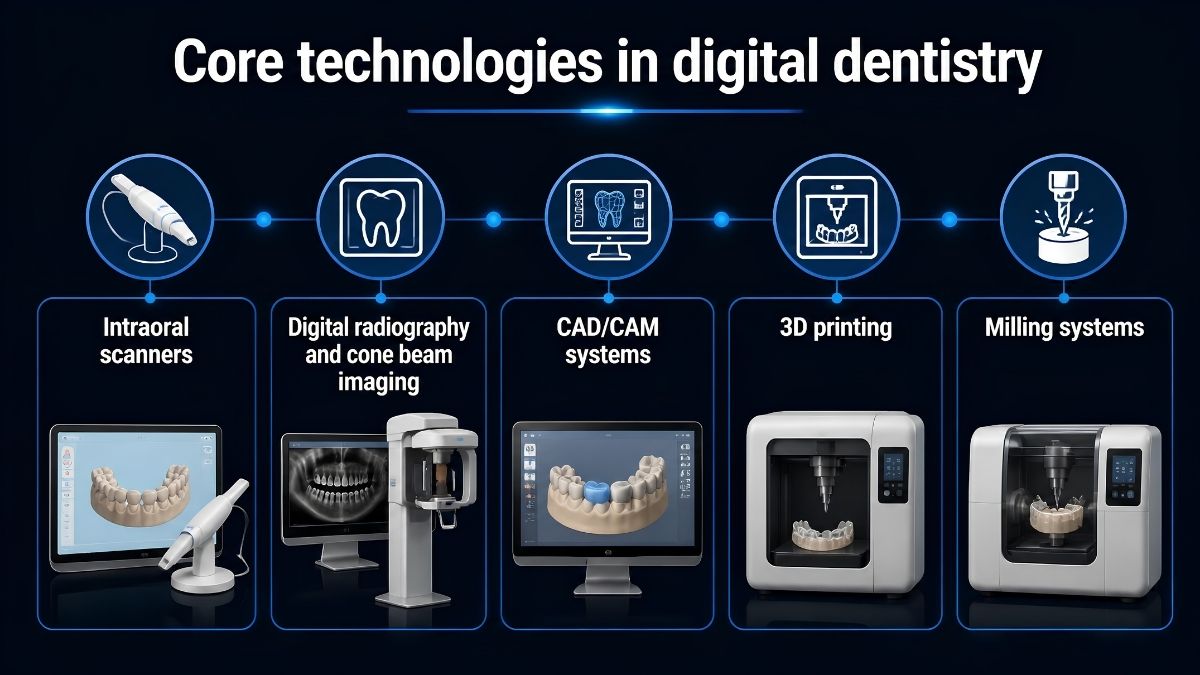
Core technologies in digital dentistry
Digital dentistry depends on a combination of hardware, software, imaging, and manufacturing systems.
Intraoral scanners
Intraoral scanners capture digital impressions of teeth, soft tissue, and bite relationships.
Why they are important
They help improve:
- Patient comfort compared with conventional impressions
- Speed of data acquisition
- Accuracy of restorative records in many case types
- Direct data transfer to the laboratory
- Digital archiving for future use
These scanners are especially valuable for crowns, bridges, aligners, implant restorations, and selected removable workflows.
Digital radiography and cone beam imaging
Digital radiography provides diagnostic imaging with efficient image capture and easier data storage. Cone beam computed tomography adds three-dimensional imaging for more advanced planning.
Main uses
These technologies support:
- Caries and bone evaluation
- Endodontic assessment
- Implant planning
- Oral surgery planning
- Orthodontic assessment
- Temporomandibular and airway analysis in selected cases
CAD/CAM systems
CAD/CAM stands for computer-aided design and computer-aided manufacturing. It is central to modern dental restoration production.
What CAD/CAM enables
CAD/CAM workflows help create:
- Crowns
- Bridges
- Veneers
- Inlays and onlays
- Denture components
- Surgical guides
- Implant restorations
These systems improve repeatability and standardization across both clinics and laboratories.
3D printing
3D printing has become a major production technology in dentistry.
Common applications
It is widely used for:
- Study models
- Surgical guides
- Clear aligner models
- Try-ins
- Custom trays
- Splints
- Denture bases in selected workflows
- Provisional restorations
Its biggest strengths include rapid prototyping, flexible production, and scalable manufacturing.
Milling systems
Milling systems fabricate restorations and prosthetic components from solid material blocks or discs.
Why milling matters
Milling is often preferred for:
- Zirconia restorations
- PMMA components
- Wax patterns
- Titanium components in selected systems
- Full-contour and framework restorations
It offers excellent material consistency and high surface quality in many applications.
Artificial intelligence in dentistry
Artificial intelligence is becoming more relevant in diagnostics, planning, and workflow support.
Emerging uses of AI
AI tools may assist with:
- Image interpretation
- Margin detection
- Case triage
- Risk assessment
- Treatment simulation
- Workflow automation
AI does not replace clinical judgment, but it can improve speed and decision support.
Applications of digital dentistry
Digital dentistry now influences nearly every major dental discipline.
Restorative dentistry
Digital workflows are widely used for crowns, bridges, veneers, inlays, and onlays.
Main restorative advantages
They support:
- More accurate impressions
- Faster laboratory communication
- Better restoration design control
- Reduced remakes in some workflows
- Improved chairside and lab efficiency
Prosthodontics and removable dentistry
Digital methods are increasingly used in complete dentures, partial dentures, overdentures, and full-arch prosthetic planning.
Why digital prosthodontics is growing
It enables:
- Better file storage for remakes
- More standardized setups
- Efficient prototype production
- Improved communication between practice and lab
Implant dentistry
Implant treatment has become deeply connected to digital planning tools.
Digital implant workflow advantages
These workflows help improve:
- Implant position planning
- Guided surgery design
- Prosthetically driven treatment
- Laboratory coordination
- Final restoration accuracy
Orthodontics
Orthodontics was one of the earliest areas to scale digital workflows broadly.
Common digital orthodontic uses
These include:
- Digital study models
- Aligner planning
- Retainer fabrication
- Treatment simulation
- Progress monitoring
Patient communication and case presentation
Digital tools help patients better understand their treatment.
Why this matters
Visual communication improves:
- Treatment acceptance
- Clarity of expectations
- Perceived transparency
- Confidence in complex care plans
Benefits of digital dentistry
Digital dentistry offers advantages across clinical care, laboratory production, and business operations.
Greater precision
Digital records and computer-guided production often improve consistency and reduce variability.
Better efficiency
Cases can move faster from diagnosis to design to manufacturing, especially when clinic and lab are digitally connected.
Improved patient experience
Many patients prefer scanning over traditional impressions, and shorter or more organized appointments improve satisfaction.
Easier communication
Digital files are easier to share among dentists, specialists, and laboratories than physical impressions and paper records.
Better data retention and remake potential
Stored digital files can simplify reproduction, monitoring, and future modifications.
Scalable production for laboratories
For dental labs, digital workflows improve standardization, quality control, and multi-case production efficiency.
Challenges and limitations of digital dentistry
Despite its advantages, digital dentistry also has practical and operational limitations.
High initial investment
Scanners, software, milling systems, printers, and training require significant upfront cost.
Learning curve
Clinical teams and laboratory technicians need training to use digital systems effectively and consistently.
System compatibility
Different software and hardware ecosystems do not always integrate smoothly.
Data management and security
Digital workflows require careful handling of patient files, backups, and privacy compliance.
Not every case is equally simple to digitize
Some edentulous, subgingival, or highly complex cases may still require hybrid or conventional steps.
Future trends in digital dentistry
Digital dentistry is expanding rapidly and will likely become even more integrated across dental care.
More connected workflows
Future systems will improve interoperability between scanners, imaging platforms, laboratories, and practice management systems.
Stronger AI integration
AI will likely play a larger role in diagnostics, planning, and quality assurance.
Better materials for printing and milling
Material innovation will expand the indications for digital manufacturing.
More personalized treatment design
Digital tools will increasingly support anatomy-based, patient-specific solutions.
Growth of remote collaboration
Cloud systems and tele-dentistry tools will make it easier for practices and labs to collaborate across regions.
Why digital dentistry matters in dental lab outsourcing
For outsourcing relationships, digital dentistry changes both speed and quality expectations. Practices increasingly expect their laboratory partners to receive digital cases, manage data accurately, communicate clearly, and deliver repeatable results across restorative, removable, and implant workflows.
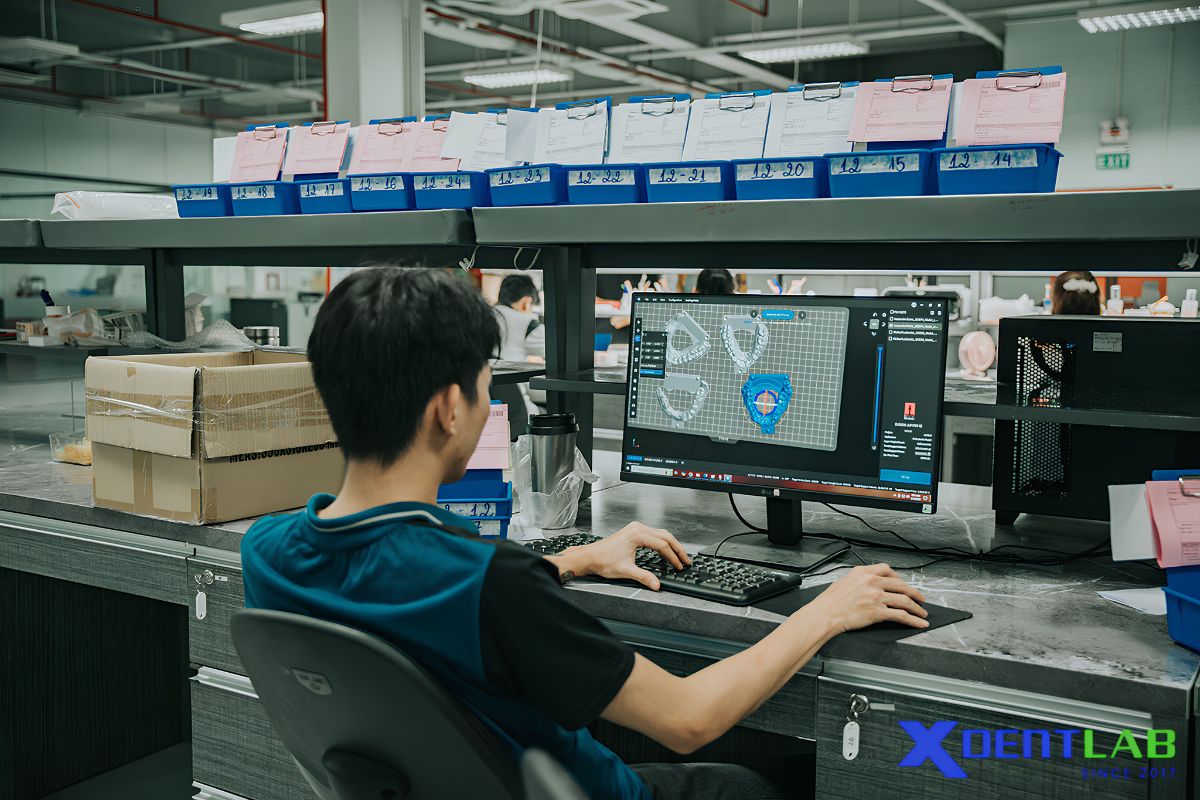
What dental practices should expect from a digital lab partner
A strong lab outsourcing partner should offer:
- Acceptance of digital impressions and files
- Support for conventional and digital cases
- CAD/CAM design capability
- 3D printing and milling integration
- Quality control systems
- Efficient case communication
- Experience in restorative, removable, and implant workflows
Relevance to XDENT LAB
Digital dentistry aligns closely with XDENT LAB’s position as a Vietnam dental lab serving dental practices that prioritize quality and consistency. With state-of-the-art technology, certified technicians, FDA- and ISO-aligned standards, and dedicated expertise in removable and implant cases, XDENT LAB supports the digital transformation of lab-to-lab outsourcing.
Its multi-factory capacity and full-service workflow make it well suited for practices seeking a reliable partner for digital case intake, prosthetic manufacturing, and scalable production support. In digital dentistry, the files may travel instantly, but quality still depends on the people, systems, and standards behind them.
Key takeaways
Digital dentistry is the use of connected digital technologies to improve diagnosis, planning, manufacturing, and communication in dental care. It includes tools such as intraoral scanners, digital imaging, CAD/CAM, milling, 3D printing, and AI-assisted systems.
Its main value lies in greater precision, efficiency, reproducibility, and collaboration between practices and laboratories. For dental practices looking to ensure quality and consistency, working with an experienced outsourcing partner such as XDENT LAB can help turn digital workflows into dependable clinical and laboratory outcomes.
About XDENT LAB:
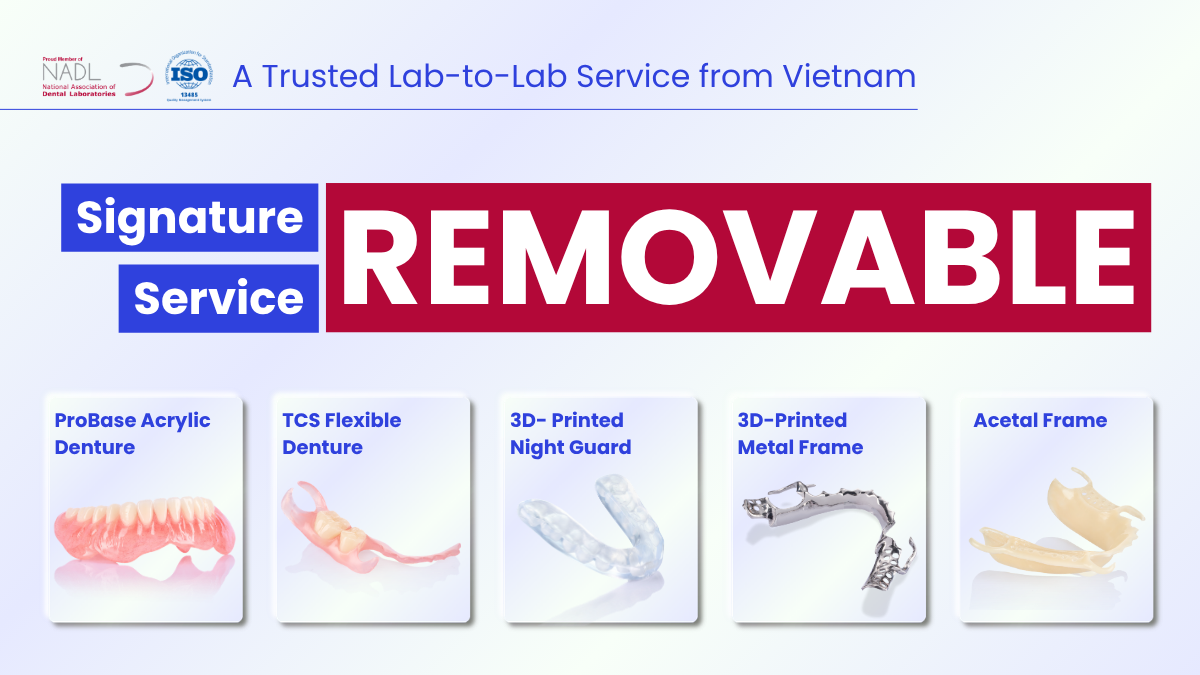
We are experts in Lab-to-Lab Full Service from Vietnam, with the signature services of Removable, meet U.S. market standards, FDA-registered, ISO 13485-certified. Founded in 2017, from local root to global reach, we scale with 2 Factories with over 100+ employees.
Our Commitments Built on “Trusted. Commitment. Quality”
- Commit to Large-Scale Manufacturing, high volume, remake rate < 1%.
- Commit to 5-Year Warranty
- Commit to Competitive Price
XDENT LAB | A Trusted Lab-to-Lab Service from Vietnam
Share this post:
Related Posts
Understanding and applying the correct Layer Thickness settings not only saves labs time and production cost, but also ensures stable output quality for each specific type of dental product.
A technical guide to post curing in digital denture fabrication, helping dental lab technicians understand the parameters for consistent product quality.
Discover removable dentistry methods and applications in dental labs, from complete dentures to partials, overdentures, and digital production workflows.

