
A comprehensive academic review of conventional glass ionomer cements, their fluoride-releasing properties, and applications in modern dentistry. XDENT LAB ensures quality dental lab services.
Table of contents [Show]
Introduction and Definition
Conventional glass-ionomer cements (GICs) are a foundational class of dental materials known for their dual restorative and preventive capabilities. As the original formulation of glass ionomer materials, conventional GICs have been widely used in dentistry for decades due to their unique properties, such as fluoride release and direct adhesion to dental tissues. These materials, made from a combination of silicate and polycarboxylate, are biocompatible and play a critical role in preventive and restorative dentistry.
Historical Development
Evolution of Conventional GICs
Conventional GICs were developed as an innovation from earlier dental materials such as silicate cements and zinc polycarboxylate. Key milestones include:
1969-1972: Invented by Wilson and Kent as a new category of dental cement.
1970s-1990s: Refinements in powder and liquid formulations improved handling and clinical performance.
Modern Era: Advances in particle size, distribution, and chemistry have optimized the physical and chemical properties of GICs, ensuring their continued relevance in dentistry.
Generational Improvements
First Generation: Basic acid-base cements with limited mechanical properties.
Second Generation: Introduction of tartaric acid to improve working and setting times.
Third Generation: Enhanced powder formulations for better durability and handling.
Modern GICs: Focus on optimizing particle size, fluoride release, and clinical performance.
Composition and Chemistry
Powder Components
The powder is primarily composed of:
Calcium fluoroaluminosilicate glass: The core material providing fluoride release.
Silicon dioxide (SiO₂): 29-50%, forms the glass matrix.
Aluminum oxide (Al₂O₃): 16-30%, contributes to strength.
Calcium fluoride (CaF₂): 15-25%, provides a source of fluoride ions.
Sodium and aluminum fluorides: Aid in setting and fluoride release.
Liquid Components
The liquid phase includes:
Polyacrylic acid (30-50%): Reacts with the glass powder.
Itaconic acid copolymers: Enhance handling and reduce viscosity.
Tartaric acid (5-10%): Controls setting time and improves strength.
Distilled water: Acts as the reaction medium.
Setting Reaction Mechanism
The setting process involves an acid-base reaction:
Acid attack: Polyacrylic acid dissolves the glass particles.
Ion release: Calcium, aluminum, sodium, and fluoride ions are released.
Matrix formation: Polyacrylate salts form, creating a rigid matrix.
Maturation: The material strengthens over weeks as the matrix stabilizes.
Unique Properties
Chemical Adhesion
Conventional GICs chemically bond directly to enamel and dentin through:
Ionic interaction with hydroxyapatite.
Chelation of calcium ions.
Micromechanical interlocking.
Elimination of the need for separate bonding agents.
Fluoride Release and Recharge
Key fluoride-related properties include:
Initial burst release: High levels of fluoride are released within the first 24-48 hours.
Sustained release: Fluoride is released gradually over months or years.
Recharge capability: GICs can absorb fluoride from external sources such as toothpaste and professional fluoride treatments, renewing their preventive effects.
Dimensional Stability
Minimal shrinkage or expansion during setting.
A thermal expansion coefficient similar to natural tooth structure.
Reduced microleakage and excellent marginal adaptation.
Physical and Mechanical Properties
Strength Characteristics
Conventional GICs exhibit:
Compressive strength: 70-220 MPa, suitable for low-stress restorations.
Tensile strength: 4.5-7.0 MPa, lower than resin-based materials.
Flexural strength: 10-20 MPa, limiting use in stress-bearing areas.
Working and Setting Times
Working time: 1.5-3 minutes.
Setting time: 4-7 minutes.
Moisture sensitivity during the initial set requires careful isolation.
Solubility and Water Sorption
Vulnerable to moisture contamination during the early setting phase.
Water absorption during maturation is necessary for proper setting.
Surface protection is recommended during the first 24 hours.
Clinical Applications
Restorative Applications
Conventional GICs are widely used in:
Class III and V restorations: Especially for non-load bearing areas.
Deciduous teeth: Ideal for pediatric dentistry due to their ease of use and fluoride release.
Atraumatic Restorative Treatment (ART): Effective in minimally invasive dentistry.
Lining and Base Applications
Used as:
Protective linings under amalgam and composite restorations.
Bases in the sandwich technique to replace dentin and provide thermal insulation.
Preventive Applications
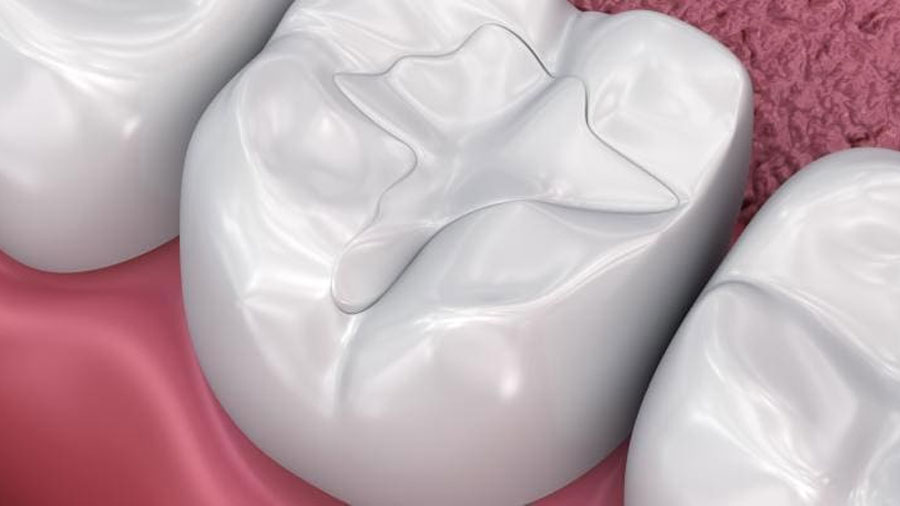
Pit and fissure sealants for caries prevention.
High-risk surface protection in caries-prone patients.
Advantages of Conventional GICs
Biological and Clinical Benefits
Biocompatible with minimal pulpal irritation.
Continuous fluoride release for caries prevention.
Chemical adhesion to tooth structure without the need for bonding agents.
Tolerance to moisture during placement, reducing technique sensitivity.
Preventive Benefits
Fluoride release promotes remineralization of adjacent enamel.
Antibacterial effects help reduce the risk of secondary caries.
Limitations and Challenges
Mechanical Limitations
Lower tensile and flexural strength compared to modern resin-based materials.
Brittleness under tension limits use in stress-bearing restorations.
Clinical Limitations
Moisture sensitivity during placement.
Extended maturation time before achieving full strength.
Limited aesthetic properties for anterior restorations.
Recent Innovations and Future Directions
Material Enhancements
Particle size optimization: Reduces porosity and improves strength.
Bioactive glass additions: Enhance remineralization and ion release.
Nanotechnology: Improves mechanical properties and fluoride release.
Future Applications
Development of smart GICs with pH-responsive fluoride release.
Integration into digital workflows, including 3D printing for precise restorations.
Conclusion
Conventional glass ionomer cements remain a cornerstone of preventive and restorative dentistry due to their unique fluoride release, chemical adhesion, and biocompatibility. While they have limitations in mechanical strength, their preventive benefits make them indispensable for specific clinical applications, particularly in pediatric, geriatric, and minimally invasive dentistry. With ongoing advancements in material science, conventional GICs continue to evolve, ensuring their relevance in modern dental practices.
XDENT LAB is committed to supporting dental professionals with high-quality lab-to-lab services, ensuring precision and compliance in all restorations. Our expertise in dental lab outsourcing and adherence to U.S. standards make us the trusted partner for your dental practice.
About XDENT LAB:
We are experts in Lab-to-Lab Full Service from Vietnam, with the signature services of Removable, meet U.S. market standards, FDA-registered, ISO 13485-certified. Founded in 2017, from local root to global reach, we scale with 2 Factories with over 100+ employees.
Our Commitments Built on “Trusted. Commitment. Quality”
- Commit to Large-Scale Manufacturing, high volume, remake rate < 1%.
- Commit to 5-Year Warranty
- Commit to Competitive Price
XDENT LAB | A Trusted Lab-to-Lab Service from Vietnam
Share this post:
Related Posts
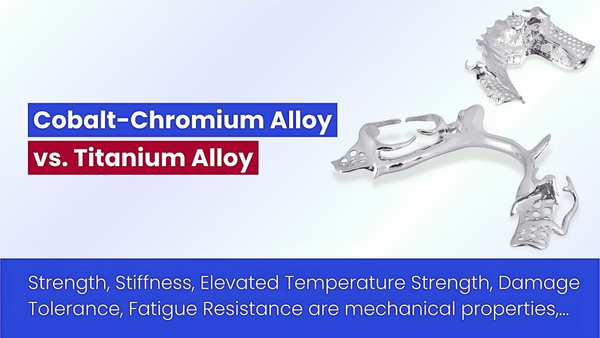
Learn the key differences between titanium and cobalt-chromium alloys used in removable partial denture frameworks, from mechanical properties to production requirements.
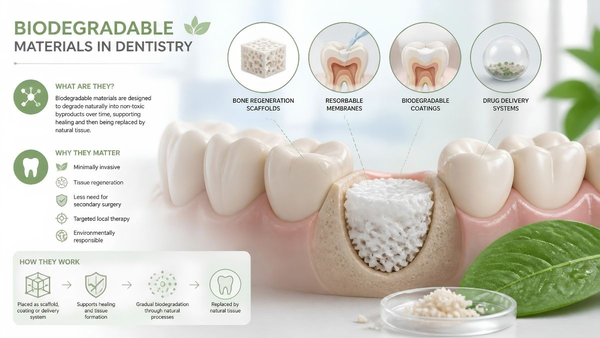
Explore biodegradable materials in dentistry, including their applications, benefits, limitations, and future potential in regenerative and sustainable dental care.
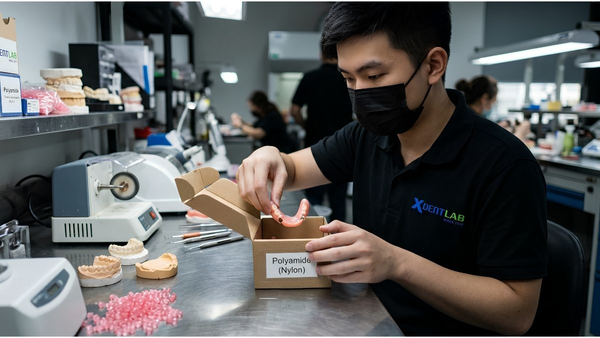
Learn how polyamide dental materials support flexible dentures and removable prosthetics through biocompatibility, aesthetics, comfort, and lightweight performance.

