
Explore biodegradable materials in dentistry, including their applications, benefits, limitations, and future potential in regenerative and sustainable dental care.
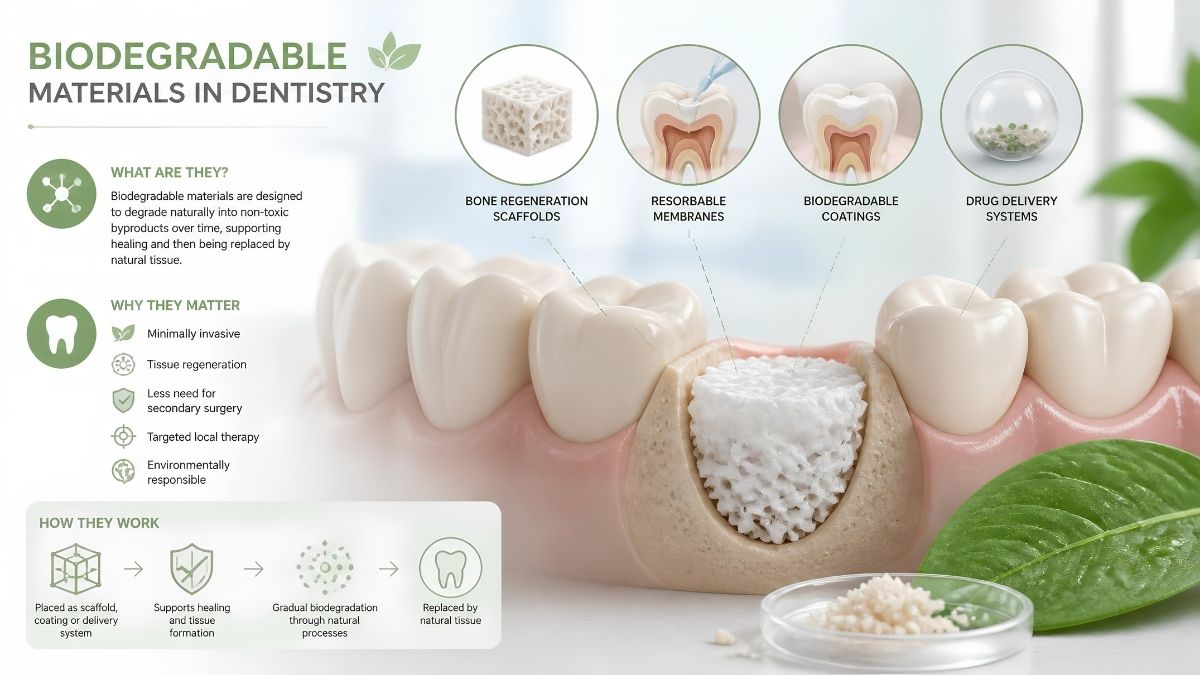
Table of contents [Show]
- What are biodegradable materials in dentistry?
- Types of biodegradable materials in dentistry
- Applications of biodegradable materials in dentistry
- Advantages of biodegradable materials in dentistry
- Challenges and limitations of biodegradable materials
- Future directions
- Why biodegradable materials matter for dental labs and outsourcing
- Key takeaways
- References
Biodegradable materials are becoming increasingly important in modern dentistry as the industry moves toward more biocompatible, regenerative, and environmentally responsible solutions. Unlike permanent materials that remain unchanged over time, biodegradable materials are designed to break down into non-toxic byproducts either within the body or in the surrounding environment. This characteristic makes them highly relevant in applications where temporary function, tissue support, drug release, or gradual replacement by natural tissue is clinically desirable.
In dentistry, biodegradable materials are gaining attention across tissue engineering, periodontal therapy, drug delivery systems, temporary restorations, implant-related applications, and orthodontics. Their appeal comes from a combination of biological compatibility, functional versatility, and sustainability potential. At the same time, their clinical use depends heavily on how well their degradation behavior, mechanical strength, and surface properties are matched to the intended indication. This article provides a comprehensive overview of biodegradable materials in dentistry, including their definition, types, applications, advantages, limitations, and future direction in dental manufacturing and treatment planning.
What are biodegradable materials in dentistry?
Biodegradable materials are materials designed to degrade naturally into non-toxic byproducts over time. In dentistry, they are used in clinical and laboratory applications where a temporary structure, scaffold, coating, or delivery system is required before being replaced by natural tissue or eliminated from the treatment environment.
Basic material concept
The defining characteristic of a biodegradable dental material is not simply that it breaks down, but that it does so in a controlled and biologically acceptable manner. The degradation process may occur through hydrolysis, enzymatic action, cellular activity, or a combination of biological and chemical mechanisms, depending on the material class.
This makes biodegradable materials especially valuable in regenerative dentistry, where the material supports healing or tissue formation and then gradually disappears as the biological structure matures.
Why they matter in dentistry
Biodegradable materials matter because they align with several major trends in modern dental care. These include minimally invasive treatment concepts, tissue regeneration, targeted local therapy, reduced need for secondary surgical intervention, and growing interest in environmentally responsible clinical materials.
In practical terms, biodegradable materials are not a single product category. They are a broad family of polymers, ceramics, and composites that can be adapted for many specialized dental uses.
Types of biodegradable materials in dentistry
Biodegradable materials used in dentistry can generally be grouped into polymers, ceramics, and composite systems.
Biodegradable polymers
Biodegradable polymers are among the most widely studied materials in this field because they can be engineered for different degradation rates, forms, and biological functions.
Synthetic polymers
Common examples include polylactic acid (PLA), polyglycolic acid (PGA), polycaprolactone (PCL), polyanhydrides, and polyphosphazenes.
These materials are often used in drug delivery systems, scaffolds for tissue regeneration, and coatings for dental implants. Their main advantage is that they can be designed with relatively predictable structure-property relationships and adapted to specific treatment objectives.
Natural polymers
Natural biodegradable polymers include chitosan, gelatin, fibrin, hyaluronic acid, and alginate.
These materials are often valued for wound healing, periodontal regeneration, and scaffold applications in tissue engineering. Because they are closer to naturally occurring biological substances, they may offer favorable biological interactions, although their handling and mechanical behavior can vary widely.
Biodegradable ceramics
Biodegradable ceramics include materials such as calcium phosphate, hydroxyapatite, and tricalcium phosphate.
These materials are especially important in bone grafting, dental implant support, and maxillofacial reconstruction. Their role is often to support mineralized tissue regeneration while gradually resorbing as natural bone replaces them.
Biodegradable composites
Biodegradable composites combine polymers and ceramics to improve both biological and mechanical performance.
These systems are relevant in temporary restorations, bone graft substitutes, and tissue engineering scaffolds where neither a polymer nor a ceramic alone may provide the ideal balance of strength, degradation behavior, and regenerative support.
Applications of biodegradable materials in dentistry
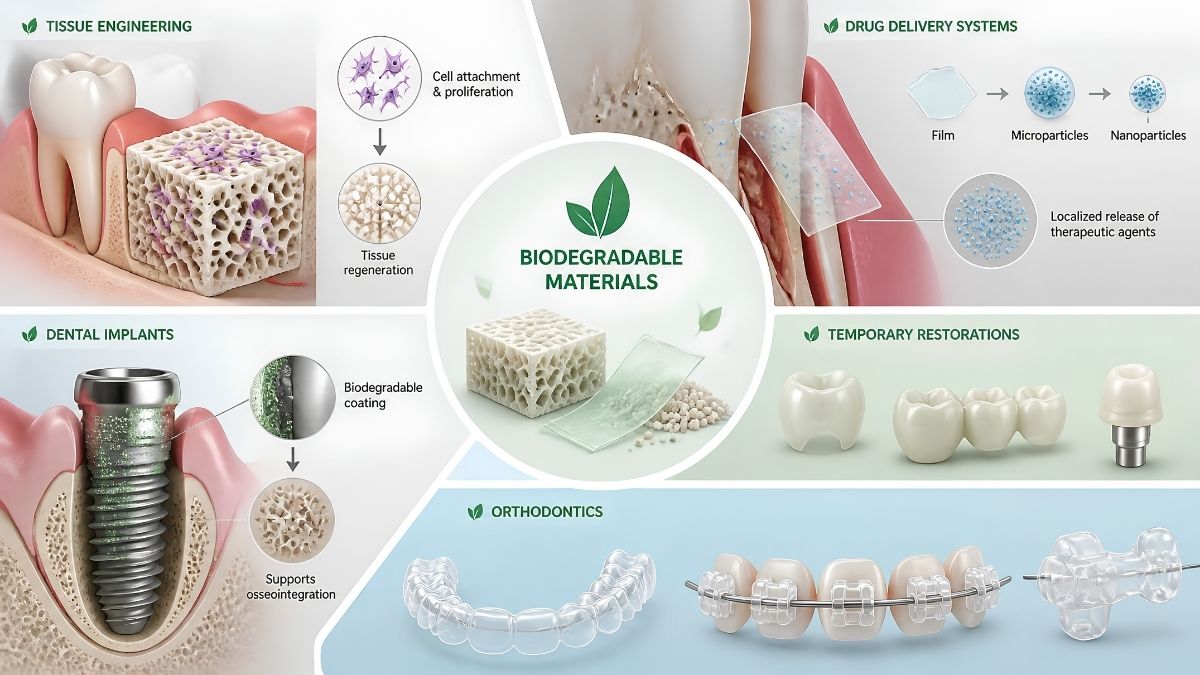
Biodegradable materials are used in several important clinical and technical areas of dentistry.
Tissue engineering
One of the most significant applications is tissue engineering.
Biodegradable scaffolds made from polymers such as PLA and PCL can support the regeneration of bone, periodontal ligament, and dentin. In these applications, the material acts as a temporary matrix that supports cell attachment, proliferation, and tissue organization during healing.
Drug delivery systems
Biodegradable materials are also highly useful in localized drug delivery.
They can be fabricated into films, membranes, microparticles, or nanoparticles that release antibiotics, anti-inflammatory agents, or growth factors directly at the treatment site. This is especially relevant in periodontal and endodontic therapies where site-specific release can improve efficiency while reducing systemic exposure.
Dental implants
In implant-related dentistry, biodegradable materials may be used as coatings or regenerative adjuncts.
Biodegradable coatings can support osseointegration and may help reduce infection-related risks. In some situations, biodegradable ceramics are also considered for temporary implant or bone-support applications where natural tissue replacement is expected over time.
Temporary restorations
Biodegradable materials may also be applied in temporary crowns, bridges, healing components, and other provisional structures.
Their value in these indications comes from temporary function and the possibility of gradual degradation, depending on the intended clinical design. This makes them relevant where short-term use is sufficient and removal procedures may be reduced or simplified.
Orthodontics
Biodegradable polymers are also being explored in orthodontic appliances.
Possible uses include temporary aligner-related systems, brackets, or corrective devices where short-term action is needed. Their suitability depends on the balance between flexibility, strength, and degradation timing.
Advantages of biodegradable materials in dentistry
Biodegradable materials offer several meaningful advantages when used in the right clinical context.
Eco-friendliness
One major advantage is environmental relevance.
Because these materials are designed to degrade, they may reduce long-term material waste compared with non-biodegradable alternatives. This aligns with broader interest in sustainable healthcare and more responsible material selection in dental practice and manufacturing.
Biocompatibility
Biocompatibility is another major benefit.
Many biodegradable materials are engineered to degrade into non-toxic byproducts, which can reduce the likelihood of adverse tissue reactions when the material is properly selected and processed for the intended indication.
Elimination of secondary surgeries
In regenerative and implant-related treatments, biodegradability can eliminate the need for later material removal.
This is particularly valuable in scaffolds, membranes, and temporary support systems that are designed to disappear once healing or tissue formation has progressed sufficiently.
Enhanced tissue regeneration
Biodegradable scaffolds can support cell adhesion and proliferation, which may improve tissue regeneration outcomes.
This is important in procedures involving bone regeneration, periodontal healing, and other biologically driven dental treatments where the material is intended to assist the body rather than function as a permanent prosthetic structure.
Customizability
With digital design and 3D printing technologies, biodegradable materials can increasingly be tailored to specific shapes, defects, and treatment plans.
This improves personalization and may make these materials more adaptable to complex anatomical and regenerative needs.
Challenges and limitations of biodegradable materials
Despite their promise, biodegradable materials also present important technical and clinical limitations.
Mechanical properties
Some biodegradable materials do not provide the strength or durability required for long-term load-bearing applications.
This limits their use in situations where prolonged structural stability is necessary, especially in demanding prosthetic or functional environments.
Degradation control
One of the biggest challenges is controlling the degradation rate.
If the material degrades too quickly, it may lose function before tissue healing or regeneration is complete. If it degrades too slowly, it may not provide the intended biological or clinical advantage. Matching degradation timing to the healing timeline remains a central design challenge.
Cost considerations
Biodegradable materials and their associated manufacturing processes may be more expensive than conventional options.
Cost may come from advanced formulations, specialized fabrication methods, research-driven material development, and lower production scale compared with conventional dental materials.
Surface properties and biofilm behavior
Surface behavior also matters significantly in the oral environment.
Issues such as roughness, bacterial adhesion, and biofilm formation can affect how a biodegradable material performs over time. This is especially important in a wet, chemically active, and microbiologically complex oral setting.
Future directions
The future of biodegradable materials in dentistry is closely connected to material science, regenerative medicine, and digital manufacturing.
Self-healing polymers
One promising research direction involves self-healing biodegradable polymers.
These materials aim to restore part of their integrity after minor damage, which could improve functional life while still preserving the benefits of biodegradability.
Smart materials
Another major development area is smart biodegradable materials.
These may include pH-responsive or temperature-sensitive systems designed for targeted drug delivery or adaptive tissue engineering behavior. Such materials could respond to local biological conditions rather than acting as passive structures alone.
Improved biocompatibility
Advances in material engineering are also focused on making biodegradable materials more biomimetic.
The closer a material behaves to natural tissues in structure and biological response, the better its integration and regenerative performance may become.
Sustainability and renewable sourcing
Research is also moving toward biodegradable materials derived from renewable resources.
This reflects growing attention to sustainability not only in clinical care, but also in dental manufacturing, material sourcing, and waste reduction.
Why biodegradable materials matter for dental labs and outsourcing
For dental laboratories and outsourcing partners, biodegradable materials represent a growing area of technical relevance. Even though many biodegradable applications are more closely tied to regenerative and clinical biomaterial use than conventional removable prosthetics, labs still benefit from understanding how these materials are shaping future workflows, temporary devices, and patient-specific manufacturing.
What dental practices need from a lab partner
Dental practices need lab partners who understand emerging material categories, their indications, their limitations, and their production implications. This includes knowledge of temporary applications, digital customization, material handling, and the relationship between biomaterial behavior and clinical outcomes.
Relevance to XDENT LAB
For XDENT LAB, awareness of biodegradable materials supports a broader commitment to advanced dental manufacturing, quality-focused lab-to-lab service, and long-term alignment with evolving industry needs. As a Vietnam dental lab serving international partners, XDENT LAB operates at the intersection of material knowledge, scalable production, and dental lab outsourcing support for practices that value consistency, innovation, and compliance.
In a changing dental landscape, understanding material trends is not just academic. It is part of how dental laboratories remain useful, competitive, and clinically relevant.
Key takeaways
Biodegradable materials are an important and evolving category in dentistry. They include polymers, ceramics, and composites designed to degrade into non-toxic byproducts while supporting functions such as tissue regeneration, localized drug delivery, temporary restorations, implant-related healing, and orthodontic treatment.
Their key advantages include biocompatibility, eco-friendliness, elimination of some secondary removal procedures, regenerative support, and increasing customization through digital technologies. Their limitations include mechanical constraints, degradation control challenges, cost, and surface-related performance concerns. As research continues, biodegradable materials are likely to play a larger role in regenerative, personalized, and sustainability-oriented dentistry.
References
- Biodegradable materials in dentistry - Wiley Online Library
- Biodegradable polymers in dentistry - University of Arizona
- Biodegradable ceramic materials for dentistry - Springer
- Review: biodegradable materials in dentistry - Ecronicon
About XDENT LAB:
We are experts in Lab-to-Lab Full Service from Vietnam, with the signature services of Removable, meet U.S. market standards, FDA-registered, ISO 13485-certified. Founded in 2017, from local root to global reach, we scale with 2 Factories with over 100+ employees.
Our Commitments Built on “Trusted. Commitment. Quality”
- Commit to Large-Scale Manufacturing, high volume, remake rate < 1%.
- Commit to 5-Year Warranty
- Commit to Competitive Price
XDENT LAB | A Trusted Lab-to-Lab Service from Vietnam
Share this post:
Related Posts
Learn the key differences between titanium and cobalt-chromium alloys used in removable partial denture frameworks, from mechanical properties to production requirements.
Learn how polyamide dental materials support flexible dentures and removable prosthetics through biocompatibility, aesthetics, comfort, and lightweight performance.
Explore how light-curing resin is being applied in 3D printed nightguards, from flexible materials and digital workflows to post-processing techniques that improve accuracy, durability, and overall pe...

