
A 2025 year-end analysis of how 3D printing is reshaping removable partial denture (RPD) manufacturing, highlighting major trends, new materials, and metal printing systems unveiled at IDS 2025 and Formnext 2025.
Table of contents [Show]
- Key Points
- Introduction
- Methodology
-
Trends in 3D-Printed RPD Manufacturing in 2025
- Metal additive manufacturing moves toward the mainstream for RPD frameworks
- Flexible and resin-based partial dentures gain momentum
- Integrated metal–resin production ecosystems become widely accessible to labs
- The industry narrative shifts from “if” to “how fast” RPD manufacturing will go fully digital
- Highlighted Products and Solutions at IDS 2025 & Formnext 2025
- Conclusion
- References
Key Points
Metal additive manufacturing becomes mainstream for Co–Cr RPD frameworks in 2025.
Resin-based and flexible partial dentures expand rapidly with new materials.
Integrated digital ecosystems combining metal AM and resin printing become widely accessible to labs.
Industry sentiment shifts from “if” to “how fast” the transition to fully digital RPD manufacturing will occur.
IDS 2025 and Formnext 2025 showcase new materials and 3D printing systems relevant to RPD production.
Introduction
Traditional manufacturing of removable partial dentures (RPDs) relies on a multi-step workflow that includes wax-up, casting cobalt–chromium (Co–Cr) frameworks, and manual finishing. While this approach has been the standard for decades, it is inherently time-consuming, prone to dimensional inaccuracies, and highly dependent on individual technician skill. The lack of standardization often results in inconsistent fit, repeated adjustments, and variable clinical outcomes.
The rapid advancement of 3D printing technologies has transformed the production phase of RPDs, enabling greater automation, reproducibility, and design freedom. In particular, metal additive manufacturing has reshaped the way Co–Cr frameworks are fabricated, offering superior precision and eliminating several error-prone steps associated with conventional casting. Simultaneously, the rise of resin and flexible materials has expanded the possibilities for manufacturing esthetic clasps, interim partial dentures, and non-metallic framework alternatives.
As 2025 concludes, the rapid expansion of 3D-printed RPD solutions provides an opportunity to evaluate the year’s most significant developments. This report aims to:
Summarize key trends in 3D-printed RPD manufacturing observed throughout 2025.
Highlight products and solutions showcased at the International Dental Show (IDS) 2025 & Formnext 2025 that are relevant to RPD production.
Together, these insights provide a comprehensive year-end overview of how 3D printing is reshaping the manufacturing landscape for RPDs.
Methodology
This report is based entirely on secondary research. The analysis draws on publicly available sources published primarily in 2024–2025, with a specific focus on developments that shaped the manufacturing phase of RPDs throughout 2025. The following sources were used:
Academic literature related to RPD production.
Product announcements, press releases, and technical brochures from 3D printing vendors, with a particular focus on new metal printers, resin systems, and materials showcased at IDS 2025 in Cologne, and Formnext 2025 in Frankfurt.
Event summaries and trade-press coverage from dental industry media reporting on additive manufacturing trends relevant to RPD fabrication.
Official product documentation describing materials, printing technologies, and production workflows specifically intended for dental laboratories involved in RPD fabrication.
Only technologies and solutions with a direct application to the production of removable partial dentures were included. Digital steps such as intraoral scanning or CAD design were intentionally excluded, as the scope of this report focuses solely on the manufacturing stage. The aim is not to compile an exhaustive inventory of every dental 3D printing product, but to highlight representative developments that signal broader trends in RPD manufacturing.
Because the report relies on vendor publications, media sources, and technical documentation rather than independent laboratory testing, the findings primarily reflect how manufacturers present and position their technologies. No interviews, internal adoption data, or practice-level performance metrics were collected. As a result, the conclusions should be interpreted as a snapshot of the 2025 market landscape, rather than definitive evidence of effectiveness or universal adoption across all dental laboratories.
Trends in 3D-Printed RPD Manufacturing in 2025
A 2025 systematic review on metal 3D-printed RPD frameworks (SLM, DMLS) concludes that digitally fabricated Co–Cr frameworks show comparable or superior fit, adequate mechanical properties and acceptable clinical performance versus conventional casting, supporting their use as a routine alternative rather than an experimental technique [1].
A systematic review on RPD fit accuracy reports that digital methods (including SLM/DMLS) generally achieve smaller or similar internal gaps than lost-wax techniques [2].
A 2025 clinical trial found that DMLS frameworks required fewer repetitions and fewer adjusted components than cast frameworks while maintaining clinically acceptable fit [3].
Industry players echo this shift: TRUMPF, for example, now describes metal 3D printing of dentures as faster and more affordable than casting or milling for many indications, positioning laser metal fusion as a standard solution in dental technology [4].
Together, these data show that by 2025, metal AM for RPD frameworks has effectively moved into the mainstream production toolbox of many labs.
Flexible and resin-based partial dentures gain momentum
Recent materials research indicates that 3D-printed polymers are moving beyond prototyping to functional roles in RPDs. A 2024 review on polymeric materials for 3D-printed dentures highlights PMMA-type resins as the current workhorse but also identifies PEEK, ABS, PLA and composite formulations as promising candidates to overcome brittleness and mechanical limitations of conventional denture bases, signalling an active push toward stronger, more durable printed prostheses [5]. A 2025 review on innovations in 3D-printed denture base resins similarly emphasizes efforts to enhance fracture toughness and fatigue resistance, noting that improved materials are expanding indications for printed removable prostheses [6].
Clinically, a 2025 study on a fully digital PEEK RPD workflow reports that completely digital RPDs can provide acceptable fit, masticatory efficiency and patient satisfaction compared with semi-digital approaches [7]. In immediate and interim RPDs, case reports and clinical series using fully digital workflows show that printed resin bases can reliably deliver functional temporary partial dentures with adequate accuracy and esthetics [8].
Overall, 2024–2025 evidence supports a growing role for resin and flexible materials in esthetic clasps, interim partials, metal-free designs and hybrid castable workflows alongside metal frameworks.
The literature increasingly describes RPD production as part of an integrated digital workflow rather than isolated printing steps. A 2025 article on enhancing digital workflows for RPDs notes that digital laboratory processes now combine surveying, design and manufacturing within connected software–hardware ecosystems, aiming to reduce errors and inefficiencies in partial denture fabrication [9].
Reviews on 3D printing in dentistry published in 2024 highlight how SLA/DLP resin printing and metal AM are being incorporated into prosthodontic workflows as coordinated stages of a single production chain [10].
In parallel, practice-oriented articles describe the shift from large, centralized lab systems to compact, user-friendly printers that allow chairside or small-lab production of dentures and partials, lowering the barrier to entry [11].
A case study from GPS Digital RPD demonstrates that fully digital, mixed metal–resin workflows can cut RPD production times by half, while improving scalability and consistency [12].
These converging sources indicate that integrated metal–resin ecosystems are no longer reserved for large centers but are becoming widely accessible infrastructure for everyday RPD production.
The industry narrative shifts from “if” to “how fast” RPD manufacturing will go fully digital
Expert commentary around IDS 2025 captures a clear change in tone: additive manufacturing is framed not as an alternative but as the inevitable future of dental manufacturing. In his IDS 2025 recap, Dr. Ahmad Al-Hassiny describes 3D printing as having evolved from a niche tool for models and guides to a mainstream method for manufacturing everything from clear aligners to permanent restorations, noting that major material manufacturers now treat AM as central to their long-term strategy and that the key question is no longer if 3D printing will replace traditional methods, but when and how quickly [13].
A 2025 survey of leading additive manufacturing companies similarly reports that the industry is entering a stage where a broader group of users is starting to implement additive manufacturing and anticipates major changes in how production is organized over the next few years [14].
Broader 3D-printing trend reports describe sustained market growth, ecosystem maturation and expanding application in high-value manufacturing, including medical and dental sectors [15].
Taken together, alongside the growing clinical and laboratory evidence supporting 3D-printed Co–Cr RPD frameworks and printed resin components, these signals reinforce a clear conclusion: RPD manufacturing is already on the path toward predominantly digital, additively manufactured workflows. The remaining question is mainly how fast this transition will happen, not whether it will happen at all.
Materials
Detax – dx denture flex (3D-printable flexible partial denture material)
Detax introduced dx denture flex, a medical-grade flexible resin specifically formulated for metal-free partial dentures and esthetic clasps. The material is promoted as a breakthrough for 3D-printed partials due to its thin section strength, gingiva-like translucency, and MDR certification for intraoral use. Detax emphasizes its ability to streamline partial denture workflows while providing increased comfort and improved aesthetics compared with conventional metal clasps. Nils Pederzani, production supervisor at one of Europe’s leading 3D dental labs Flemming Tec, tested dx denture flex and shared his enthusiasm: “dx denture flex is finally bringing flexible partial dentures into the 3D dental lab world. The material offers the perfect combination of durability and flexibility to meet highest patient standards.” [16]
BEGO – WIRONIUM® RP and WIRONIUM® RP Hybrid (Co–Cr alloys for additive manufacturing of RPD frameworks)
At IDS 2025, BEGO highlighted the company’s successful, market-leading partial dentures technology, including SLM-manufactured partial dentures frameworks made of WIRONIUM ® RP and WIRONIUM® RP Hybrid.
WIRONIUM® RP: a Co–Cr alloy engineered for SLM with high fatigue strength and ductility, enabling activation of clasps comparable to conventional casting.
WIRONIUM® RP Hybrid: supports hybrid workflows combining SLM + milling, enabling telescopic components and complex precision attachments.
These materials illustrate the maturation of metal AM from experimental to production-grade workflows.
3D Printers & Additive Systems
imes-icore – CORiTEC Mythos (a combined system for milling and additive technology)
At IDS 2025, imes-icore unveiled the prototype of CORiTEC Mythos, a fully automated hybrid system that integrates 5-axis milling and 5-axis additive manufacturing of paste-based materials within a single unit. Although scheduled for commercial release in 2026, Mythos was one of the most discussed technologies on the show floor due to its potential impact on partial denture production.
Designed for indications ranging from single crowns to removable partial dentures, the system enables a sequential workflow in which:
the metal framework is milled,
the resin denture base and teeth are additively printed,
and the restoration is returned to the milling side for finishing.
By allowing multiple material layers to be combined without manual repositioning, Mythos illustrates the next stage of integrated, multi-process digital manufacturing, a direction strongly aligned with industry trends observed in 2025.
HeyGears – Multi-Material Fusion (MMF) DLP 3D Printing Technology (multi-material DLP platform for monolithic dentures and partial components)
At IDS 2025, HeyGears showcased a preview of its Multi-Material Fusion (MMF) DLP 3D printing technology, attracting strong attention from attendees due to its ability to print monolithic dental appliances using multiple materials and colors in a single build. The technology enables printing of monolithic dental applications using several materials at once in different colors, reducing manual assembly and streamlining production.
MMF represents a significant step toward highly automated, resin-based manufacturing workflows and aligns closely with the broader industry trend of expanding indications for printed partial dentures and integrated multi-material ecosystems.
Justin Cheng, Digital Specialist at HeyGears, described MMF as “a first: one-piece dentures printed with multiple materials using DLP technology. It’s a game changer that’s going to impact denture production forever.”
The MT170 was showcased at both IDS 2025 and Formnext 2025, underscoring its position as a next-generation metal additive manufacturing solution designed specifically for dental applications. As a dedicated dental metal printer, the MT170 offers multiple build cylinder configurations optimized for batch production of Co–Cr RPD frameworks, enabling laboratories to scale production while maintaining consistent accuracy.
The system features a modular build chamber, adaptable Co–Cr powder handling architecture, and nesting strategies tailored to dental geometries, all of which contribute to lower per-framework production costs and increased throughput compared with traditional casting workflows. Its presence across both a dental-focused event (IDS) and the world’s largest industrial AM exhibition (Formnext) reflects broader industry momentum toward mainstream adoption of metal additive manufacturing in removable partial denture production.
TRUMPF introduced an automated sieving unit for TruPrint systems, improving powder cleanliness by removing residuals and burnt particles [17].
For dental laboratories producing Co–Cr RPD frameworks using metal AM, improved powder cleanliness contributes to higher print reliability, reduced build failures, and more consistent framework quality. A modification kit also allows the unit to be retrofitted onto existing TruPrint systems, making the upgrade accessible to current users.
Although not a dental-specific device, the sieving system represents a meaningful improvement in workflow efficiency and powder-loop standardization, supporting the broader adoption of metal AM in RPD manufacturing.
Conclusion
The year 2025 marks a pivotal moment in the evolution of RPD manufacturing. Metal additive manufacturing has matured into a reliable mainstream method for producing Co–Cr frameworks, while advances in resin materials are expanding clinical possibilities for flexible and metal-free partial dentures. Integrated ecosystems, combining metal AM, resin printing, hybrid production and workflow optimization tools, have become increasingly accessible to laboratories of all sizes.
Insights from IDS 2025 and Formnext 2025 show a clear trajectory: the future of RPD production is decisively digital. As materials strengthen, printers diversify and workflows converge, the transition toward fully additively manufactured RPDs is expected to accelerate throughout the next decade.
References
[4] How 3D Printing is Revolutionizing Dental Technology
[5] Application of Polymeric Materials for 3D Printed Dentures: A review
[6] Enhancing 3D-printed denture base resins: A review of material innovations
[7] A completely digital workflow for PEEK removable partial dentures: A preliminary clinical study
[9] Enhancing digital workflows for removable partial dentures: A novel diagnostic surveyor and designer
[10] Application of 3D Printing Technology in Dentistry: A Review
[11] How 3D-Printing Is Reshaping the Dental Workflow
[13] IDS 2025 Highlights – The Latest Releases in Digital Dentistry
[14] 3D Printing Trends for 2025: Executive Survey of Leading Additive Manufacturing Companies
[15] 3D Printing Trend Report 2024
[16] dx denture flex · The revolution for printed partial dentures IDS 2025
[17] The State of Technology Innovations @IDS 2025
About XDENT LAB:
We are experts in Lab-to-Lab Full Service from Vietnam, with the signature services of Removable, meet U.S. market standards - approved FDA & ISO. Founded in 2017, from local root to global reach, we scale with 2 Factories with over 100+ employees.
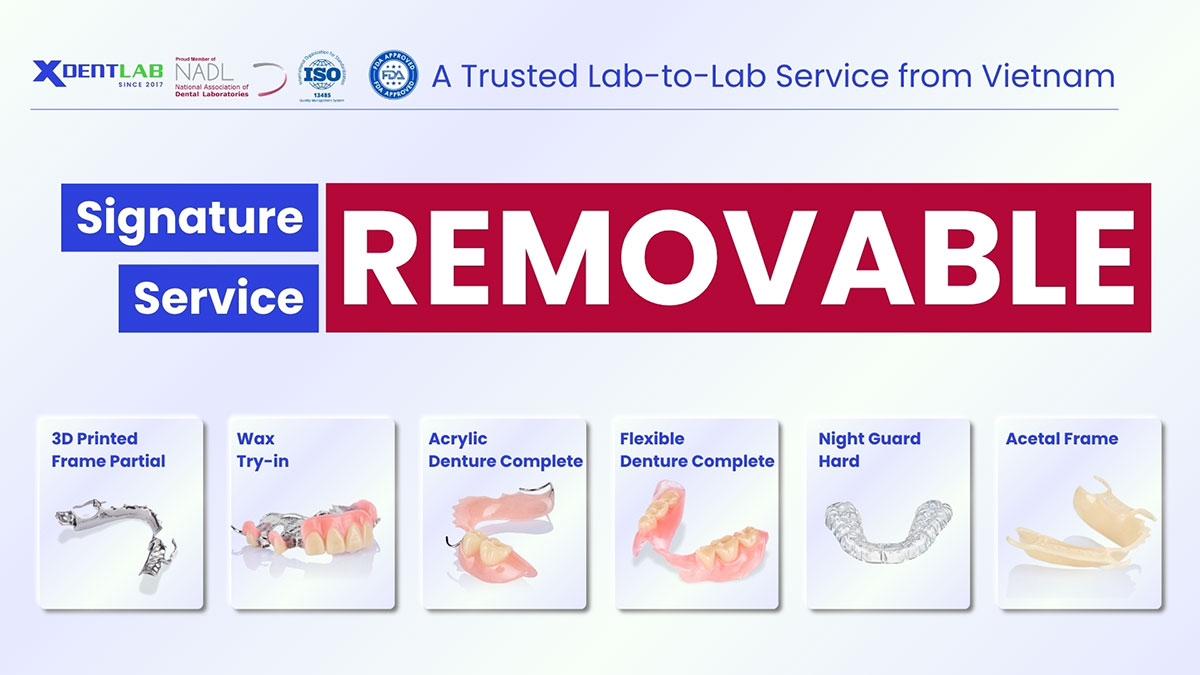
Our 5 Commitments Built on “Trusted. Commitment. Quality”
- Commit to 100% FDA-Approved Materials
- Commit to Large-Scale Manufacturing, high volume, remake rate < 1%.
- Commit to 2~3 days in lab (*digital file)
- Commit to Cost Savings 30%
- Commit to Best Price
XDENT LAB | A Trusted Lab-to-Lab Service from Vietnam
Share this post:
Related Posts
Understanding and applying the correct Layer Thickness settings not only saves labs time and production cost, but also ensures stable output quality for each specific type of dental product.
A technical guide to post curing in digital denture fabrication, helping dental lab technicians understand the parameters for consistent product quality.
Learn about digital dentistry, including scanners, CAD/CAM, 3D printing, AI, workflows, benefits, challenges, and dental lab applications.

