
Explore additive manufacturing technologies for modern dental laboratories, including 3D printing methods, materials, applications, and production benefits.
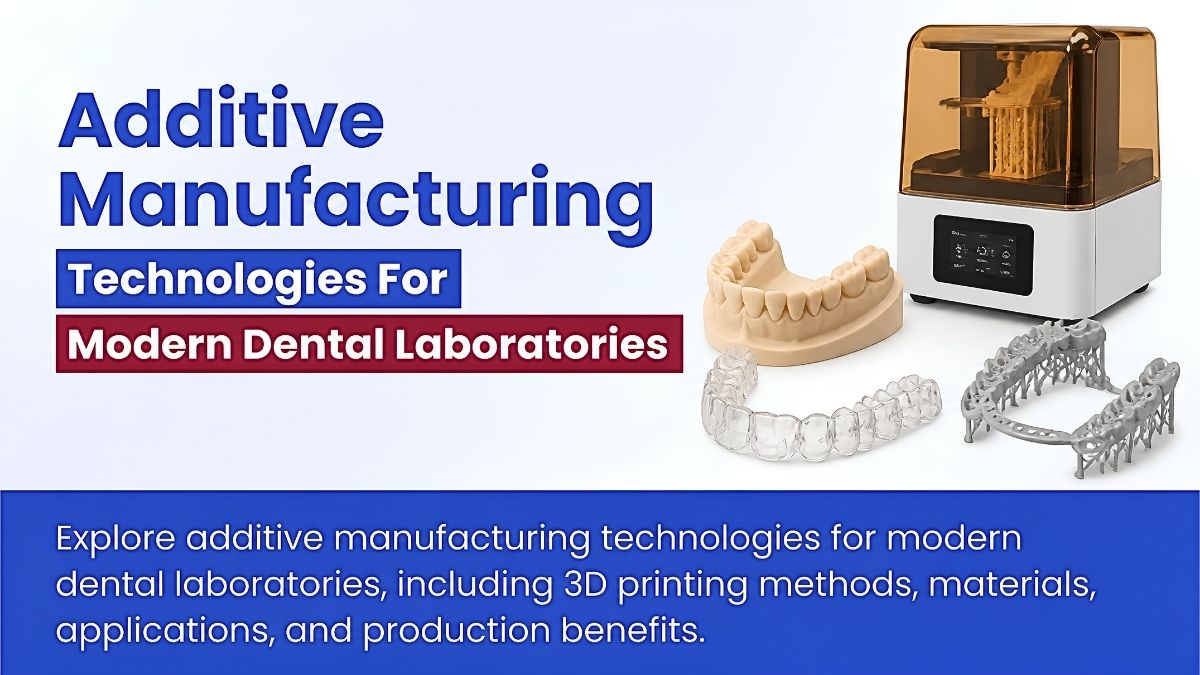
Table of contents [Show]
- What is additive manufacturing in dentistry?
- Main additive manufacturing technologies in dentistry
- Materials used in additive manufacturing for dentistry
- Applications of additive manufacturing in dentistry
- Advantages of additive manufacturing in dentistry
- Challenges and limitations
- Future direction of additive manufacturing in dentistry
- Why additive manufacturing matters for lab-to-lab outsourcing
- Key takeaways
- References
Additive manufacturing technologies have become one of the most transformative forces in modern dentistry because they change how dental products are designed, produced, and delivered. Commonly known as 3D printing, additive manufacturing allows dental laboratories and clinics to create highly accurate, patient-specific devices layer by layer using digital files. This shift is not just about speed. It is about precision, repeatability, customization, and more connected workflows across restorative, surgical, orthodontic, and prosthetic dentistry.
For dental practices and laboratory partners, additive manufacturing is no longer a niche capability. It is becoming a core production method for dental models, surgical guides, clear aligner workflows, provisional restorations, denture components, implant planning aids, and selected final prosthetic frameworks. As digital dentistry continues to mature, the importance of additive manufacturing grows alongside CAD/CAM, intraoral scanning, and AI-assisted design. This article explores the major additive manufacturing technologies used in dentistry, their applications, materials, benefits, limitations, and strategic value for dental lab outsourcing.
What is additive manufacturing in dentistry?
Additive manufacturing in dentistry is the process of producing three-dimensional dental objects by building them layer by layer from a digital design file.
Core definition
Unlike subtractive manufacturing, which removes material from a solid block, additive manufacturing creates an object by adding material only where needed. In dentistry, this supports the fabrication of highly customized products with strong design control and reduced material waste.
Why additive manufacturing matters
Additive manufacturing has become important in dentistry because it helps enable patient-specific design, faster production workflows, high geometric accuracy, better digital integration, lower material waste in many workflows, and improved consistency between design and manufacturing.
This matters not only for efficiency, but also for predictability across increasingly complex dental cases.
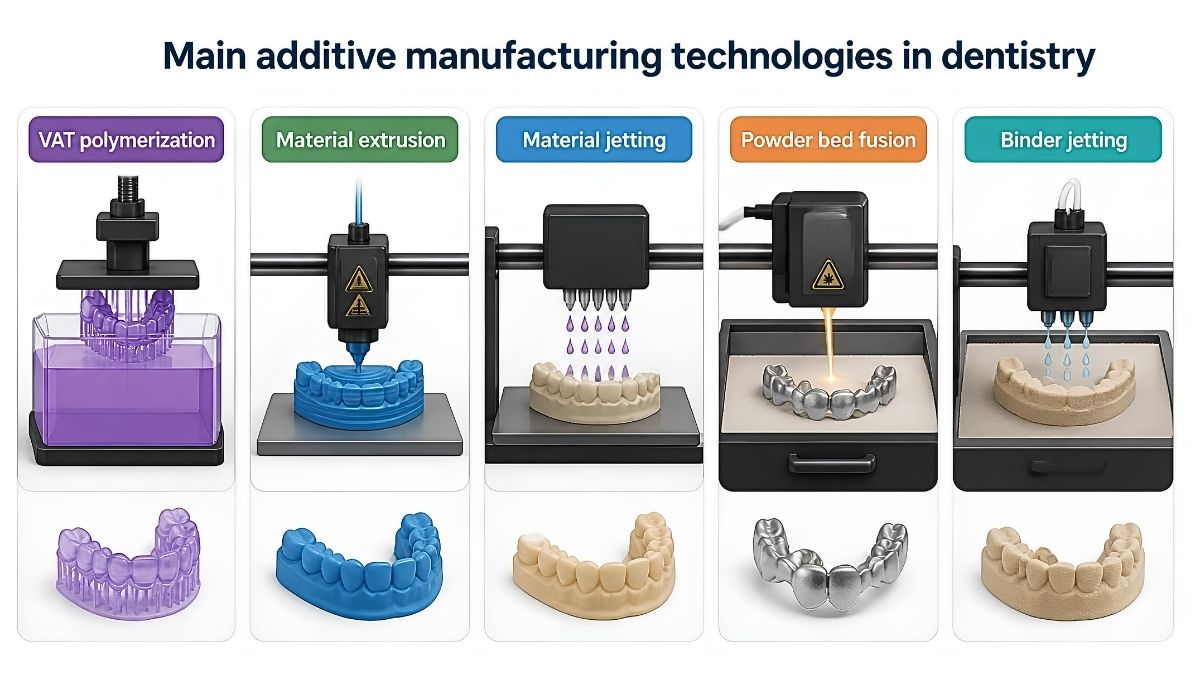
Main additive manufacturing technologies in dentistry
Different additive manufacturing technologies serve different clinical and laboratory purposes. The choice depends on required accuracy, surface detail, material type, mechanical needs, and production scale.
Vat polymerization
Vat polymerization is one of the most widely used additive manufacturing methods in dentistry.
Common types
The two most common forms are stereolithography, or SLA, and digital light processing, or DLP.
These systems use light to cure liquid photopolymer resin layer by layer.
Dental applications
Vat polymerization is commonly used for surgical guides, dental models, clear aligner models, temporary restorations, denture try-ins, and custom trays.
Its main strengths are fine detail, smooth surface quality, and suitability for highly accurate dental workflows.
Material extrusion
Material extrusion is commonly associated with fused deposition modeling, or FDM.
How it works
This process extrudes heated thermoplastic filament through a nozzle to build an object layer by layer.
Dental relevance
In dentistry, material extrusion is more commonly used for prototypes, educational models, and some non-critical dental models.
It is generally less dominant than resin-based systems for high-precision restorative work, but it remains useful for lower-cost and non-final applications.
Material jetting
Material jetting deposits droplets of photopolymer material and cures them with light.
Key strengths
This method is known for high detail resolution, smooth surface finish, and potential for multi-material printing in advanced systems.
Dental uses
Dental applications may include highly detailed models, wax patterns for casting, advanced prototypes, and specialty visual and teaching models.
Powder bed fusion
Powder bed fusion includes technologies such as selective laser sintering and selective laser melting.
Common forms
The main dental-relevant categories include selective laser sintering, or SLS, and selective laser melting, or SLM.
These systems use laser energy to fuse powdered material, often metal, into solid structures.
Dental applications
Powder bed fusion is highly relevant for metal frameworks, removable partial denture structures, implant-related components, and selected crown and bridge substructures.
Its major value lies in producing strong and complex metal parts with good design flexibility.
Binder jetting
Binder jetting works by depositing a liquid binding agent onto a powder bed.
Potential role in dentistry
Although less dominant than vat polymerization or powder bed fusion in many dental labs, binder jetting can support dental molds, framework prototypes, and specialty manufacturing workflows.
Its long-term dental role may expand as materials and finishing methods improve.
Materials used in additive manufacturing for dentistry
The performance of additive manufacturing depends heavily on material science. The printer matters, but the material often decides the clinical future of the product.
Photopolymer resins
Photopolymer resins are used in vat polymerization and material jetting systems.
Common dental indications
They may be designed for models, surgical guides, temporary crowns and bridges, denture bases, try-ins, splints, and indirect bonding trays.
Material properties vary significantly depending on intended use, curing protocol, and regulatory approval.
Thermoplastic filaments
Thermoplastic materials are used in material extrusion systems.
Typical examples
Common examples may include PLA, ABS, and other industrial polymers used in non-final dental applications.
These materials are more relevant to prototypes and educational use than definitive clinical prosthetics.
Metal additive manufacturing often uses powders such as titanium, cobalt-chromium, and stainless steel in limited non-definitive contexts.
These materials are important for durable, strong, and biocompatible frameworks and implant-related structures.
Ceramic and hybrid material development
Although still developing compared with resin and metal workflows, ceramic and hybrid materials are attracting attention for future additive applications requiring aesthetics, wear resistance, and biological compatibility.
Applications of additive manufacturing in dentistry
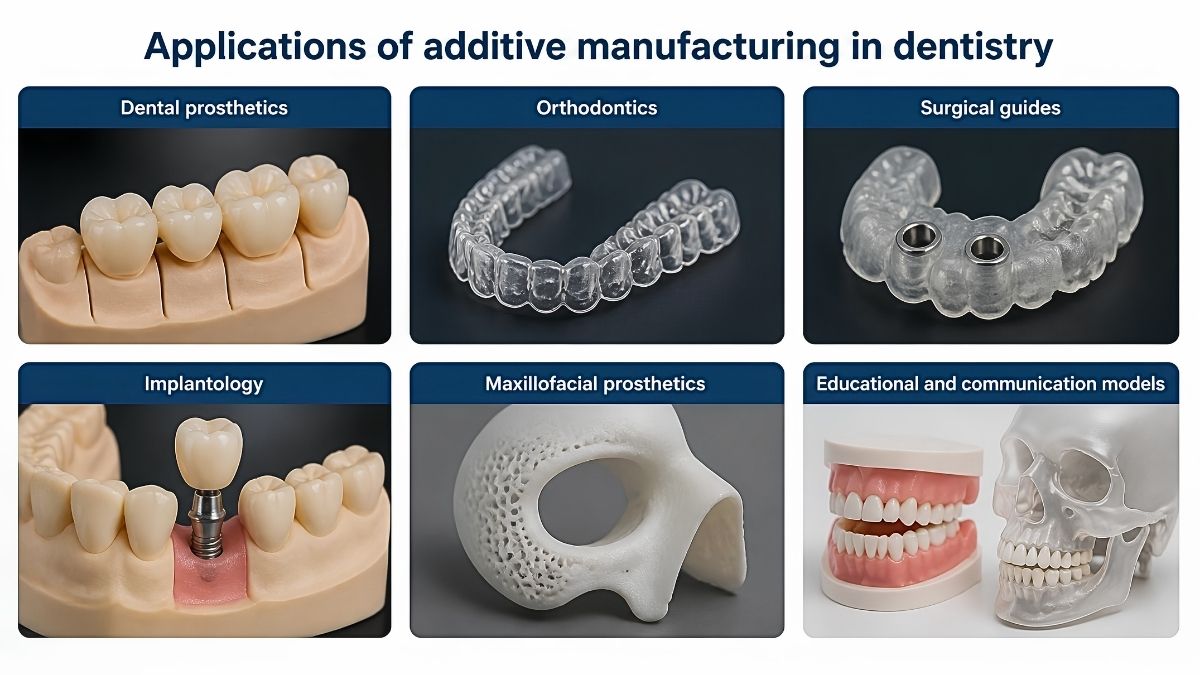
Additive manufacturing touches nearly every major branch of dentistry, particularly where digital precision and customization are essential.
Dental prosthetics
Additive manufacturing supports the fabrication of provisional crowns and bridges, denture bases, denture try-ins, wax patterns, framework prototypes, and partial denture components in selected workflows.
Its value is especially strong where speed and repeatability are critical.
Orthodontics
Orthodontic workflows use additive manufacturing for clear aligner models, retainers, indirect bonding trays, and diagnostic models.
This is one of the fastest-growing areas of 3D printing in dentistry.
Surgical guides
Custom surgical guides for implant placement are among the most established dental uses of additive manufacturing.
Clinical advantages of surgical guides
These guides help improve implant placement precision, surgical predictability, treatment planning transfer, and chairside efficiency.
Implantology
In implant dentistry, additive manufacturing supports surgical planning guides, custom components in selected workflows, framework fabrication, and prototype verification devices.
This integration strengthens prosthetically driven planning and restorative coordination.
Maxillofacial prosthetics
Additive manufacturing is also highly valuable in maxillofacial rehabilitation, where patient-specific anatomy is complex and customization is essential.
Educational and communication models
Dental laboratories and clinics use printed models for patient education, team communication, case planning, and training and simulation.
These models can improve understanding and support more effective decision-making.
Advantages of additive manufacturing in dentistry
The growth of additive manufacturing is driven by a set of practical and strategic advantages.
Customization
Additive manufacturing supports highly personalized production based on patient-specific digital data. This improves fit, design accuracy, and case adaptation.
Precision
Well-calibrated digital workflows can produce highly detailed results with strong consistency, especially for models, guides, and designed prosthetic components.
Speed and workflow efficiency
Additive manufacturing often reduces turnaround time by streamlining production and minimizing labor-intensive manual steps.
Material efficiency
Because the object is built layer by layer, waste can be reduced compared with subtractive methods in many workflows.
Scalability
Dental laboratories can scale production more effectively once digital systems, validated materials, and standardized protocols are in place.
Challenges and limitations
Despite its advantages, additive manufacturing also introduces important technical, financial, and regulatory challenges.
High initial investment
Printers, software, curing systems, validation protocols, and material inventories can involve significant startup costs.
Material limitations
Not every material performs equally well in printed form. Some printed materials may still have limitations in strength, wear resistance, long-term stability, or indication range compared with traditional options.
Post-processing requirements
Printed dental products often require washing, post-curing, support removal, surface finishing, inspection, and validation.
This means printing is not the end of the workflow. It is only one part of it.
Regulatory compliance
Dental products must meet strict quality, biocompatibility, and traceability expectations, especially in regulated markets.
For outsourcing partners and production labs, this makes quality systems, documentation, and validated manufacturing processes essential.
Future direction of additive manufacturing in dentistry
The future of additive manufacturing in dentistry is moving toward greater biological sophistication, production efficiency, and digital integration.
Bioprinting research
Bioprinting remains an emerging area of research involving tissue engineering for structures such as bone, gingiva, and potentially more complex biological restorations.
Multi-material printing
Future systems may increasingly support printing with multiple materials in a single workflow, allowing more realistic and functionally layered dental products.
AI-integrated workflows
Artificial intelligence is expected to contribute to design automation, error detection, print optimization, support generation, quality control, and workflow planning.
Sustainability improvements
Dental manufacturing is also moving toward more sustainable production methods through improved material efficiency, lower waste, smarter nesting, and longer-lasting validated workflows.
Why additive manufacturing matters for lab-to-lab outsourcing
For dental practices, additive manufacturing is not only a technology trend. It is a production capability that directly affects turnaround time, consistency, customization, and communication.
What practices need from a lab partner
Practices need outsourcing partners who can provide validated digital workflows, accurate printed models and guides, consistent materials and finishing, quality control documentation, scalable production capacity, and reliable turnaround.
Relevance to XDENT LAB
For XDENT LAB, additive manufacturing technologies align strongly with its role as a Vietnam dental lab focused on lab-to-lab full service, removable and implant solutions, and dental lab outsourcing for demanding international markets.
With advanced manufacturing systems, certified technicians, FDA and ISO-oriented standards, and scalable production through multiple facilities, XDENT LAB is positioned to support dental practices that need precision, consistency, and digital manufacturing reliability across restorative and prosthetic workflows.
Key takeaways
Additive manufacturing technologies are reshaping dentistry by enabling highly customized, digitally controlled, and increasingly efficient production across restorative, surgical, orthodontic, and prosthetic applications. From vat polymerization and material jetting to metal powder bed fusion, each technology serves different clinical and laboratory purposes.
For dental practices and outsourcing partners, the real value of additive manufacturing lies not only in printing objects, but in building a dependable digital production system. When combined with validated materials, strong post-processing protocols, and laboratory expertise, additive manufacturing becomes a major driver of precision, scalability, and modern dental workflow integration.
References
- Additive manufacturing for dentistry - ScienceDirect
- Current status and applications of additive manufacturing - PMC
- Additive manufacturing technologies and their applications - MDPI
- How 3D printing is shaping the future of dental care - Decisions in Dentistry
About XDENT LAB:
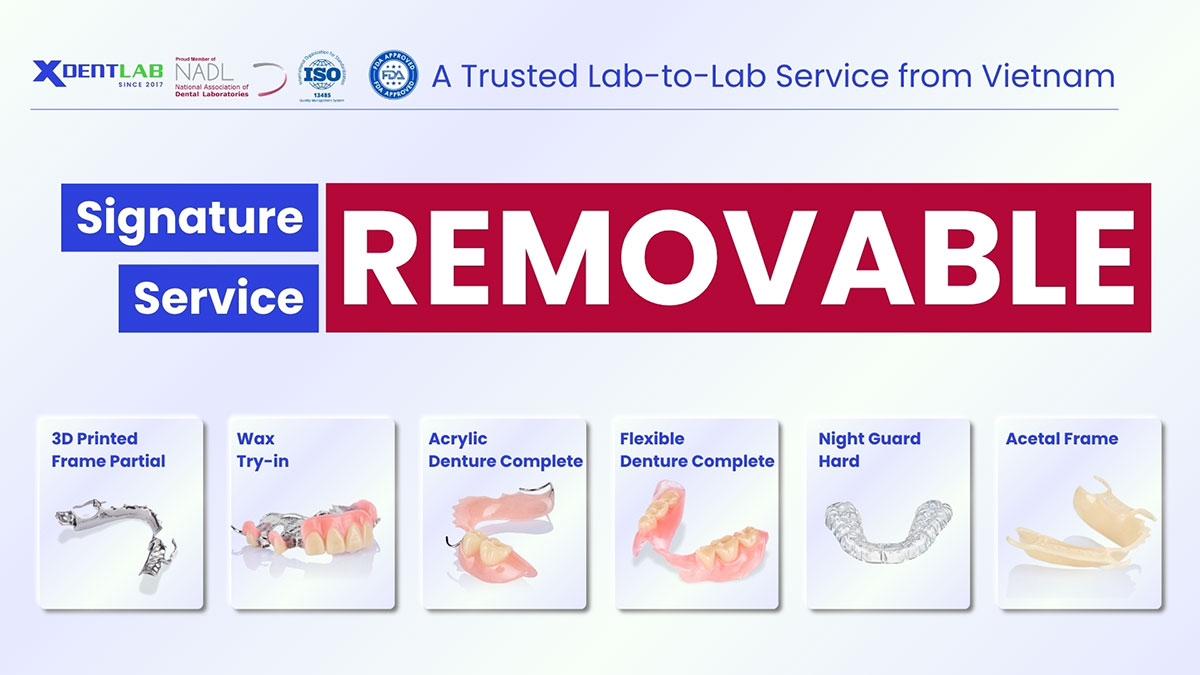
We are experts in Lab-to-Lab Full Service from Vietnam, with the signature services of Removable, meet U.S. market standards - approved FDA & ISO. Founded in 2017, from local root to global reach, we scale with 2 Factories with over 100+ employees.
Our 5 Commitments Built on “Trusted. Commitment. Quality”
- Commit to 100% FDA-Approved Materials
- Commit to Large-Scale Manufacturing, high volume, remake rate < 1%.
- Commit to 2~3 days in lab (*digital file)
- Commit to Cost Savings 30%
- Commit to Best Price
XDENT LAB | A Trusted Lab-to-Lab Service from Vietnam
Share this post:
Related Posts
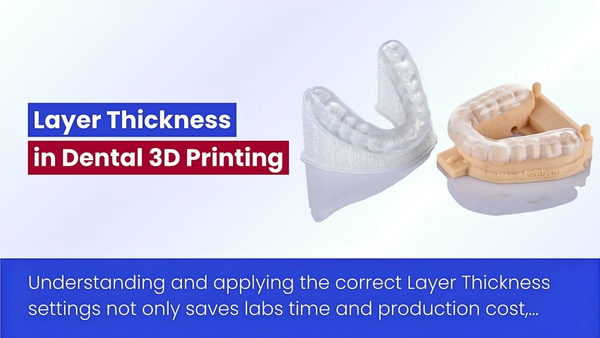
Understanding and applying the correct Layer Thickness settings not only saves labs time and production cost, but also ensures stable output quality for each specific type of dental product.
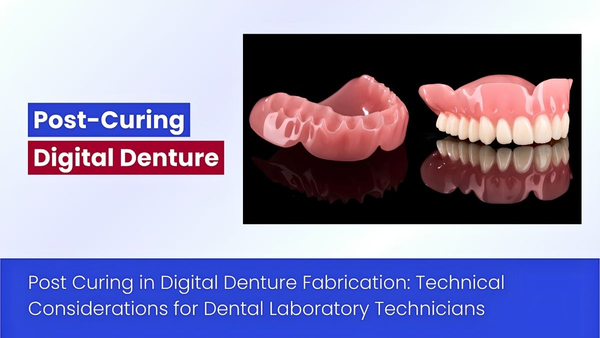
A technical guide to post curing in digital denture fabrication, helping dental lab technicians understand the parameters for consistent product quality.
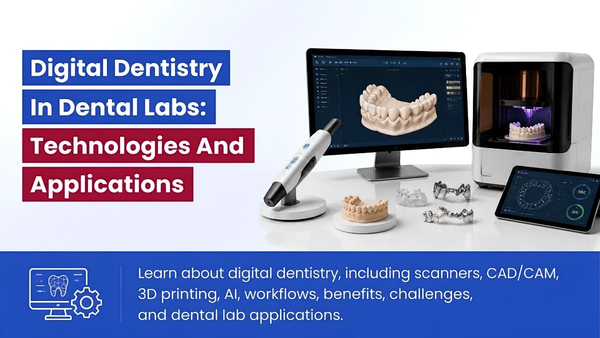
Learn about digital dentistry, including scanners, CAD/CAM, 3D printing, AI, workflows, benefits, challenges, and dental lab applications.

