
Learn about the differences between Customized Abutments and Stock Abutments in terms of design, manufacturing processes, precision, and customization in implant restorations.
Table of contents [Show]
- What Customized Abutments and Stock Abutments are
- Key Design Differences
- Differences in the Manufacturing Process
- Materials Used for Custom and Stock Abutments
- What Dental Labs Should Consider When Choosing Custom or Stock Abutments
- XDENT LAB – A Provider of Customized Abutment Solutions
- Conclusion
- References
This article highlights the differences between two commonly used types of abutments: Customized Abutment and Stock Abutment. Although they serve the same basic function, they differ in design, manufacturing methods, and the ability to be customized for individual cases. XDENT LAB will help you understand the characteristics, advantages, and limitations of each type, providing a better basis for selecting a suitable solution for implant restoration requirements while ensuring precision, aesthetics, and functional efficiency.
What Customized Abutments and Stock Abutments are
Customized Abutment
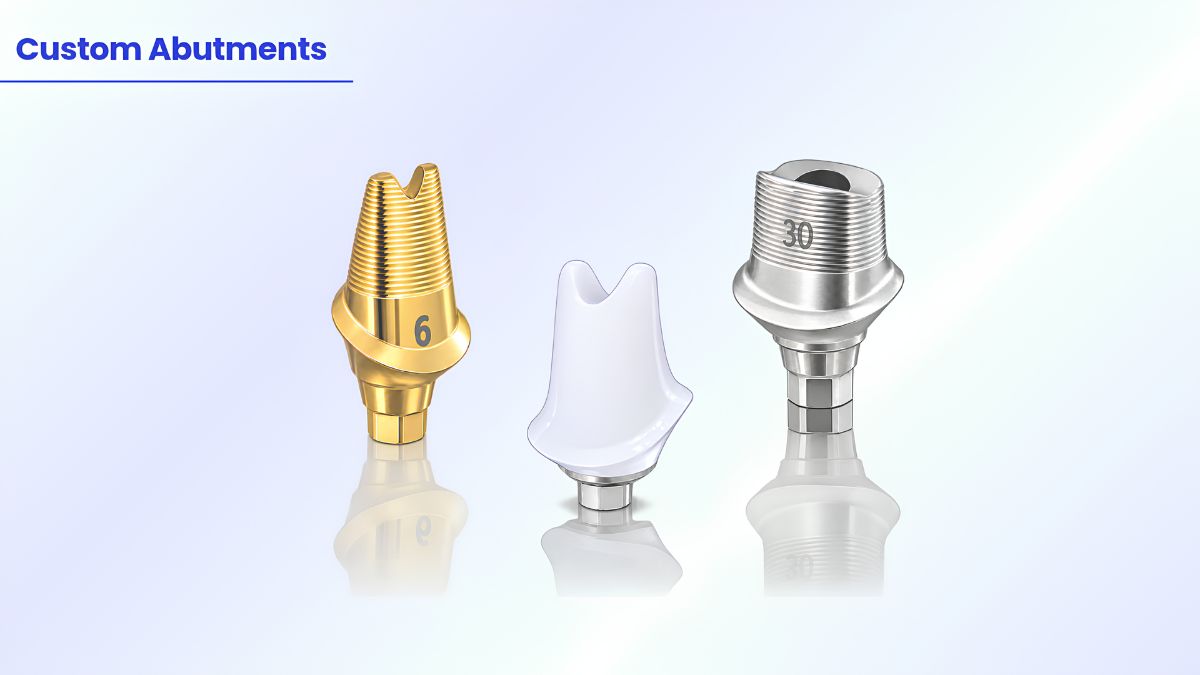
A Customized Abutment is an abutment individually designed to meet the requirements of each implant restoration case. Rather than relying entirely on predefined standard shapes, its shape and dimensions can be adjusted based on implant position, restorative space, soft tissue contours, and the final restoration design.
Today, many types of Customized Abutments are digitally designed using CAD software and manufactured through CAM milling technology.
Some key characteristics of Customized Abutments include:
- Individually designed for each case.
- Better control over shape and dimensions.
- Can be adjusted to suit the desired Emergence Profile and restoration contours.
- Usually manufactured using CAD/CAM technology.
Customized Abutments are particularly useful in cases where a standard abutment cannot achieve the desired shape or dimensions without extensive adjustments.
XDENT LAB has expertise in manufacturing Customised Abutment Each Customised Abutment is developed according to the requirements of the individual restoration case, rather than using a fixed configuration for all cases.
Stock Abutment
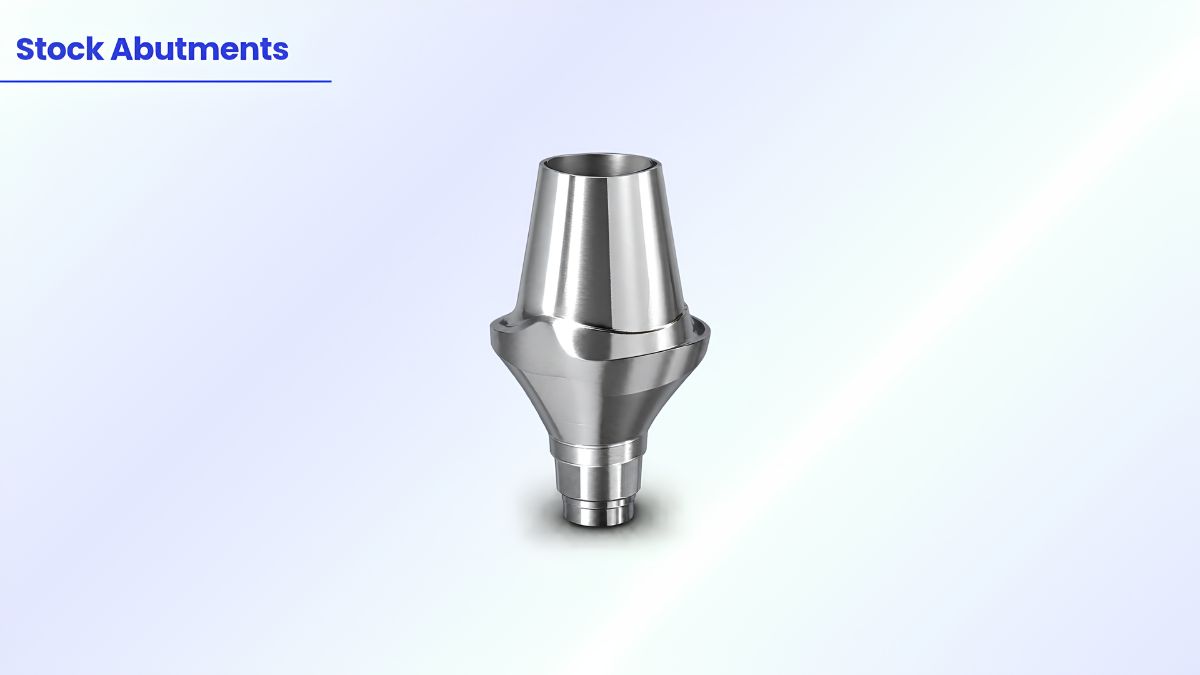
A Stock Abutment is an abutment manufactured in advance by the implant system manufacturer. It is produced in standardized shapes, dimensions, and connection configurations to be compatible with specific implant systems.
Some key characteristics of Stock Abutments include:
- Pre-manufactured according to standardized specifications.
- Available in various shapes, heights, diameters, and angulations.
- Designed to be compatible with specific implant systems.
- May require additional adjustments to suit the restoration design.
Stock Abutments simplify the restoration process because their basic shape and implant connection have already been determined by the manufacturer.
Key Design Differences
The biggest difference between the two types of abutments lies in their design and external shape.
Shape and Dimensions
- Customized Abutment: Allows adjustments to various design parameters, such as abutment height and diameter, cervical contour, external wall shape, and the position and shape of the restorative finish line (Margin).
- Stock Abutment: Has predefined shapes and dimensions. However, the selected shape may not always fully match the available restorative space or the desired contour of the final crown.
Emergence Profile
The Emergence Profile refers to the contour of the restoration as it transitions from the implant or abutment, passes through the surrounding soft tissue, and extends toward the crown body.
- Customized Abutment: Provides greater flexibility in shaping this transition area. Technicians can design contours that better suit the implant position and the anticipated crown shape.
- Stock Abutment: Is largely determined by the pre-existing shape provided by the manufacturer.
Margin Position
The Margin is the finishing boundary where the restoration meets the abutment.
- Customized Abutment: The position and shape of the Margin can be designed according to the restoration requirements.
- Stock Abutment: Usually has a predefined Margin configuration. These configurations may not always match the desired finish line position in every specific case.
Implant Angulation
The position and angulation of the implant can affect the available space for the restoration. When an implant is placed at an angle or restorative space is limited, a standard abutment may not provide the desired external shape.
- Customized Abutment: Offers greater flexibility in adjusting the abutment body to accommodate these conditions.
- Stock Abutment: Has angulation, height, and shape predefined by the manufacturer, making it less flexible when the implant is angled or its axis is not favorable for the restorative direction.
Differences in the Manufacturing Process
In addition to design, the two types of abutments also differ in their manufacturing processes.
Customized Abutment Manufacturing Process
Customized Abutments are commonly manufactured through a digital workflow. Unlike standard products, the external shape of a Customized Abutment is individually designed before manufacturing.
A typical CAD/CAM workflow includes:
- Step 1: Digital Data Acquisition
The Dental Lab receives the necessary data, such as intraoral scan data, scanned model data, implant position information, and details of the corresponding implant system.
Accurate input data is essential because the abutment design must match the actual implant connection and restoration requirements.
- Step 2: CAD Design
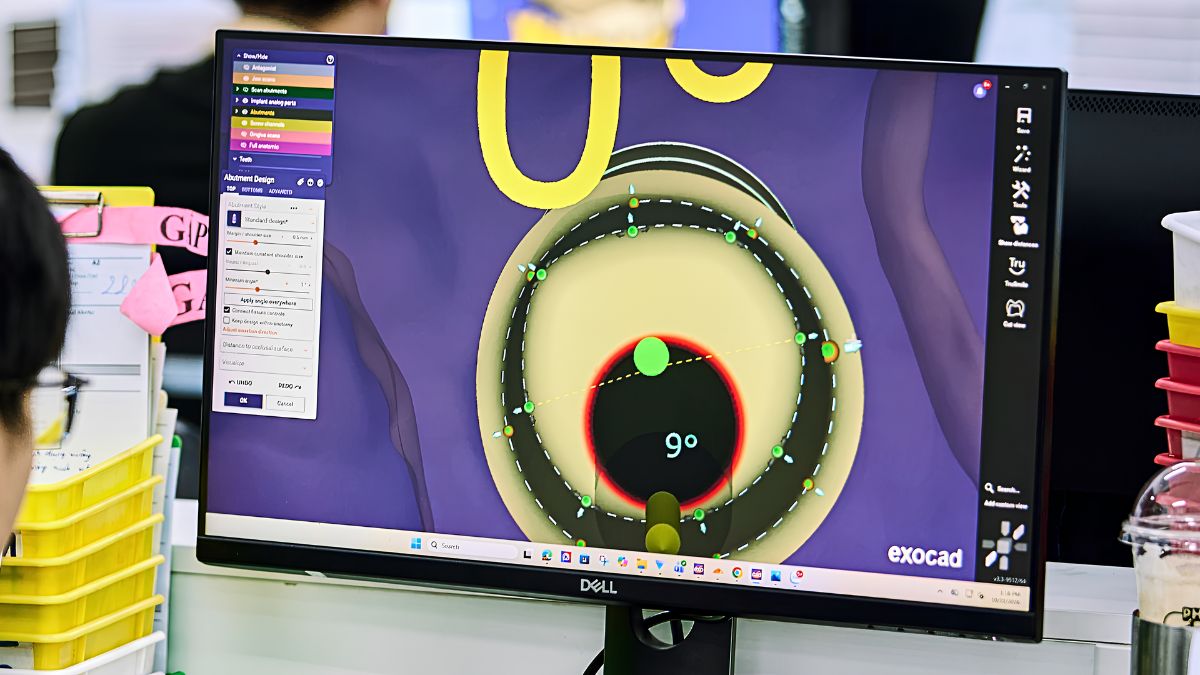
Technicians use specialized dental CAD software to design the abutment.
At this stage, technicians can determine:
- Abutment height and diameter.
- Emergence Profile.
- Cervical contour and Margin position.
- External shape.
- The space required for the final restoration.
The design must also take into account the implant connection and the material selected for manufacturing.
For Customized Abutments at XDENT LAB, parameters such as height, angulation, and finish line position are important considerations during the design process. The goal is to create an abutment that matches the input data and restoration requirements.
- Step 3: CAM Milling
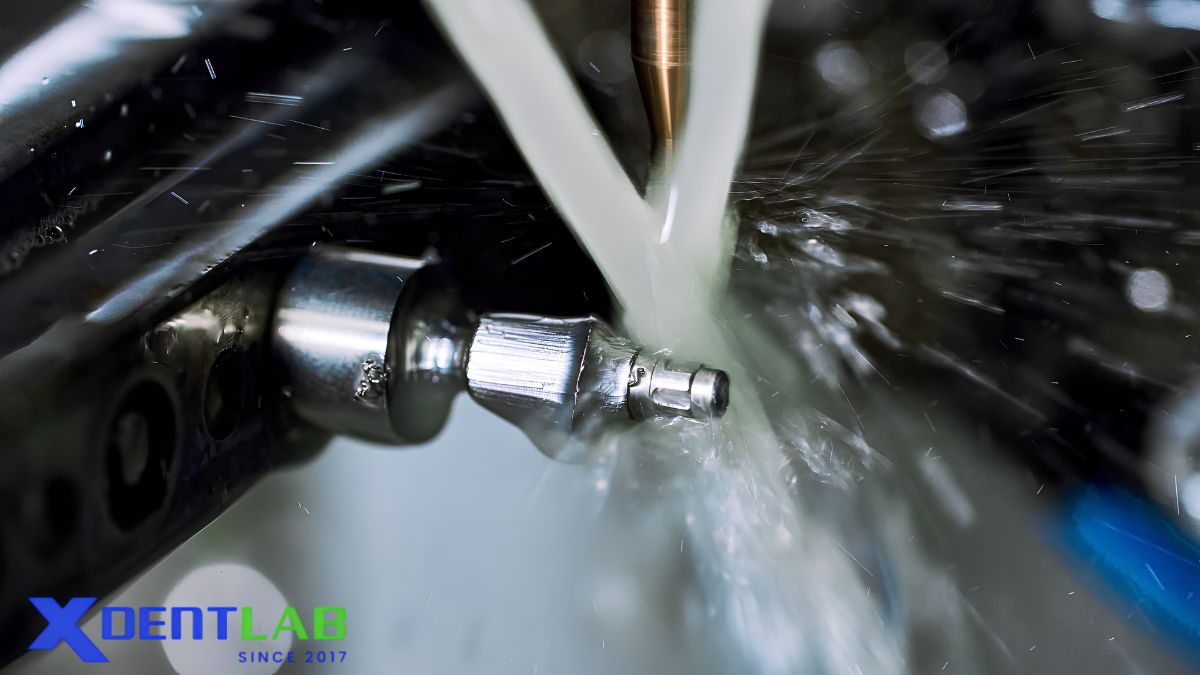
Once the design is completed, the data is transferred to CAM software to generate machining instructions for the milling machine. The abutment is then manufactured using a milling machine.
One common method is to use a Pre-mill Abutment. This is a pre-manufactured abutment blank in which the implant connection has already been completed by the component manufacturer. The Dental Lab mills the external body according to the customized design while preserving the original standardized connection.
Another method is to mill the abutment from a suitable material disc or block. However, directly machining the implant connection requires an appropriately validated manufacturing system, compatible components, and a strict quality control process.
- Step 4: Finishing and Quality Inspection
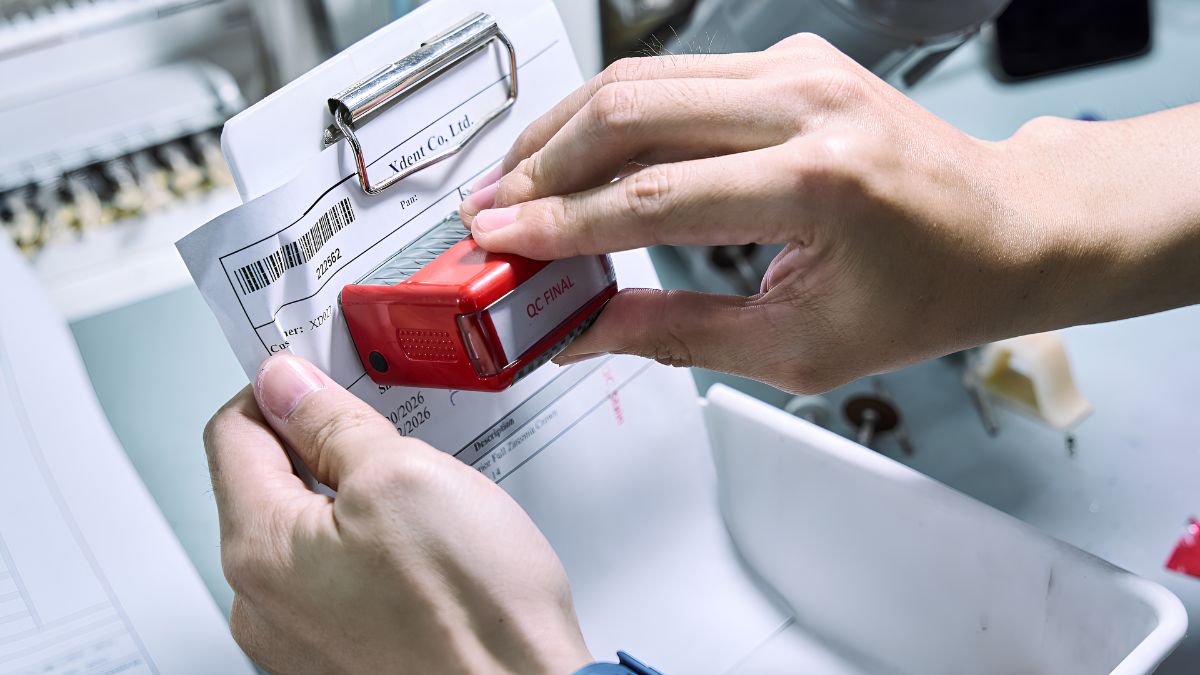
After milling, the abutment undergoes finishing procedures depending on the material and manufacturing instructions.
The Dental Lab performs the following checks:
- Overall dimensions and design accuracy.
- Surface quality and finishing.
- Compatibility of the implant connection.
- Seating fit and placement accuracy.
- Cleanliness and the absence of machining debris.
These inspection steps help ensure that the finished component is suitable for the next stage of the restoration manufacturing process.
At XDENT LAB, we focus on ensuring consistency between the input data, design, and requirements of each case. These factors need to be controlled throughout the process to help Dental Lab partners receive products that match the information provided.
Stock Abutment Manufacturing Process
Stock Abutments are industrially manufactured through a standardized process.
The dimensions and implant connection of each product are determined before it is supplied to dentists and Dental Labs.
The general process includes:
- Design and Specification: The manufacturer determines the abutment shape and compatible implant connection system.
- Industrial Manufacturing: Components are produced through a controlled manufacturing process.
- Quality Inspection: Dimensions, surface quality, and connection compatibility are checked.
- Distribution: Finished abutments are supplied through standardized product catalogs.
Since the products are pre-manufactured, the Dental Lab does not need to design and manufacture the entire abutment for each case.
Depending on the product, technicians may perform some limited adjustments to the external portion to suit the restoration. However, all adjustments must follow the manufacturer's instructions and must not affect the implant connection or the integrity of the product.
Materials Used for Custom and Stock Abutments
Both Stock and Customized Abutments can be manufactured from various materials, depending on the implant system and restoration requirements.
Titanium
Titanium and titanium alloys are widely used in implant abutment manufacturing due to their mechanical properties and established applications in implant dentistry. Titanium is commonly selected when strength and the ability to meet functional requirements are important considerations.
Titanium is commonly selected when strength and the ability to meet functional requirements are important considerations. This material can be used for both standard components and CAD/CAM-manufactured Customized Abutments.
We offer Titanium 5 as a material option for Customized Abutments. Titanium Grade 5 is one of the common materials used in customized abutment manufacturing and is widely used in various implant systems.
Zirconia
Zirconia is a ceramic material used in implant restorations, particularly when aesthetics are a consideration. Its color, which is close to natural tooth color, can offer an advantage in cases where the abutment may affect the appearance of the surrounding soft tissue. However, Zirconia Abutments require careful consideration of material thickness, connection design, and the specific implant system.
Read more: Dental Implant Materials: Titanium vs Zirconia - A Comprehensive Review
What Dental Labs Should Consider When Choosing Custom or Stock Abutments
No type of abutment is always better in every situation. The choice depends on the specific requirements of each restoration case.
Before selecting an abutment, Dental Labs should consider the following criteria:
- Implant Compatibility: Confirm the manufacturer, implant system, connection type, and component specifications.
- Implant Position: Evaluate the position and angulation of the implant.
- Restorative Space: Check whether the available height and width are suitable for the restoration design.
- Emergence Profile: Consider the required transition contour from the implant-supported component to the final crown.
- Material Requirements: Select a material that suits the design and mechanical requirements of the restoration.
- Manufacturing Capabilities: Consider the available CAD/CAM software, compatible implant libraries, milling systems, and quality control procedures.
If a partner needs a standardized shape that meets the requirements of the case, a Stock Abutment may be a suitable choice. In contrast, when greater control over parameters such as height, angulation, or finish line position is required, a Customized Abutment is an option worth considering.
XDENT LAB – A Provider of Customized Abutment Solutions
With experience in implant restorations, XDENT LAB provides Customized Abutment manufacturing services for Dental Labs seeking flexible, case-specific design solutions. Rather than being limited to available standard configurations, our Customized Abutments are designed based on the data and specific requirements of each restoration case.
XDENT LAB offers material options for Customized Abutments to meet different requirements for mechanical strength and aesthetics:
- Titanium (Grade 5): High mechanical strength and load resistance. High biocompatibility and safe for peri-implant tissues. A common choice for customized restorations. It is also a widely used material across most implant brands.
In terms of compatibility, XDENT LAB supports popular implant systems such as:
- Nobel Biocare
- Straumann
- Dentium
- Osstem
- etc.
For Customized Abutment cases with complete digital impression data, the production time at XDENT LAB is 2–3 working days at the laboratory.
To ensure a smooth process, XDENT LAB encourages partners to provide all necessary information from the beginning, including scan data, the implant system, connection type, and specific design requirements. Actual production time may vary depending on case complexity and the completeness of the input data.
Conclusion
Stock Abutments and Customized Abutments serve the same basic function but differ in design methods, customization capabilities, and manufacturing processes. Stock Abutments provide pre-manufactured standardized solutions that simplify the restoration process. Meanwhile, Customized Abutments offer greater flexibility in adjusting external shapes to meet the specific requirements of each case.
Looking for a Customized Abutment manufacturing partner for your Dental Lab? Connect with XDENT LAB to discuss your needs and submit your restoration case information.
- Website: https://xdentlab.com/
- Email: [email protected]
References
Share this post:
Related Posts
Explore the key components of screw-retained implant restorations, their functions, and how they work together to ensure stability, precision, and esthetics.
Discover the screw-retained implant crown fabrication process at a dental laboratory, from case intake and data verification to CAD design, material selection, milling, quality control, and final deli...
Explore maxillofacial prosthodontics, from obturators and facial prostheses to materials, digital design and dental lab workflows.

