
Learn how to select materials for cement-retained implant crowns and bridges, comparing Zirconia, E.max®, PFM, Full Metal, and key technical factors.
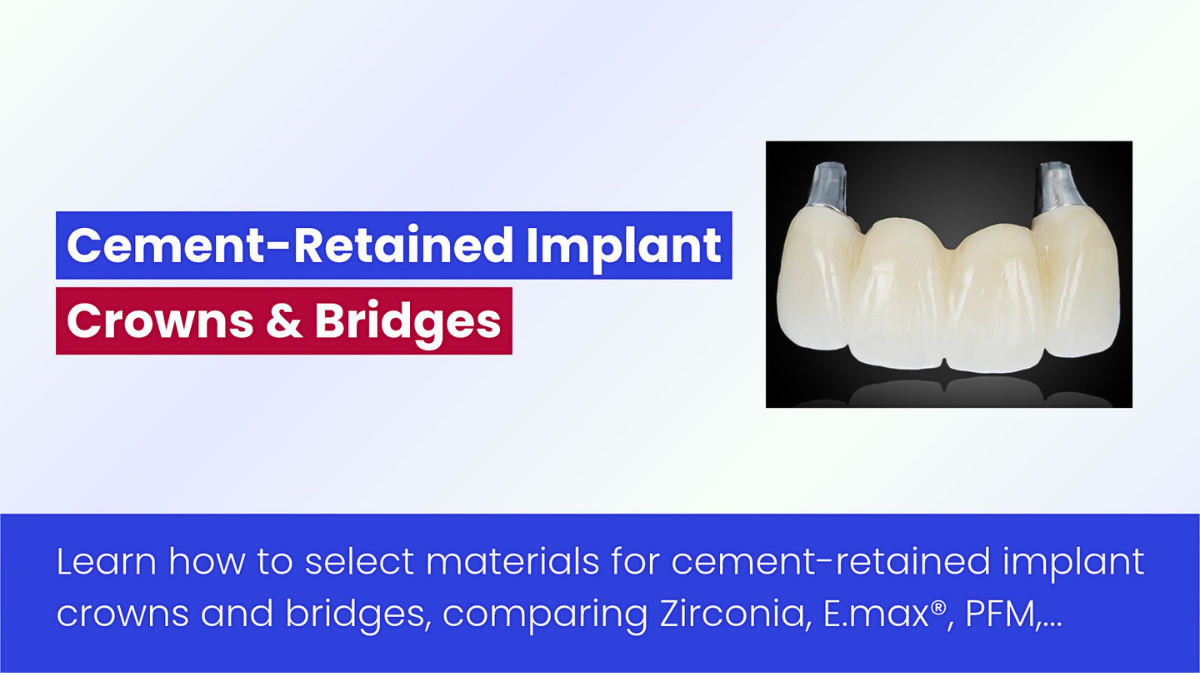
Table of contents [Show]
- What Are Cement-Retained Implant Restorations?
- Cement-Retained vs. Screw-Retained: What Are the Differences?
- Common Materials for Cement-Retained Implant Crowns & Bridges
- Key Factors in Material Selection
- The Role of Dental Laboratories in Material Selection
- Material Solutions for Cement-Retained Implant Restorations at XDENT LAB
- Why Choose XDENT LAB as Your Lab-to-Lab Partner?
- Conclusion
- References
This article provides essential information on material selection for Cement-Retained Implant Crowns and Bridges, focusing on material properties, esthetic requirements, load-bearing capacity, and technical considerations during the fabrication process.
For dental laboratories, understanding these properties helps identify fabrication solutions that are more suitable for each clinical indication while maintaining a balance between restoration quality, production efficiency, and partner requirements. Let's explore the common materials and key criteria for selecting materials for Cement-Retained Implant Restorations with XDENT LAB.
What Are Cement-Retained Implant Restorations?
Cement-Retained Implant Restoration is a restorative method in which a crown or bridge is cemented onto an Abutment using dental cement, rather than being directly secured to the Implant with a screw.
A basic cement-retained implant restoration consists of the following components:
- Implant Fixture: The implant fixture is placed in the jawbone and serves as an artificial tooth root.
- Abutment: The connecting component between the Implant and the Crown, providing support and retention for the restoration.
- Dental Cement: The luting material used to secure the crown or bridge onto the Abutment.
- Crown/Bridge: The upper restorative component, fabricated from materials such as Zirconia, E.max®, PFM, or Full Metal.
Cement-Retained vs. Screw-Retained: What Are the Differences?
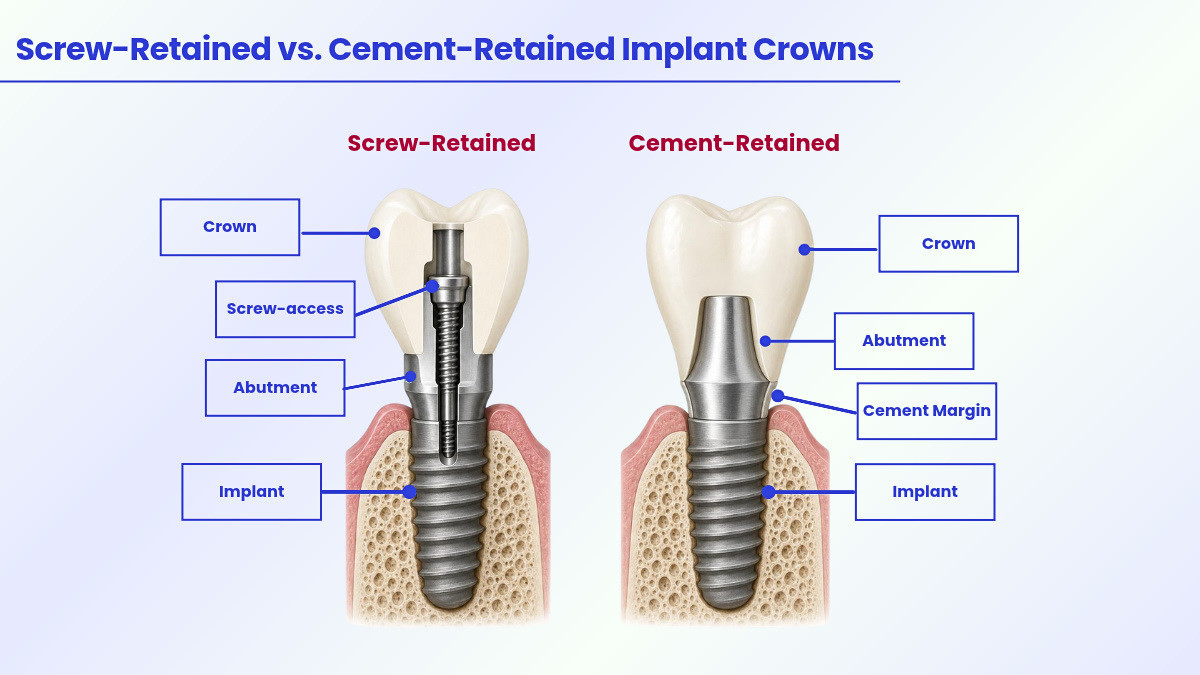
The main difference between these two methods lies in how the restoration is retained.
- Cement-Retained: The restoration is cemented onto the Abutment using Dental Cement. No screw access hole is required through the occlusal surface or outer surface of the crown.
- Screw-Retained: The restoration is secured with a screw through a Screw Access Channel, allowing it to be removed when maintenance is required.
Cement-Retained restorations are often considered when avoiding a screw access hole that may affect the contour and esthetics of the restoration is a priority. However, this method requires the dentist to carefully control the Abutment margin position and the amount of excess cement remaining after cementation.
For dental laboratories, Abutment design plays an important role because wall height, taper, and margin position directly affect restoration retention and the ability to remove excess cement.
Read more: Implant Restorations: Screw-Retained vs Cement-Retained
Common Materials for Cement-Retained Implant Crowns & Bridges
Material selection for restorations requires balancing three main factors:
- Mechanical strength
- Esthetic requirements
- Location of use
Below are four common material groups used in the fabrication of Implant Crowns & Bridges:
Zirconia
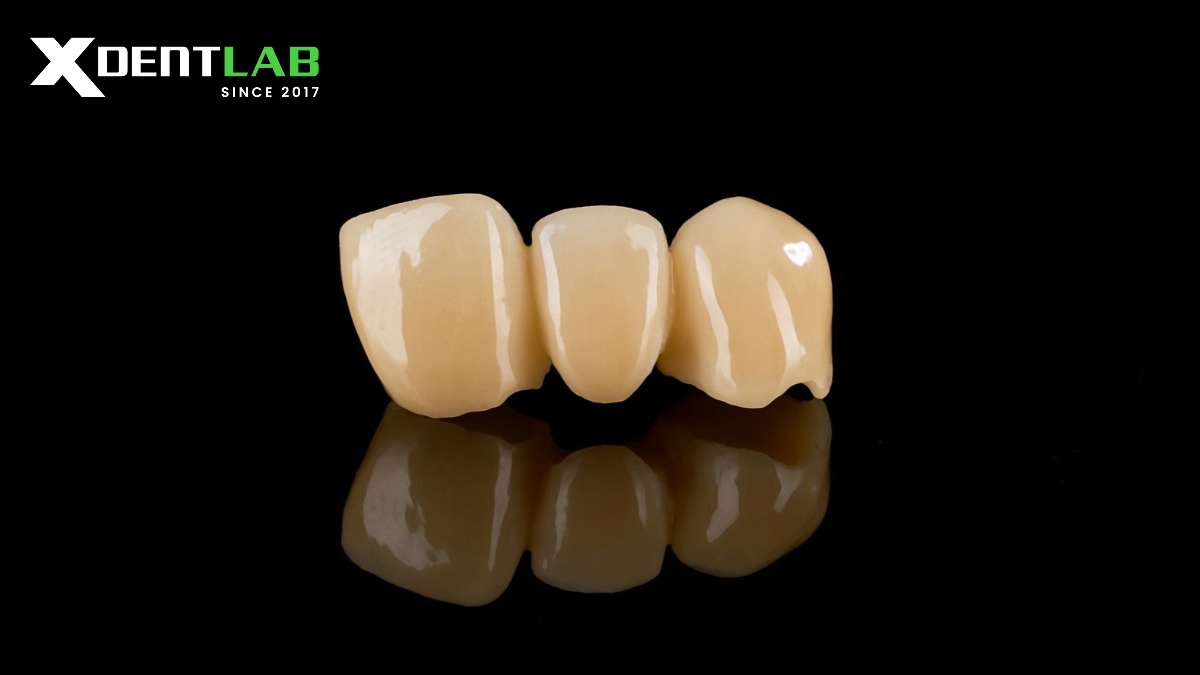
Zirconia is a ceramic material primarily composed of Zirconium Dioxide (ZrO₂). It is widely used in dental restorations due to its high mechanical strength and ability to meet various esthetic requirements.
One advantage of Zirconia is that it can be fabricated as a Monolithic Restoration, helping reduce the risk of chipping or fracturing of the outer veneering ceramic layer (Veneering Ceramic Chipping).
Depending on its composition and Yttria content, Zirconia has different properties in terms of strength and translucency. Therefore, not all Zirconia materials have the same indications.
Advantages:
- High strength and good load-bearing capacity.
- Suitable for posterior restorations, where chewing forces are greater.
- Can be used to fabricate single crowns and multi-unit Implant Bridges when an appropriate Zirconia material is selected.
- Multilayer Zirconia products help reproduce natural shades and color gradients.
Limitations:
- Some Zirconia materials have low translucency, which may limit their esthetic performance.
- Highly translucent Zirconia generally has lower mechanical strength than some less translucent Zirconia materials.
- The appropriate material must be selected based on the restoration location, bridge span, and load-bearing requirements.
Applications:
Zirconia is suitable for both Anterior and Posterior Implant Crowns. In particular, Zirconia materials with appropriate mechanical properties can also be used for multi-unit Implant Bridges.
At XDENT LAB, Zirconia is one of the material options available for Crown & Bridge restorations, meeting different requirements for strength, precision, and esthetics across various clinical indications.
Read more: Zirconia Crown Case By Vietnam Dental Lab – Outsourcing Service
E.max®
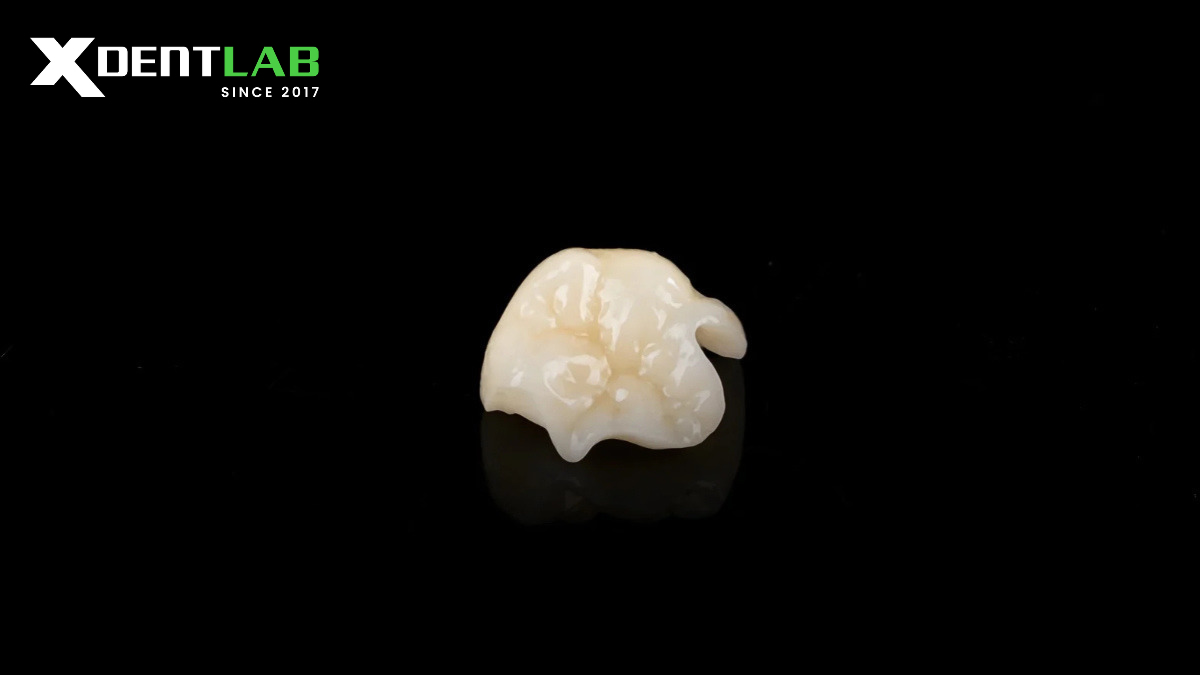
Lithium Disilicate is a Glass-Ceramic material known for its light transmission and ability to reproduce colors close to those of natural teeth. E.max® is one of the widely used Lithium Disilicate material systems in dentistry.
Compared with Zirconia, Lithium Disilicate offers advantages in optical properties, particularly in cases requiring high translucency and color depth.
Advantages:
- High translucency and good light transmission.
- Natural-looking color reproduction, making it suitable for anterior restorations.
- Capable of meeting demanding esthetic requirements.
- Can be fabricated using CAD/CAM processes.
Limitations:
- Mechanical strength depends on the material type and fabrication method.
- Not suitable for every case involving high occlusal forces.
- Careful consideration is required when using it for multi-unit Implant Bridges.
Applications:
Lithium Disilicate is commonly indicated for Single Implant Crowns, particularly in the anterior region. According to professional reviews and recommendations, this material is more suitable for single crowns than for multi-unit Implant Bridges.
For cases with high esthetic demands, Dental Laboratories need to pay attention to restoration thickness, the underlying Abutment shade, and the material's masking ability to achieve a natural-looking result.
Read more: Lithium Disilicate (E.max) In Dental Ceramic Frameworks: A Comprehensive Analysis
PFM is a restoration that combines a metal framework with an outer porcelain veneering layer.
The metal framework provides rigidity and structural support for the restoration, while the outer porcelain layer is responsible for reproducing the tooth's shape and color.
This material has been used for many years in Crown & Bridge restorations, including Implant-Supported Restorations.
Advantages:
- The metal framework provides good structural support.
- Can be used for multi-unit bridge restorations.
- Has a long history of clinical use.
- Can meet the requirements of cases that need a combination of strength and esthetics.
Limitations:
- Its translucency and optical effects are generally less natural than those of some all-ceramic materials.
- A metal margin or metallic appearance may become visible around the cervical area in certain designs.
- The porcelain veneering layer may be susceptible to chipping if the framework design and occlusal control are inadequate.
Applications:
PFM can be used for Implant Crowns and Implant Bridges, particularly in cases requiring a metal framework to support the restorative structure.
For dental technicians, designing the appropriate framework thickness, porcelain veneering space, and anatomic contour are important factors in helping reduce mechanical complications.
Full Metal restorations are fabricated entirely from metal alloys without an outer porcelain veneering layer. Materials may include Gold Alloys and other dental alloys, depending on the clinical indication.
This material focuses more on mechanical strength and load-bearing capacity than on aesthetics.
Advantages:
- Good load-bearing capacity and resistance to chipping.
- Can be fabricated with a relatively thin thickness compared with some ceramic materials.
- Suitable for locations with lower esthetic demands.
- No risk of porcelain delamination or chipping because no Veneering Ceramic layer is used.
Limitations:
- The metallic color does not resemble natural teeth.
- Not suitable for cases with high esthetic demands in the anterior region.
- The cost depends on the type of alloy and raw material prices.
Applications:
Full Metal is commonly considered for Posterior Implant Crowns, particularly in cases requiring strength, where restorative space is limited, or where esthetics are not a major priority.
Key Factors in Material Selection
No single material is suitable for every case of Cement-Retained Implant Restorations. Material selection should be based on a combination of clinical indications, material properties, and fabrication capabilities at the Dental Lab.
Restoration Location
The location of the tooth being restored directly affects material selection requirements.
- Anterior Region: Materials capable of reproducing natural color, translucency, and light effects are preferred. Lithium Disilicate and suitable translucent Zirconia materials are commonly considered.
- Posterior Region: Load-bearing capacity and mechanical strength are given greater priority. Monolithic Zirconia, PFM, and Full Metal are options that can be considered depending on the case.
Read more: The Combination Anterior-Posterior Palatal Bar In RPD
Occlusal Forces and Loading
Implants do not have a periodontal ligament system like natural teeth. Therefore, their ability to perceive and adjust to chewing forces is different.
In cases involving high loading, particularly in the molar region or in patients with Bruxism, the selected material needs to have appropriate mechanical properties.
Dental Laboratories need to pay attention to:
- Occlusal Contact positions.
- Material thickness according to the manufacturer's recommendations.
- Anatomic contours and restoration design.
- The ability to minimize excessive stress concentration points.
Selecting a high-strength material does not mean that occlusal design can be overlooked. Both factors need to be considered together to help reduce the risk of cracking, fracture, or restorative complications.
Esthetic Requirements
For Implant Restorations, esthetics depend not only on the crown material but are also influenced by the Abutment shade and the surrounding soft tissue.
For example, a dark metallic Abutment may affect the color appearance of an all-ceramic restoration, particularly when a highly translucent material is used.
Therefore, dental technicians need to consider:
- Restoration Shade.
- Material Translucency and Opacity.
- The shade of the underlying Abutment.
- Restoration thickness and masking ability.
- The characteristics of the soft tissue surrounding the Implant.
Restorative Space
Restorative Space refers to the available space for the Abutment and the restoration above the Implant.
When restorative space is limited, dental technicians need to consider material thickness, crown contour, and supporting structure to ensure that the restoration meets mechanical requirements.
In particular, designs that are too thin compared with the manufacturer's recommendations should be avoided, as they may increase the risk of material cracking or fracture.
Abutment Design and Retention
This is a particularly important factor for Cement-Retained Implant Restorations.
Crown retention does not depend solely on the type of cement. It is also related to Abutment wall height, wall taper, surface area, and preparation geometry.
An Abutment with an appropriate wall height and well-controlled taper helps improve restoration retention.
In addition, the Abutment Margin position needs to be designed in a way that allows excess cement to be controlled and removed after cementation.
Note: Excess cement around Implants is associated with an increased risk of Peri-Implant Mucositis and Peri-Implantitis. Therefore, designing an accessible finish line and ensuring that excess cement can be properly removed are important considerations that should not be overlooked.
The Role of Dental Laboratories in Material Selection
Material selection is not simply a decision based on the name or properties of each ceramic material. Dental Laboratories need to understand the restorative indications and coordinate with Dentists to determine suitable solutions.
In the Lab-to-Lab workflow, several important factors should be checked before fabrication begins:
- Reviewing Case Information: The Implant location and quantity, Implant System and Implant Connection, Abutment information, shade, and esthetic requirements need to be checked.
- Evaluating Materials and Design: Based on the case information, technicians need to identify the appropriate material while also checking material thickness, supporting structure, and related design parameters.
- Applying CAD/CAM: The CAD/CAM process supports restoration design and fabrication with high precision. However, the final result still depends on input data, design, material properties, and the production process.
- Quality Control: Before completion, restorations need to be inspected for Marginal Fit accuracy, Contour and Emergence Profile, Occlusal Contacts, surface quality and shade, and overall restoration finishing.
Material Solutions for Cement-Retained Implant Restorations at XDENT LAB
XDENT LAB provides Crown & Bridge and Implant Restoration fabrication solutions with a variety of material options to meet different requirements for esthetics, strength, and restoration design.
The material options available at XDENT LAB include:
- Zirconia: Monolithic restorations and Multilayer Zirconia options, suitable for various crown and bridge indications.
- E.max®: A solution for cases requiring natural color reproduction and translucency.
- PFM: Combines a metal framework with a porcelain veneering layer to meet Crown & Bridge fabrication requirements.
- Full Metal: Metal restorations for suitable indications, particularly in the posterior region.
In addition to material selection, we also focus on CAD/CAM design processes, restoration accuracy, and quality control at every stage of production. For Dental Lab Owners, choosing a reliable manufacturing partner capable of handling a variety of materials and Implant indications helps optimize outsourcing processes while maintaining consistency in product quality.
Why Choose XDENT LAB as Your Lab-to-Lab Partner?
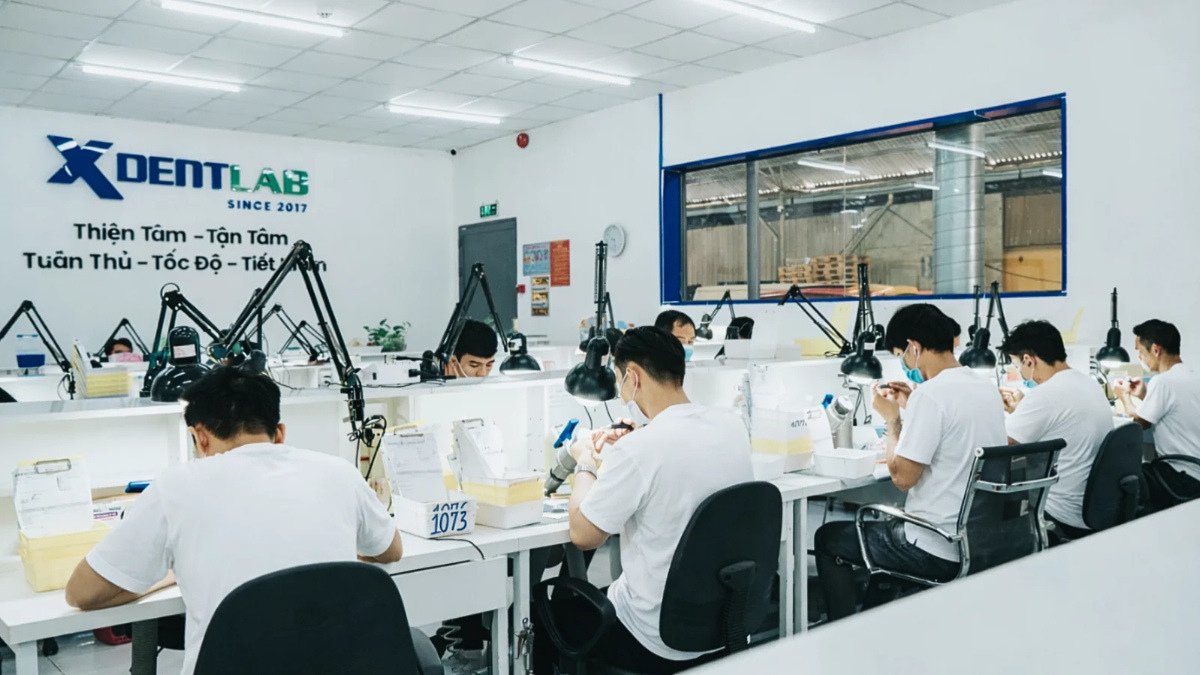
We are experts in Lab-to-Lab Full Service from Vietnam, meet U.S. market standards - FDA & ISO approved. Founded in 2017, from local root to global reach, we scale with 2 Factories with over 100+ employees.
We specialize in providing a wide range of Crown & Bridge restoration solutions, including PFM, E.max®, layered Zirconia, and full-contour Zirconia, flexibly meeting different technical and esthetic requirements for each restoration case.
For Dental Lab Owners looking to expand their production operations through outsourcing, XDENT LAB provides solutions that help optimize operating costs, improve efficiency, and increase case-handling capacity without requiring significant additional investment in personnel, equipment, or facilities. With a professionally organized production process and a customer-centric approach, we aim to become a long-term manufacturing partner, supporting businesses throughout their growth journey.
Are you looking for a reliable dental manufacturing partner to expand your production capacity and improve your laboratory's business efficiency?
Contact XDENT LAB today to share your production needs, explore suitable restoration solutions, and discover partnership opportunities with us on the journey toward long-term growth.
Conclusion
Material selection for Cement-Retained Implant Crowns and Bridges requires a balance between mechanical strength, esthetic requirements, restoration location, and Abutment design.
Zirconia offers flexibility across various Implant Crown and Bridge indications; Lithium Disilicate is suitable for single crown cases with high esthetic demands; PFM provides a combination of a metal framework and porcelain veneering; while Full Metal meets the needs of cases where load-bearing capacity is a priority.
For Dental Laboratories, understanding the properties of each material and maintaining close coordination with Dentists are essential to producing restorations that are appropriate for each indication.
XDENT LAB - A Trusted Lab-to-Lab Service from Vietnam.
With a variety of material options, CAD/CAM processes, and manufacturing capabilities in Vietnam, we are ready to support Dental Laboratories in expanding their services and growing their businesses.
References
Share this post:
Related Posts
Compare dental filling materials and treatment options, with guidance on tooth preservation, placement quality, repair and long-term care.
Learn about the differences between Customized Abutments and Stock Abutments in terms of design, manufacturing processes, precision, and customization in implant restorations.
Explore the key components of screw-retained implant restorations, their functions, and how they work together to ensure stability, precision, and esthetics.

