
A design breakdown of the A-P bar connector: how it achieves rigidity with narrow coverage, and why that's not the same as being the strongest option.
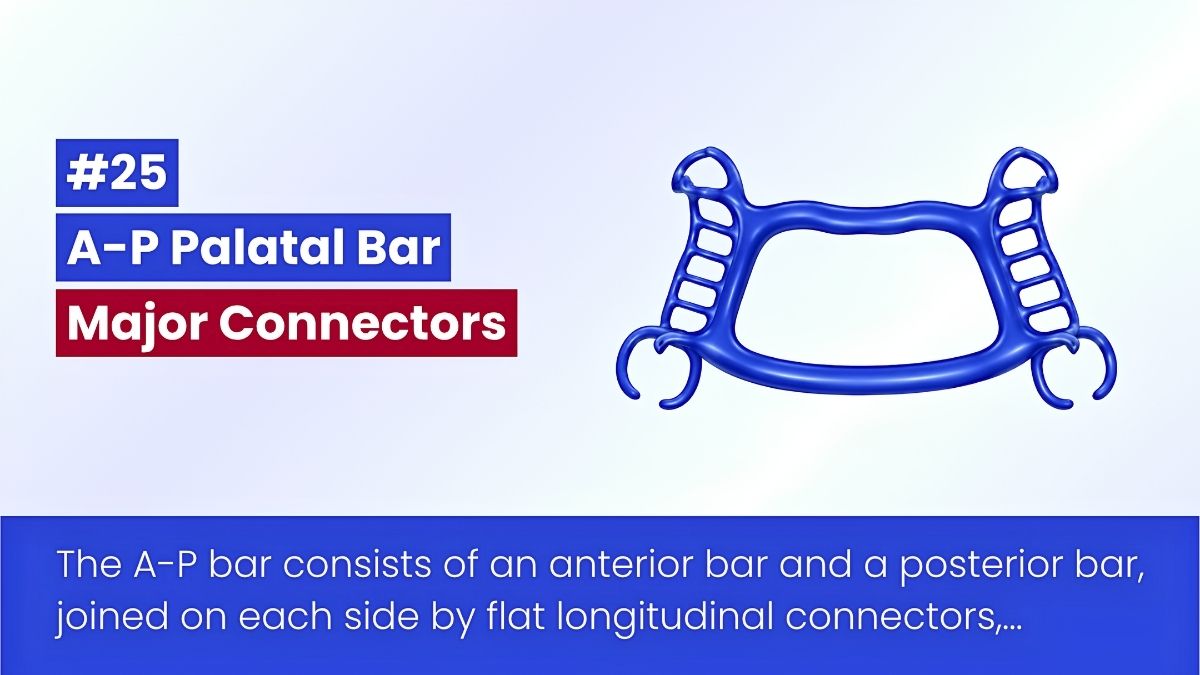
Table of contents [Show]
Of the six maxillary major connector types, the anterior-posterior palatal bar (aka A-P bar) gets grouped with the A-PP strap often enough that the two are sometimes treated as interchangeable. They're not. Both use a closed, four-sided frame to achieve rigidity through bracing rather than bulk, but the similarity ends at the geometry. What separates them is width, and width changes what each connector is actually good for.
The A-P bar isn't a smaller, more efficient version of the A-PP strap. It's a narrower connector built for a specific trade-off: rigidity with minimal palatal tissue contact, at the cost of support the strap's wider frame can provide.
This article covers how the A-P bar achieves its rigidity, where that rigidity is actually useful, where the design falls short, and how it compares to the strap it's most often confused with.
Key Points
- Anterior and posterior bars joined by flat longitudinal connectors on each side, forming a closed rectangular frame that produces both a circle effect and an L-beam effect.
- Main advantage: good rigidity with minimal soft tissue coverage.
- Indicated when support isn't the primary concern, when anterior and posterior abutments are widely separated, or when a large inoperable palatal torus is present.
- Contraindicated for cases with reduced periodontal support, since the limited palatal contact leaves compromised abutments overloaded.
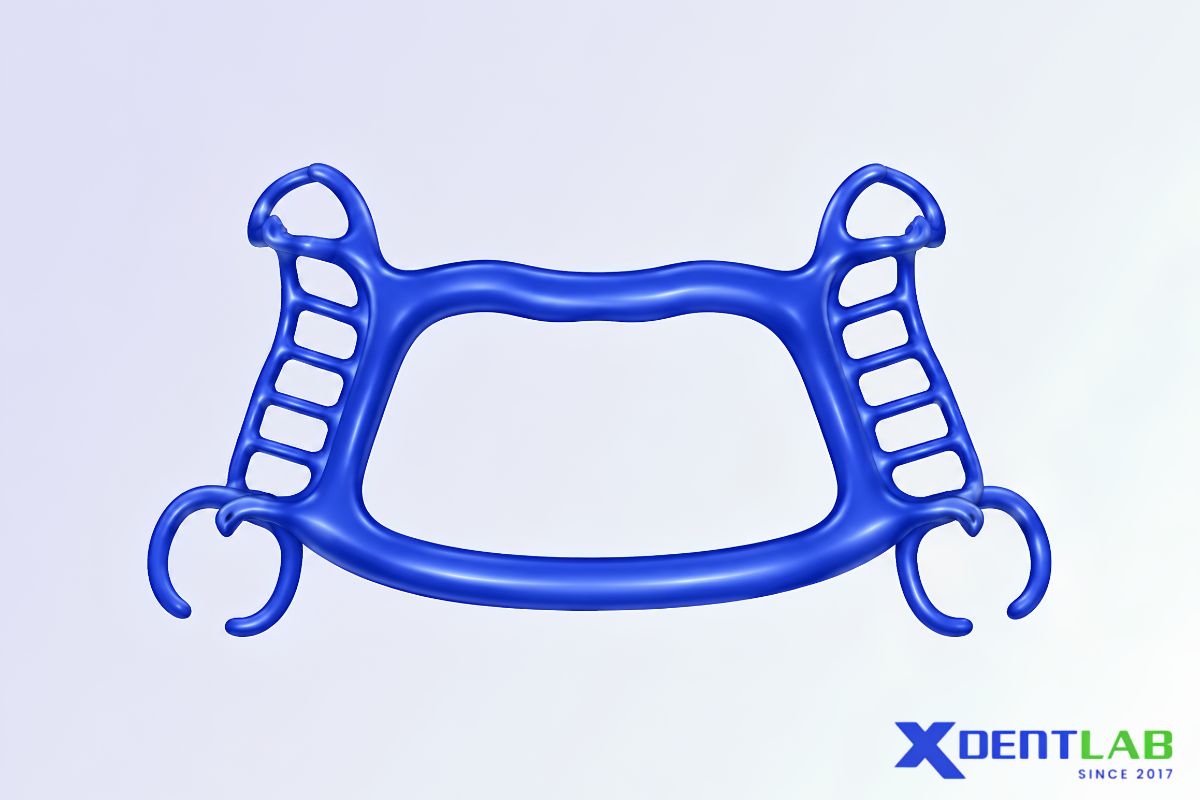
The A-P bar consists of an anterior bar and a posterior bar, joined on each side by flat longitudinal connectors, forming a closed rectangular frame. That closed geometry produces two reinforcing effects at once: a circle effect from the frame acting as a single braced unit, and an L-beam effect from the components meeting at right angles, similar to the principle that gives the A-PP strap its stiffness.
This is where the comparison to the A-PP strap needs a correction that's worth making explicitly. The A-P bar has good rigidity relative to other maxillary connectors, but that doesn't mean it's more rigid than the A-PP strap. If anything, the logic runs the other way. The A-PP strap forms a wider, closed frame with greater cross-sectional width in its components, and that extra width distributes stress more effectively than a narrower bar can. So the two connectors aren't competing on rigidity in a way where the A-P bar comes out ahead. They're built for different priorities.
The distinction that actually matters between the A-P bar and the A-PP strap is coverage, not strength:
- A-PP strap: wider components, more tissue contact, more support.
- A-P bar: narrower components, less tissue contact, less support, but also less bulk.
That's the trade the A-P bar is built around. It sacrifices some of the support a wider frame would provide in exchange for covering less of the palate. Whether that trade makes sense depends entirely on whether the case needs that support in the first place.
Support is not a primary concern
If the remaining teeth and residual ridge already provide adequate load-bearing capacity on their own, the A-P bar's narrower coverage doesn't cost the case anything functionally. Choosing a strap or plate in this scenario would just add unnecessary tissue coverage.
Anterior and posterior abutments are widely separated
A long anterior-posterior distance between abutments gives the frame more length to work with, which favors a design built around bracing over one built around broad surface support.
A large inoperable palatal torus is present
Like the A-PP strap, the A-P bar's frame geometry can route around a torus without needing continuous palatal coverage across the midline, making it a viable option when the anatomy rules out other connector types.
Where It's Contraindicated
Reduced periodontal support
This is the clearest limitation of the design. With minimal palatal contact, the bony palate contributes very little to overall support, which means the abutment teeth end up carrying more of the functional load on their own. If those abutments already have compromised periodontal support, the A-P bar doesn't relieve that burden, it leaves it fully in place, and in some cases makes overloading more likely.
As a default or first-choice connector
The A-P bar should be selected only after other connector types have been evaluated and ruled out for the case, not reached for as a starting point. Its narrow set of genuine advantages, mainly minimal tissue coverage, only pays off when the case specifically calls for that trade-off.
Advantages and Disadvantages
Advantages
- Good rigidity relative to most other maxillary connectors, achieved through the combined circle effect and L-beam effect of the closed frame.
- Minimal soft tissue coverage, useful whenever avoiding palatal contact is a priority for the patient or the case.
- Can route around a large inoperable palatal torus without needing continuous coverage across the midline, the same structural advantage the A-PP strap offers.
- Well suited to cases with widely separated anterior and posterior abutments, where the frame's length works in its favor.
Disadvantages
- The bulk required to achieve adequate rigidity interferes with tongue comfort and phonetics, the same trade-off that limits other narrower connector designs.
- Limited tissue contact translates directly into limited palatal support, making it a poor fit for cases with compromised abutments.
- It shares its core disadvantages with the single palatal bar: narrow coverage helps with comfort but leaves little margin when the case needs more support than the abutments alone can provide.
Conclusion
The A-P bar earns its place through minimal tissue coverage, not superior strength. It holds up well when support isn't the deciding factor, when abutments are widely separated, or when a torus needs to be routed around, but it should never be assumed to outperform the A-PP strap on rigidity. Where the strap trades bulk for maximum support and stress distribution, the A-P bar trades support for conservative coverage. Choosing between them comes down to which side of that trade-off the case actually needs, not which connector sounds more robust on paper.
References
[1] Ben Z, Matalon S, Aviv I, Cardash HS (1989) Rigidity of major connectors when subjected to bending and torsion forces. J Prosthet Dent. 62(5): 557–562.
[2] Gad MM (2017) Removable Partial Denture Designing: Variation of Hard and Soft Tissue Anatomy and Maxillary Major Connector Selection. Int J Dentistry Oral Sci. 4(4): 457-463.
[3] Maeda Y, Nokubi T, Okuno Y (1982) Morphological analysis of palate in relation to designing major connectors for removable partial dentures. J Osaka Univ Dent Sch. 22: 193-205.
[4] Ozkan P, Aydin AK (2001) Comparison of deformation by stereophotogrammetry of various kinds of major connectors in maxillary Kennedy Class I removable partial dentures. Int J Prosthodont.14(1): 71-76.
[5] Phoenix RD, Cagna DR, DeFreest CF (2003) Stewart's Clinical Removable Partial Prosthodontics. (4th Edn), Chicago: Quintessence Publ. 19-31.
[6] Zeev BU, Eitan M, Colin G, Tamar B (1999) Stiffness of different designs and cross-sections of maxillary and mandibular major connectors of removable partial dentures. J Prosthet Dent. 81(5): 526–532.
Share this post:
Related Posts
Explore the types, materials, retention methods and lab workflows for maxillofacial removable prostheses, with practical guidance for dental practices.
Explore precision attachment denture types, benefits and limitations, plus key considerations for design, fabrication and maintenance in dental practices.
Explore telescopic denture materials, retention designs and lab workflows, with practical guidance on fit, fabrication and maintenance for dental practices.

