
Explore precision attachment denture types, benefits and limitations, plus key considerations for design, fabrication and maintenance in dental practices.
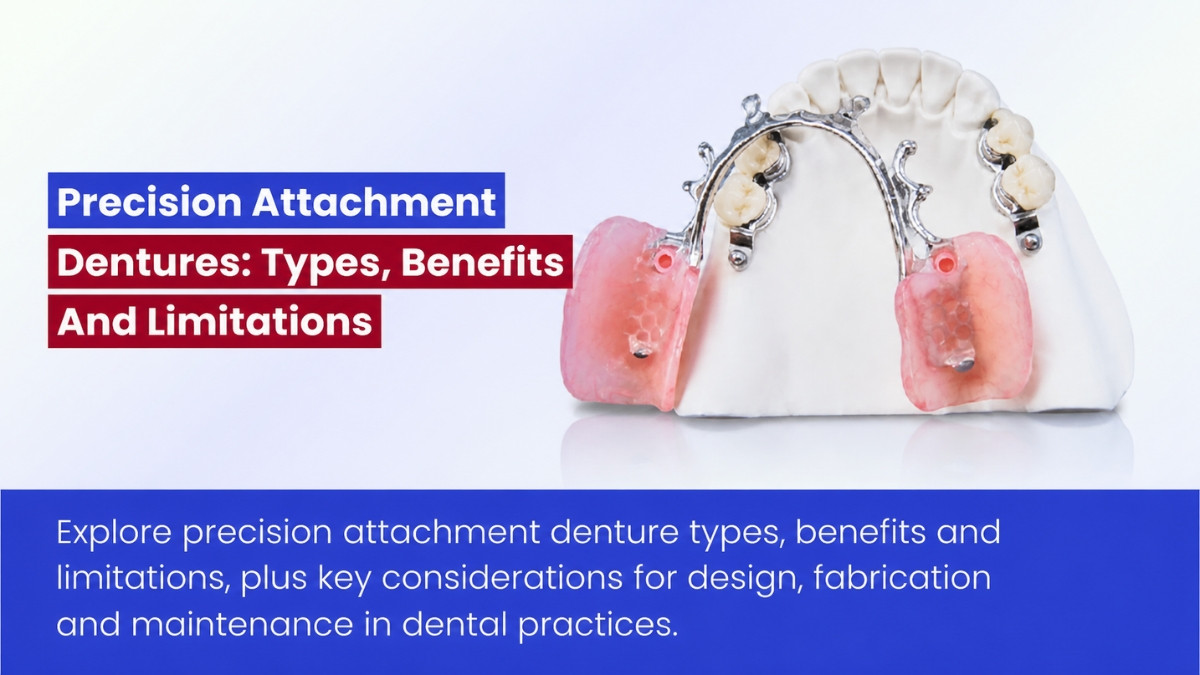
Table of contents [Show]
- What are precision attachment dentures?
- When should a dental practice consider attachment retention?
- Materials and laboratory workflow
- Evidence, maintenance and quality considerations
Precision attachment dentures use interlocking components to retain a removable prosthesis without relying on conventional visible clasps. They can offer discreet esthetics and controlled retention, particularly when abutment teeth already need crowns. Their success, however, depends on more than the attachment: abutment health, framework design, denture-base support, accurate fabrication and maintenance all matter.
For dental practices, the central principle is simple: an attachment is a retainer, not a substitute for sound removable partial denture design. This guide explains how attachment systems work, when to consider them and what to specify when working with a dental laboratory.
A precision attachment denture is a removable prosthesis connected to teeth, restorations, retained roots, implants or a supporting bar through complementary attachment components. In a common tooth-supported design, an attachment on a crowned abutment engages a corresponding component within the removable denture.
- Patrix: The projecting or male component.
- Matrix: The receiving or female component.
- Retentive element: A component, such as a replaceable insert or clip, that controls retention in some systems.
- Housing: The structure that accommodates a matrix or retentive element within the prosthesis.
Either the patrix or matrix may be positioned on the fixed or removable side, depending on the system. The exact manufacturer and component designation therefore belong in the laboratory prescription and case record.
The traditional distinction describes how components are made. Prefabricated precision attachments are manufactured with controlled dimensions, while semi-precision attachments have commonly been produced through laboratory casting from patterns. Neither term guarantees a better clinical result on its own.
| Characteristic | Precision attachment | Semi-precision attachment |
|---|---|---|
| Traditional production | Prefabricated, machined components | Components cast from laboratory patterns |
| Fit control | Strongly dependent on manufacturer specifications and correct assembly | Strongly influenced by casting, finishing and laboratory processing |
| Servicing | May offer standardized replacement components | Replacement depends on the individual design |
CAD/CAM has made this historical distinction less clear. A digitally manufactured attachment still needs validated materials, tolerances, wear behavior and a practical servicing plan.
| Design | Typical position | Planning consideration |
|---|---|---|
| Intracoronal | Within the contour of a crown | Requires sufficient crown dimensions and restorative space |
| Extracoronal | Outside the crown contour | Requires room for the attachment, denture materials and hygiene access |
| Stud | On a root, implant abutment or selected restoration | Insert wear and replacement should be anticipated |
| Bar and clip | A bar links supports and engages retainers in the denture | Requires adequate restorative and cleaning space |
| Auxiliary latch or plunger | Within a specialized retaining mechanism | Patient dexterity and future servicing are important |
Both approaches can provide clasp-free retention, but they use different interfaces. Conventional precision attachment dentures engage localized components at selected sites. Telescopic dentures use fitted inner and outer crowns. Their fabrication, load transfer and maintenance requirements should be evaluated separately.
Attachment selection should begin with the patient’s clinical needs and the condition of the supporting structures, not with a product catalogue.
Potential indications and benefits
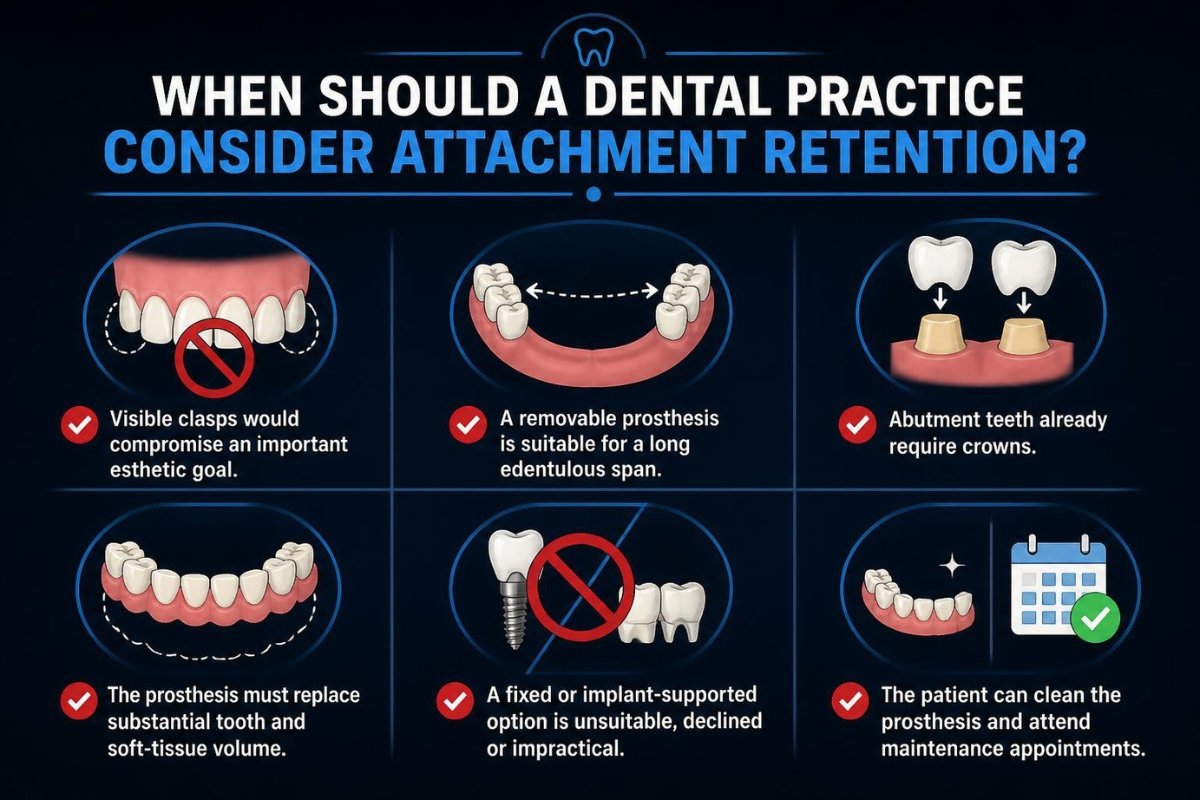
An attachment-retained removable partial denture may be appropriate when:
- Visible clasps would compromise an important esthetic goal.
- A removable prosthesis is suitable for a long edentulous span.
- Abutment teeth already require crowns.
- The prosthesis must replace substantial tooth and soft-tissue volume.
- A fixed or implant-supported option is unsuitable, declined or impractical.
- The patient can clean the prosthesis and attend maintenance appointments.
Attachments can provide controlled retention and may include replaceable components. They can also increase cost, clinical complexity and the amount of tooth preparation required. Esthetic preference alone does not justify crowning otherwise healthy teeth.
Clinical cautions
Predictability decreases when there is untreated periodontal disease, active caries, poor plaque control, insufficient restorative space, weak abutments or limited ability to handle the denture. Severe parafunction and uncertain access to replacement parts also deserve attention.
Short clinical crowns may limit both crown retention and space for an attachment. Suitability must be judged from the complete restorative design rather than a single measurement.
Biomechanics beyond retention
An attachment-retained denture still needs support against tissueward movement, bracing against horizontal movement and appropriate control of rotation. Its framework must remain rigid enough to preserve the intended relationship between components.
Reciprocation counteracts lateral forces associated with insertion and removal. Indirect retention may be needed to resist lifting in a distal-extension design. Some attachment systems contribute to these functions; others require additional rests, guiding surfaces or framework features.
Why distal-extension cases need particular care
In a distal-extension removable partial denture, the supporting ridge and abutment tooth generally move differently under load. The attachment must be selected as part of a design that also considers broad denture-base coverage, ridge adaptation, occlusion, framework rigidity and relining as the tissues change.
Rigid attachments limit relative movement. Resilient attachments permit specific, controlled movement. Neither design is universally “stress-free,” and an attachment cannot compensate for a poorly adapted denture base.
A 2023 clinical trial on reciprocation designs followed 14 participants for nine months. It highlights the importance of reciprocation, but its small sample and short follow-up do not establish a universally superior design.
Materials and laboratory workflow
Precision attachment dentures are assemblies of crowns or abutments, attachment components, a framework, a denture base and artificial teeth. Each part must fit the prescribed insertion path and leave enough room for the others.
Material selection
| Material | Common role | Key consideration |
|---|---|---|
| Noble and high-noble alloys | Crowns and selected attachment components | Compatible processing and corrosion behavior |
| Cobalt–chromium | Rigid removable frameworks | Dimensional control and accurate finishing |
| Titanium and titanium alloys | Implant components, bars and selected structures | System compatibility and appropriate processing |
| Zirconia | Selected crowns or supporting structures | Validated attachment integration and connection design |
| System-specific polymers | Replaceable inserts and other retentive elements | Wear, deformation and correct retention grade |
| PMMA and composites | Denture bases, teeth and facings | Adequate bulk and reliable bonding around housings |
Component compatibility is essential. Visually similar inserts or housings from different manufacturers should not be mixed unless compatibility is explicitly validated. Color coding for retention strength is not standardized across attachment systems.
Clinical and laboratory stages
- Diagnose and design: Assess abutment prognosis, ridge support, occlusion, available space, hygiene and likely maintenance needs. Select the exact attachment system.
- Survey the case: Establish the insertion path and plan guiding surfaces, bracing, reciprocation and framework components.
- Fabricate the fixed components: Prepare abutments as indicated and position attachments using the system’s specified tools and procedures.
- Verify crowns and attachments: Confirm seating, margins, orientation and occlusal clearance before proceeding.
- Record the final relationship: Transfer the positions of the fixed components and supporting tissues accurately.
- Try in the framework: Check simultaneous seating, support and stability. Retention must not conceal a framework that does not fit.
- Process the denture: Incorporate housings with the correct spacers, processing components and materials for the selected system.
- Deliver and document: Assess retention, teach insertion and cleaning, and record the components installed for future servicing.
Critical checks before delivery
The laboratory should confirm enough space for the attachment, housing, framework, base material and artificial teeth. Attachment orientation must match the insertion path; misalignment can cause difficult seating, uneven retention and accelerated wear.
Processing compatibility also matters. A prefabricated component should not be exposed to casting, firing or joining temperatures unless its manufacturer approves that process. Where a resilient attachment requires a processing spacer, omitting it may change how the system functions.
Digital fabrication and case records
Digital surveying, CAD design, milling and metal additive manufacturing can help with positioning and reproducibility. They do not eliminate scan error, manufacturing tolerances or the need to verify fit. A component’s presence in a design library is not proof that a complete custom attachment workflow has been clinically validated.
For predictable servicing, the case record should identify the attachment manufacturer, exact system and components, insert grade, materials, lot information where applicable, processing method and replacement-part instructions.
Evidence, maintenance and quality considerations
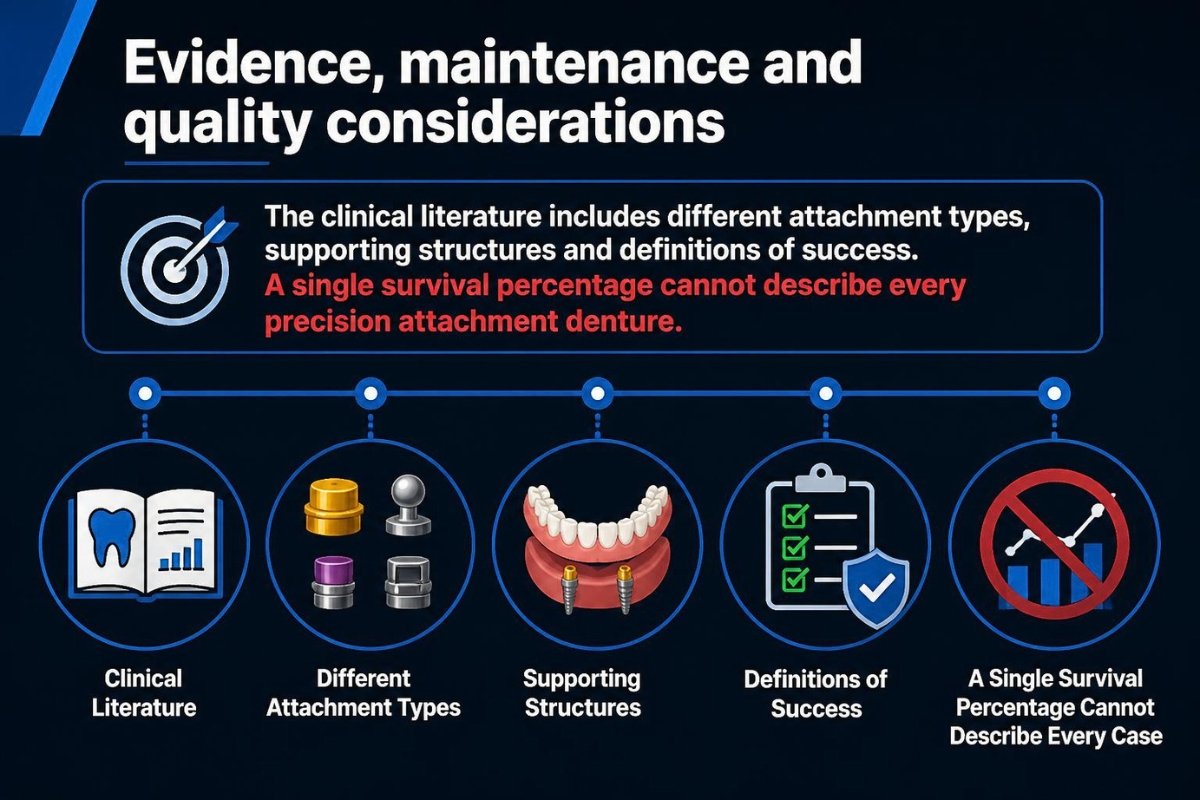
The clinical literature includes different attachment types, supporting structures and definitions of success. A single survival percentage cannot describe every precision attachment denture.
What does the evidence tell us?
A systematic review and meta-analysis on tooth-supported attachments for distal-extension dentures directly addresses attachment selection, but its findings should be applied within the designs and outcomes studied. Foundational clinical discussions, including a review of precision attachment removable partial dentures, are useful for classification and selection principles; they do not show that attachments outperform well-designed clasp dentures in every case.
Adhesive attachments are a distinct, more conservative approach in selected cases. A 2026 systematic review of adhesive attachments found reported survival ranging from 96% at one year to 61% at 15 years across different studies. The review also identified technical complications, particularly debonding, and rated the included evidence as low certainty. These figures should not be applied to conventional crown-supported attachments or implant overdentures.
When reviewing any outcome claim, distinguish attachment survival, abutment survival, prosthesis survival and complication-free survival. A denture may remain usable while requiring insert replacement, recementation, relining or repair.
Maintenance and common complications
Retentive inserts can wear or fracture. Housings can loosen, crowns can decement, and changes in ridge support may require relining. Biological problems can include caries, gingival inflammation, periodontal deterioration, abutment fracture or peri-implant disease.
Before replacing an insert because retention has declined, the clinical team should check seating, alignment, attachment wear and denture-base support. Installing a stronger insert may mask an underlying problem and make the prosthesis harder to remove.
Recall intervals should reflect the patient’s disease risk and the complexity of the prosthesis. Patients need instructions for cleaning around attachment components, using compatible cleaning products and avoiding excessive force during insertion.
Standards and the practice–laboratory handoff
Relevant standards may address metallic dental materials, ceramics, denture-base polymers, artificial teeth and medical-device quality-management systems. Examples include ISO 22674, ISO 6872, ISO 20795-1, ISO 22112 and ISO 13485. The current edition and scope of each standard should be checked in the official ISO catalogue.
Material compliance does not certify the performance of a finished attachment denture. Likewise, ISO 13485 certification concerns a quality-management system; it does not establish that a particular attachment has suitable retention or long-term clinical durability. Claims about FDA authorization should refer to the specific product and regulatory status rather than imply blanket approval of a laboratory.
For practices outsourcing removable prosthetics, a clear prescription should specify the abutment and framework design, exact attachment system, materials, required movement, retention components and servicing plan. At XDENT LAB, this case-level information supports the coordination needed for consistent lab-to-lab removable prosthetic work.
Frequently asked questions
Yes. The patient removes the denture for cleaning, while fixed crowns or other supporting components remain in place.
Are they better than clasp-retained dentures?
Not in every case. Attachments may improve esthetics and offer controlled retention, but they can require more tooth preparation, restorative space and maintenance. A well-designed clasp denture may be the more conservative choice.
Many systems have retentive elements that wear and can be replaced. Replacement intervals depend on the system, use, alignment and condition of the supporting denture.
No. The cause of looseness should be assessed. An inadequately supported or poorly adapted base may need adjustment or relining rather than a stronger retentive insert.
Key takeaway: A reliable precision attachment denture is a serviceable fixed–removable system, not merely a denture with hidden retainers. Its performance depends on healthy abutments, appropriate biomechanics, compatible components, accurate laboratory fabrication and a maintenance plan the patient and practice can follow.
About XDENT LAB:
We are experts in Lab-to-Lab Full Service from Vietnam, with the signature services of Removable, meet U.S. market standards, FDA-registered, ISO 13485-certified. Founded in 2017, from local root to global reach, we scale with 2 Factories with over 100+ employees.
Our Commitments Built on “Trusted. Commitment. Quality”
- Commit to Large-Scale Manufacturing, high volume, remake rate < 1%.
- Commit to 5-Year Warranty
- Commit to Competitive Price
XDENT LAB | A Trusted Lab-to-Lab Service from Vietnam
Share this post:
Related Posts
Explore telescopic denture materials, retention designs and lab workflows, with practical guidance on fit, fabrication and maintenance for dental practices.
Materials used in fixed prosthodontics, from zirconia and lithium disilicate to alloys, with guidance on indications, bonding, workflows, and selection.
Learn how implant-retained overdentures rely on clinical planning, attachment selection, and laboratory QC for stable, predictable removable outcomes.

