
Learn how implant-retained overdentures rely on clinical planning, attachment selection, and laboratory QC for stable, predictable removable outcomes.
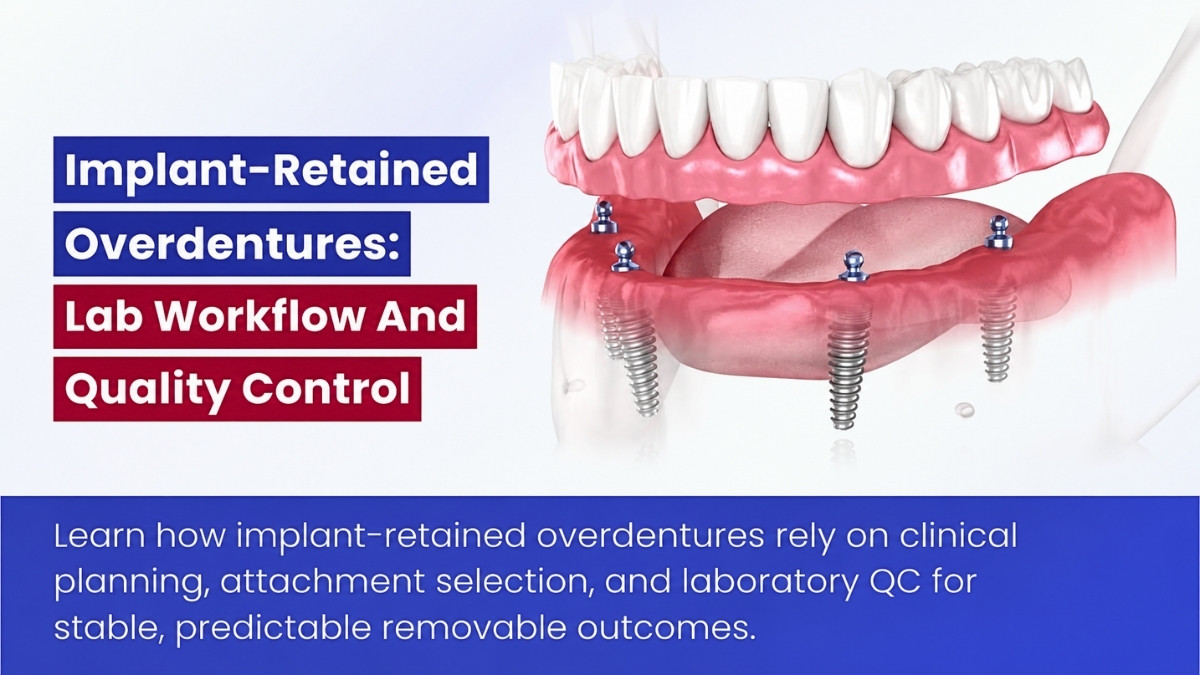
Table of contents [Show]
- What is an implant-retained overdenture
- Implant-retained vs implant-supported overdentures
- Why implant-retained overdentures matter
- Indications
- Contraindications and risk factors
- Implant number and distribution
- Main attachment systems
- Locator-type attachments
- Ball attachments
- Bar-retained overdentures
- Magnet attachments
- Telescopic implant overdentures
- Bar vs Locator vs ball attachments
- Restorative space requirements
- Treatment planning workflow
- Clinical workflow
- Dental laboratory workflow
- Digital implant overdenture workflow
- Denture base reinforcement
- Occlusion for implant overdentures
- Biological complications
- Mechanical and prosthetic complications
- Maintenance protocol
- Implant overdenture vs fixed full-arch prosthesis
- International standards and documentation
- Laboratory quality control checklist
- Why this matters for XDENT LAB
- Key takeaways
Implant-retained overdentures are one of the most practical and patient-satisfying treatments in removable prosthodontics, especially for edentulous patients who struggle with conventional complete dentures. From a dental laboratory perspective, they are not simply dentures with attachments. They are biomechanical removable prostheses that require careful control of implant position, attachment selection, denture base strength, restorative space, tissue support, hygiene access, occlusion, maintenance, and component traceability.
For dental practices looking to ensure quality and consistency, implant-retained overdentures offer a strong middle ground between conventional complete dentures and fixed full-arch prostheses. They improve retention and function while remaining removable, maintainable, and often more cost-effective than fully fixed implant solutions.
What is an implant-retained overdenture
An implant-retained overdenture is a removable dental prosthesis that replaces missing teeth and is retained by dental implants through attachment systems.
The patient can remove it for cleaning, but the implants provide additional retention and stability compared with a conventional complete denture.
Core definition
An implant overdenture may be:
- Implant-retained and tissue-supported
- Implant-supported and implant-retained
- Bar-retained
- Stud-retained
- Locator-retained
- Ball-retained
- Magnet-retained
- Telescopic-retained
Simple explanation
A conventional complete denture rests mainly on soft tissue.
An implant-retained overdenture still rests partly on tissue, but implants help hold it in place.
The result is usually:
- Less movement
- Better chewing confidence
- Better speech control
- Fewer denture dislodgements
- Better patient satisfaction
For many lower denture patients, two implants can transform an unstable mandibular denture into a far more functional prosthesis.
Implant-retained vs implant-supported overdentures
These terms are often used interchangeably, but they are not exactly the same.
| Type | Primary support | Retention | Common example |
|---|---|---|---|
| Implant-retained overdenture | Mainly mucosa or tissue | Implants retain denture | 2 mandibular implants with Locator attachments |
| Implant-supported overdenture | Mainly implants or bar | Implants support and retain denture | 4 implants with milled bar |
| Hybrid situation | Shared implant and tissue support | Implants and tissue | Many clinical overdenture designs |
Practical difference
- A 2-implant mandibular Locator overdenture is usually implant-retained and tissue-supported.
- A bar overdenture on 4 implants may provide more implant support.
- A milled bar with additional attachments can function more like an implant-supported removable prosthesis.
This distinction matters because support design affects attachment choice, denture base thickness, occlusal loading, maintenance, and long-term prosthetic behavior.
Why implant-retained overdentures matter
Implant-retained overdentures are a major advancement over conventional complete dentures, particularly in the mandible.
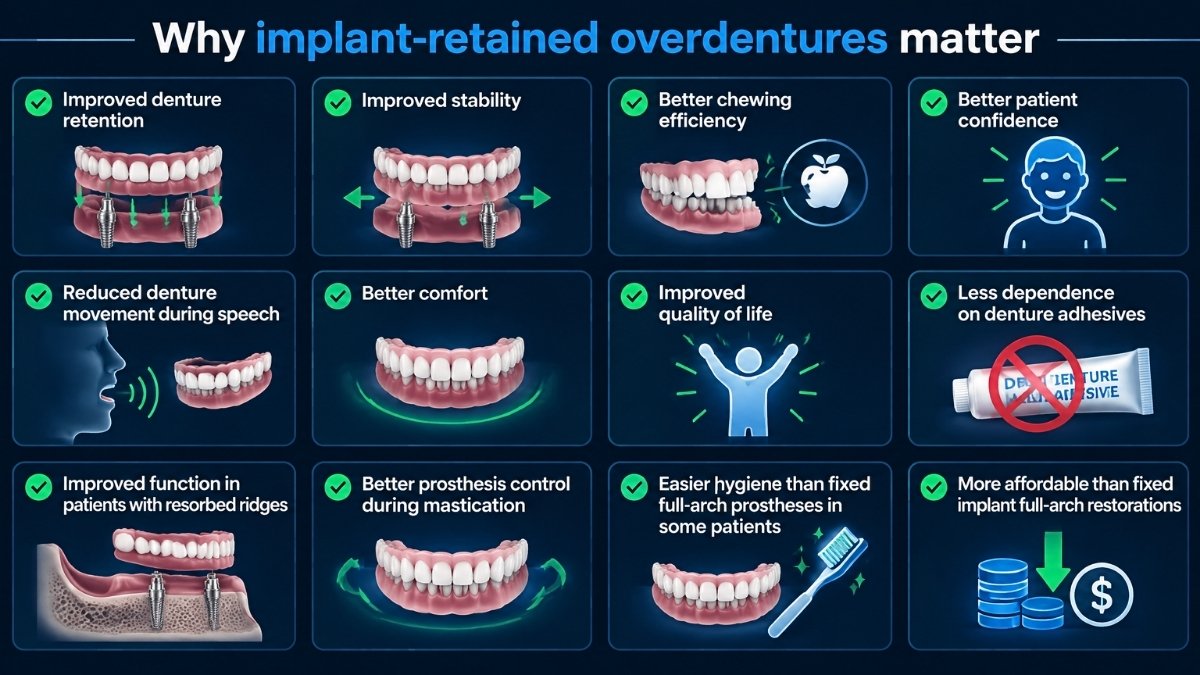
Main benefits
- Improved denture retention
- Improved stability
- Better chewing efficiency
- Better patient confidence
- Reduced denture movement during speech
- Better comfort
- Improved quality of life
- Less dependence on denture adhesives
- Improved function in patients with resorbed ridges
- Better prosthesis control during mastication
- Easier hygiene than fixed full-arch prostheses in some patients
- More affordable than fixed implant full-arch restorations
Most common clinical scenario
The classic indication is the edentulous mandible where the lower complete denture lacks retention.
This is one reason why the two-implant mandibular overdenture is widely accepted as a standard entry-level treatment for edentulous mandibular cases.
Indications
Implant-retained overdentures are indicated when conventional dentures are unstable, uncomfortable, or functionally inadequate, and the patient is suitable for implant therapy.
Common indications
| Clinical situation | Why implant overdenture helps |
|---|---|
| Poor mandibular denture retention | Implants provide attachment retention |
| Severe ridge resorption | Improves stability despite poor anatomy |
| Denture instability during speech | Reduces movement |
| Poor chewing efficiency | Improves functional confidence |
| Patient cannot tolerate conventional denture | Better comfort and control |
| Financial limitation for fixed implant prosthesis | More economical implant solution |
| Hygiene limitation for fixed prosthesis | Removable design easier to clean |
| Need for facial or lip support | Denture flange can replace lost tissue volume |
| Maxillary edentulism with poor retention | Four or more implants may improve retention |
| Transition from failing dentition | Implant overdenture may simplify rehabilitation |
Ideal patient factors
- Good oral hygiene potential
- Adequate bone or feasible grafting
- Realistic expectations
- Accepts maintenance requirements
- Can remove and clean prosthesis
- Controlled systemic conditions
- Stable soft tissue health
- Sufficient restorative space
- Willing to attend recalls
Contraindications and risk factors
Implant overdentures are not suitable for every patient.
Contraindications
- Uncontrolled systemic disease
- Poor surgical candidate
- Uncontrolled diabetes
- Heavy smoking with poor healing risk
- Untreated periodontal disease in remaining teeth
- Poor oral hygiene
- Inability to maintain attachments
- Severe parafunction without protection
- Unrealistic expectations
- Inadequate restorative space
- Inability to remove or insert denture
- Severe dexterity limitations without caregiver help
- Poor compliance with recall visits
Prosthetic risk factors
| Risk factor | Potential problem |
|---|---|
| Insufficient vertical space | Weak acrylic, attachment exposure, fracture |
| Divergent implants | Attachment wear, insertion difficulty |
| Poor implant distribution | Rotation and instability |
| High occlusal force | Attachment wear, denture fracture |
| Thin denture base | Midline fracture or housing exposure |
| Poor hygiene access | Peri-implant mucositis or peri-implantitis |
| Unfavorable ridge anatomy | Denture instability despite implants |
| Opposing natural teeth | Higher occlusal load |
| Bruxism | Component wear and prosthesis fracture |
Implant number and distribution
Implant number depends on arch, bone, prosthesis design, patient expectations, and support requirements.
Common implant configurations
| Arch | Common implant number | Typical design |
|---|---|---|
| Mandible | 2 implants | Locator, ball, stud attachments |
| Mandible | 3 to 4 implants | Bar overdenture or improved support |
| Maxilla | 4 implants minimum often preferred | Locator or bar overdenture |
| Maxilla | 4 to 6 implants | Bar or splinted design |
| Severely resorbed maxilla | Advanced planning required | Zygomatic or grafted solutions |
Mandibular overdentures
A two-implant mandibular overdenture is one of the most widely supported implant overdenture treatments.
Maxillary overdentures
The maxilla often needs more implants than the mandible because:
- Bone quality is often poorer
- Occlusal load distribution differs
- Palatal coverage may be reduced
- The prosthesis may need more support
- Implant splinting may be beneficial
Attachment choice is one of the biggest clinical-laboratory decisions in implant overdentures.
| Attachment type | Description | Typical use |
|---|---|---|
| Locator-type attachment | Low-profile stud attachment with replaceable inserts | Common for 2-implant mandibular overdentures |
| Ball attachment | Ball abutment with O-ring or cap | Simple and economical |
| Bar attachment | Implants splinted by bar with clips or riders | More support and splinting |
| Magnet attachment | Magnetic keeper and denture magnet | Low retention, useful for limited dexterity |
| Telescopic attachment | Primary coping and secondary prosthetic component | High precision, advanced cases |
| Equator or low-profile attachment | Low vertical height stud attachment | Limited restorative space cases |
| Milled bar with Locators | CAD/CAM bar plus stud attachments | Advanced retention and support design |
Attachment selection should be driven by implant position, restorative space, hygiene needs, dexterity, maintenance expectations, and cost.
Locator-type attachments are among the most common implant overdenture systems.
Advantages
- Low profile
- Good retention
- Different insert retention levels
- Useful with limited vertical space
- Some tolerance for implant divergence
- Easy insert replacement
- Commonly available
- Familiar to many dentists and labs
Limitations
- Nylon inserts wear over time
- Retention decreases with function
- Housings require adequate acrylic thickness
- Divergence increases wear
- Inserts require maintenance
- May collect plaque if hygiene is poor
Laboratory considerations
- Housing pickup must be accurate
- Relief around attachments must be adequate
- Denture base must be thick enough
- Inserts should not be damaged during processing
- Correct cuff height must be selected clinically
- The lab should know implant brand, platform, attachment height, and insert retention level
Ball attachments are a classic stud attachment system.
Advantages
- Simple design
- Economical
- Easy to understand
- Good retention initially
- Useful for two-implant mandibular overdentures
- Widely available
Limitations
- O-rings or caps wear
- Less forgiving with implant divergence
- Maintenance may be frequent
- Vertical space required
- Retention can vary with wear
Best use
Ball attachments work well when implants are:
- Parallel or nearly parallel
- Properly spaced
- Placed in sufficient bone
- Used in patients who can attend maintenance visits
A bar overdenture uses a metal bar connecting implants, with clips or other retentive elements inside the denture.
Advantages
- Splints implants
- Improves load distribution
- Can compensate for implant angulation
- Good retention
- Useful for compromised implant positions
- Can provide more support than solitary attachments
- Helpful in maxillary overdentures
- Can be milled with CAD/CAM for precision
Limitations
- Requires more vertical restorative space
- More expensive
- More difficult hygiene
- Bar clips wear
- More laboratory complexity
- More prosthetic bulk
- Food and plaque accumulation risk under bar
- Requires excellent polishing and passivity
Laboratory requirements
- Passive bar fit
- Correct bar height
- Proper tissue clearance
- Clip path aligned
- Highly polished tissue surface
- Enough acrylic thickness over clips
- Adequate space for teeth and base
- Verified implant master cast or digital record
Magnet attachments use magnetic retention between implant abutments and components in the denture.
Advantages
- Easy insertion and removal
- Useful for patients with reduced dexterity
- Less path-of-insertion sensitivity
- Lower lateral stress transmission
- Simple seating
Limitations
- Lower retention than many mechanical systems
- Corrosion risk if seal fails
- Retention loss over time
- Less resistance to lateral forces
- Limited use in high-demand cases
Best use
Magnets may be useful in:
- Elderly patients
- Patients with limited hand control
- Cases where ease of seating is more important than high retention
- Transitional or lower-load situations
Telescopic implant overdentures
Telescopic overdentures use primary copings on implants and secondary copings inside the denture.
Advantages
- Excellent guidance
- Good retention and stability
- Splinting effect possible
- Esthetic and clasp-free
- Long-term serviceability
- Useful in advanced removable prosthodontics
Limitations
- High cost
- Technique-sensitive
- Requires precise parallelism
- Requires excellent laboratory control
- Maintenance can be complex
- More common in some European prosthodontic traditions
No attachment is universally best. The best attachment depends on anatomy, implant position, space, hygiene, cost, and maintenance expectations.
| Factor | Locator-type | Ball | Bar |
|---|---|---|---|
| Cost | Moderate | Lower to moderate | Higher |
| Vertical space | Lower requirement | Moderate | Higher requirement |
| Hygiene | Easier | Easier | More difficult |
| Implant divergence tolerance | Moderate to good depending on system | Lower | Good if bar corrects path |
| Retention | Good | Good initially | Very good |
| Maintenance | Insert replacement | O-ring or cap replacement | Clip or bar maintenance |
| Splinting implants | No | No | Yes |
| Lab complexity | Moderate | Low to moderate | High |
| Maxillary use | Possible, often more implants | Possible | Often useful |
| Best indication | 2-implant mandibular overdenture | Simple economical cases | Multiple implants, angulation issues, higher support needs |
Restorative space requirements
Restorative space is essential. Many implant overdenture failures are caused by inadequate room for attachments, acrylic, teeth, and reinforcement.
Required space includes
- Attachment height
- Metal housing
- Denture base acrylic thickness
- Denture tooth height
- Occlusal clearance
- Reinforcement if needed
- Hygiene space around bar
- Soft tissue clearance
Consequences of insufficient space
- Denture base fracture
- Attachment housing exposure
- Tooth debonding
- Weak acrylic around implants
- Poor esthetics
- Excessive vertical dimension
- Difficulty seating denture
- Painful tissue pressure
- Increased maintenance
Relative space requirement by design
| Design | Relative space requirement |
|---|---|
| Low-profile Locator-style attachments | Lower |
| Ball attachments | Moderate |
| Bar overdenture | Higher |
| Milled bar with secondary structure | Highest |
Treatment planning workflow
A successful implant overdenture should be planned prosthetically first.
Planning sequence
Patient assessment
→ Existing denture evaluation
→ Diagnostic impressions or scans
→ Jaw relation records
→ Tooth setup or digital wax-up
→ CBCT and implant planning
→ Surgical guide if indicated
→ Implant placement
→ Healing period
→ Attachment selection
→ Definitive impression or scan
→ Denture design and fabrication
→ Attachment pickup
→ Insertion
→ Maintenance
Records needed
- Medical history
- Denture history
- Existing denture evaluation
- Smile and lip support assessment
- Ridge anatomy
- Interarch space
- CBCT
- Implant positions
- Implant system and platform
- Soft tissue thickness
- Opposing arch
- Occlusal scheme
- Patient dexterity
- Hygiene ability
Prosthetic-driven planning
Implants should be placed where the overdenture needs support and retention, not only where bone happens to be convenient.
Poor implant position complicates attachment selection, hygiene access, occlusion, and long-term maintenance.
Clinical workflow
Conventional workflow
- Initial examination
- Preliminary impressions
- Diagnostic casts
- Wax rim and tooth setup
- CBCT with radiographic guide if needed
- Implant planning
- Implant placement
- Healing or immediate loading protocol
- Uncovering and healing abutments
- Attachment selection
- Final impression
- Master cast with implant analogs
- Denture fabrication
- Chairside or laboratory pickup of housings
- Occlusal adjustment
- Delivery and instructions
- Recall maintenance
- Implant-level impression
- Abutment-level impression
- Closed-tray impression
- Open-tray impression
- Intraoral scan with scan bodies
- Denture duplication scan
- Functional impression with attachment planning
Chairside pickup vs laboratory pickup
| Method | Advantages | Limitations |
|---|---|---|
| Chairside pickup | Captures intraoral position directly | Technique-sensitive, resin heat, cleanup needed |
| Laboratory pickup | Controlled lab environment | Requires very accurate master cast |
| Hybrid pickup | Lab prepares recesses, clinician picks up | Often practical and predictable |
Dental laboratory workflow
New implant overdenture workflow
Prescription received
→ Implant system and attachment details verified
→ Master cast or digital file reviewed
→ Denture design planned
→ Record base, wax rim, or digital setup
→ Tooth setup
→ Wax try-in or printed try-in
→ Denture base processing, milling, or printing
→ Reinforcement design if needed
→ Attachment housing preparation
→ Pickup or lab processing of housings
→ Finish and polish
→ Final QC
→ Delivery
Converting an existing denture
Evaluate denture fit and tooth position
→ Reline or remake decision
→ Mark attachment positions
→ Create relief holes
→ Block out undercuts
→ Pick up housings with autopolymerizing resin
→ Finish and polish
→ Check seating and retention
→ Adjust occlusion
Laboratory responsibilities
- Verify implant system
- Verify abutment or attachment type
- Ensure adequate denture base thickness
- Provide reinforcement when needed
- Avoid locking acrylic under attachment undercuts
- Maintain passive fit where required
- Polish intaglio and tissue surfaces
- Record material and component lot numbers
- Provide replacement insert information
Digital implant overdenture workflow
Digital workflows are increasingly common in implant overdenture treatment.
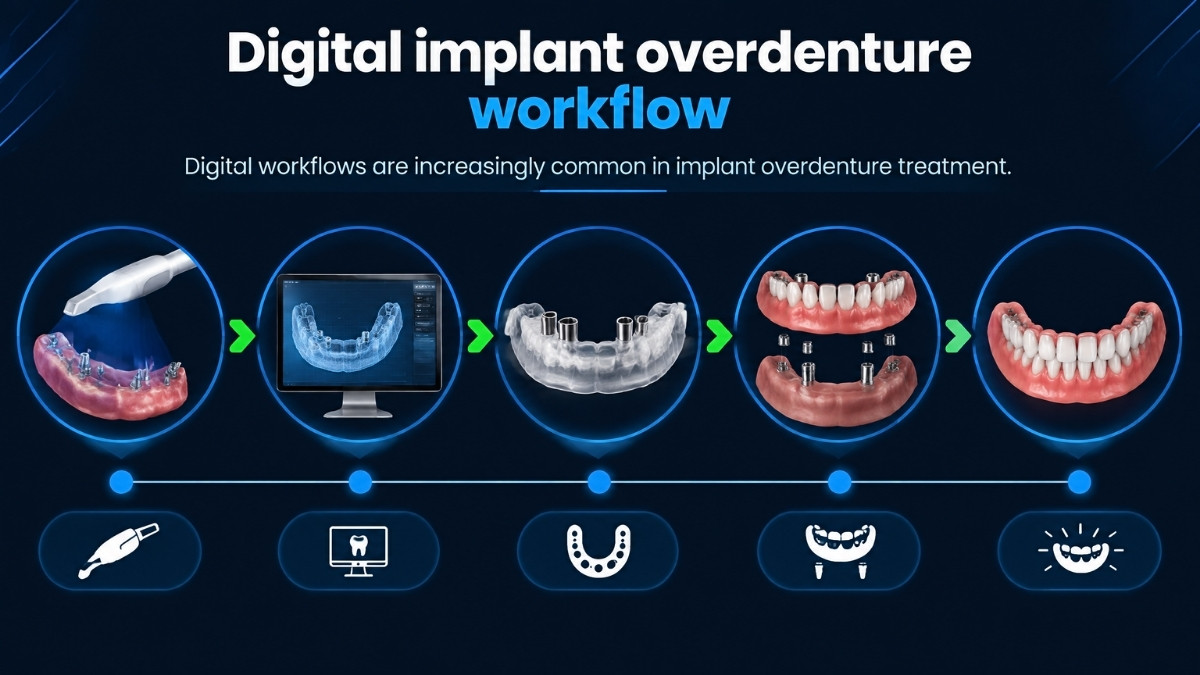
Digital inputs
- Intraoral scans
- Scan bodies
- Existing denture scan
- CBCT
- Facial scans
- Digital jaw relation records
- Photogrammetry in advanced cases
- CAD denture design
Digital manufacturing
- Milled PMMA denture base
- Printed denture base
- Milled denture teeth
- Bonded denture teeth
- Printed try-in denture
- CAD/CAM milled titanium bar
- SLM metal framework
- Digital duplicate denture
Advantages
- Digital archiving
- Easier remake
- Consistent tooth setup
- Precise bar fabrication
- Controlled prosthetic space
- Efficient prototype try-ins
- Better communication between clinic and lab
Limitations
- Scan accuracy around edentulous tissues can be challenging
- Soft tissue compression is difficult to capture digitally
- Attachment pickup may still be best intraorally
- Bar passivity must be verified
- Printed resin properties vary by product
- Denture base bonding to teeth must be controlled
Denture base reinforcement
Implant overdentures often need reinforcement because attachment housings reduce acrylic bulk.
- Cast metal framework
- Stainless steel mesh
- Fiber reinforcement
- Milled titanium reinforcement
- CAD/CAM metal framework
- High-impact acrylic
- Increased acrylic thickness where possible
When reinforcement is recommended
- Thin mandibular denture
- High occlusal force
- Opposing natural dentition
- Multiple attachment housings
- Bar overdenture
- History of denture fracture
- Immediate-load prosthesis
- Limited restorative space
- Bruxism
Common fracture zones
- Midline mandibular denture
- Around Locator housings
- Around bar clips
- Thin anterior flange
- Distal to attachments
- Around implant access reliefs
Occlusion for implant overdentures
Occlusion must stabilize the denture and reduce harmful implant and tissue loading.
Occlusal goals
- Stable centric contacts
- Even bilateral contact where appropriate
- Avoid premature contacts
- Reduce lateral tipping forces
- Avoid heavy anterior contacts in mandibular overdentures
- Control cantilever effects
- Harmonize with opposing arch
- Protect against parafunction
- Consider lingualized occlusion in many complete denture cases
Opposing arch considerations
| Opposing arch | Risk |
|---|---|
| Complete denture | Balanced occlusion may be useful |
| Natural teeth | Higher wear or fracture risk |
| Fixed implant prosthesis | High load on overdenture components |
| Ceramic crowns | Denture tooth wear |
| Partial denture | Complex occlusal movement |
Bruxism
For bruxers:
- Use stronger denture teeth
- Reinforce denture base
- Consider more implants or bar support
- Monitor inserts frequently
- Provide a night guard only when clinically appropriate
- Schedule shorter recalls
Biological complications
Implants supporting overdentures require hygiene and maintenance.
Common biological complications
- Peri-implant mucositis
- Peri-implantitis
- Plaque accumulation
- Soft tissue hyperplasia
- Tissue soreness
- Denture stomatitis
- Keratinized tissue issues
- Bone loss
- Food impaction
- Poor hygiene under bar
- Attachment-related soft tissue pressure
Contributing factors
- Poor denture hygiene
- Inadequate tissue relief
- Overextended flange
- Poor bar hygiene access
- Rough intaglio surface
- Patient smoking
- Uncontrolled diabetes
- Lack of recalls
- Continuous denture wearing
- Smooth polished intaglio
- Proper relief around abutments
- Avoid bulky overcontours
- Design cleanable bar spaces
- Round and polish all metal surfaces
- Avoid food traps
- Use tissue-friendly contours
Mechanical and prosthetic complications
Implant overdentures require planned maintenance. This is normal, not necessarily treatment failure.
Common mechanical complications
| Complication | Likely cause |
|---|---|
| Loss of retention | Worn inserts, clips, or O-rings |
| Attachment wear | Normal function, divergence, hygiene |
| Denture base fracture | Thin acrylic around housings |
| Tooth fracture or debonding | Limited space or occlusal overload |
| Housing loosening | Poor pickup or inadequate acrylic |
| Abutment screw loosening | Improper torque or overload |
| Bar clip wear | Normal use |
| Soft liner degradation | Aging material |
| Opposing tooth wear | Occlusal imbalance |
| Insert discoloration or debris | Poor hygiene |
Maintenance is expected
Patients should understand that attachments are consumable components. They function well, but they wear over time and require periodic replacement.
Maintenance protocol
A durable overdenture case depends on recall discipline.
Recall schedule
A common schedule includes:
- 24 to 48 hours after delivery
- 1 week
- 1 month
- Every 3 to 6 months initially
- Every 6 to 12 months long term depending on risk
At recall visits, evaluate
- Tissue health
- Implant hygiene
- Attachment wear
- Insert retention
- Denture fit
- Occlusion
- Denture base cracks
- Tooth wear
- Patient cleaning ability
- Radiographic bone levels when indicated
- Need for reline
- Need for insert replacement
Patient home care
Recommend:
- Remove denture at night unless otherwise instructed
- Clean denture daily
- Brush attachments or abutments gently
- Clean around implants
- Use non-abrasive cleanser
- Avoid boiling water
- Avoid bending or picking inserts
- Keep denture stored appropriately for its material
- Attend maintenance visits
Implant overdenture vs fixed full-arch prosthesis
Implant overdentures and fixed full-arch prostheses solve different problems.
| Feature | Implant overdenture | Fixed full-arch prosthesis |
|---|---|---|
| Patient removes it | Yes | No |
| Hygiene access | Easier for many patients | More difficult |
| Cost | Lower | Higher |
| Implant number | Often fewer | Usually more or strategically placed |
| Lip or facial support | Good with flange | May require prosthetic gingiva |
| Maintenance | Inserts, relines, clips | Screws, ceramic or acrylic repairs |
| Patient perception | Removable | Fixed teeth |
| Repair | Often easier | More complex |
| Space requirement | Moderate to high | High |
| Best for | Poor denture retention, cost-conscious, hygiene-focused patients | Patients demanding fixed teeth and suitable anatomy |
An implant overdenture is often the more hygienic and maintainable option for patients who need lip support or cannot clean under a fixed prosthesis effectively.
International standards and documentation
Implant overdentures are custom medical devices and should be produced with traceable, validated materials.
Relevant standards
| Standard / framework | Relevance |
|---|---|
| ISO 13485 | Quality management system for medical device manufacturing |
| ISO 20795 Series | Denture base polymers |
| ISO 22674 | Metallic materials for dental restorations and appliances |
| ISO 10993 Series | Biological evaluation of medical devices |
| ISO 7405 | Biological evaluation of dental materials |
| ISO 14801 | Fatigue testing for endosseous dental implants |
| Manufacturer IFU | Implant attachment, torque, pickup, processing instructions |
| Local medical device regulations | Country-specific dental laboratory compliance |
Laboratory documentation should include
- Dentist prescription
- Patient or case ID
- Implant system
- Implant platform
- Attachment brand and size
- Cuff height
- Insert retention level
- Housing lot number
- Denture resin lot number
- Denture tooth brand, shade, and mold
- Bar material and lot number if applicable
- CAD file or design record
- Processing method
- Final QC record
- Maintenance instructions
Laboratory quality control checklist
A structured QC system helps prevent avoidable overdenture problems.
IMPLANT-RETAINED OVERDENTURE FINAL QC FORM
Case ID: ___________________________
Dentist / Clinic: __________________
Patient ID: ________________________
Arch: Maxillary / Mandibular
Implant System: ____________________
Implant Platform: __________________
Attachment Type: ___________________
Attachment Brand/Size: _____________
Cuff Height: _______________________
Insert Retention Level: ____________
Date: ______________________________
CASE VERIFICATION
[ ] Prescription reviewed
[ ] Implant system verified
[ ] Implant platform verified
[ ] Attachment type verified
[ ] Cuff height verified
[ ] Insert retention level verified
[ ] Opposing arch reviewed
[ ] Special instructions reviewed
FIT AND ATTACHMENT CHECK
[ ] Denture seats fully
[ ] No rocking on master cast
[ ] Housings seated securely
[ ] Inserts/clips correctly placed
[ ] Relief around attachments adequate
[ ] No acrylic locking undercuts
[ ] Retention acceptable
[ ] Path of insertion smooth
DENTURE BASE CHECK
[ ] Acrylic thickness adequate
[ ] Reinforcement included if prescribed
[ ] No porosity
[ ] No cracks
[ ] Borders smooth
[ ] Intaglio surface smooth
[ ] Tissue relief appropriate
[ ] Bar space cleanable if applicable
OCCLUSION AND ESTHETICS
[ ] Tooth shade/mold verified
[ ] Tooth arrangement verified
[ ] Midline and smile line checked
[ ] Occlusion checked
[ ] No heavy premature contacts
[ ] Denture teeth polished
[ ] External surfaces polished
BAR / FRAMEWORK CHECK, IF APPLICABLE
[ ] Passive bar fit verified
[ ] Screw access clear
[ ] Correct screws included
[ ] Bar tissue clearance adequate
[ ] Clip retention checked
[ ] Bar polished
[ ] Torque values included
FINAL RELEASE
[ ] Denture cleaned and disinfected
[ ] Material/component lot numbers recorded
[ ] Maintenance instructions included
[ ] Replacement insert information included
[ ] Case packed securely
[ ] Final QC approved
Technician: ________________________
QC Inspector: ______________________
Why this matters for XDENT LAB
Implant-retained overdentures align directly with XDENT LAB’s strengths in removable prosthodontics, implant workflows, and lab-to-lab manufacturing support.
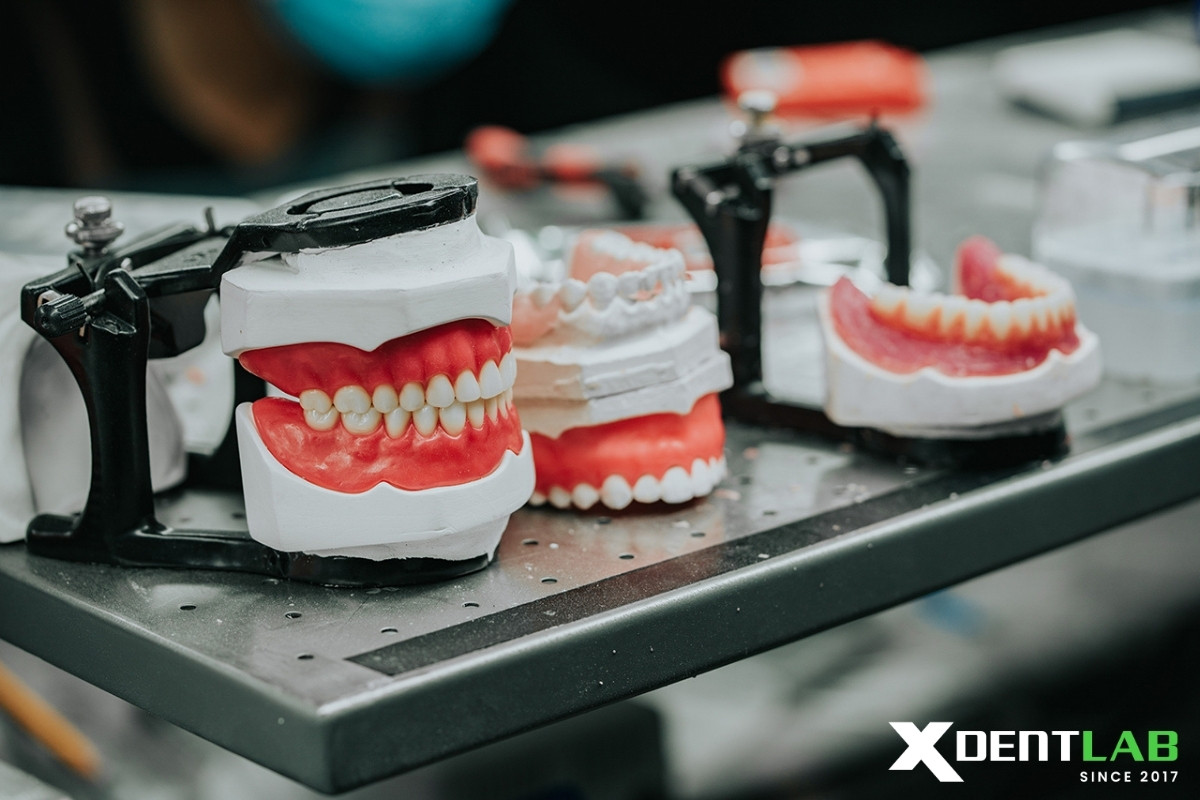
XDENT LAB value in overdenture cases
- Implant overdenture case coordination
- Attachment-based removable design
- Conventional and digital overdenture workflows
- CAD/CAM bar and framework fabrication
- Denture base reinforcement strategies
- Structured QC and traceability
- FDA and ISO-aligned documentation systems
- Scalable Vietnam dental lab production for consistent output
For dental practices that prioritize quality and consistency, this matters because overdenture success depends on more than implant placement. It also depends on how accurately the laboratory controls restorative space, attachment fit, acrylic thickness, hygiene design, and finishing quality.
Key takeaways
Implant-retained overdentures are removable prostheses retained by dental implants using attachments such as Locators, balls, bars, magnets, or telescopic systems.
- They dramatically improve retention and stability compared with conventional complete dentures.
- Two implants in the mandible are widely accepted as a standard entry-level treatment for many edentulous mandibular cases.
- The maxilla usually requires more implants, commonly four or more, because of bone quality, support needs, and prosthetic design factors.
- Attachment selection depends on implant position, restorative space, hygiene, dexterity, cost, and maintenance expectations.
- Locator-type attachments are popular, but inserts wear and require periodic replacement.
- Bar overdentures offer splinting and strong retention, but require more space, more hygiene effort, and greater laboratory precision.
- Restorative space is critical because inadequate space can lead to fracture, housing exposure, poor esthetics, and maintenance problems.
- Digital workflows are increasingly important, especially for milled bars, CAD denture design, printed try-ins, and archived remakes.
- Maintenance is part of the treatment, not an afterthought.
- A well-designed implant overdenture is removable, stable during function, cleanable, repairable, and biologically maintainable.
In practical prosthodontics, implant-retained overdentures often represent the sweet spot between conventional dentures and fixed full-arch prostheses. They are more stable than a conventional denture, more maintainable than many fixed full-arch options, and often more accessible for patients.
Share this post:
Related Posts
Learn how tooth-supported overdentures rely on careful clinical planning, abutment selection, attachments, and laboratory QC for stable, predictable results.
Explore cast metal framework partial dentures, including design principles, material selection, lab workflow, fit, hygiene, and long-term clinical performance.
Not all occlusal rests are the same. Here is what distinguishes the extended, interproximal, internal types, and the clinical situations each one is designed for.

