
Not all occlusal rests are the same. Here is what distinguishes the extended, interproximal, internal types, and the clinical situations each one is designed for.
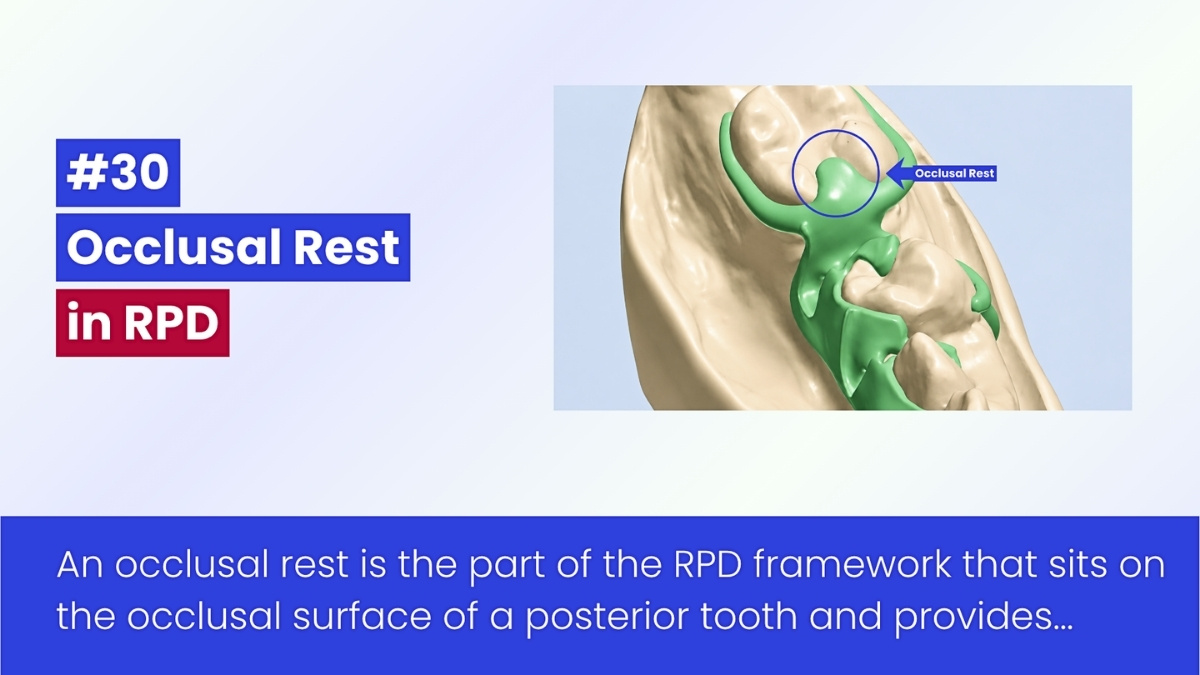
Table of contents [Show]
Introduction
Parts 1 and 2 of this series covered what rests do and what the correct form of an occlusal rest looks like. This post goes one level deeper: not all occlusal rests are the same, and the differences between them are not cosmetic.
Each type exists because a standard occlusal rest cannot solve every clinical situation. A tilted abutment, a rest seat between two adjacent teeth, or a case where aesthetics require hiding the clasp arm. Each of these calls for a different approach. Understanding which type fits which situation is part of what separates a well-designed framework from one that causes problems over time.
What Is An Occlusal Rest?
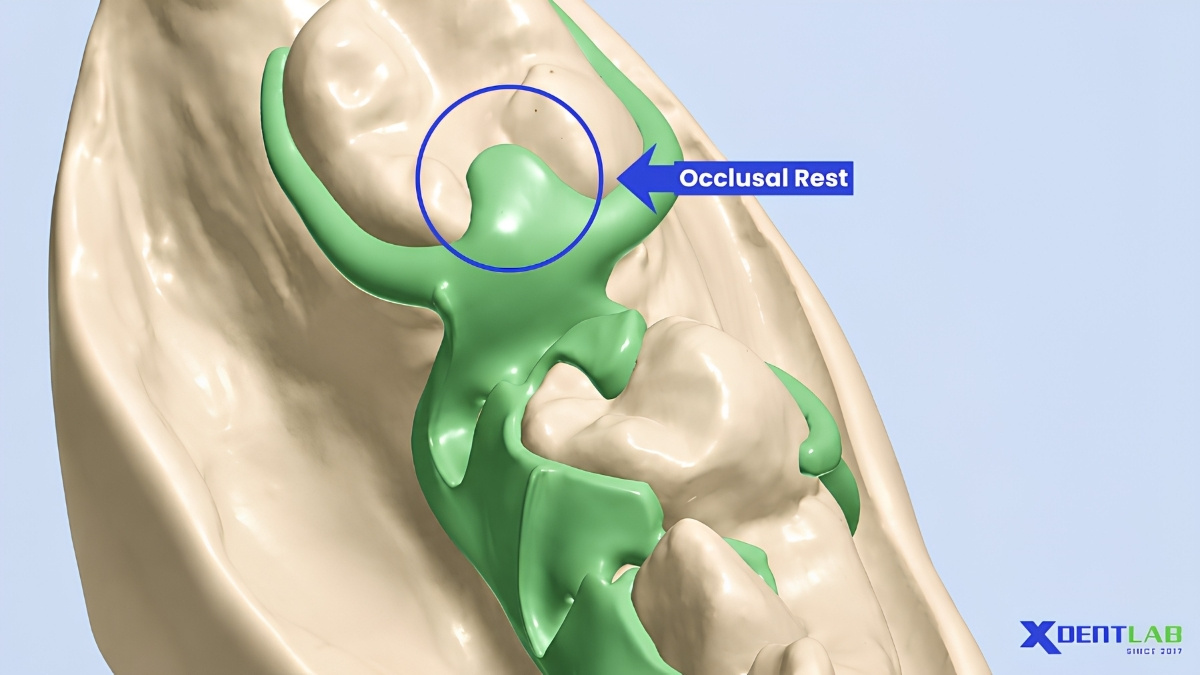
An occlusal rest is the part of the RPD framework that sits on the occlusal surface of a posterior tooth and provides vertical support for the prosthesis. It is the most common type of rest in RPD design because posterior teeth are built to receive vertical load, and their occlusal surfaces offer enough surface area to distribute that load without concentrating it at a single point.
The standard occlusal rest works well when the abutment tooth is upright, the rest seat can be prepared within normal dimensions, and the framework design does not create aesthetic concerns. When any of those conditions are not met, one of the three variations below becomes necessary.
Extended Occlusal Rest In RPD
What Extended Occlusal Rest Is?
An extended occlusal rest is the extended occlusal rest that covers more than half the mesiodistal width of the tooth and approximately one third of the buccolingual width. The larger footprint distributes force across a broader area and, more importantly, allows the rest geometry to redirect load down the long axis of the tooth despite the tilt.
The Problem Extended Occlusal Rest Solves
When a molar has tipped mesially, its occlusal surface is no longer perpendicular to its long axis. A standard occlusal rest placed on a tilted tooth would transmit force at an angle, pushing the tooth to tip further rather than loading it axially. Over time, a poorly placed rest on a tilted molar accelerates the very movement it was meant to prevent.
Interproximal Occlusal Rest In RPD
What Interproximal Occlusal Rest Is?
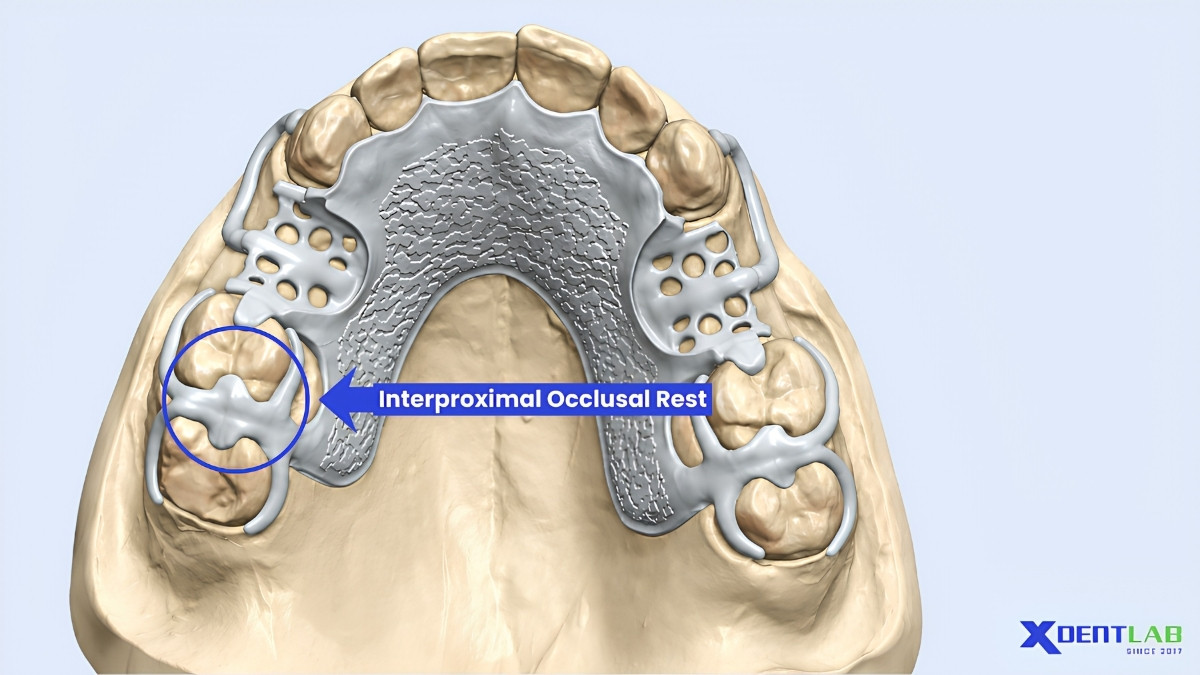
Interproximal occlusal rests are two individual rest seats prepared on adjacent teeth, extended further lingually than a standard preparation. Because there are two separate rests rather than one shared rest, no single piece of metal sits between the teeth in a way that can wedge them apart. The two rests work together to support the framework while each stays on its own tooth.
The joined rest design also shunts food away from the contact area rather than trapping it there.
The Problem Interproximal Occlusal Rest Solves
Some direct retainer assemblies require placing a rest in the area between two adjacent teeth rather than entirely on one tooth. A single rest placed in that interproximal space creates a wedging effect: each time the patient bites down, the rest is driven deeper into the contact area and the two teeth are pushed apart. Over time this opens the contact point, creates a food trap, and destabilizes both teeth.
Internal Occlusal Rest In RPD
What Internal Occlusal Rest Is?
An internal occlusal rest sits inside the abutment tooth or its restoration rather than on top of the occlusal surface. It is a precisely shaped recess, parallel to the path of placement, slightly tapered occlusally, and slightly dovetailed proximally to prevent dislodgment.
It provides two functions simultaneously. The floor of the recess provides vertical support, the same role a standard occlusal rest plays. The near-vertical walls of the recess provide horizontal stabilization, which a standard rest cannot do on its own. This means the internal rest resists both vertical settling and lateral movement of the prosthesis.
Retention is provided by a lingual clasp arm, either cast or wrought wire, sitting in an infrabulge area on the lingual surface. The buccal surface of the tooth remains free of visible metal.
The Problem Internal Occlusal Rest Solves
A standard occlusal rest requires a clasp arm on the buccal surface of the abutment tooth to provide retention. That clasp arm is visible when the patient speaks or smiles. In aesthetic zones or in patients who prioritize appearance, a visible clasp arm is a significant drawback.
The internal rest addresses this by relocating both the rest and the retention mechanism in a way that eliminates the need for a visible buccal clasp arm.
Conclusion
Each type solves a different problem. The extended rest corrects for a titted abutment. The interproximal rest avoids wedging when the rest position falls between two teeth. The internal rest eliminates visible clasps while adding horizontal stabilization.
They are not interchangeable. The clinical situation determines which type is appropriate, and that decision should be made before the impression is taken.
References
Carr AB, Brown DT. McCracken's Removable Partial Prosthodontics. 12th ed. St. Louis: Mosby/Elsevier; 2011.
https://ekitap.ankara.edu.tr/dentures/chapter/okluzal-tirnaklar
https://uomus.edu.iq/img/lectures21/MUCLecture_2022_82753789.pdf
About XDENT LAB:
We are experts in Lab-to-Lab Full Service from Vietnam, with the signature services of Removable, meet U.S. market standards, FDA-registered, ISO 13485-certified. Founded in 2017, from local root to global reach, we scale with 2 Factories with over 100+ employees.
Our Commitments Built on “Trusted. Commitment. Quality”
- Commit to Large-Scale Manufacturing, high volume, remake rate < 1%.
- Commit to 5-Year Warranty
- Commit to Competitive Price
XDENT LAB | A Trusted Lab-to-Lab Service from Vietnam
Share this post:
Related Posts
Explore lab-to-lab workflow and QC for implant-supported fixed prostheses, from fit and materials to retrievability, hygiene design, and consistency.
Explore lab workflow and quality standards for inlays, onlays, and overlays to improve fit, occlusion, durability, and restorative consistency.
Explore veneer laboratory workflow, shade control, and quality checks in prosthodontics for predictable esthetics, fit, bonding, and long-term results.

