
Explore full-arch fixed prosthesis planning and lab workflows, from implant distribution and framework fit to materials, hygiene and maintenance.
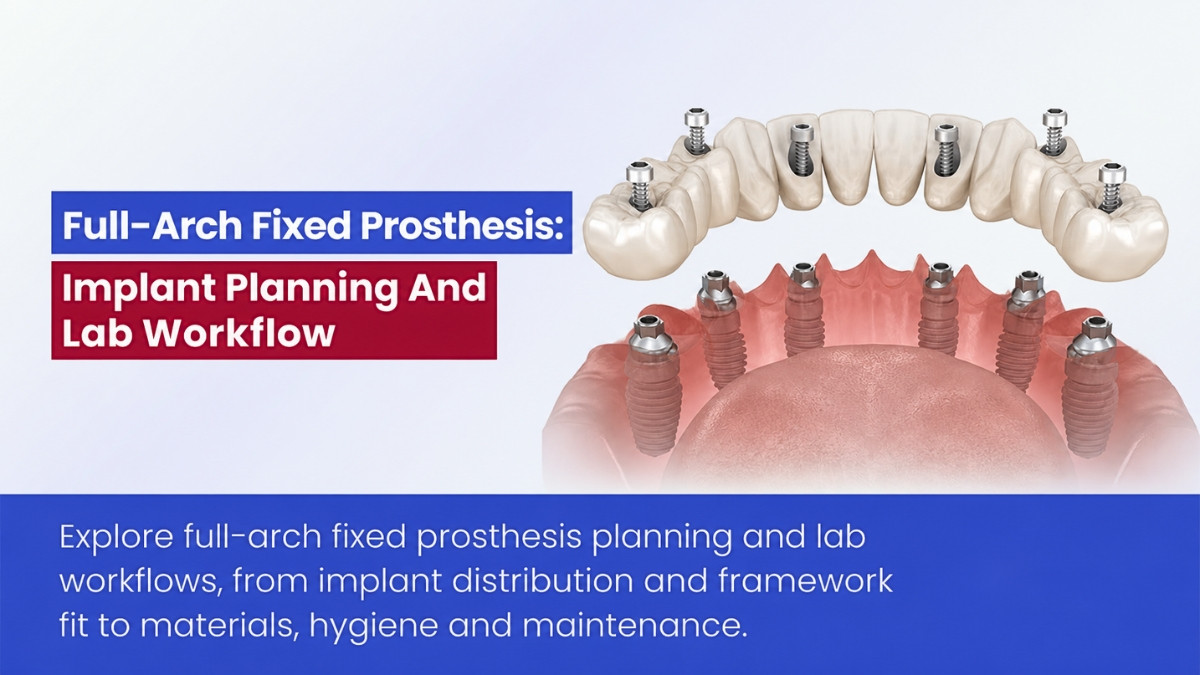
Table of contents [Show]
A full-arch fixed prosthesis replaces all the teeth in one jaw with a restoration supported by dental implants. The patient does not remove it, although many designs can be retrieved by a clinician for maintenance or repair. Depending on the anatomy, the prosthesis may replace the teeth alone or both the teeth and lost gingival tissue.
For dental practices and laboratories, the challenge is to make implant distribution, restorative space, framework fit, materials, appearance, hygiene and repairability work together. A full-arch restoration can remain in service while still needing repeated repairs or proving difficult for the patient to clean. Planning for maintainability is therefore as important as planning for delivery.
What is a full-arch fixed implant prosthesis?
Academic publications may call this restoration a complete-arch implant-supported fixed dental prosthesis or a fixed complete denture. Its construction can include implants, intermediate abutments, prosthetic screws, a framework or monolithic structure, replacement teeth and, where needed, artificial gingiva.
The term hybrid prosthesis is used inconsistently. Rather than relying on that label, a prescription should identify the framework, tooth material, gingival material and attachment method. Likewise, “All-on-4” names a particular treatment concept; it is not a synonym for every full-arch fixed prosthesis.
Teeth-only versus tissue-replacing designs
The FP classification describes the tissue a prosthesis replaces. It does not specify the number of implants or the restorative material.
| Classification | What it replaces | Planning implication |
|---|---|---|
| FP-1 | Primarily the missing tooth crowns | Requires favorable tooth positions, implant positions and tissue architecture |
| FP-2 | Crowns and part of the root form | May create longer-looking teeth |
| FP-3 | Teeth and lost gingival tissue | Requires an acceptable smile-line transition and cleanable artificial gingiva |
The distinction matters most before surgery and fabrication. A restoration that needs to replace substantial tissue must provide the intended lip support without creating an inaccessible surface beneath the prosthesis.
When is fixed treatment appropriate?
A full-arch fixed prosthesis may suit a patient who is edentulous or has a genuinely terminal dentition, has suitable anatomical and restorative conditions, and can maintain the restoration and peri-implant tissues. The patient also needs to understand the surgical, financial and long-term maintenance commitments.
Fixed treatment is not automatically preferable to an implant overdenture. A removable flange may provide better lip support, improve cleaning access or make repairs more manageable. Restorable teeth should not be extracted simply to streamline a full-arch workflow. Their prognosis and preservation options deserve assessment first.
Which records guide treatment planning?
Planning should begin with the proposed tooth arrangement and facial result—not implant locations alone. Useful records include photographs, scans or impressions, jaw-relation and occlusal records, a diagnostic tooth arrangement, information from provisional restorations, and imaging when clinically justified.
The clinical team and laboratory should establish:
- Tooth positions, smile line and the visibility of any prosthesis–tissue transition.
- Lip support, speech, vertical dimension and jaw relationships.
- Available restorative space and the proposed construction.
- Implant distribution, abutment selection and screw-access positions.
- Opposing dentition, parafunction and occlusal goals.
- Patient cleaning access, clinician retrieval and repair options.
A technically accurate restoration can still be unsatisfactory if its transition line shows during smiling or its tissue-facing surface cannot be cleaned.
How many implants are needed?
There is no implant number that guarantees success for every full arch. Four, six or other configurations may be appropriate in selected cases. The maxilla or mandible, available bone, implant position, support distribution, restorative height, cantilevers and opposing dentition all influence the decision.
A systematic review by Daudt Polido and colleagues examines implant number for complete-arch fixed prostheses. Its findings should not be converted into a universal claim that one implant count is equivalent to another for every patient. The clinical team must also consider what happens to the restoration if one implant is lost.
Immediate loading is a separate decision
Immediate implant placement, immediate restoration and immediate loading are not interchangeable terms. Loading a provisional full arch soon after surgery requires appropriate implant stability and distribution, an accurately fitting provisional, controlled occlusion and a backup plan if the clinical criteria are not met. No single torque or stability reading establishes suitability in every case.
Materials, retention and full-arch design
The best material is not simply the strongest one. It must be appropriate for the planned architecture, available space, component system and expected maintenance needs.
Common restorative constructions
These systems differ in how they wear, fracture and can be repaired.
| Construction | Potential advantage | Key limitation |
|---|---|---|
| Metal framework with acrylic or composite teeth and gingiva | Useful for tissue replacement and often repairable | Tooth fracture, wear, discoloration and bond maintenance |
| Metal–ceramic | Rigid framework with established restorative use | Veneer chipping and potentially complex repairs |
| Monolithic zirconia | Avoids a separate veneer layer in monolithic areas | Major fractures and some interface failures can be difficult to repair |
| Zirconia with limited veneering | Additional esthetic characterization | Veneered regions retain chipping risk |
| Titanium framework with individual crowns | Individual units may be replaceable | More bonding or attachment interfaces to manage |
These are construction categories, not rankings. A provisional PMMA bridge and a definitive framework-supported polymer prosthesis have different intended uses. Similarly, evidence supporting a material for a single crown does not establish that it is suitable for a one-piece full-arch framework.
What matters in a zirconia full arch?
“Zirconia” describes a family of materials with different compositions and mechanical properties. The laboratory must match the selected product to the intended full-arch indication and follow its requirements for thickness, screw-channel regions, cantilevers, nesting, sintering and finishing.
Clinical research includes a large retrospective report on complete-arch zirconia prostheses and a systematic review of monolithic zirconia full-arch restorations. Such evidence needs interpretation by prosthesis architecture, follow-up duration and the definition of a complication. Results for one zirconia system should not be assumed to apply to every blank or framework design.
Why is screw retention common?
Screw retention is often selected for full-arch restorations because clinician retrieval can support repair, component inspection and treatment of peri-implant tissues. It still requires accessible screw channels, adequate material around those channels, and exact approved screws, drivers and torque instructions.
Cement retention may be considered in selected designs, but excess-cement control and future retrieval require careful planning. The ITI consensus on retention methods addresses implant-supported fixed reconstructions more broadly: neither screw nor cement retention eliminates complications.
A restoration bonded extraorally to titanium bases can still be screw-retained at the implants or abutments. That construction should not be confused with cementing the prosthesis inside the mouth.
How do cantilevers and contours affect maintenance?
Cantilever demands depend on load position, implant distribution, crown height, framework geometry, material and opposing dentition. There is no universally safe cantilever length or restorative-space measurement for every full-arch system.
The tissue-facing design must also be tested as a cleaning surface. Smooth contours should allow appropriate cleaning aids to reach the relevant areas without unnecessary food trapping, tissue pressure or speech problems. A polished but inaccessible underside is still difficult to maintain.
Bone reduction may help create restorative space in some treatment plans, but it is irreversible. It should be justified by the patient’s complete clinical needs, not solely by a preferred laboratory construction.
Clinical–laboratory workflow and quality controls
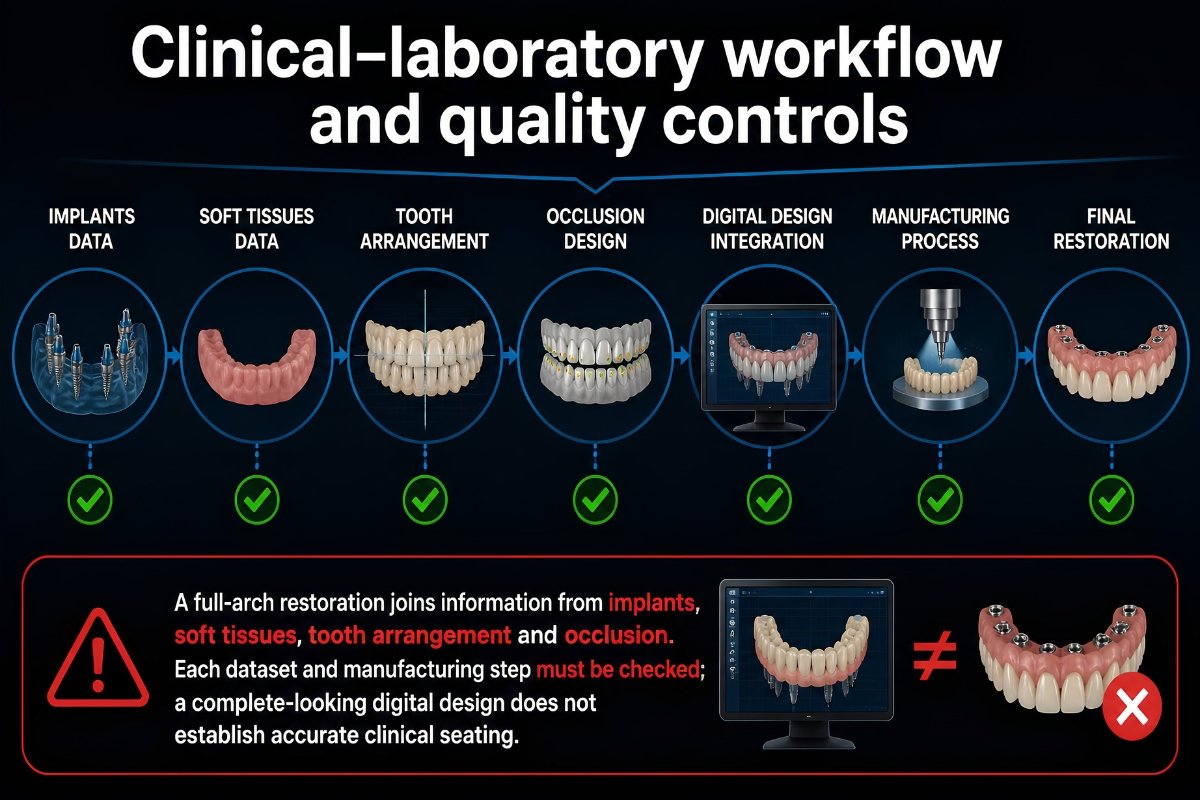
A full-arch restoration joins information from implants, soft tissues, tooth arrangement and occlusion. Each dataset and manufacturing step must be checked; a complete-looking digital design does not establish accurate clinical seating.
What should the laboratory prescription identify?
Before production, the prescription should specify the implant manufacturer and connection, whether the restoration is implant-level or abutment-level, the exact intermediate abutments and heights, scan bodies or impression components, approved screws and titanium bases, planned materials, tooth arrangement, occlusion and verification stages.
Platform diameter alone does not establish component compatibility. Third-party parts require documented compatibility and appropriate regulatory consideration, rather than reliance on apparent seating.
Conventional, digital and photogrammetric records
Records may be obtained with conventional impressions, intraoral scanning, photogrammetry or a hybrid workflow. The suitable approach depends on implant distribution, clinical access, the equipment used and how the result will be verified.
Photogrammetry can help record relative implant or abutment positions. It does not necessarily capture all the soft-tissue and occlusal information needed to design the prosthesis. Scan-body seating, software libraries and alignment between datasets remain important sources of potential error.
How is framework fit verified?
Verification may include an appropriate verification device, visual and tactile checks, radiographs when indicated, and controlled screw-sequence assessments. The team should investigate rocking, visible gaps or incomplete seating.
Do not tighten screws to draw a visibly misfitting framework into place. Review the record, component seating, manufacturing process and assembly instead. “Passive fit” is a useful clinical objective, but no single test proves an absolute absence of strain.
Provisional findings must transfer to the definitive design
A provisional can test tooth position, vertical dimension, speech, lip support, occlusion and hygiene access. Its approved features should be communicated clearly to the laboratory. The definitive restoration still needs its own fit assessment because manufacturing and bonding can introduce new discrepancies.
Manufacturing, bonding and traceability
Relevant controls include milling accuracy, metal processing, zirconia nesting and sintering, veneering support, titanium-base alignment, material-specific surface conditioning and removal of excess bonding resin. Functional connections and screw seats should not be modified casually.
Traceability should identify component and material lots, processing steps, fit checks, bonding procedures and delivery instructions. Recurrent screw loosening should prompt diagnosis of fit, loading and component integrity—not repeated tightening alone.
International standards can support defined quality processes and material testing. Depending on the construction, relevant examples include ISO 6872 for dental ceramics, ISO 22674 for metallic restorative materials, ISO 14971 for medical-device risk management and ISO 13485 for quality-management systems. Current editions and scopes can be checked through the official ISO catalogue. Compliance with a standard does not prove that a particular full-arch design will perform successfully in a specific patient.
Complications, maintenance and long-term value
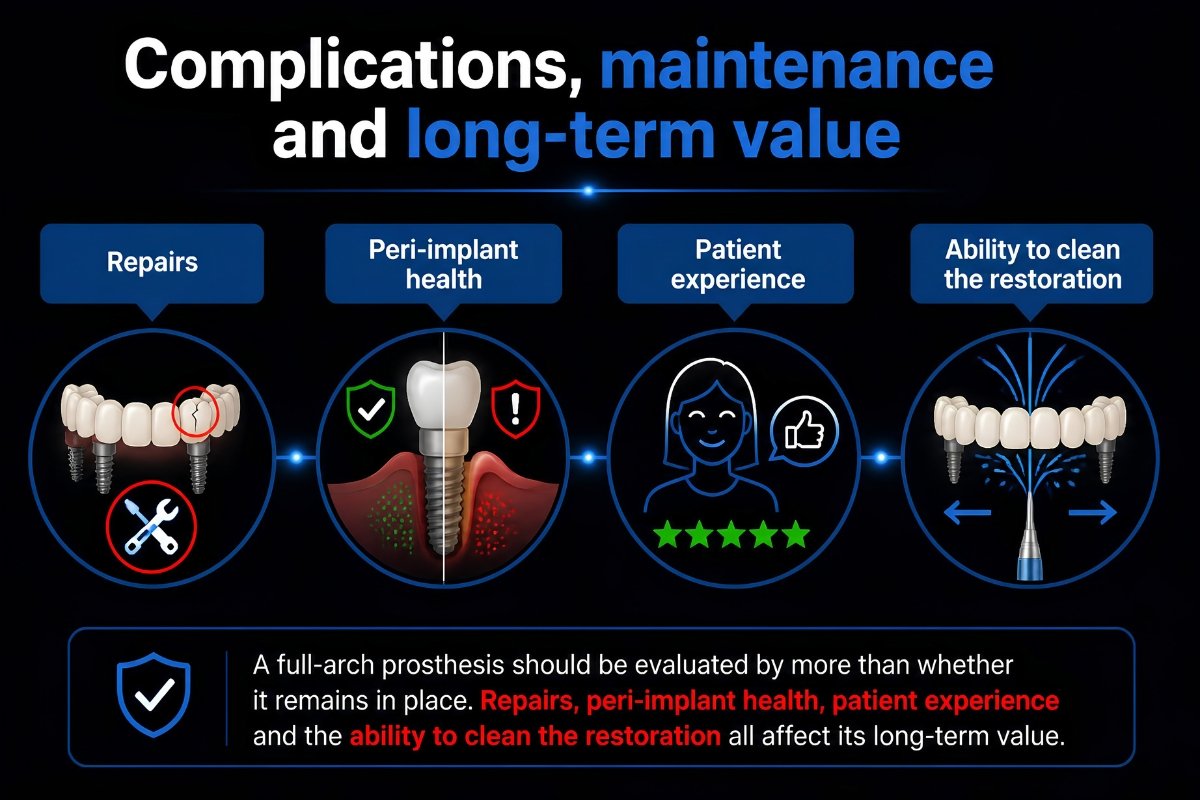
A full-arch prosthesis should be evaluated by more than whether it remains in place. Repairs, peri-implant health, patient experience and the ability to clean the restoration all affect its long-term value.
Which complications should the team anticipate?
Technical complications can include tooth fracture or wear, ceramic chipping, framework fracture, titanium-interface debonding, screw loosening and loss of access fillings. Biological concerns include peri-implant mucositis, peri-implantitis and inflammation associated with poor cleaning access.
A retrospective study available through the University of North Carolina repository provides supplementary information on monolithic zirconia full-arch prostheses, including interface-related complications. Its design and publication type should be considered when weighing it against broader clinical evidence.
What happens at maintenance visits?
Individualized recall should assess plaque control, peri-implant tissues, cleaning access, occlusion, component stability, wear and bonding interfaces. Radiographs may be appropriate when clinically indicated. The European Federation of Periodontology’s S3 clinical practice guideline provides an evidence-based resource for peri-implant disease prevention and treatment.
A fixed prosthesis need not automatically be removed at every visit. Retrieval should follow clinical need and the agreed maintenance protocol. Persistent bleeding, suppuration, pain, increasing probing depths or mobility warrants professional assessment.
What should dental practices expect from a lab partner?
For dental practices using lab-to-lab service or dental lab outsourcing, a dependable handoff includes exact component identification, a verified restorative record, agreed fit checks and documentation that supports future retrieval or repair. These steps are particularly valuable when clinical and manufacturing teams work in different locations.
XDENT LAB supports implant and removable prosthetic workflows through its Vietnam-based lab-to-lab service. For a full-arch case, the laboratory’s role is to manufacture to the agreed design and component specifications, document its processes and communicate issues that affect fit or maintainability. Treatment selection, clinical verification and ongoing patient care remain the responsibility of the treating team.
The practical takeaway: A full-arch fixed prosthesis should be planned as a cleanable, retrievable and repairable system. Implant survival matters, but lasting value also depends on accurate fit, appropriate construction, healthy peri-implant tissues and a maintenance plan the patient can follow.
About XDENT LAB:
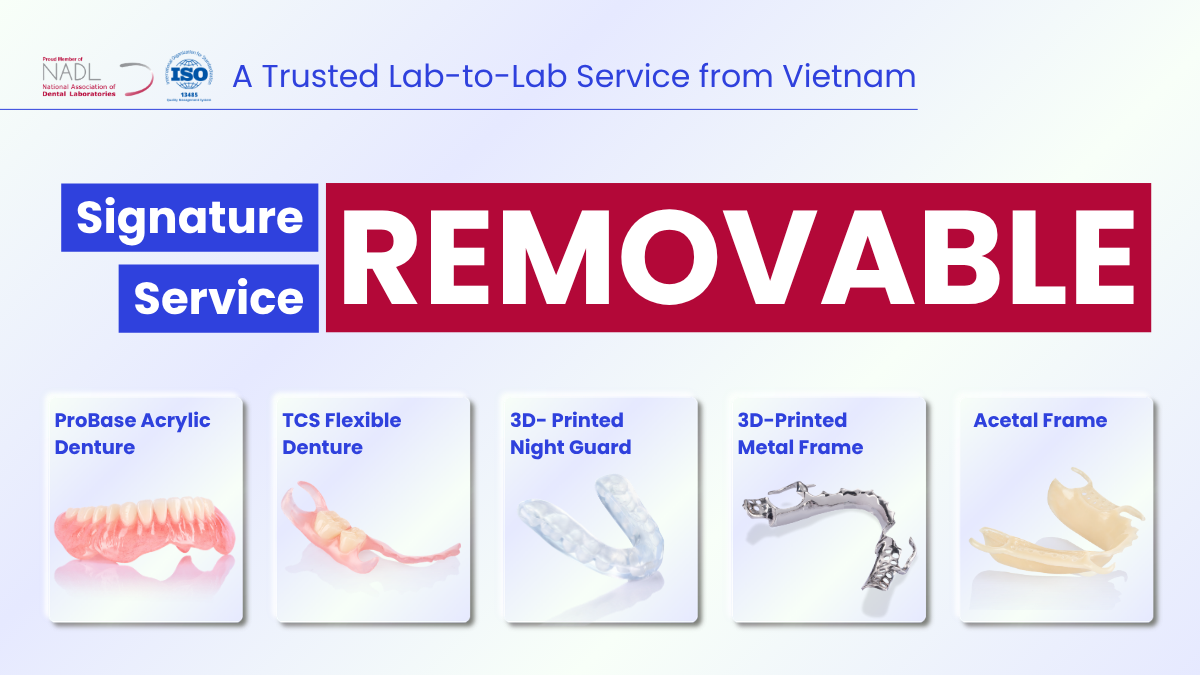
We are experts in Lab-to-Lab Full Service from Vietnam, with the signature services of Removable, meet U.S. market standards, FDA-registered, ISO 13485-certified. Founded in 2017, from local root to global reach, we scale with 2 Factories with over 100+ employees.
Our Commitments Built on “Trusted. Commitment. Quality”
- Commit to Large-Scale Manufacturing, high volume, remake rate < 1%.
- Commit to 5-Year Warranty
- Commit to Competitive Price
XDENT LAB | A Trusted Lab-to-Lab Service from Vietnam
Share this post:
Related Posts
A practical guide to implant-supported bridges for dental practices, covering retention, materials, cleanable contours and lab quality checks.
From digital scan to final glaze, see how a full zirconia crown or bridge is designed, milled, sintered and finished, and what affects quality along the way.
A practical guide to single implant crowns, covering abutments, Ti-bases, crown materials, common complications and ongoing care.

