
A practical guide to single implant crowns, covering abutments, Ti-bases, crown materials, common complications and ongoing care.
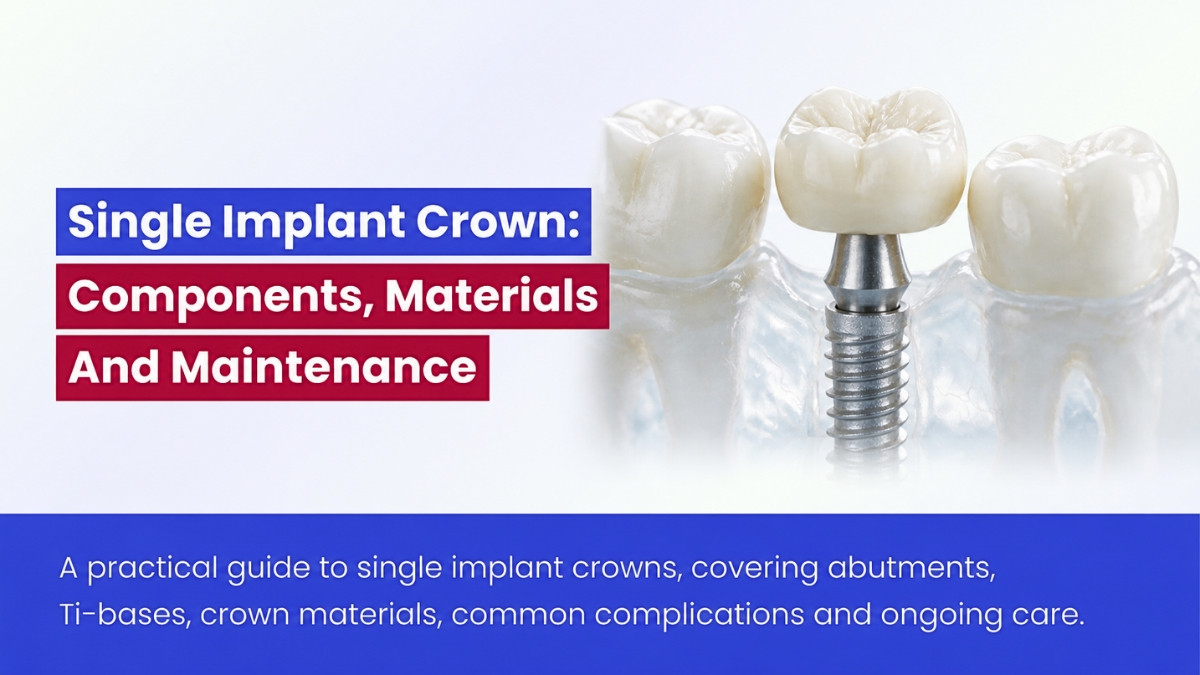
Table of contents [Show]
A single implant crown replaces one missing tooth with a restoration connected to a dental implant. Although the result looks like a natural tooth, its performance depends on more than the crown itself. Implant position, component compatibility, crown contour, fit and the surrounding tissues all matter.
For dental practices and laboratories, the guiding principle is restoration-driven planning. The intended tooth shape and position should inform implant placement and component selection—not be improvised after the implant has healed. This guide explains the clinical and laboratory decisions behind a cleanable, maintainable single implant crown.
What is a single implant crown?
A single implant crown is a fixed restoration supported by one dental implant. The patient does not remove it, although many designs can be retrieved by a clinician for maintenance or repair.
Components of a single implant crown
The restoration is an assembly of components with distinct functions:
- Implant fixture: The component placed in bone.
- Implant connection: The interface between the implant and its restorative component.
- Abutment or titanium base: The component that connects the crown structure to the implant.
- Prosthetic screw: Secures an abutment or screw-retained restoration.
- Crown: Provides the visible tooth form, proximal contacts and occlusal surface.
- Peri-implant tissues: The surrounding soft tissue and bone that require ongoing assessment and care.
A crown, abutment and titanium base are not interchangeable terms. Depending on the design, some of their functions may be combined in one assembled restoration. A single crown generally also requires an appropriate anti-rotational connection so that it cannot rotate independently on the implant.
How does an implant crown differ from a tooth-supported crown?
An implant does not have the periodontal ligament that allows a natural tooth to move slightly under load. It also requires an artificial transition from the implant platform to the wider shape of the replacement tooth. These differences affect contour, loading and maintenance.
| Feature | Natural-tooth crown | Single implant crown |
|---|---|---|
| Support | Natural tooth root | Osseointegrated implant |
| Movement | Physiological tooth movement | Much less movement |
| Connection | Bonded or cemented to tooth structure | Connected through an abutment, screw or bonded assembly |
| Biological concerns | Caries and periodontal or pulpal disease | Peri-implant inflammation and supporting-bone loss |
| Additional technical concerns | Crown fracture or loss of retention | Screw loosening, component fracture or titanium-base debonding |
Implants do not develop caries, but the neighboring teeth still can. Peri-implant tissues also remain susceptible to disease, making a cleanable crown design essential.
Planning a single implant crown
Successful treatment starts by assessing the proposed restoration and the patient’s ability to maintain it. An implant that integrates well can still leave a difficult restorative problem if it is poorly positioned.
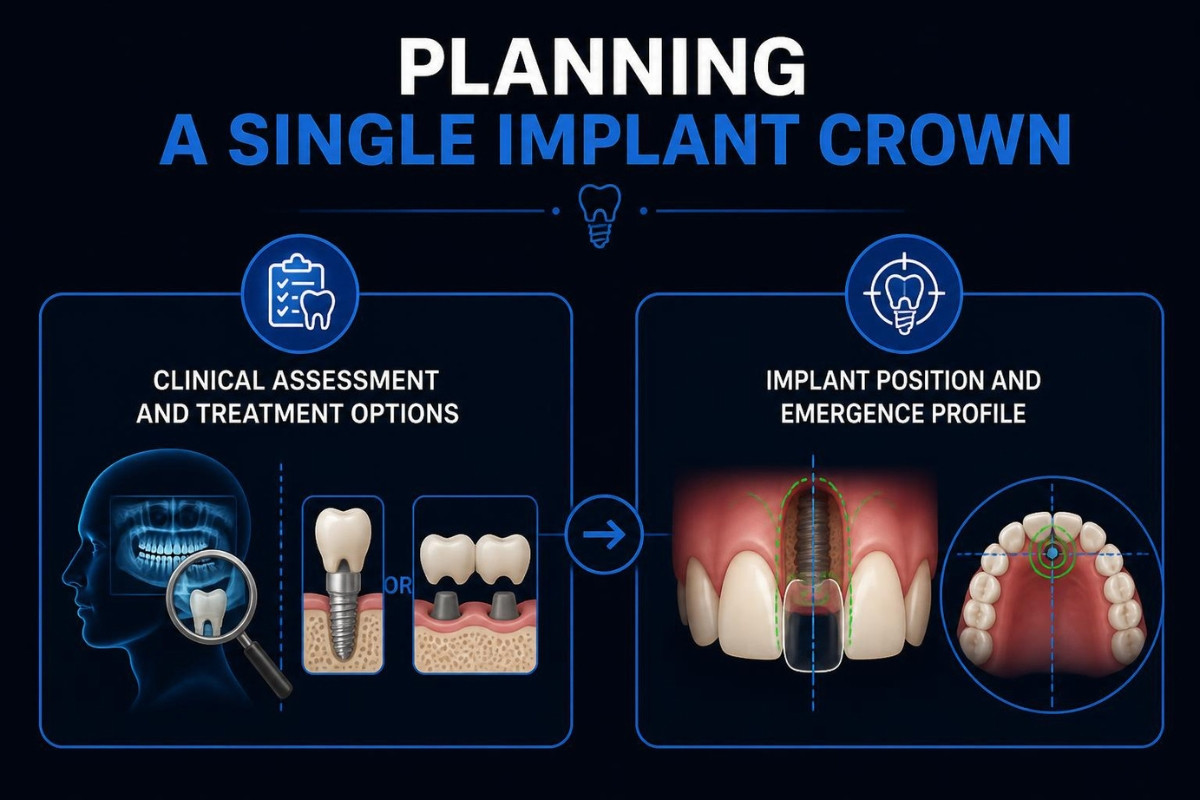
Before choosing an implant crown, the treating clinician should evaluate whether the original tooth can be preserved. Assessment also includes available bone and soft tissue, space between adjacent teeth and roots, bite relationships, smile line, plaque control, periodontal history, relevant systemic conditions and patient expectations.
Depending on the case, alternatives may include a conventional bridge, resin-bonded bridge, removable prosthesis, orthodontic space closure or no replacement. Implant treatment should not be presented as automatically preferable to preserving a restorable tooth.
Implant position and emergence profile
Three-dimensional implant position influences the screw-access location, crown thickness, appearance, restorative leverage and cleaning access. It also determines how the crown emerges from the soft tissue.
The emergence profile is the transition from the relatively narrow implant interface to the broader replacement tooth. An abrupt or overcontoured transition can make plaque control more difficult. A systematic review of emergence angle and peri-implantitis reported associations between wider emergence angles and disease in some studied groups, but the limited evidence does not establish a universal safe angle for every implant crown.
The role of a provisional crown
When clinically appropriate, a provisional crown can help assess appearance, tissue contour, contacts and the patient’s ability to clean around the restoration. It can also give the laboratory a reference for the approved emergence profile.
Immediate implant placement, immediate restoration and immediate functional loading are separate decisions. The presence of a provisional crown does not, by itself, establish that the implant should receive functional loading immediately.
Retention, abutments and crown materials
Material and component choices should follow the overall restoration design. Selecting a material solely because it has a high strength rating or an appealing shade overlooks connection, thickness and maintenance requirements.
Screw-retained versus cement-retained crowns
Both retention methods can be used successfully, but they involve different trade-offs.
| Consideration | Screw-retained crown | Cement-retained crown |
|---|---|---|
| Retrieval | Generally more straightforward | May be difficult or require crown damage |
| Access opening | Required through the restoration | Usually absent from the crown surface |
| Residual intraoral cement | Avoided during crown delivery | Must be minimized and removed |
| Potential complications | Screw loosening or access-filling loss | Loss of retention or cement-associated inflammation |
Screw retention is often attractive when planned retrieval is important and the access opening can be accommodated. For cement-retained crowns, margin position should allow excess cement to be identified and removed. The ITI consensus resource on screw- and cement-retained restorations provides further context on their clinical performance and complications.
Approved angulated screw-channel systems may improve access position in selected cases. They still require the specified components, driver, angulation limits and torque protocol; they cannot correct every consequence of an unfavorable implant position.
Titanium bases and hybrid restorations
A titanium base, or Ti-base, provides a prefabricated metal interface to which a customized ceramic structure can be bonded outside the mouth. Two common configurations are:
- Hybrid abutment: A customized ceramic abutment bonded to a Ti-base, with a separate crown.
- Hybrid abutment-crown: A crown-shaped ceramic structure bonded to a Ti-base and delivered as a screw-retained unit.
The ITI’s clinical overview of hybrid abutment-crowns explains these configurations. A separate ITI consensus resource on Ti-base restorations discusses their clinical performance while recognizing variation between Ti-base designs.
Not all Ti-bases are equivalent. Base height, geometry, surface condition, ceramic design and the bonding protocol can affect the assembled restoration.
Which crown material is appropriate?
The best material depends on implant location, available space, esthetic demands, occlusion and the manufacturer’s indication for the intended design.
| Material | Potential advantage | Design consideration |
|---|---|---|
| Metal–ceramic | Established clinical use | Veneer chipping and possible esthetic limitations |
| Monolithic zirconia | Avoids a separate veneering layer | Product-specific thickness, polishing and screw-channel design |
| Veneered zirconia | Allows detailed esthetic characterization | Potential veneer-related complications |
| Lithium disilicate | Favorable optical and adhesive properties | Product-specific crown and Ti-base indications |
| Resin-based materials | Useful for provisionals and selected applications | Wear, aging and indication-specific evidence |
A 2018 systematic review of metal–ceramic and zirconia–ceramic single crowns reported high estimated five-year survival for the restorations studied. More recent reviews address additional all-ceramic designs, including veneered and monolithic implant-supported single crowns. Results should be interpreted by material, crown design and follow-up period rather than applied to every modern ceramic product.
Crown survival is not the same as complication-free success. A crown may remain in service after a repair, screw replacement or other maintenance.
Clinical and dental lab workflow
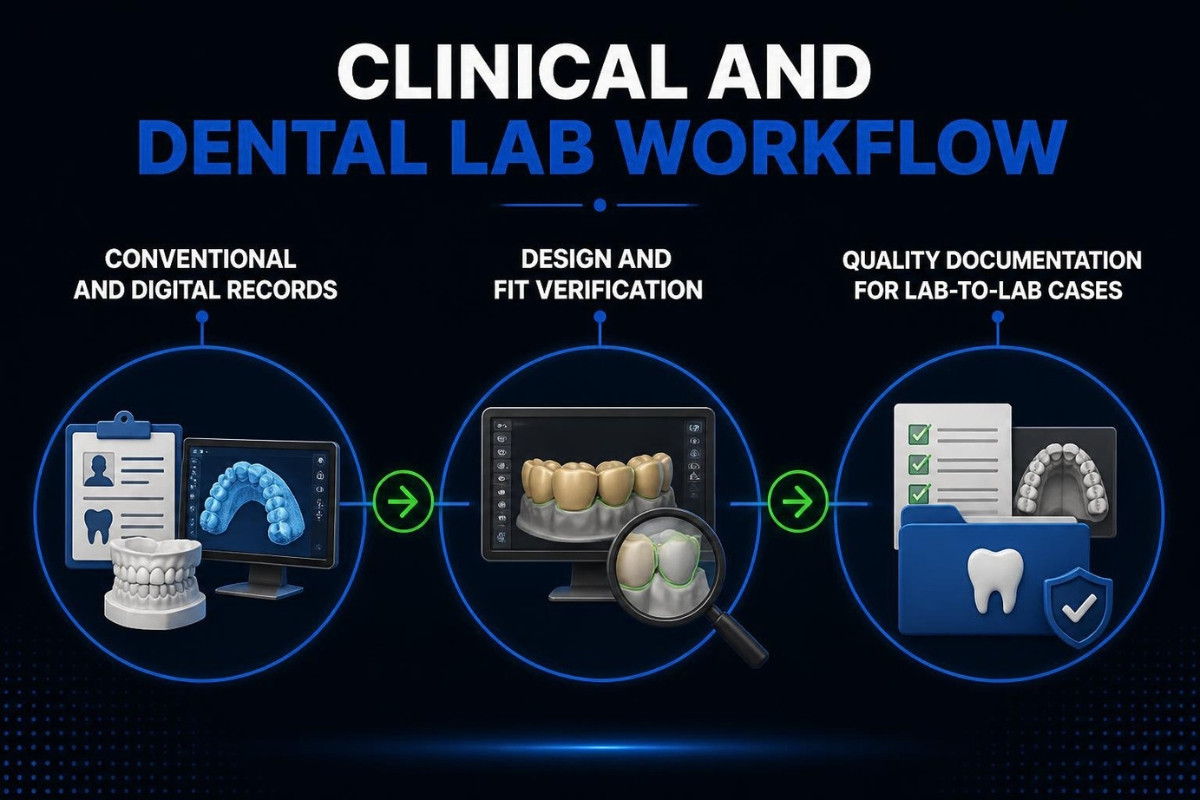
Reliable fabrication depends on accurate records, exact component identification and clear communication between the treating practice and laboratory. A visually convincing digital design cannot compensate for an incorrect implant library or incompatible component.
What should the laboratory prescription include?
For a single implant crown, the prescription should identify:
- The implant manufacturer, system, connection and platform.
- Whether the restoration is planned at implant level or abutment level.
- The exact scan body or impression coping.
- The selected abutment or Ti-base reference.
- The prosthetic screw, driver and approved torque instructions.
- The retention method, crown material and shade.
- The desired emergence profile, contacts and occlusal requirements.
A description such as “implant crown, 4 mm platform” does not establish component compatibility. Third-party components require documented compatibility and appropriate regulatory consideration, not merely an apparent physical fit.
Conventional and digital records
Conventional records may include an implant impression coping, impression and master cast. A digital workflow typically uses a correctly seated scan body, scans of the surrounding teeth and tissues, an opposing arch and a bite record. A scan of an approved provisional restoration may also help transfer its emergence profile.
Digital accuracy depends on scan-body seating and visibility, the selected implant library, scanner performance and operator technique. Choosing the wrong library can result in a well-designed crown for the wrong virtual connection.
Design and fit verification
Before release and at clinical delivery, the team should assess complete seating, anti-rotation, proximal contacts, crown thickness, screw-channel clearance, occlusion and cleaning access.
Do not use the prosthetic screw to pull an incompletely seated crown into place. An excessively tight proximal contact, incorrect component or interference with tissue may prevent full seating. Clinical verification may include a radiograph when the connection cannot be assessed reliably by other means.
Ti-base bonding and surface preparation
Bonding a ceramic structure to a Ti-base is a controlled laboratory procedure, separate from tightening the restoration to the implant. The approved protocol should specify cleaning, titanium and ceramic surface preparation, primer and resin-cement compatibility, seating, polymerization and removal of excess resin.
Glass ceramics and zirconia require different surface treatments. Functional implant interfaces and screw seats should be protected during processing, and Ti-base dimensions should not be altered without explicit approval.
Screw handling and occlusal checks
Use the correct screw and driver with a maintained torque device and the component manufacturer’s instructions. A single generic torque value is not appropriate for every implant system.
Occlusion should be assessed in the context of crown height, contact location, opposing teeth and patient-specific function. Proximal contacts also warrant follow-up because adjacent natural teeth may move relative to the implant, creating an open contact and food trapping over time.
Quality documentation for lab-to-lab cases
A useful release record documents component and material traceability, design checks, bonding steps, fit verification, finishing, cleaning requirements and relevant torque or retrieval information. This helps the receiving laboratory or practice confirm exactly what was fabricated and how it should be handled.
International standards can support material testing, biological evaluation, risk management and quality systems. Their current editions and scope should be checked through the official ISO standards catalogue. A quality-system certification does not, on its own, validate every individual crown design.
Maintenance and long-term complications
A single implant crown should be designed for professional assessment and patient cleaning from the start. Its appearance at delivery is only one measure of success.
Common biological and technical problems
Biological problems may include peri-implant mucositis, peri-implantitis, soft-tissue recession or inflammation associated with retained cement or difficult-to-clean contours.
Technical complications may include screw loosening, ceramic fracture, Ti-base debonding, loss of cement retention, access-filling loss and open proximal contacts. Recurrent problems call for an assessment of the complete assembly—including fit, components, loading and crown design—rather than repeated tightening or repair alone.
What should follow-up assess?
At individualized recall appointments, the treating team may assess tissue health, plaque control, contacts, food trapping, occlusion, crown integrity and component stability. Radiographic review may be indicated according to clinical findings and the patient’s maintenance plan.
Persistent bleeding, suppuration, increasing probing depths, pain or mobility requires professional assessment. An implant crown does not need to be removed at every recall; retrieval should follow clinical need and the restoration’s maintenance protocol.
What dental practices should expect from a lab partner
For practices using dental lab outsourcing, consistency begins with a precise handoff. The laboratory should be able to identify the specified implant components, follow approved material and bonding protocols, check restoration fit and provide traceable documentation.
XDENT LAB supports removable and implant laboratory workflows through its lab-to-lab service from Vietnam. For single implant crown cases, clear component records and a documented manufacturing process help the practice evaluate the delivered restoration. Implant selection, clinical verification and ongoing patient care remain with the treating clinical team.
Key takeaway: A single implant crown is a coordinated restorative assembly, not simply a ceramic tooth attached to an implant. Exact components, verified seating, an appropriate material, a cleanable emergence profile and a practical maintenance plan are all part of a reliable result.
About XDENT LAB:
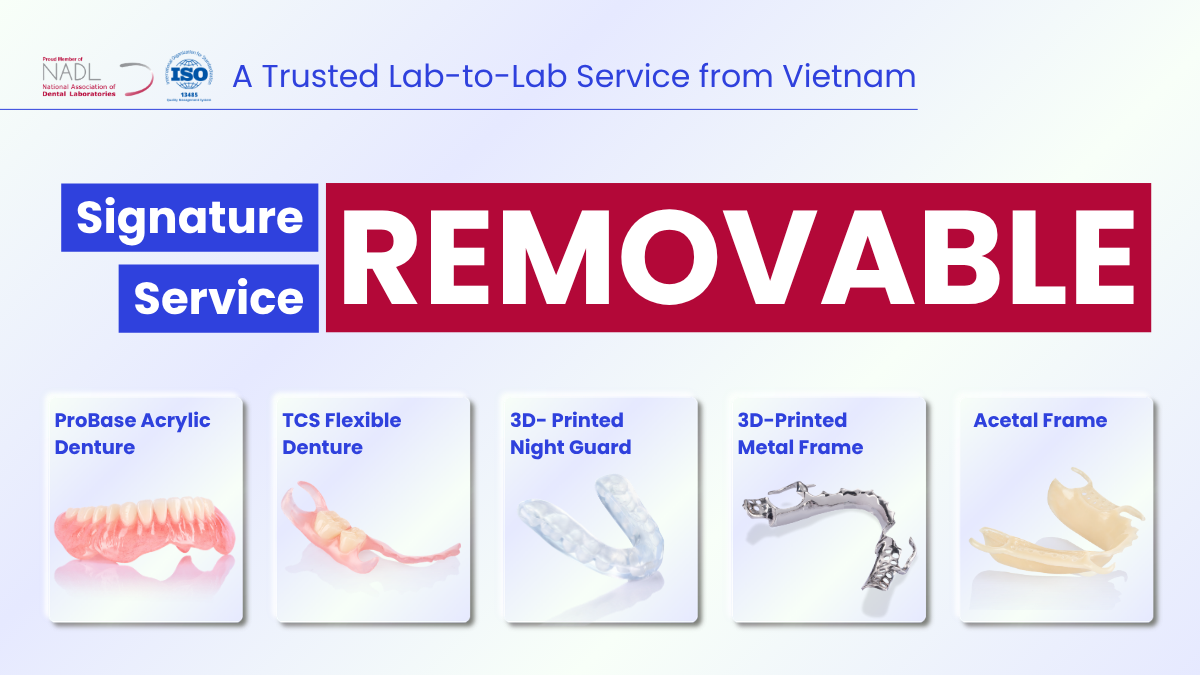
We are experts in Lab-to-Lab Full Service from Vietnam, with the signature services of Removable, meet U.S. market standards, FDA-registered, ISO 13485-certified. Founded in 2017, from local root to global reach, we scale with 2 Factories with over 100+ employees.
Our Commitments Built on “Trusted. Commitment. Quality”
- Commit to Large-Scale Manufacturing, high volume, remake rate < 1%.
- Commit to 5-Year Warranty
- Commit to Competitive Price
XDENT LAB | A Trusted Lab-to-Lab Service from Vietnam
Share this post:
Related Posts
A practical guide to implant crowns, bridges and overdentures, covering materials, component compatibility and laboratory workflow.
Explore the types, materials, retention methods and lab workflows for maxillofacial removable prostheses, with practical guidance for dental practices.
Explore precision attachment denture types, benefits and limitations, plus key considerations for design, fabrication and maintenance in dental practices.

