
A practical guide to implant crowns, bridges and overdentures, covering materials, component compatibility and laboratory workflow.
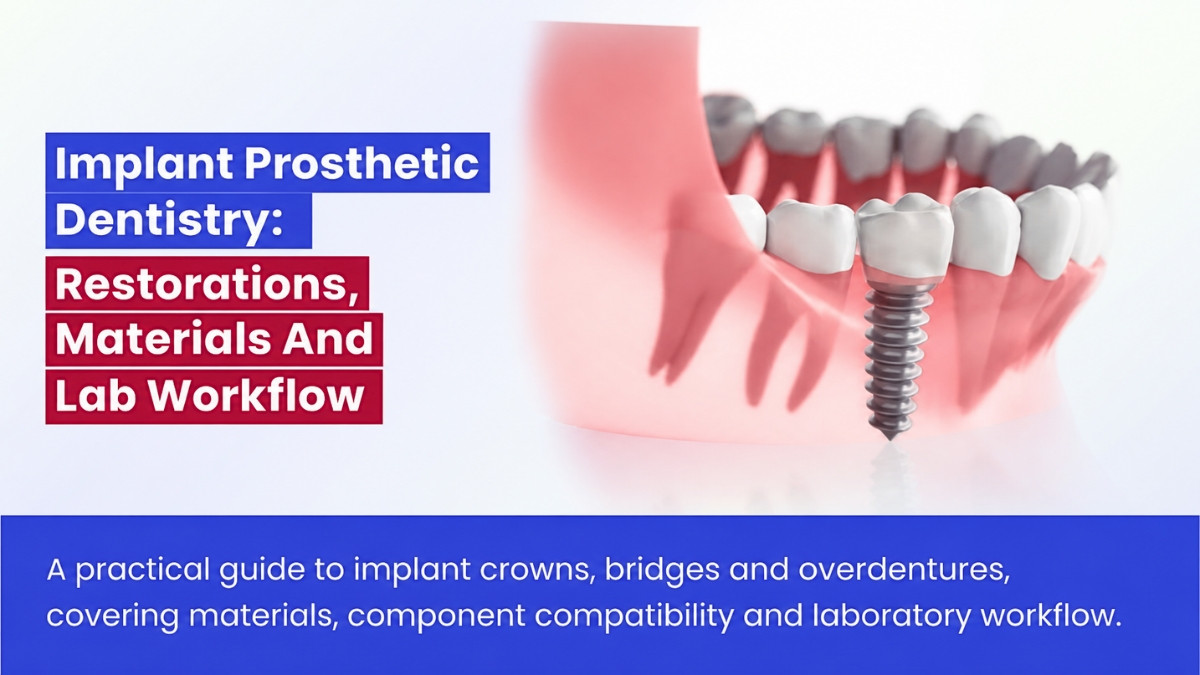
Table of contents [Show]
Implant prosthetic dentistry covers the planning, fabrication, delivery and maintenance of restorations supported or retained by dental implants. These restorations range from a single crown to an implant bridge, a full-arch fixed prosthesis or a removable overdenture.
The guiding principle is prosthetically driven treatment: the desired tooth position, appearance, function and hygiene access should inform implant planning. For dental practices and laboratories, this means treating the implant, its components and the restoration as one coordinated system.
What is implant prosthetic dentistry?
An implant restoration may include an implant fixture, an implant connection, an abutment or intermediate component, a screw or attachment, and the visible prosthesis. The surrounding bone and soft tissues are also essential to its long-term health.
These parts are not interchangeable merely because they appear to fit. Connection geometry, screw design, manufacturing tolerances and torque requirements must be compatible with the selected implant system.
Types of implant prostheses
Each restoration type has different requirements for support, retention and maintenance.
| Restoration | Typical use | Planning priority |
|---|---|---|
| Single implant crown | Replacement of one tooth | Tooth position, emergence profile, contacts and retrieval |
| Implant-supported bridge | Replacement of several teeth | Implant distribution, framework design and hygiene |
| Full-arch fixed prosthesis | Restoration of an edentulous arch | Restorative space, support, speech and repairability |
| Implant-retained overdenture | Removable denture retained by implant attachments | Denture-base support, attachment wear and relining |
| Implant-supported overdenture | Removable prosthesis receiving substantial implant support | Support design, restorative space and maintenance |
Implant-retained and implant-supported are not synonymous. An overdenture may gain retention from implants while much of its support still comes from the underlying tissues. Likewise, a fixed implant prosthesis is often retrievable by a clinician, even though the patient does not remove it.
Why prosthetically driven planning matters
Before implant placement, the team should establish the proposed tooth positions, smile line, lip support, occlusion, restorative space, screw-access locations and cleaning access. Diagnostic tooth arrangements, provisional restorations, scans and clinically justified imaging can help connect these prosthetic requirements to the surgical plan.
An implant may integrate successfully yet leave limited room for an appropriate emergence profile, an accessible screw channel or a cleanable restoration. Implant position therefore has long-term prosthetic consequences.
Patient and maintenance considerations
Planning should also consider periodontal history, plaque control, smoking, relevant systemic conditions, medications, parafunction, available bone and soft tissue, and the patient’s ability to maintain the restoration. Implants should be compared with preservation of restorable teeth and other prosthetic options rather than treated as an automatic replacement.
Implant placement timing and loading timing are separate decisions. Immediate placement after extraction does not automatically mean immediate loading. The ITI consensus resource on placement and loading protocols provides definitions and a framework for coordinating these decisions.
Retention methods and restorative materials
There is no universally best implant crown, abutment or framework material. The appropriate design depends on implant position, restorative space, appearance, mechanical demands and the expected maintenance pathway.
Screw-retained versus cement-retained restorations
Both retention methods have advantages and limitations that should be considered during treatment planning.
| Consideration | Screw-retained | Cement-retained |
|---|---|---|
| Retrieval | Generally more straightforward | May require cutting or damaging the crown |
| Residual intraoral cement | Avoided at the implant interface | Must be controlled and removed |
| Access opening | Required through the restoration | Not required through the crown |
| Potential technical issues | Screw loosening or access-filling loss | Decementation or difficult retrieval |
Screw retention is often useful when future access is a priority. Cement retention may help in selected restorative situations, but margins should allow reliable removal of excess cement. Deep submucosal margins can make that task more difficult. The ITI Academy resource on cement and screw retention discusses their indications and complications.
A restoration bonded to a titanium base outside the mouth can still be screw-retained at the implant. This differs from cementing a crown intraorally over an abutment.
Abutments and framework materials
Abutment choices include stock or custom titanium abutments, selected zirconia abutments, titanium bases and multi-unit abutments. Selection depends on the implant connection, tissue depth, emergence profile, restorative height, mechanical loading and manufacturer indications.
| Material or system | Common application | Key consideration |
|---|---|---|
| Metal–ceramic | Implant crowns and bridges | Established use, with potential veneer complications |
| Monolithic zirconia | Selected crowns, bridges and full arches | Product-specific thickness, span and finishing rules |
| Veneered zirconia | Esthetically individualized restorations | Veneer-related chipping risk |
| Lithium disilicate | Selected single crowns and titanium-base restorations | Indication limits and bonding protocol |
| Titanium or cobalt–chromium | Selected multi-unit frameworks | Framework fit and manufacturing accuracy |
| PMMA or composite over a framework | Provisional or selected definitive full arches | Wear, repair and replacement needs |
A material-family name is not a blanket indication. A zirconia product suitable for a single crown may not be suitable for a long-span bridge. The laboratory must follow the specified material’s design and processing instructions.
What does crown-survival evidence mean?
A 2018 systematic review of implant-supported single crowns reported high estimated five-year survival for the metal–ceramic and zirconia–ceramic crowns it examined. Those findings apply to the studied crown designs and follow-up periods; they should not be presented as a guarantee for modern monolithic crowns, full-arch prostheses or individual patients.
Survival is not the same as complication-free success. A restoration may remain in service after repairs, screw replacement or other maintenance.
Full-arch prostheses and overdentures
Full-arch fixed restorations require careful evaluation of implant distribution, cantilevers, framework rigidity, material thickness, lip support, speech, cleaning access and repairability. There is no universal implant count or safe cantilever length for every patient.
Overdentures require a different maintenance plan. Studs, bars, clips and other attachment systems may need servicing, while the denture base may still require adjustment or relining. Fitting a stronger attachment insert will not correct an unstable denture base; the cause of retention loss should be diagnosed first.
Clinical-to-lab workflow for implant restorations
Accurate implant prosthetics depends on transferring implant or abutment positions, identifying the exact components and verifying that the finished restoration seats without being forced into place.
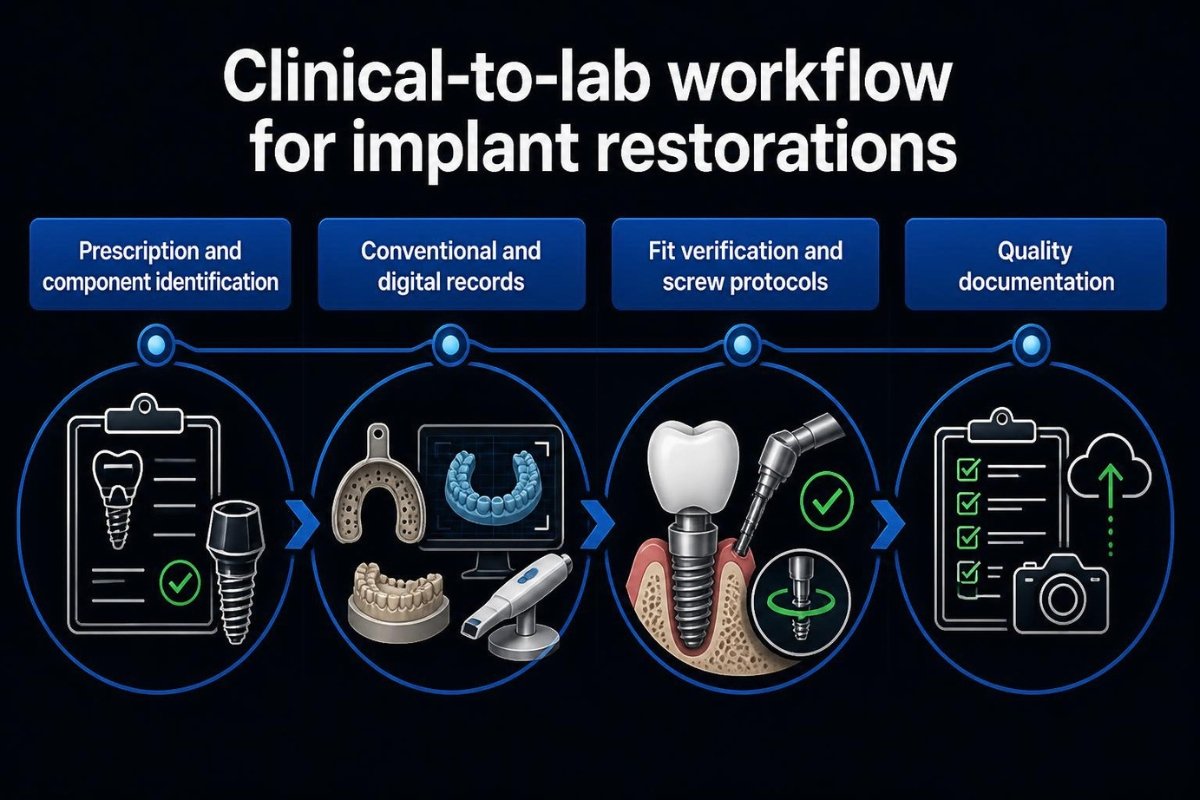
Prescription and component identification
A laboratory prescription should identify the implant manufacturer and system, connection and platform, implant-level or abutment-level workflow, impression coping or scan body, abutment or titanium base, prosthetic screw, retention method and restorative material.
A nominal platform diameter alone is not enough to establish compatibility. Third-party components require documented compatibility and consideration of their applicable regulatory status. A part that appears to fit may differ in tolerances or mechanical behavior.
Conventional and digital records
Conventional workflows may use impression copings, master casts and verification devices. Digital workflows may use intraoral scans, scan bodies and, in selected cases, photogrammetry. A hybrid approach can combine methods when additional verification is needed.
Accuracy depends on the span, number and distribution of implants, complete scan-body seating, the scanner and software, tissue visibility and technique. Photogrammetry can help record implant positions but may not provide all the tissue and occlusal information needed for a finished restoration.
A complete-looking digital model does not, by itself, prove that a full-arch framework will fit clinically.
Fit verification and screw protocols
The laboratory and clinical team should assess component seating, framework adaptation, contacts, occlusion, screw-access positions, tissue contours and cleaning access. Clinical checks may involve visual, tactile and radiographic assessment where appropriate.
Prosthetic screws should not be used to pull a misfitting framework into place. Recurrent screw loosening also calls for assessment of fit, component compatibility, loading and restoration design.
Use the exact approved screw and driver, and follow the component manufacturer’s torque and replacement instructions. One generic torque value should not be applied across implant systems.
Finishing and bonding
Bonding and surface preparation are material-specific. Glass ceramics, zirconia and titanium bases require different cleaning and conditioning protocols. Adjusted ceramic surfaces should be finished appropriately, while implant connections and screw seats should not be modified casually.
Contours matter as much as polish. An overcontoured emergence profile or inaccessible full-arch undersurface can make plaque control difficult even when the restoration has a smooth finish.
Quality documentation
A useful laboratory release record documents component identity, material and lot traceability, manufacturing parameters, fit checks, bonding steps, finishing, cleaning guidance, torque instructions and repair information.
Standards may apply to specific materials, biological evaluation, risk management or quality systems. Their current scope and editions should be checked in the official ISO catalogue. ISO 13485 quality-system certification does not, on its own, establish the clinical performance of a particular implant restoration.
Complications, maintenance and the role of the laboratory
Long-term maintenance begins with the restoration’s design. Patients and clinicians need access to peri-implant tissues, while the prosthetic team needs a way to inspect, retrieve and repair components when indicated.
Biological and technical complications
Biological concerns include peri-implant mucositis and peri-implantitis. The European Federation of Periodontology’s S3-level clinical practice guideline provides an evidence-based framework for prevention and treatment of peri-implant diseases.
Technical problems may include screw loosening or fracture, ceramic chipping, framework fracture, titanium-base debonding, attachment wear, loss of cement retention and food trapping. Recurrent complications should prompt evaluation of the whole system rather than repeated replacement of the failed part alone.
Plan for ongoing care
Maintenance may include tissue assessment, plaque-control review, examination of contacts and occlusion, inspection of attachments and screws, and checks for fracture or debonding. Recall frequency should reflect the patient’s risk and clinical findings rather than a single schedule for every implant restoration.
Persistent bleeding, suppuration, increasing probing depths, pain or mobility requires professional assessment. Implant survival alone does not show whether tissues remain healthy or whether the prosthesis has needed repair.
Working with an implant prosthetics laboratory
For dental practices using lab-to-lab services or dental lab outsourcing, the most valuable handoff is a complete prescription supported by accurate records and exact component identifiers. XDENT LAB’s removable and implant laboratory workflows can support fabrication and quality documentation, while implant selection, clinical verification and patient maintenance remain the responsibility of the treating team.
Key takeaway: Implant prosthetic dentistry succeeds when surgical planning, restorative design, compatible components, verified fit and ongoing maintenance are treated as one system. The best restoration is not only attractive and strong; it is also cleanable, retrievable when needed and practical to service over time.
About XDENT LAB:
We are experts in Lab-to-Lab Full Service from Vietnam, with the signature services of Removable, meet U.S. market standards, FDA-registered, ISO 13485-certified. Founded in 2017, from local root to global reach, we scale with 2 Factories with over 100+ employees.
Our Commitments Built on “Trusted. Commitment. Quality”
- Commit to Large-Scale Manufacturing, high volume, remake rate < 1%.
- Commit to 5-Year Warranty
- Commit to Competitive Price
XDENT LAB | A Trusted Lab-to-Lab Service from Vietnam
Share this post:
Related Posts
Explore the types, materials, retention methods and lab workflows for maxillofacial removable prostheses, with practical guidance for dental practices.
Explore precision attachment denture types, benefits and limitations, plus key considerations for design, fabrication and maintenance in dental practices.
Explore telescopic denture materials, retention designs and lab workflows, with practical guidance on fit, fabrication and maintenance for dental practices.

