
Explore removable partial denture frameworks in dental labs, including design, materials, fabrication workflow, and why quality matters for predictable outcomes.
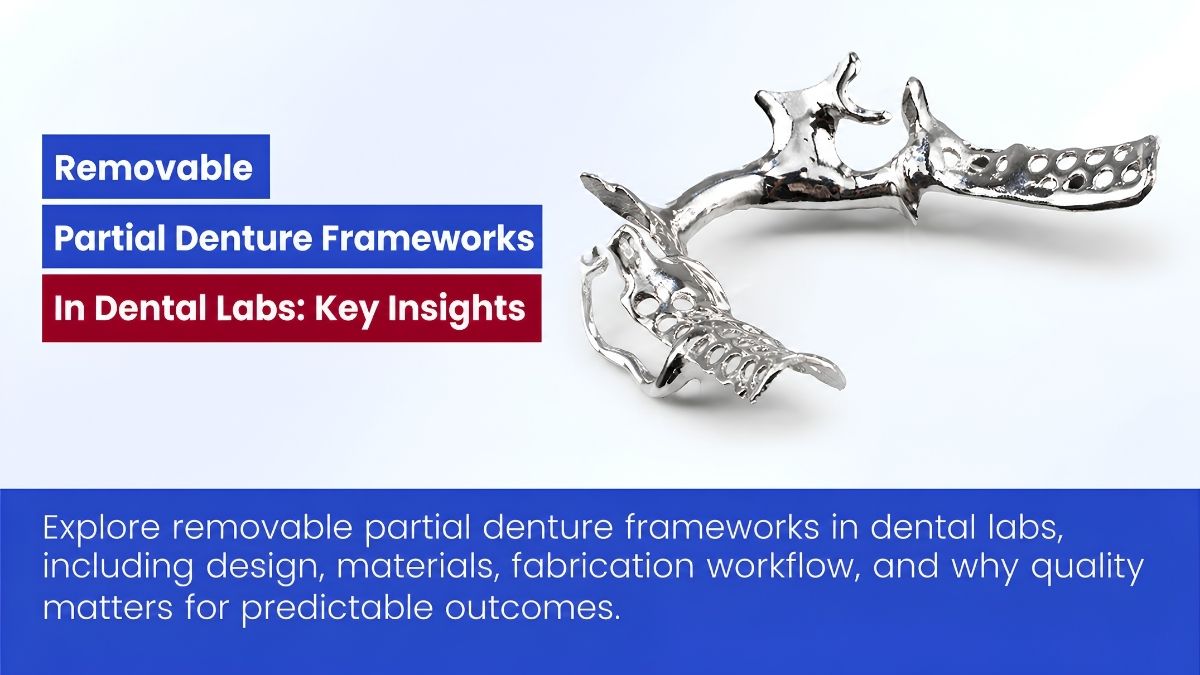
Table of contents [Show]
- What are removable partial denture frameworks?
- Main components of removable partial denture frameworks
- Design principles for removable partial denture frameworks
- Materials used in removable partial denture frameworks
- Fabrication workflow for removable partial denture frameworks
- Benefits of removable partial denture frameworks
- Challenges and limitations of removable partial denture frameworks
- Digital dentistry and the future of removable partial denture frameworks
- Why removable partial denture framework quality matters in dental lab outsourcing
- Key takeaways
Removable partial denture frameworks are the structural foundation of many partial tooth replacement solutions. They connect the prosthetic teeth, acrylic base, and support elements into one functional design that helps restore chewing, speech, stability, and appearance. For dental practices, understanding framework design is important because long-term success depends on more than replacing missing teeth. It depends on how the framework distributes forces, interacts with abutment teeth, and supports patient comfort over time.
In modern prosthodontics, removable partial denture frameworks remain highly relevant because they offer a practical option for partially edentulous patients who need a non-surgical, cost-conscious, and adaptable restorative solution. They are widely used when implants are not ideal, when fixed options are limited, or when future treatment flexibility matters. This article explains what removable partial denture frameworks are, their major components, design principles, materials, fabrication workflow, benefits, challenges, and the growing role of digital dentistry in removable prosthetics.
What are removable partial denture frameworks?
A removable partial denture framework is the internal supporting structure of a removable partial denture. It provides the foundation that holds the denture together and connects the retentive, supportive, and stabilizing components of the prosthesis.
Role in removable prosthodontics
The framework is designed to:
- Support replacement teeth and denture bases
- Distribute functional forces appropriately
- Improve retention and resistance to displacement
- Stabilize the prosthesis during chewing and speaking
- Protect abutment teeth and supporting tissues when properly designed
Without a well-designed framework, a removable partial denture may lack fit, function, and longevity.
When they are used
Removable partial denture frameworks are commonly indicated for patients with:
- Several missing teeth in one arch
- Bilateral or unilateral edentulous spaces
- Remaining teeth that can support a prosthesis
- Financial or anatomical limitations for fixed restorations or implants
- A need for a removable solution that allows future modification
Main components of removable partial denture frameworks
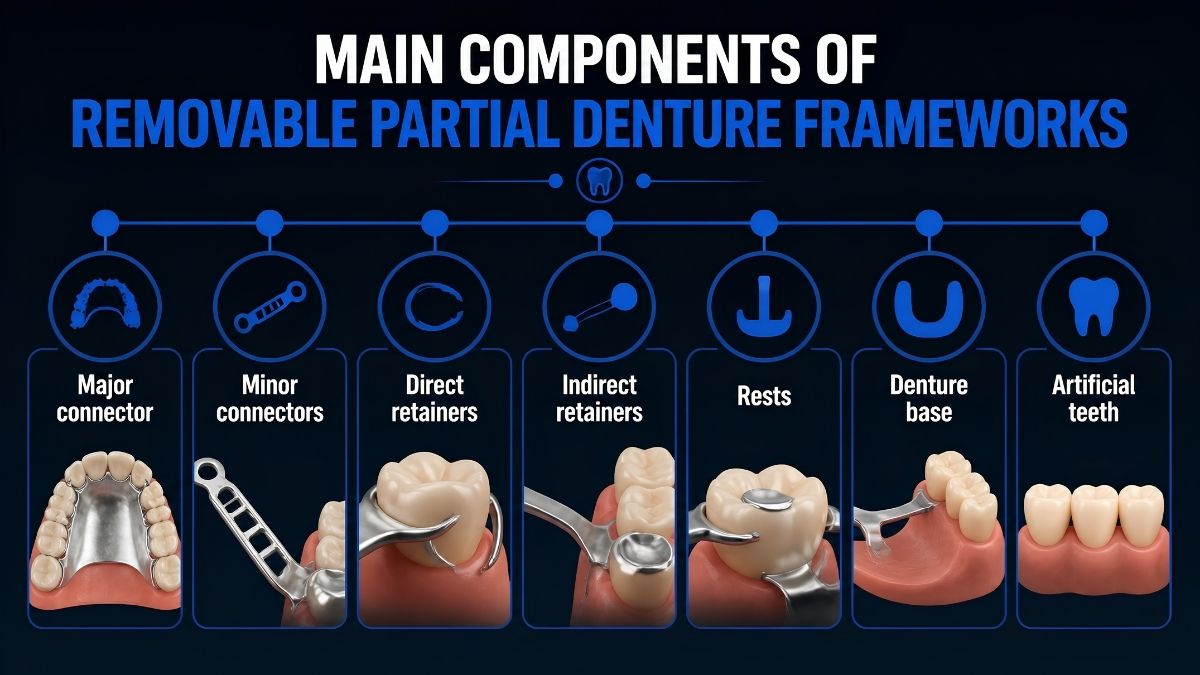
Each component of the framework has a specific biomechanical purpose. Together, these components determine how the prosthesis functions in the mouth.
Major connector
The major connector is the principal connecting element of the framework. It unites the components on one side of the arch with those on the other side.
Common examples
In the maxilla, major connectors may include:
- Palatal strap
- Anteroposterior palatal strap
- Horseshoe connector
- Palatal plate
In the mandible, common designs include:
- Lingual bar
- Lingual plate
- Sublingual bar in selected cases
Main function
The major connector provides rigidity and cross-arch stabilization. A rigid connector is essential for proper force distribution.
Minor connectors
Minor connectors link other components of the prosthesis to the major connector.
What they connect
They typically connect:
- Rests
- Clasps
- Denture bases
- Indirect retainers
These connectors transfer functional forces to the supporting structures.
Direct retainers
Direct retainers, commonly called clasps, help resist dislodgement of the prosthesis.
Common clasp types
Common designs include:
- Circumferential clasps
- Bar clasps
- Ring clasps
- Wrought wire clasps
- Combination clasps
Why clasp design matters
Clasp selection affects:
- Retention
- Flexibility
- Stress distribution
- Esthetics
- Abutment tooth protection
Indirect retainers
Indirect retainers help prevent rotational displacement, especially in distal extension cases.
Clinical importance
They are especially useful when the prosthesis rotates away from the tissue under functional forces. Proper placement improves stability.
Rests
Rests provide vertical support and help direct forces along the long axis of abutment teeth.
Types of rests
They may be:
- Occlusal rests
- Cingulum rests
- Incisal rests
A properly prepared rest seat helps the framework seat accurately and function predictably.
Denture base
The denture base supports the artificial teeth and rests on the edentulous ridge.
Why the base matters
Its design affects:
- Tissue support
- Stability
- Load distribution
- Future relining or rebasing potential
Artificial teeth
Artificial teeth restore function and appearance.
They are commonly made from:
- Acrylic resin
- Composite-based denture tooth materials
- Porcelain in selected cases
Tooth selection should consider esthetics, wear compatibility, occlusion, and ridge relationships.
Design principles for removable partial denture frameworks
Framework success depends on sound biomechanical planning, not just material choice.
Support
Support resists vertical movement toward the tissues.
Main sources of support
Support comes from:
- Abutment teeth through rests
- Edentulous ridges through denture bases
Balanced support reduces harmful tissue loading.
Retention
Retention resists movement away from the tissues.
How retention is achieved
It is primarily achieved by:
- Clasp engagement of tooth undercuts
- Accurate framework adaptation
- Indirect retention in distal extension designs
Stability
Stability resists horizontal and rotational movement.
Why stability matters
A stable prosthesis improves:
- Patient comfort
- Masticatory efficiency
- Speech
- Long-term tissue health
Reciprocation and bracing
Frameworks must control the forces generated by retentive clasp arms.
Functional value
Reciprocation and bracing help:
- Counteract lateral forces
- Protect abutment teeth
- Improve prosthesis balance during insertion and removal
Rigidity
Rigid framework elements distribute loads more predictably.
Clinical implication
If major connectors or other structural areas flex excessively, force control is compromised and damage to teeth or tissues may increase.
Materials used in removable partial denture frameworks
Material selection affects rigidity, weight, esthetics, comfort, and manufacturing approach.
Cobalt-chromium alloy
Cobalt-chromium is the most widely used framework material for conventional cast metal removable partial dentures.
Advantages
It offers:
- High strength
- Good rigidity
- Corrosion resistance
- Relatively low bulk compared with some alternatives
- Long clinical history
Titanium
Titanium is used in selected removable framework applications.
Benefits
It provides:
- Excellent biocompatibility
- Lighter weight
- Corrosion resistance
However, processing can be more technique-sensitive than traditional cobalt-chromium workflows.
Acrylic resin
Acrylic resin is commonly used for denture bases and transitional partial dentures rather than as the primary rigid framework material.
Best use cases
It is often used for:
- Interim prostheses
- Economical partial dentures
- Cases requiring easy modification
Flexible thermoplastic materials
Flexible nylon-like materials are used in metal-free removable partial dentures.
Main characteristics
They are known for:
- Improved esthetics in selected cases
- Flexible clasping elements
- Greater patient acceptance in some anterior esthetic zones
They also have limitations in adjustment, repair, support, and long-term biomechanical control.
Fabrication workflow for removable partial denture frameworks
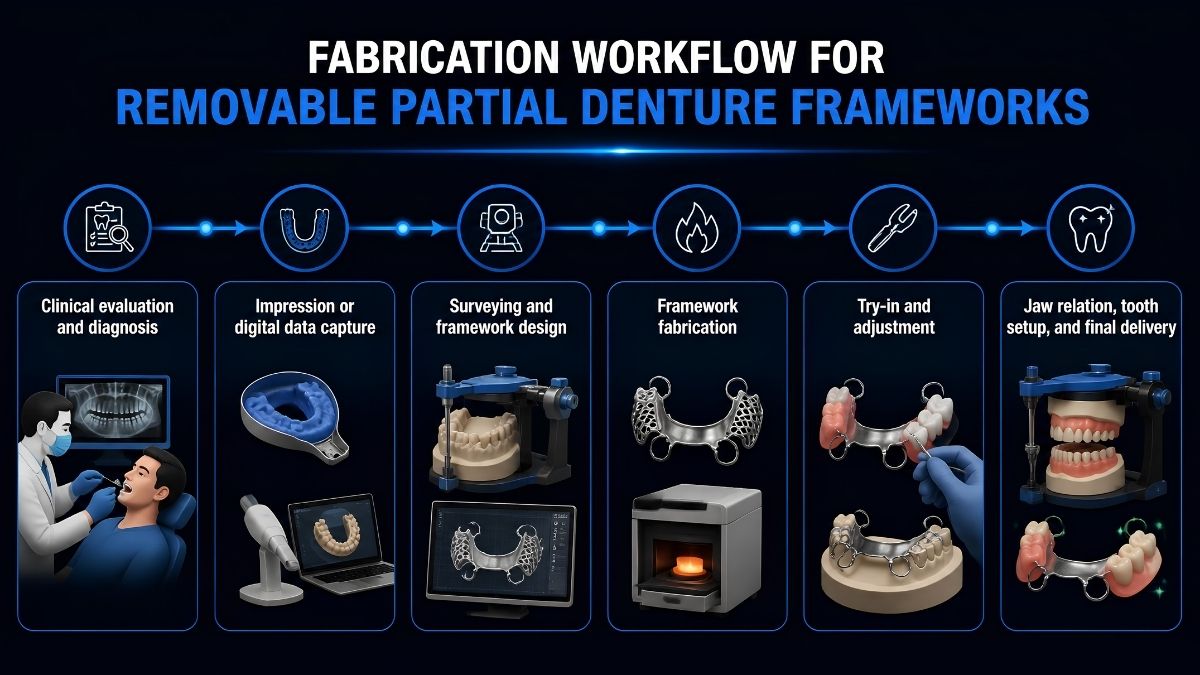
The quality of a removable partial denture framework depends on coordinated planning between the dentist and the laboratory.
Clinical evaluation and diagnosis
The process begins with a full assessment of oral condition, periodontal health, occlusion, tooth support, and edentulous span characteristics.
What the dentist evaluates
This usually includes:
- Remaining teeth condition
- Abutment prognosis
- Ridge anatomy
- Occlusal relationship
- Path of insertion considerations
- Need for mouth preparation
Impression or digital data capture
Accurate records are essential for framework design.
Data sources may include
- Conventional impressions
- Master casts
- Intraoral scans in suitable workflows
- Bite registrations
- Photographs and design instructions
The cast or digital model is analyzed to determine the path of insertion, undercuts, guiding planes, and clasp design.
What the design stage determines
This stage defines:
- Major connector type
- Clasp location and type
- Rest seat placement
- Indirect retainer position
- Denture base extension
Framework fabrication
Traditional frameworks are usually made through waxing, investing, casting, finishing, and polishing.
Conventional workflow steps
These often include:
- Duplication and refractory cast creation
- Wax pattern fabrication
- Spruing and investing
- Casting
- Divesting
- Finishing and polishing
Try-in and adjustment
The metal framework is checked clinically for fit, seating, stability, and tissue adaptation.
Key checkpoints
The dentist typically evaluates:
- Complete seating
- Rocking or instability
- Rest adaptation
- Clasp fit
- Soft tissue impingement
- Path of insertion
Jaw relation, tooth setup, and final delivery
After framework approval, the denture base and teeth are added, followed by wax try-in, processing, finishing, and insertion.
Benefits of removable partial denture frameworks
Removable partial denture frameworks continue to be important because they offer practical advantages for many treatment plans.
Cost-effectiveness
They are generally more affordable than many fixed restorative options or multi-implant treatments.
Conservative treatment approach
They usually avoid surgical intervention and can preserve future treatment flexibility.
Versatility
They can be designed for many partially edentulous situations and can sometimes be modified if additional tooth loss occurs.
Restorative function
They help restore:
- Mastication
- Speech
- Occlusal balance
- Facial support in selected cases
- Dental appearance
Laboratory customization
Frameworks can be highly customized to suit anatomy, esthetics, and biomechanical requirements.
Challenges and limitations of removable partial denture frameworks
Like any prosthetic option, removable partial denture frameworks have clinical limitations.
Adaptation period
Some patients need time to adjust to insertion, removal, speech, and chewing.
Esthetic concerns
Visible metal clasps may be a concern, especially in anterior areas.
Maintenance requirements
These prostheses require good hygiene, regular review, and occasional relines, repairs, or adjustments.
Risk to abutment teeth if poorly designed
Inadequate design, poor support, or improper clasping can overload teeth and tissues.
Tissue changes over time
Residual ridge resorption can affect fit, especially in distal extension cases.
Digital dentistry and the future of removable partial denture frameworks
Digital technology is reshaping removable prosthodontics, including framework design and production.
Digital design advantages
Digital workflows can improve:
- Design standardization
- Data storage
- Communication between clinic and lab
- Reproducibility
- Planning efficiency
Manufacturing innovation
Modern workflows may use:
- CAD software for framework design
- 3D printed patterns
- Milled components in selected applications
- Digital archives for remakes or modifications
Implant-assisted removable partial dentures
In some cases, implants can improve support, retention, and stability for distal extension removable prostheses.
Why removable partial denture framework quality matters in dental lab outsourcing
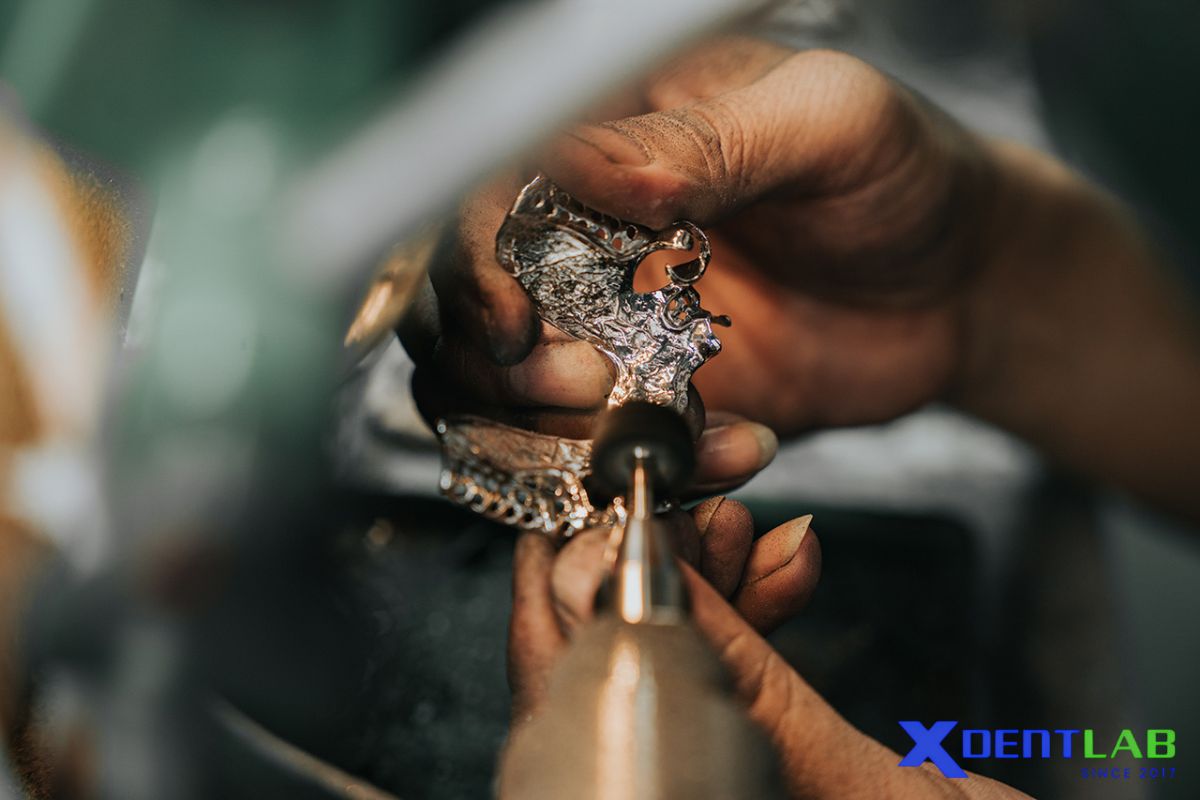
For dental practices, the outcome of a removable case depends heavily on laboratory quality. A well-made framework should seat accurately, reflect the prescribed design, maintain rigidity, and support functional longevity.
What practices should expect from an outsourcing lab
A reliable dental lab partner should provide:
- Accurate framework fabrication
- Clear case communication
- Strong understanding of removable design principles
- Consistent quality control
- Support for both conventional and digital workflows
- Experience with complex removable and implant-related cases
Relevance to XDENT LAB
For practices seeking a Vietnam dental lab with dependable lab-to-lab service, XDENT LAB offers relevant strength in removable and implant workflows. Its combination of certified technicians, state-of-the-art technology, FDA- and ISO-aligned standards, and scalable production capacity supports quality and consistency across outsourced dental laboratory work.
As removable prosthodontics becomes more digitally integrated, outsourcing partners must do more than fabricate frameworks. They must understand biomechanics, workflow precision, case communication, and long-term restorative predictability. That is where an experienced dental lab partner creates measurable value for the practice.
Key takeaways
Removable partial denture frameworks are the structural core of many partial tooth replacement solutions. Their design influences support, retention, stability, patient comfort, and prosthesis longevity. Success depends on proper component selection, biomechanical planning, material choice, and accurate laboratory execution.
For dental practices that prioritize quality and consistency, working with an experienced outsourcing partner such as XDENT LAB can help deliver more predictable removable prosthetic outcomes across conventional and digital workflows.
About XDENT LAB:
We are experts in Lab-to-Lab Full Service from Vietnam, with the signature services of Removable, meet U.S. market standards, FDA-registered, ISO 13485-certified. Founded in 2017, from local root to global reach, we scale with 2 Factories with over 100+ employees.
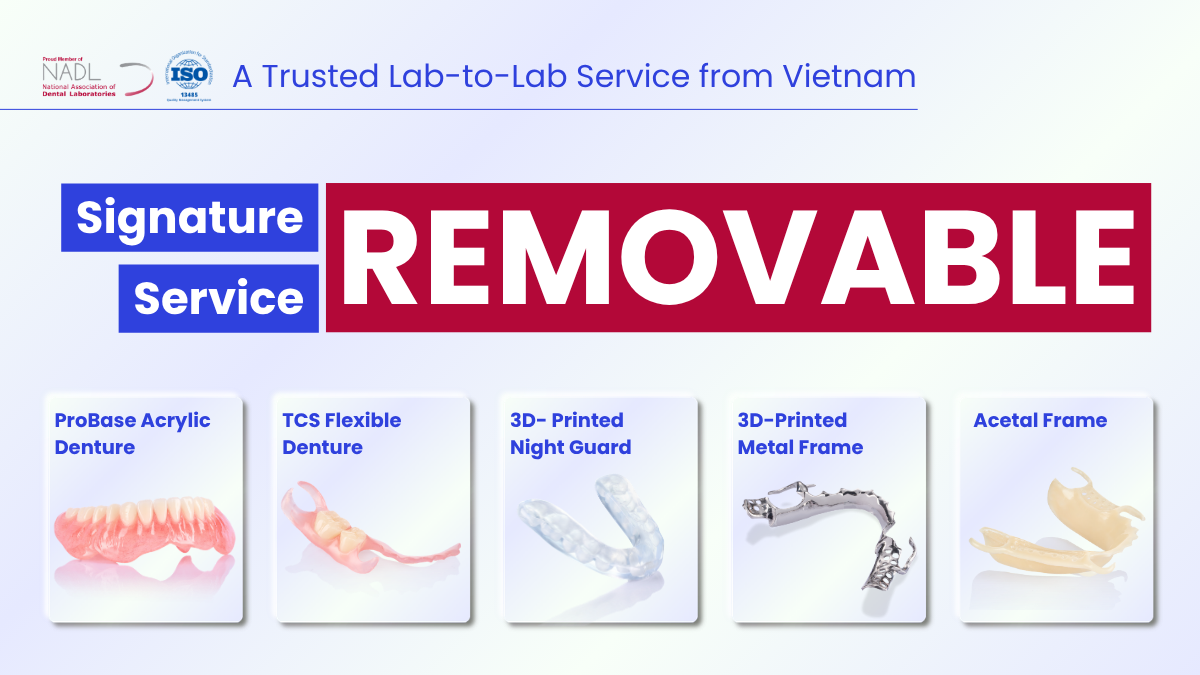
Our Commitments Built on “Trusted. Commitment. Quality”
- Commit to Large-Scale Manufacturing, high volume, remake rate < 1%.
- Commit to 5-Year Warranty
- Commit to Competitive Price
XDENT LAB | A Trusted Lab-to-Lab Service from Vietnam
Share this post:
Related Posts
Explore telescopic denture materials, retention designs and lab workflows, with practical guidance on fit, fabrication and maintenance for dental practices.
Materials used in fixed prosthodontics, from zirconia and lithium disilicate to alloys, with guidance on indications, bonding, workflows, and selection.
Learn how implant-retained overdentures rely on clinical planning, attachment selection, and laboratory QC for stable, predictable removable outcomes.

