
A design breakdown of the A-PP strap connector: why its four-sided frame outperforms other maxillary connectors, its indications, and its design specs.
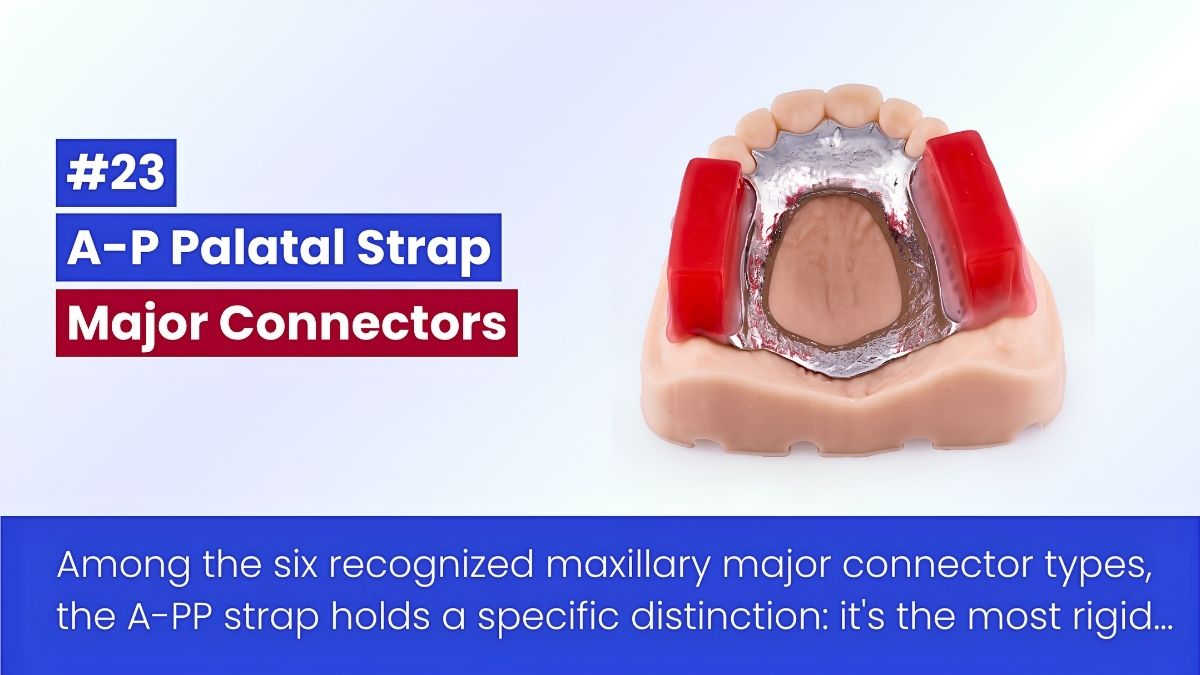
Table of contents [Show]
Among the six recognized maxillary major connector types, the combination anterior-posterior palatal strap, usually shortened to A-PP strap, holds a specific distinction: it's the most rigid design of the group, and by a meaningful margin. That's not a matter of opinion. Multiple finite element and mechanical loading studies place it at the top of the rigidity ranking among tested maxillary connectors, with the least deformation under load.
What makes it worth understanding in detail isn't just that ranking, it's why the design achieves it. The A-PP strap gets its strength from geometry, not bulk, which is precisely what separates it from connectors that have to trade tissue coverage or thickness for stiffness.
This article covers the structural logic behind the A-PP strap, where it's indicated, its design specifications, and how it compares against the other major connector types it's most often chosen over.
Key Points
- Two transverse straps, one anterior and one posterior, joined by two longitudinal straps along the sides, forming an open rectangular frame.
- The most rigid of the six maxillary connector designs, confirmed across multiple loading studies, with the least measured deformation.
- Usable in almost any maxillary partial denture design, most frequently in Kennedy Class II and IV, and can encircle an inoperable palatal torus without losing rigidity, as long as the torus doesn't extend to the soft palate.
- Trade-off: a more complex design with more metal-tissue borders than a single strap.
Structure: Why a Frame Outperforms a Single Band
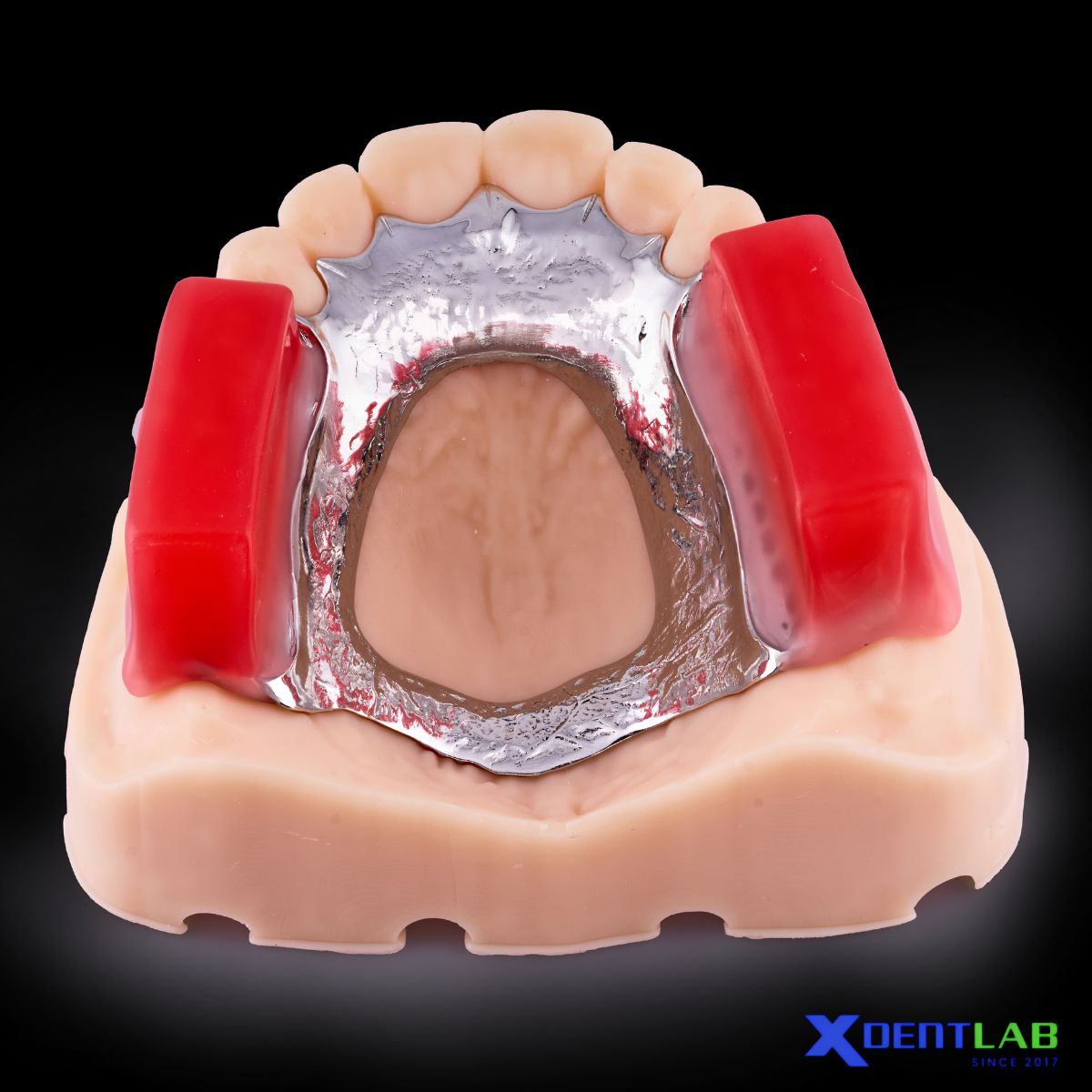
The A-PP strap consists of two transverse palatal straps, one anterior and one posterior, connected by two longitudinal straps running along either side of the arch. The result is an open, roughly rectangular or parallelogram-shaped frame rather than a solid band or a covered plate.
The rigidity advantage comes directly from this geometry. Each of the four components braces the others against torque and flexure, so the connector resists deformation as a unit rather than relying on the stiffness of any single piece. Because the transverse and longitudinal straps sit in two different planes rather than one flat plane, the frame behaves more like a beam than a strip, an effect that measurably increases stiffness compared to a single-plane design. The practical result is that flexure under function is close to negligible, and this has been confirmed repeatedly in mechanical testing: across several comparative studies of maxillary connector designs, the A-PP strap consistently ranks as the stiffest configuration tested, with the lowest measured deformation of the group.
Where the A-PP Strap Is Indicated
Most maxillary partial denture situations
Unlike the single palatal strap , which is confined to a narrow set of tooth-supported cases, the A-PP strap's frame geometry makes it viable across a much wider range of arch configurations. It doesn't depend on the same load-path assumptions a single strap does, so it tolerates more variation in tooth support and edentulous span location.
Class I and II arches with strong abutment and residual ridge support
When retention and support are already adequate through direct means, the A-PP strap provides sufficient rigidity without requiring the added palatal coverage of a plate-type connector for indirect retention.
Long edentulous spans in Class II modification 1 arches
The frame's stiffness holds up over spans that would flex a single strap, without needing to escalate to full palatal coverage.
Class IV arches requiring anterior tooth replacement
The anterior transverse strap can be extended forward to support the replacement teeth. In this configuration, the design is functionally a U-shaped connector reinforced by the added posterior strap, which is exactly what gives it the rigidity a standalone U-shaped connector lacks.
Inoperable palatal tori that don't extend to the soft palate
This is one of the more useful properties of the design: the frame can be routed around a torus without a loss of rigidity, because the connector's strength comes from its overall geometry, not from continuous coverage across the midline. A single strap can't offer this workaround; it depends on a direct, unobstructed crossing of the palate.
Where It's Not the Right Choice
When a simpler connector will do
If a case has short, bilateral, posterior edentulous spans with solid tooth support, a single palatal strap accomplishes the same unification with far less design and fabrication complexity. Reaching for an A-PP strap by default, rather than by indication, adds unnecessary metal-tissue border for no functional gain.
Large inoperable palatal tori extending posteriorly to the soft palate
Once the torus reaches that far back, the frame no longer has a clear route around it. A broad U-shaped connector becomes the more appropriate choice at that point.
Advantages and Disadvantages
Advantages
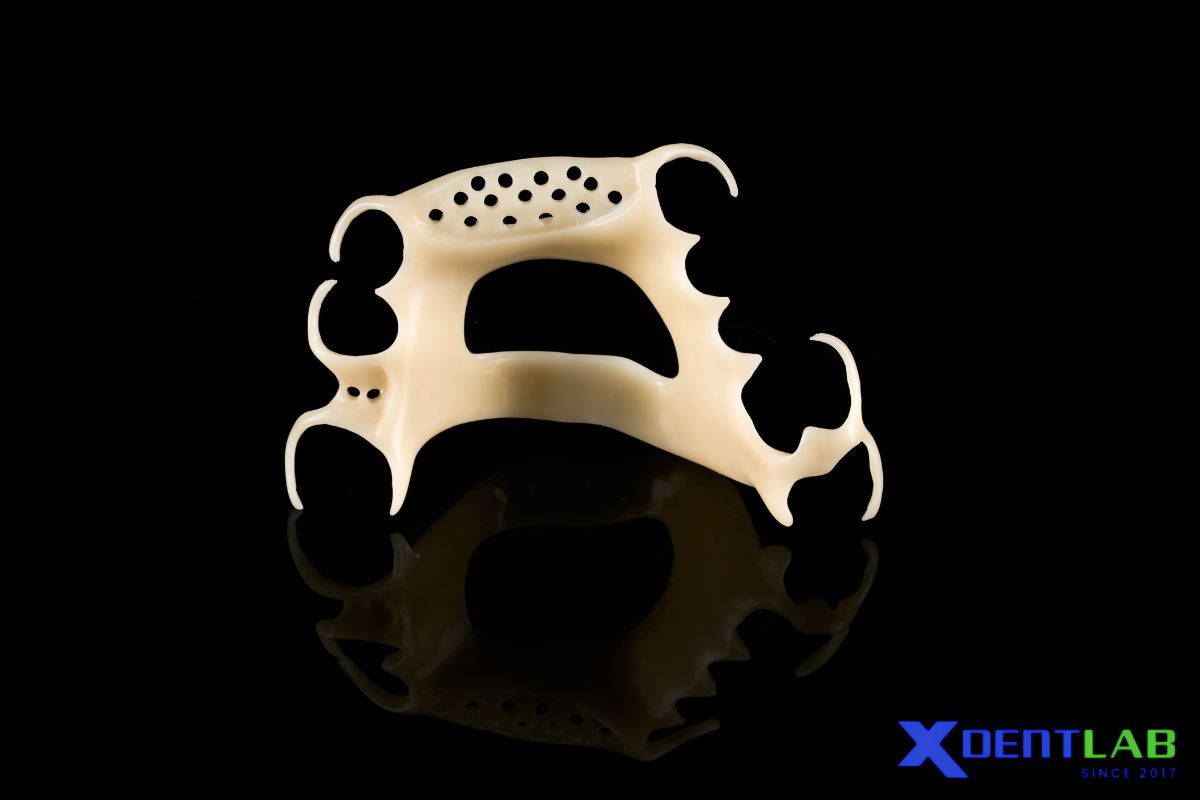
Maximum rigidity without the bulk of a single strap would need to achieve comparable stiffness, and less palatal tissue coverage than a full plate-type connector, delivering strength and conservative coverage at the same time.
Disadvantages
Considerably more complex to design and fabricate than a single strap, with more metal-tissue borders overall. Two execution errors show up often enough to be worth flagging specifically: the posterior strap frequently fails to adapt closely to the palate, and the anterior border is frequently placed too far into the rugae area rather than following the valleys between them.
Design Specifications and Placement
- Overall shape: parallelogram or rectangular frame, open in the center.
- Anterior and posterior transverse straps: 8-10mm wide.
- Lateral (longitudinal) straps: narrower, roughly 6-9mm, running parallel to the arch curve, kept at least 6mm clear of the gingival crevices of remaining teeth.
- Anterior strap border: not positioned farther forward than the anterior rests, never closer than 6mm to the lingual gingival crevices, and follows the valleys of the rugae at right angles to the median palatal suture. Where the posterior border of this strap falls within the rugae area, it follows the same rule.
- Posterior strap border: positioned at the junction of the hard and soft palates, at right angles to the median palatal raphe, and extended to the hamular notch area on any distal extension side.
- Surface finish: anatomic replica or matte surface.
- Midline crossing: like all maxillary major connectors, the frame should cross the midline at a right angle rather than diagonally. Symmetrically placed components are better tolerated by the tongue than asymmetric ones.
A Quick Reference: Connector Type by Kennedy Class
The research on this connector points to a rough, non-absolute pattern in how the three most common maxillary connector types map to Kennedy classifications:
- Single wide palatal strap: most frequently used in Class III.
- A-PP strap: most frequently used in Class II and Class IV.
- Palatal plate-type connector: most frequently used in Class I.
This isn't a rigid rule, case-specific anatomy always takes priority, but it's a useful starting point when narrowing down connector options for a given arch.
The Bottom Line
The A-PP strap earns its place as the most rigid maxillary major connector through structural geometry rather than added material, four braced components across two planes outperforming any single flat band. That makes it the right choice for a wide range of cases, including several a single strap can't safely handle, such as long spans, anterior tooth replacement, and tori that don't extend to the soft palate. The trade-off is fabrication complexity and a couple of well-documented placement errors that are avoidable with attention to the palate's actual anatomy rather than a generic template.
References
[1] Antony KK (1956) Effect of partial denture design on bilateral force distribution. J Prosthet Dent. 6(3): 373-385.
[2] Ben Z, Matalon S, Aviv I, Cardash HS (1989) Rigidity of major connectors when subjected to bending and torsion forces. J Prosthet Dent. 62(5): 557-562.
[3] Bhojaraju N, Srilakshmi J, Vishwanath G (2014) Study of Deflections in Maxillary Major Connectors: A Finite Element Analysis. J Indian Prosthodont Soc. 14(1): 50-60.
[4] Carr AB, Brown DT (2011) McCracken's Removable Partial Prosthodontics. 12th edn, Mosby, 45.
[5] Eto M, Wakabayashi N, Ohyama T (2002) Finite element analysis of the deflections in major connectors for maxillary RPDs. Int J Prosthodont. 15(5): 433-438.
[6] Gad MM (2017) Removable Partial Denture Designing: Variation of Hard and Soft Tissue Anatomy and Maxillary Major Connector Selection. Int J Dentistry Oral Sci. 4(4): 457-463.
[7] LaVere AM, Krol AJ (1973) Selection of a major connector for the extension-base removable partial denture. J Prosthet Dent. 30(1): 102-105.
[8] Phoenix RD, Cagna DR, DeFreest CF (2003) Stewart's Clinical Removable Partial Prosthodontics. 4th edn, Quintessence, Chicago, 525.
[9] Pienkos TE, Morris WJ, Gronet PM, Cameron SM, Looney SW (2007) The strength of multiple major connector designs under simulated functional loading. J Prosthet Dent.
[10] Polychronakis N, Sotiriou M, Zissis A (2013) A Survey of Removable Partial Denture Casts and Major Connector Designs Found in Commercial Laboratories, Athens, Greece. J Prosthodont. 22(3): 245-249.
[11] Zeev BU, Eitan M, Colin G, Tamar B (1999) Stiffness of different designs and cross-sections of maxillary and mandibular major connectors of removable partial dentures. J Prosthet Dent. 81(5): 526-532.
About XDENT LAB:
We are experts in Lab-to-Lab Full Service from Vietnam, with the signature services of Removable, meet U.S. market standards, FDA-registered, ISO 13485-certified. Founded in 2017, from local root to global reach, we scale with 2 Factories with over 100+ employees.
Our Commitments Built on “Trusted. Commitment. Quality”
- Commit to Large-Scale Manufacturing, high volume, remake rate < 1%.
- Commit to 5-Year Warranty
- Commit to Competitive Price
XDENT LAB | A Trusted Lab-to-Lab Service from Vietnam
Share this post:
Related Posts
Explore telescopic denture materials, retention designs and lab workflows, with practical guidance on fit, fabrication and maintenance for dental practices.
Materials used in fixed prosthodontics, from zirconia and lithium disilicate to alloys, with guidance on indications, bonding, workflows, and selection.
Learn how implant-retained overdentures rely on clinical planning, attachment selection, and laboratory QC for stable, predictable removable outcomes.

