
A practical Kennedy Classification guide: clearly explaining Class I, II, III, and IV cases and adopt dental laboratory frameworks—lab‑to‑lab consistency with XDENT LAB.
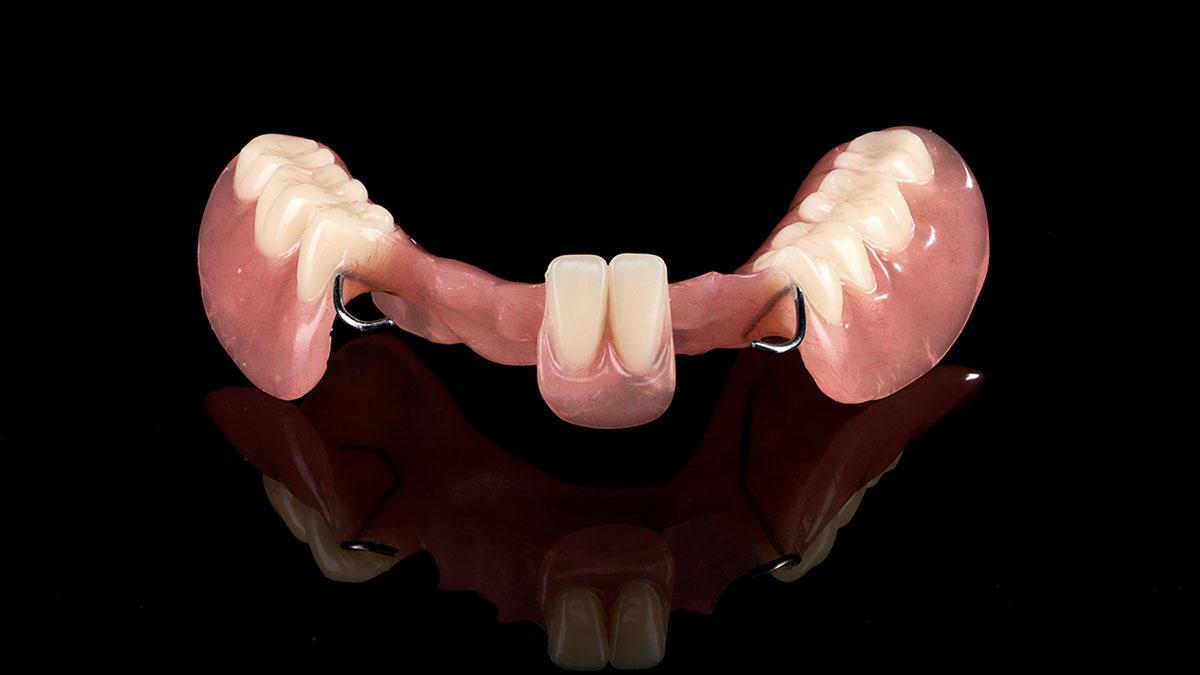
Table of contents [Show]
- Overview
- The Kennedy Classification System
- Prevalence & Clinical Significance
- Biomechanics That Drive Design
- Design Playbooks by Class
- Digital Workflows & Materials
- Implant-Assisted Kennedy Dentures (Classes I & II)
- Comparative Snapshot
- Maintenance & Long-Term Success
- QA & Risk Control for Clinics and Labs
- Where XDENT LAB Fits
- Key Takeaways
Overview
Kennedy dentures are removable partial dentures (RPDs) planned and designed using the Kennedy Classification, a century-old system that remains the global standard for categorizing partial edentulism. Its staying power comes from clinical clarity: the classification mirrors how forces travel through teeth, mucosa, and frameworks, and it supports consistent communication between dentist and lab. Modern advances—implants, digital design, high-performance polymers—augment, rather than replace, Kennedy principles.
The Kennedy Classification System
Core Classes
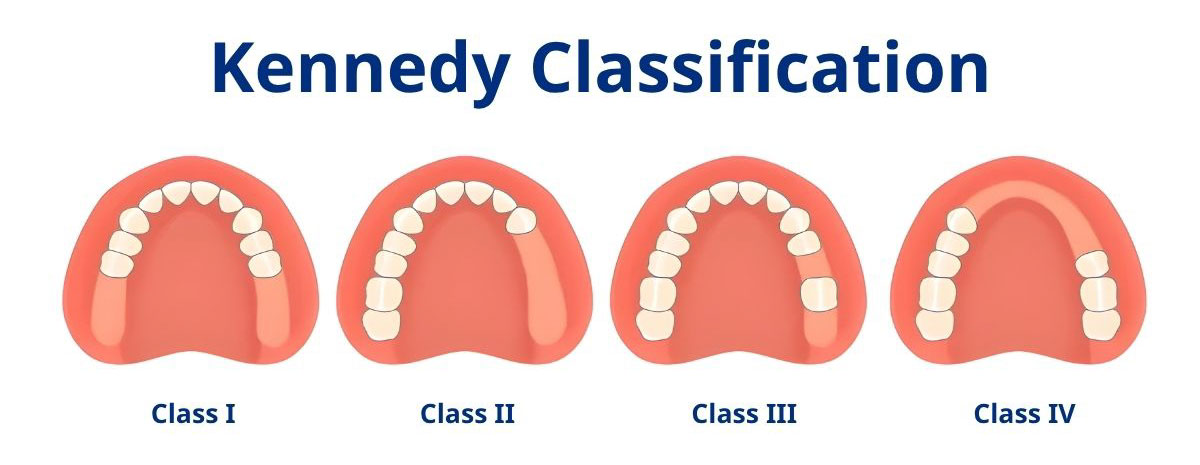
- Class I: Bilateral posterior edentulous areas (bilateral distal extension)
- Class II: Unilateral posterior edentulous area (unilateral distal extension)
- Class III: Unilateral bounded edentulous area (teeth remain anterior and posterior)
- Class IV: Single anterior edentulous area crossing the midline
Applegate’s Rules (Essentials)
- Classify after extractions that change posterior support.
- Ignore missing third molars unless serving as abutments.
- Ignore non-replaced second molars.
- The most posterior edentulous area determines the class.
- Additional edentulous areas are “modifications” by number.
- Class IV has no modifications.
Prevalence & Clinical Significance
- Class III is typically the most common overall; bounded spaces are frequent in both arches.
- Class I is often most common in older mandibular arches due to progressive posterior tooth loss.
- With age, Class I and II prevalence rises as support shifts from teeth to mucosa.
- Service planning implication: distal-extension cases require more adjustments and more frequent relines.
Biomechanics That Drive Design
Distal Extension (Classes I & II)
- Primary issue: rotation around a fulcrum line through the most posterior rests on abutments.
- Tissue compressibility under distal extension bases causes differential movement.
- Design levers: broad base coverage, indirect retainers, stress-releasing clasp assemblies (RPI/RPA), altered cast techniques, and implant assistance.
Tooth-Bounded (Class III)
- Tooth-supported frameworks with minimal tissue displacement.
- Focus on rigid connectors, ideal rest seats, and retentive undercuts to reduce torque on abutments.
Anterior Extension (Class IV)
- Aesthetics and leverage control dominate.
- Balanced clasping/attachments, indirect retention, and rotational path strategies minimize visibility and unseating forces.
Design Playbooks by Class
Kennedy Class I (Bilateral Distal Extension)
- Framework: Maxilla—anteroposterior palatal strap or full palatal coverage; Mandible—lingual bar if depth allows, otherwise lingual plate.
- Support & Retention: Mesial rests on distal abutments, guiding planes, RPI/RPA clasping, indirect retainers anterior to fulcrum line, broad bases with mesh, altered cast impressions.
- Implants: One implant per quadrant posteriorly often converts biomechanics toward Class III; use Locator/ball attachments.
- Risks mitigated: Ridge resorption, abutment overload, rotation under function.
Kennedy Class II (Unilateral Distal Extension)
- Framework: Emphasize cross-arch rigidity; connector selection mirrors Class I principles.
- Support & Retention: Indirect retainer on contralateral side, strategic clasping for balance and aesthetics, altered cast recommended.
- Implants: One to two implants on the distal-extension side reduce fulcrum rotation and improve stability.
Kennedy Class III (Bounded)
- Framework: Rigid major connector with conservative base coverage.
- Support & Retention: Rest seats on teeth bounding the span, conventional clasping (circumferential/Akers, cast clasps).
- Alternatives: Fixed prostheses or implants depending on span and abutment quality.
- Strengths: Fewer complications and high acceptance due to tooth support.
Kennedy Class IV (Anterior Across Midline)
- Aesthetics: Minimize visible clasps via rotational path designs or precision attachments.
- Biomechanics: Rigidity and indirect retention to counter anterior leverage.
- Alternatives: Implant-supported or resin-bonded fixed options when feasible.
Digital Workflows & Materials
Digital Impressions & CAD
- Accurate capture of undercuts, guiding planes, and ridge morphology.
- Virtual surveying for path of insertion and blockout planning.
- Rapid iterations and precise clinician–lab communication.
- Milled metal frameworks for consistent thickness and rigidity.
- Printed patterns for casting or direct-printed high-performance polymers (case dependent).
- PEEK frameworks: lightweight, metal-free; case selection is essential.
Denture Base & Teeth
- High-impact acrylics; milled or printed bases for controlled fit and reduced distortion.
- Attachment housings integrated with sufficient bulk and verified post-cure stability.
Implant-Assisted Kennedy Dentures (Classes I & II)
Rationale and Protocol
- Convert mucosa-dependent support into tooth/implant-bounded support.
- Reduce base movement and improve chewing efficiency and satisfaction.
- Place posterior implants near first molar/second premolar zones when feasible; verify restorative space early.
- Low-profile attachments (e.g., Locator) ease insertion/removal and hygiene.
Expected Outcomes
- Improved stability and retention, reduced ridge resorption, decreased abutment stress.
- Cost-effective alternative to fully fixed solutions for many patients.
Comparative Snapshot
| Kennedy Class | Support Pattern | Core Risks | Priority Design Elements |
|---|---|---|---|
| I (bilateral distal extension) | Teeth + mucosa | Rotation, abutment overload, ridge resorption | Broad bases, mesial rests, RPI/RPA, indirect retainers, altered cast; consider implants |
| II (unilateral distal extension) | Teeth + mucosa | Asymmetric rotation, off-axis loading | Cross-arch rigidity, indirect retainer opposite side, altered cast; consider implants |
| III (bounded) | Teeth | Minimal if well-designed | Rigid connector, ideal rests/guiding planes, conservative coverage; consider fixed options |
| IV (anterior across midline) | Teeth (posterior) | Aesthetics, leverage | Rigid connector, indirect retention, esthetic clasping/attachments; consider implants or fixed |
Maintenance & Long-Term Success
Clinical and Patient Protocols
- Professional recall every 6–12 months to assess fit, occlusion, tissue health, and clasp tension.
- Daily cleaning, clasp hygiene, removal at night, and case-specific insertion paths.
- Periodic relines for distal extensions; more frequent in Class I/II.
- Occlusal refinement for wear and tissue changes; periodontal maintenance for abutments.
QA & Risk Control for Clinics and Labs
Process Controls
- Verify classification after planned extractions; document modification spaces.
- Survey casts to define path of insertion and guide plane preparation.
- Impressions: altered cast or selective pressure for distal extensions; functional border molding.
- Framework try-in to confirm passive fit; re-survey if discrepancies appear.
- Implant attachments: confirm parallelism and housing seating; preserve acrylic bulk around housings.
- Documentation: photos, STL files, shade/contour preferences, clasp visibility notes.
Where XDENT LAB Fits
Capabilities and Collaboration
- FDA/ISO-aligned lab-to-lab capacity from Vietnam, specialized in Removable & Implant cases.
- Digital-first collaboration: survey analysis, CAD design previews, and documented QA.
- Validated SOPs for distal extension impressions, altered cast workflows, and implant attachment processing.
- Consistency, turnaround, and traceability tailored for group practices and DSOs seeking predictable outcomes.
Key Takeaways
Clinical and Operational Summary
- Kennedy Classification maps biomechanics to design choices and remains central to RPD planning.
- Distal extension cases benefit from broad base support, stress-release clasping, indirect retention, altered cast techniques, and often implants.
- Digital surveying, CAD/CAM frameworks, and modern materials enhance precision but do not replace biomechanical fundamentals.
- Maintenance and abutment care determine longevity as much as initial design.
- Partnering with an FDA/ISO-aligned lab like XDENT LAB streamlines complex cases and ensures repeatable quality across multi-site practices.
About XDENT LAB:
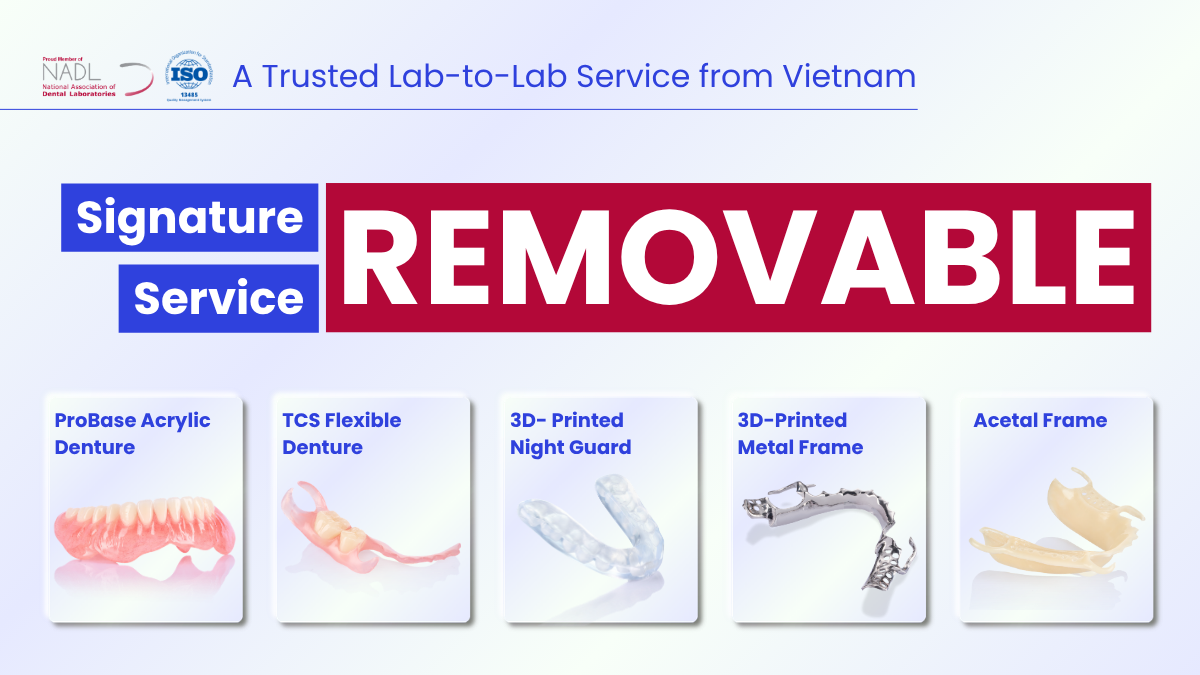
We are experts in Lab-to-Lab Full Service from Vietnam, with the signature services of Removable, meet U.S. market standards, FDA-registered, ISO 13485-certified. Founded in 2017, from local root to global reach, we scale with 2 Factories with over 100+ employees.
Our Commitments Built on “Trusted. Commitment. Quality”
- Commit to Large-Scale Manufacturing, high volume, remake rate < 1%.
- Commit to 5-Year Warranty
- Commit to Competitive Price
XDENT LAB | A Trusted Lab-to-Lab Service from Vietnam
Share this post:
Related Posts
Explore telescopic denture materials, retention designs and lab workflows, with practical guidance on fit, fabrication and maintenance for dental practices.
Materials used in fixed prosthodontics, from zirconia and lithium disilicate to alloys, with guidance on indications, bonding, workflows, and selection.
Learn how implant-retained overdentures rely on clinical planning, attachment selection, and laboratory QC for stable, predictable removable outcomes.

