
Learn how tooth-supported overdentures rely on careful clinical planning, abutment selection, attachments, and laboratory QC for stable, predictable results.
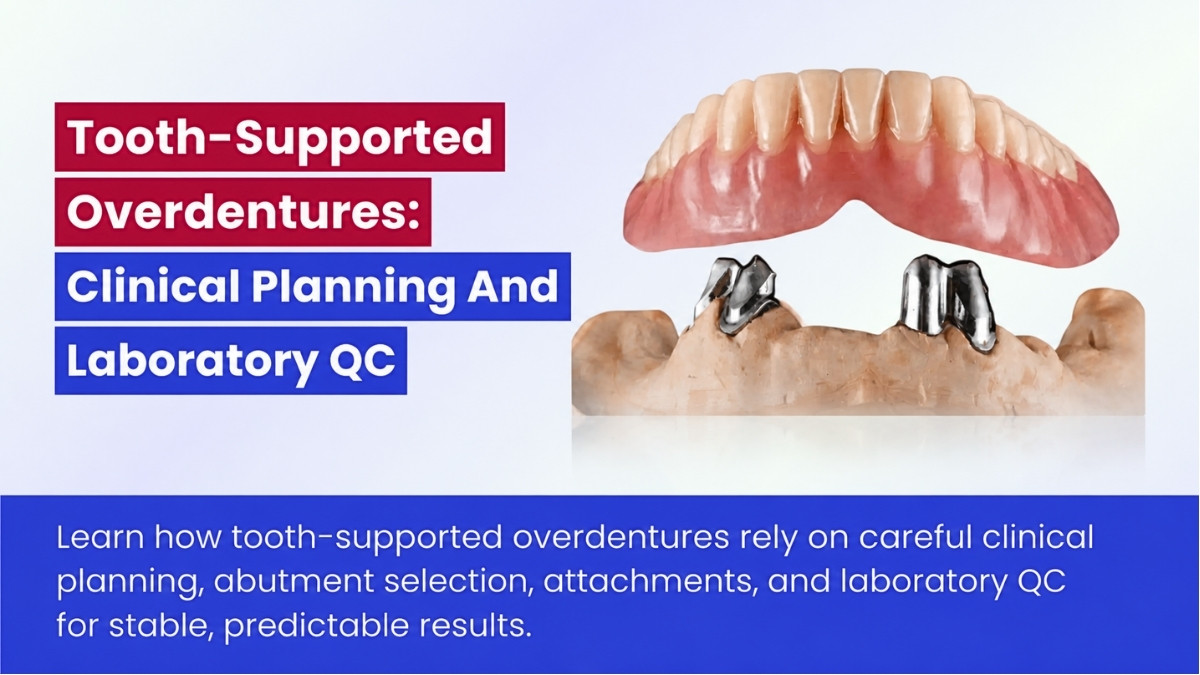
Table of contents [Show]
- What is a tooth-supported overdenture
- Why tooth-supported overdentures matter
- Tooth-supported vs implant-supported overdentures
- Indications
- Contraindications and high-risk cases
- Classification of tooth-supported overdentures
- Abutment selection
- Pre-prosthetic clinical treatment
- Copings for tooth-supported overdentures
- Attachments for tooth-supported overdentures
- Bar-supported tooth overdentures
- Telescopic tooth-supported overdentures
- Impression procedures
- Laboratory workflow
- Materials used in tooth-supported overdentures
- Occlusion in tooth-supported overdentures
- Periodontal health and abutment maintenance
- Complications
- Repair, reline, and conversion
- Tooth-supported overdentures and patient satisfaction
- Laboratory quality control
- Practical final QC form
- International standards and documentation
- Why this matters for XDENT LAB
- Key takeaways
Tooth-supported overdentures are one of the classic tooth-preserving treatments in removable prosthodontics. Instead of extracting every remaining tooth and making a conventional complete denture, selected roots or teeth are retained, prepared, treated, and used to support, retain, stabilize, and preserve the foundation of a removable denture. In daily laboratory and clinical practice, they are especially valuable for patients with a few strategically positioned remaining teeth, compromised dentition, reduced ridge support, or a need for a more stable removable prosthesis without implants.
For dental practices looking to ensure quality and consistency, tooth-supported overdentures remain relevant because they combine biological preservation with removable prosthetic function. They can improve denture performance while delaying full edentulism, preserving proprioception, and reducing the psychological and anatomical cost of extracting every remaining tooth.
What is a tooth-supported overdenture
A tooth-supported overdenture is a removable complete or partial denture that fits over retained natural teeth, prepared tooth roots, or root copings.
It is supported partly by:
- Oral mucosa
- Residual ridge
- Retained natural roots or teeth
- Copings or attachments placed on those roots
Core concept
Instead of removing all remaining teeth, the clinician preserves selected abutments and reduces them to support the denture.
The overdenture may be retained by:
- Simple prepared roots
- Metal copings
- Stud attachments
- Bar attachments
- Magnetic attachments
- Telescopic copings
- Precision attachments
Simple clinical example
A patient has only two mandibular canines remaining. Instead of extracting them and making a lower complete denture, the dentist may endodontically treat and reduce the canines, place metal copings or attachments, and fabricate a mandibular overdenture that gains extra support and retention from those roots.
That decision can dramatically improve denture stability because the canines function as small but strategically important anchors under the acrylic base.
Why tooth-supported overdentures matter
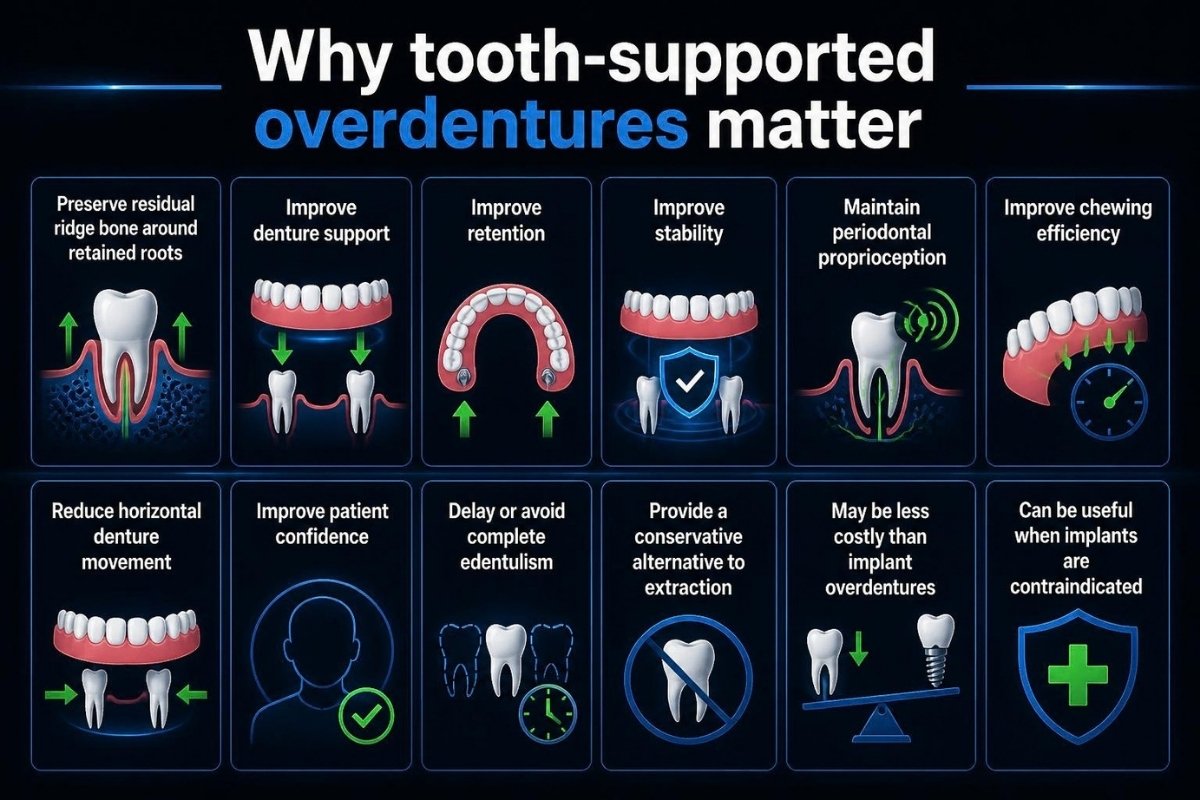
Tooth-supported overdentures are important because they preserve biological structures that conventional dentures often lose.
Main benefits
- Preserve residual ridge bone around retained roots
- Improve denture support
- Improve retention
- Improve stability
- Maintain periodontal proprioception
- Improve chewing efficiency
- Reduce horizontal denture movement
- Improve patient confidence
- Delay or avoid complete edentulism
- Provide a conservative alternative to extraction
- May be less costly than implant overdentures
- Can be useful when implants are contraindicated
Key biological advantage
Retained roots help maintain the periodontal ligament. This provides sensory feedback that conventional complete dentures lack.
That proprioception can improve:
- Bite awareness
- Chewing control
- Functional comfort
- Neuromuscular adaptation
Tooth-supported vs implant-supported overdentures
Both are removable prostheses, but their biological foundations differ.
| Feature | Tooth-supported overdenture | Implant-supported overdenture |
|---|---|---|
| Support source | Natural roots or teeth plus mucosa | Implants plus mucosa |
| Proprioception | Present through periodontal ligament | No periodontal ligament proprioception |
| Surgery required | Usually no implant surgery | Implant surgery required |
| Cost | Often lower | Usually higher |
| Abutment risk | Caries, periodontal disease, root fracture | Peri-implant disease, attachment wear |
| Maintenance | Root and attachment maintenance | Implant and attachment maintenance |
| Bone preservation | Around retained roots | Around implants |
| Ideal use | Salvageable roots remain | Teeth absent or roots not salvageable |
Implant overdentures are widely used to improve retention and stability, but tooth-supported overdentures remain highly valuable when natural abutments can still be preserved.
Indications
Tooth-supported overdentures are indicated when remaining teeth or roots can be predictably maintained and used to improve removable prosthesis support.
Common indications
| Clinical situation | Why tooth-supported overdenture helps |
|---|---|
| Few remaining teeth | Converts weak dentition into useful overdenture abutments |
| Poor mandibular denture stability risk | Retained roots improve support and retention |
| Severely worn dentition | Roots can be preserved under denture |
| Reduced residual ridge | Abutments help reduce tissue load |
| Patient cannot afford implants | Lower-cost retention or support option |
| Medical contraindication to implants | Avoids surgical implant placement |
| Need to preserve proprioception | Periodontal ligament remains active |
| Transition toward edentulism | Slows psychological and functional impact |
| Strategic canines or premolars remain | Good abutment distribution possible |
| Maxillofacial or compromised anatomy cases | Additional retention can be valuable |
Best abutment teeth
The most commonly favored teeth include:
- Canines
- Premolars
- Occasionally molars with good root support
- Strategically distributed anterior roots
- Teeth with favorable periodontal condition
Canines are often ideal because they usually have long roots, favorable distribution, and strong strategic value within the arch.
Contraindications and high-risk cases
Not every remaining tooth should be preserved. A poor abutment can become an expensive problem hiding under acrylic.
Contraindications
- Non-restorable caries
- Advanced periodontal disease
- Severe mobility
- Poor crown-root ratio
- Vertical root fracture
- Untreatable endodontic infection
- Poor oral hygiene
- High caries risk without control
- Patient unable to maintain abutments
- Insufficient interarch space
- Unfavorable root position
- Severe undercuts that prevent proper path of insertion
- Financial inability to maintain attachments or recalls
Relative contraindications
| Condition | Concern |
|---|---|
| Xerostomia | High root caries risk |
| Poor dexterity | Cleaning copings or attachments is difficult |
| Deep subgingival margins | Plaque and inflammation risk |
| Heavy bruxism | Attachment wear or root fracture |
| Very short roots | Poor support and prognosis |
| Poor compliance | High failure risk |
Classification of tooth-supported overdentures
Tooth-supported overdentures can be classified by abutment design and retention mechanism.
Main types
| Type | Description | Clinical use |
|---|---|---|
| Simple root-supported overdenture | Denture fits over reduced roots without attachments | Basic support and bone preservation |
| Coping-supported overdenture | Roots covered with metal or ceramic copings | Protects roots and improves support |
| Stud attachment overdenture | Individual attachments placed on roots | Improved retention |
| Bar-supported overdenture | Roots connected by a bar | Splinting and retention |
| Magnetic overdenture | Magnets used on root keepers | Easier insertion and removal |
| Telescopic overdenture | Primary copings on teeth, secondary crowns in denture | Excellent retention and guidance |
| Hybrid precision attachment overdenture | Uses multiple precision attachments | Advanced retention and esthetics |
Abutment selection
Correct abutment selection is the foundation of success.
Ideal abutment criteria
- Periodontally stable
- Minimal mobility
- Favorable root length
- Favorable root form
- Treatable endodontically if needed
- Restorable with coping or attachment
- Good position in arch
- Enough interarch space
- Patient can clean around it
- No vertical fracture
- No active infection
Favorable abutment distribution
Good overdenture support improves when abutments are:
- Bilaterally distributed
- Positioned near canines or premolars
- Not clustered on one side only
- Strategically placed to resist rotation
- Supported by healthy periodontal tissues
Common abutment patterns
| Remaining teeth | Potential design |
|---|---|
| Two mandibular canines | Simple copings or stud attachments |
| Canines and premolars | Bar or individual attachments |
| Four roots across arch | Splinted bar or telescopic design |
| One canine only | May help but offers limited rotation control |
| Multiple compromised teeth | Selective extraction and preservation of best roots |
Pre-prosthetic clinical treatment
Before fabricating the overdenture, the mouth must be prepared carefully.
Common clinical steps
- Diagnosis and treatment planning
- Radiographic assessment
- Periodontal evaluation
- Caries control
- Endodontic therapy when needed
- Tooth or root reduction
- Coping or attachment preparation
- Impression for copings or attachments
- Fabrication of copings
- Cementation of copings
- Final impression
- Denture fabrication
- Insertion and adjustment
- Recall and maintenance
Endodontic treatment
Many overdenture abutments require root canal treatment because the clinical crown is reduced significantly.
However, not every case requires endodontic treatment. If enough coronal tooth structure remains and the preparation is conservative, vital overdenture abutments may sometimes be used. The decision depends on tooth height reduction, pulpal risk, attachment design, and restorative plan.
Copings for tooth-supported overdentures
Copings are restorations placed over prepared roots or teeth to protect them and improve overdenture support.
Types of copings
| Coping type | Description |
|---|---|
| Short dome-shaped coping | Simple protective metal coping |
| Long coping | Provides more guidance and retention |
| Coping with stud attachment | Includes male or female retention mechanism |
| Coping with magnet keeper | Supports magnetic retention |
| Telescopic primary coping | Used with secondary crown in denture |
| Bar coping or unit | Copings connected with bar |
Materials for copings
- Cast gold alloy
- Cobalt-chromium alloy
- Titanium
- Zirconia in selected cases
- CAD/CAM milled metal
- PFM or ceramic-covered copings in selected esthetic zones
Dome copings
Dome-shaped copings are common because they:
- Protect root surfaces
- Reduce plaque retention compared with complex shapes
- Provide vertical support
- Minimize lateral forces
- Are relatively simple to fabricate
- Allow easier cleaning
Laboratory requirements
The lab must ensure:
- Smooth polished surface
- Accurate margin fit
- Proper height
- Rounded contours
- No sharp edges
- Adequate clearance for acrylic
- Correct attachment orientation if used
- Material traceability
Attachments improve retention and stability.
| Attachment type | Advantages | Limitations |
|---|---|---|
| Stud attachment | Good retention, individual abutments | Requires space and maintenance |
| Ball attachment | Simple and retentive | Wear of matrices |
| Locator-type attachment | Low profile, resilient retention | Inserts wear and need replacement |
| Bar attachment | Splints abutments, good retention | Hygiene is more difficult |
| Magnetic attachment | Easy insertion and removal | Lower lateral stability |
| Telescopic crown | Excellent guidance and retention | High technical complexity |
| Precision attachment | Esthetic, controlled retention | Cost and maintenance |
- Available vertical space
- Abutment distribution
- Denture base thickness
- Hygiene ability
- Manual dexterity
- Desired retention
- Cost
- Maintenance capability
- Laboratory familiarity
- Opposing dentition
- Occlusal load
Space requirements
Attachments require restorative space. Insufficient space can lead to:
- Thin acrylic fracture
- Tooth debonding
- Attachment exposure
- Over-contoured denture base
- Occlusal errors
- Weak prosthesis
In overdenture design, space is not optional. It behaves like an invisible structural component.
A bar-supported tooth overdenture uses a metal bar connecting two or more abutment copings.
Advantages
- Splints abutment teeth
- Improves retention
- Distributes forces
- Provides cross-arch stabilization
- Useful for multiple roots
- Can support clips or riders
Limitations
- Requires more vertical space
- Hygiene is more difficult
- More expensive
- More laboratory complexity
- Bar fracture or clip wear can occur
- Tissue hyperplasia may occur if hygiene is poor
- Passive fit
- Adequate clearance from tissue
- Smooth polish
- Proper clip retention
- No sharp internal angles
- Hygienic shape
- Adequate soldering, welding, or CAD/CAM integrity
- Parallelism when required
Telescopic tooth-supported overdentures
Telescopic overdentures use double crowns.
Components
- Primary coping: Cemented to tooth or root
- Secondary coping or crown: Incorporated into denture
Advantages
- Excellent retention
- Excellent stability
- Good path of insertion control
- Splints abutments
- Esthetic clasp-free design
- Can be modified if abutments fail
Limitations
- High cost
- Technique-sensitive
- Requires excellent parallelism
- Requires significant tooth preparation
- Laboratory precision is critical
- Maintenance required
Common materials
- Gold alloy
- Cobalt-chromium
- Titanium
- Zirconia primary copings in selected workflows
- Electroformed gold secondary components in advanced systems
Impression procedures
Accurate impressions are essential because overdentures must fit both tissues and abutments.
Impression types
- Preliminary impression
- Custom tray impression
- Border molded impression
- Final mucostatic or selective pressure impression
- Coping-level impression
- Attachment pickup impression
- Functional impression in selected cases
Key impression goals
- Capture denture-bearing tissues
- Capture vestibular extensions
- Record abutment or coping details accurately
- Provide relief where needed
- Maintain correct path of insertion
- Support border seal for complete overdenture design
Laboratory workflow
Tooth-supported overdentures require close coordination between clinical and laboratory stages.
Conventional workflow
Primary impression
→ Diagnostic casts
→ Survey and treatment planning
→ Abutment preparation
→ Endodontic therapy if required
→ Coping or attachment impression
→ Coping fabrication
→ Coping try-in
→ Coping cementation
→ Final impression
→ Master cast
→ Record base and wax rim
→ Jaw relation record
→ Tooth setup
→ Wax try-in
→ Denture processing
→ Attachment pickup if required
→ Finishing and polishing
→ Final QC
→ Delivery
Digital or hybrid workflow
Intraoral scan or model scan
→ Digital abutment or coping design
→ CAD/CAM coping fabrication
→ Printed or milled try-in
→ Denture base design
→ Milled or printed denture base
→ Denture tooth bonding or monolithic try-in
→ Attachment pickup
→ Final finishing and QC
Laboratory priorities
- Accurate master cast
- Correct coping design
- Parallelism for attachments or telescopes
- Adequate acrylic thickness
- Proper relief over copings
- Correct path of insertion
- Smooth intaglio surface
- Strong tooth arrangement
- Occlusal stability
- Attachment maintenance plan
Materials used in tooth-supported overdentures
Material selection affects durability, hygiene, retention, repairability, and workflow compatibility.
Denture base materials
| Material | Use |
|---|---|
| Heat-cured PMMA | Conventional denture base |
| CAD/CAM milled PMMA | Digital denture base |
| 3D printed denture resin | Digital denture workflows |
| High-impact acrylic | Reinforced denture bases |
| Metal-reinforced acrylic | Cases with limited space or fracture risk |
| Soft liner | Selected tissue management cases |
Tooth materials
- Acrylic denture teeth
- Composite denture teeth
- Ceramic teeth, less common today
- Milled monolithic PMMA teeth in digital dentures
- Gold alloy
- Cobalt-chromium
- Titanium
- Stainless steel attachment components
- Magnetic keepers
- Zirconia in selected cases
- CAD/CAM milled alloys
Matrix materials
- Nylon inserts
- Metal housings
- Rubber rings
- Plastic clips
- Magnetic assemblies
Occlusion in tooth-supported overdentures
Occlusion must protect abutments and tissues.
Occlusal goals
- Stable centric contacts
- Minimized lateral tipping forces
- Balanced occlusion in complete overdentures when indicated
- Lingualized occlusion in selected cases
- Avoid heavy contacts directly over weak abutments
- Reduce parafunctional overload
- Maintain denture stability during function
High-risk occlusal situations
- Bruxism
- Single complete overdenture opposing natural dentition
- Class II or Class III jaw relationship
- Severe ridge resorption
- Unilateral abutment distribution
- Thin denture base over attachments
- Lack of posterior support
Practical principle
The overdenture should load abutments primarily in a controlled vertical direction. Lateral forces are responsible for many overdenture failures.
Periodontal health and abutment maintenance
Periodontal health is a major determinant of long-term success.
Risks to abutment teeth
- Plaque accumulation
- Gingivitis
- Periodontitis
- Root caries
- Attachment-associated inflammation
- Mobility
- Furcation involvement
- Soft tissue overgrowth
- Coping margin leakage
Maintenance requirements
Patients must clean:
- Denture base
- Copings
- Attachment housings
- Root surfaces
- Gingival margins
- Interproximal spaces around retained teeth
Recommended tools may include:
- Soft toothbrush
- End-tuft brush
- Interdental brush
- Fluoride toothpaste
- Fluoride gel or varnish
- Chlorhexidine in selected short-term situations
- Denture brush
- Non-abrasive denture cleanser
Caries prevention
Root caries is one of the most important long-term risks.
Preventive strategies include:
- Daily fluoride use
- Regular professional fluoride varnish
- Low-sugar diet
- Saliva management
- Coping margin monitoring
- Recall visits
- Radiographs when indicated
- Early repair of leakage or recurrent decay
Complications
Tooth-supported overdentures can fail biologically or mechanically, and many complications are preventable with good planning and recall care.
Biological complications
| Complication | Possible cause |
|---|---|
| Root caries | Poor hygiene, xerostomia, exposed root dentin |
| Periodontal inflammation | Plaque accumulation, poor denture fit |
| Endodontic failure | Persistent infection or leakage |
| Root fracture | Excessive load, post or attachment stress |
| Abutment mobility | Periodontal disease or overload |
| Soft tissue soreness | Poor fit or unstable occlusion |
| Denture stomatitis | Poor hygiene or continuous wear |
| Residual ridge resorption | Tissue load and long-term remodeling |
Mechanical complications
| Complication | Possible cause |
|---|---|
| Attachment wear | Normal use, poor parallelism |
| Loss of retention | Worn inserts or clips |
| Denture base fracture | Insufficient acrylic thickness |
| Tooth debonding | Thin base or processing issues |
| Coping decementation | Poor retention, caries, cement failure |
| Bar fracture | Poor design or overload |
| Matrix housing loosening | Acrylic failure or inadequate pickup |
| Magnet corrosion or failure | Component degradation |
Repair, reline, and conversion
One major advantage of overdentures is that they can often be modified rather than completely replaced.
Common maintenance procedures
- Replace attachment inserts
- Pick up new housings
- Reline denture base
- Repair fractured acrylic
- Add a tooth if an abutment is lost
- Convert tooth-supported overdenture to complete denture
- Convert to implant-assisted overdenture later
- Replace worn denture teeth
- Rebase prosthesis
If an abutment fails
Possible options include:
- Extract the failed root
- Add acrylic and tooth to the denture
- Reline the denture
- Replace the attachment system if needed
- Consider implant placement if appropriate
- Convert to a conventional complete denture
This repair pathway is one reason tooth-supported overdentures can be practical for elderly or medically complex patients.
Tooth-supported overdentures and patient satisfaction
Patient satisfaction is usually improved when overdentures provide better stability than conventional dentures.
Factors affecting satisfaction
- Retention
- Comfort
- Ability to chew
- Speech
- Esthetics
- Ease of insertion and removal
- Cleaning difficulty
- Maintenance cost
- Number of sore spots
- Confidence during eating or social activity
Improved retention and stability often translate directly into better day-to-day patient confidence, especially in the mandibular arch where conventional dentures are more likely to be unstable.
Laboratory quality control
Tooth-supported overdentures require careful QC because small errors around copings or attachments can cause discomfort, retention loss, or fracture.
QC checklist
| QC area | What to verify |
|---|---|
| Case identity | Patient or case ID |
| Abutment positions | Correct roots or teeth |
| Coping fit | Margins, polish, contour |
| Attachment position | Parallelism and path of insertion |
| Denture base thickness | Adequate around attachments |
| Relief | Proper relief over copings |
| Retention | Insert, clip, or magnet function |
| Occlusion | Stable and balanced as prescribed |
| Extension | Correct border extension |
| Polish | Smooth intaglio and external surfaces |
| Hygiene access | Cleanable around abutments |
| Material traceability | Resin, teeth, metal components |
| Instructions | Maintenance and attachment replacement guidance |
Practical final QC form
A structured release checklist reduces avoidable errors and improves consistency across removable cases.
TOOTH-SUPPORTED OVERDENTURE FINAL QC FORM
Case ID: ___________________________
Dentist / Clinic: __________________
Patient ID: ________________________
Arch: Maxillary / Mandibular
Overdenture Type: __________________
Abutment Teeth / Roots: ____________
Attachment System: _________________
Date: ______________________________
CASE VERIFICATION
[ ] Prescription reviewed
[ ] Abutment teeth confirmed
[ ] Attachment type confirmed
[ ] Tooth shade and mold verified
[ ] Occlusal scheme reviewed
[ ] Special instructions reviewed
COPINGS / ATTACHMENTS
[ ] Copings fit accurately
[ ] Margins smooth
[ ] Copings highly polished
[ ] Attachments parallel where required
[ ] Attachment height adequate
[ ] No sharp edges
[ ] Metal lot numbers recorded
DENTURE BASE
[ ] Proper relief over copings
[ ] Adequate acrylic thickness
[ ] Attachment housings secure
[ ] No acrylic porosity
[ ] Borders smooth
[ ] Intaglio surface smooth
[ ] Tissue adaptation acceptable
RETENTION AND FUNCTION
[ ] Inserts/clips/magnets seated
[ ] Retention acceptable
[ ] Denture seats fully
[ ] No rocking on cast
[ ] Path of insertion smooth
[ ] Occlusion checked
[ ] No heavy premature contacts
ESTHETICS AND FINISH
[ ] Tooth arrangement approved
[ ] Midline and smile line checked
[ ] Denture polished
[ ] No sharp resin-metal junctions
[ ] Hygiene access acceptable
[ ] Denture cleaned and disinfected
FINAL RELEASE
[ ] Material traceability completed
[ ] Maintenance instructions included
[ ] Replacement insert information included if needed
[ ] Case packed securely
[ ] Final QC approved
Technician: ________________________
QC Inspector: ______________________
International standards and documentation
Tooth-supported overdentures are custom medical devices and should be manufactured using traceable materials and documented processes.
Relevant standards and frameworks
| Standard / framework | Relevance |
|---|---|
| ISO 13485 | Quality management system for medical device manufacturing |
| ISO 20795 series | Denture base polymers and orthodontic base polymers |
| ISO 22674 | Metallic materials for dental restorations and appliances |
| ISO 10993 series | Biological evaluation of medical devices |
| ISO 7405 | Biological evaluation of dental materials |
| Manufacturer IFU | Attachment, resin, metal, and processing instructions |
| Local dental device regulations | Market-specific compliance requirements |
Laboratory documentation should include
- Dentist prescription
- Patient or case identifier
- Abutment tooth numbers
- Coping material
- Attachment system and size
- Metal lot number
- Denture base resin lot number
- Denture tooth brand, mold, and shade
- Processing method
- Attachment pickup method
- Final QC record
- Delivery date
- Maintenance instructions
Why this matters for XDENT LAB
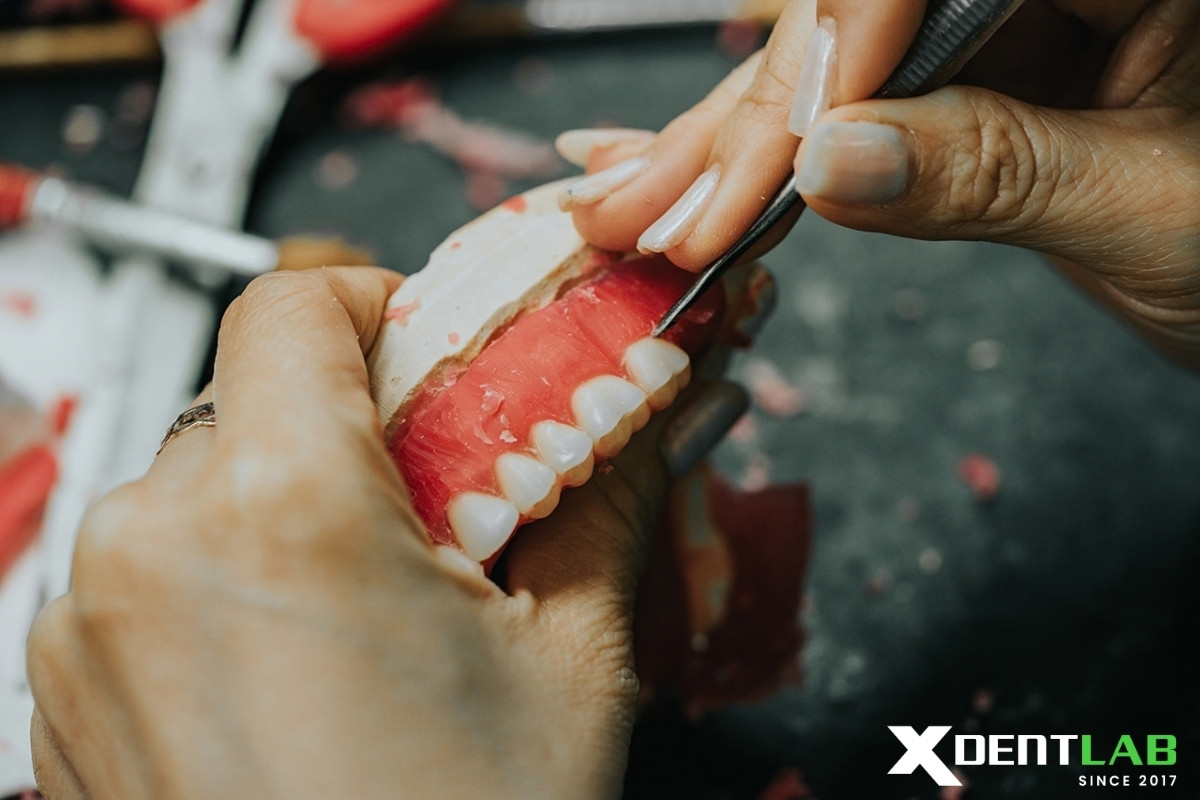
Tooth-supported overdentures align strongly with XDENT LAB’s removable prosthodontic strengths because they require case planning discipline, high coping accuracy, attachment control, and consistent QC.
Strategic relevance for XDENT LAB
- Lab-to-lab removable prosthetic workflows
- Conventional and digital coping fabrication
- Attachment-based overdenture support
- Material traceability
- FDA and ISO-aligned quality systems
- Skilled acrylic processing and finishing
- Vietnam dental lab scalability for consistent production
- Structured QC for fit, relief, retention, and polish
For dental practices that prioritize quality and consistency, these cases highlight how a dental laboratory contributes not just to denture fabrication, but to long-term maintenance, hygiene access, and biological respect for retained abutments.
Key takeaways
Tooth-supported overdentures are removable prostheses supported by retained natural teeth or roots, usually with copings or attachments.
- They preserve strategic roots instead of converting the patient immediately to complete edentulism.
- They improve support, retention, stability, and proprioception compared with many conventional complete dentures.
- Abutment selection is critical, and canines and premolars are often preferred when periodontally stable.
- Root caries and periodontal disease are the major biological risks, so hygiene and recall maintenance are non-negotiable.
- Copings and attachments must be designed for cleansability, strength, and adequate restorative space.
- Laboratory accuracy matters, especially coping fit, attachment parallelism, acrylic thickness, and occlusal control.
- They are useful when implants are not possible or not desired, while still offering better function than a conventional denture in selected cases.
- They are maintainable and convertible, meaning failed abutments can sometimes be managed without remaking the entire prosthesis.
A well-designed tooth-supported overdenture is a biologically respectful prosthesis. It preserves useful roots, improves denture performance, and gives patients a smoother transition into removable rehabilitation.
About XDENT LAB:
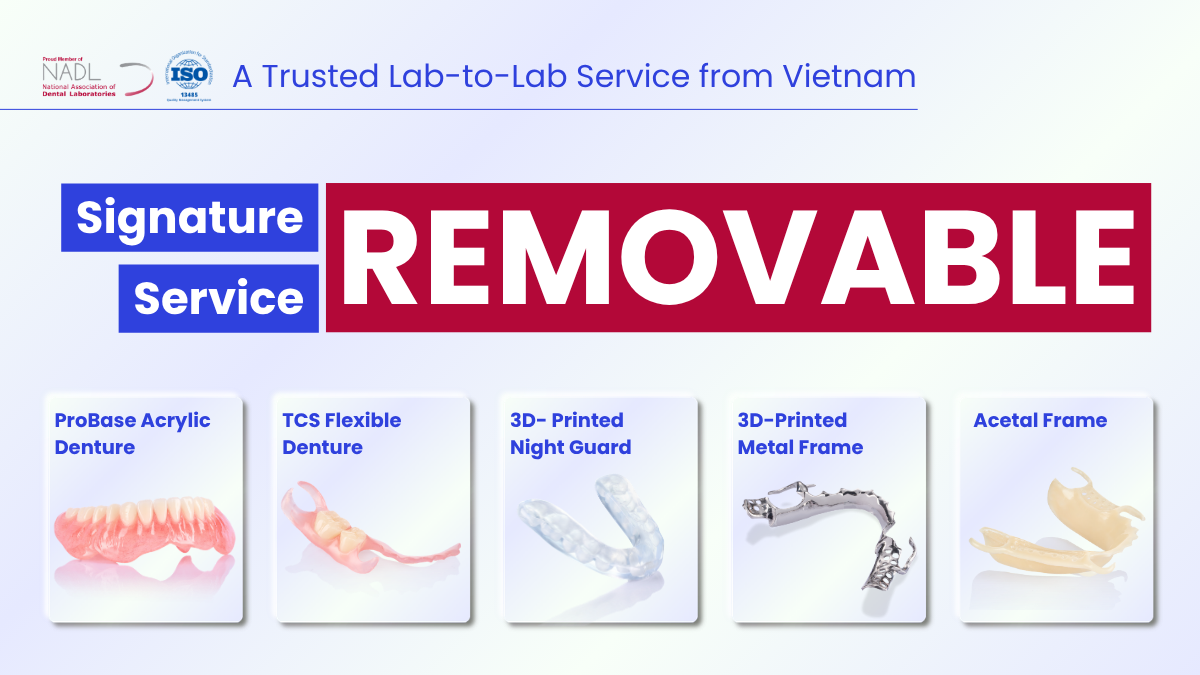
We are experts in Lab-to-Lab Full Service from Vietnam, with the signature services of Removable, meet U.S. market standards, FDA-registered, ISO 13485-certified. Founded in 2017, from local root to global reach, we scale with 2 Factories with over 100+ employees.
Our Commitments Built on “Trusted. Commitment. Quality”
- Commit to Large-Scale Manufacturing, high volume, remake rate < 1%.
- Commit to 5-Year Warranty
- Commit to Competitive Price
XDENT LAB | A Trusted Lab-to-Lab Service from Vietnam
Share this post:
Related Posts
Explore cast metal framework partial dentures, including design principles, material selection, lab workflow, fit, hygiene, and long-term clinical performance.
Not all occlusal rests are the same. Here is what distinguishes the extended, interproximal, internal types, and the clinical situations each one is designed for.
Explore lab-to-lab workflow and QC for implant-supported fixed prostheses, from fit and materials to retrievability, hygiene design, and consistency.

