
Dental metal alloys are fundamental materials in dental laboratory technology, widely used for fabricating crowns, bridges, partial denture frameworks, and implant components. These materials are chosen for their strength, durability, biocompatibility, and ability to be precisely manipulated for various prosthetic applications.
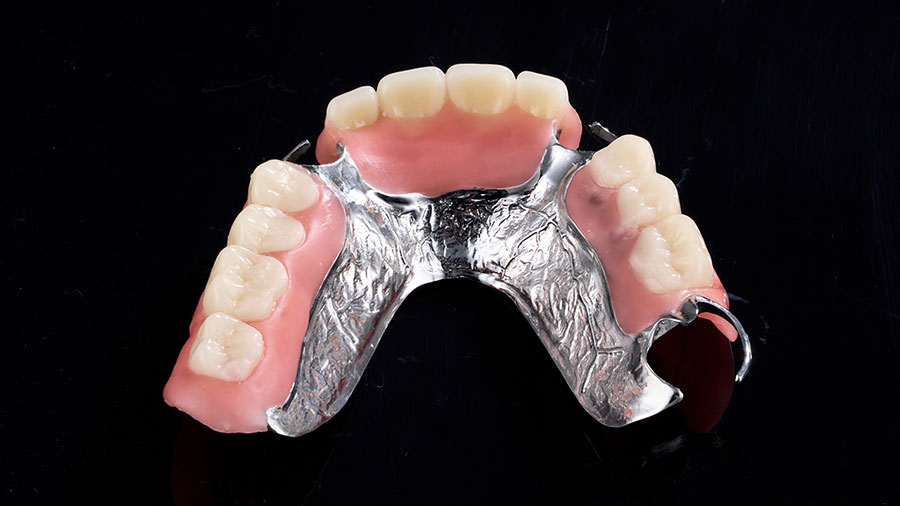
Table of contents [Show]
Dental metal alloys are fundamental materials in dental laboratory technology, widely used for fabricating crowns, bridges, partial denture frameworks, and implant components. These materials are chosen for their strength, durability, biocompatibility, and ability to be precisely manipulated for various prosthetic applications. The American Dental Association (ADA) has established specific classification systems and standards to ensure the quality, safety, and performance of these dental alloys.
ADA Classification System
The ADA classifies dental alloys into three categories based on their noble metal content:
High Noble Alloys (HN)
Noble metal content: ≥60% by weight.
Gold content: ≥40% by weight.
Composition: Gold, platinum, palladium, and other noble metals.
Examples: Type III and IV gold alloys.
Noble Alloys (N)
Noble metal content: ≥25% by weight.
No gold content required.
Composition: Primarily palladium-based or silver-palladium alloys.
Examples: Pd-Ag, Pd-Cu-Ga alloys.
Noble metal content: <25% by weight.
Composition: Nickel-chromium (Ni-Cr) or cobalt-chromium (Co-Cr) alloys.
Examples: Ni-Cr-Mo, Co-Cr-Mo alloys.
Classification by Hardness (ANSI/ADA Specification No. 5)
The ADA further classifies dental casting alloys into four types based on hardness and clinical application:
Type I - Soft
Vickers Hardness: 50-90 HV.
Applications: Simple inlays, low-stress areas.
Yield Strength: 80-180 MPa.
Type II - Medium
Vickers Hardness: 90-120 HV.
Applications: Inlays, onlays, single crowns.
Yield Strength: 180-240 MPa.
Type III - Hard
Vickers Hardness: 120-150 HV.
Applications: Crowns, short-span bridges.
Yield Strength: 240-300 MPa.
Type IV - Extra Hard
Vickers Hardness: >150 HV.
Applications: Long-span bridges, removable partial denture (RPD) frameworks.
Yield Strength: >300 MPa.
Composition of Major Alloy Groups
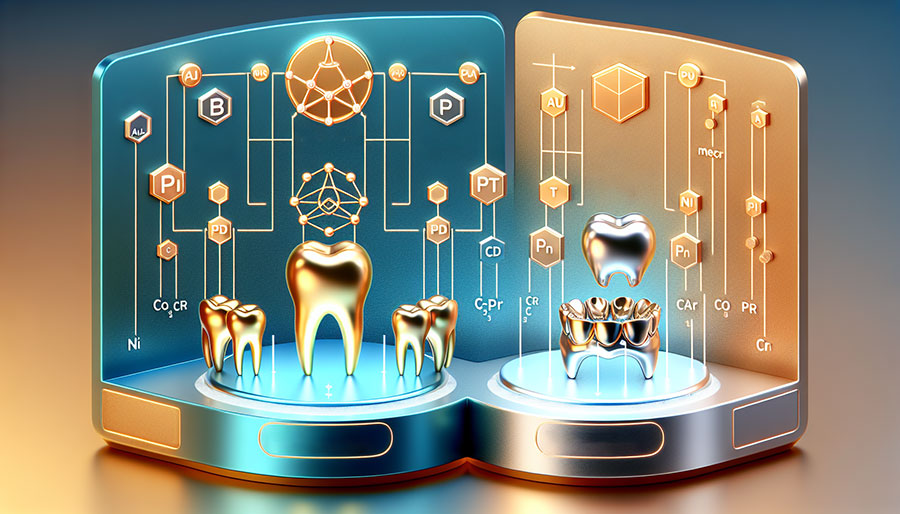
High Noble Gold-Based Alloys
Au-Pt-Pd System Composition
Gold (Au): 70-85%.
Platinum (Pt): 8-12%.
Palladium (Pd): 2-5%.
Silver (Ag): 5-15%.
Copper (Cu): 2-5%.
Zinc (Zn): 0.5-2% (grain refiner).
Properties
Excellent corrosion resistance and biocompatibility.
Easy to cast and finish.
Warm yellow color.
High density (15-18 g/cm³).
Noble Palladium-Based Alloys
Pd-Ag System Composition
Palladium (Pd): 50-60%.
Silver (Ag): 25-40%.
Indium (In): 2-5%.
Gallium (Ga): 5-8%.
Tin (Sn): 2-5%.
Pd-Cu-Ga System Composition
Palladium (Pd): 75-80%.
Copper (Cu): 10-15%.
Gallium (Ga): 5-10%.
Gold (Au): 2-5%.
Properties
White/silver color.
Lower density than gold alloys.
Good mechanical properties.
Potential for discoloration with silver-containing alloys.
Nickel-Chromium (Ni-Cr)
Nickel (Ni): 60-70%.
Chromium (Cr): 15-25%.
Molybdenum (Mo): 3-6%.
Beryllium (Be): 0-2% (controversial).
Aluminum (Al): 2-4%.
Cobalt-Chromium (Co-Cr)
Cobalt (Co): 55-65%.
Chromium (Cr): 25-30%.
Molybdenum (Mo): 4-6%.
Tungsten (W): 2-5%.
Silicon (Si): 1-2%.
Physical and Mechanical Properties
Comparative Properties Table
Property | High Noble | Noble (Pd) | Ni-Cr | Co-Cr |
| Density (g/cm³) | 15-19 | 10-11 | 7.8-8.5 | 8.3-8.8 |
| Melting Range (°C) | 900-1050 | 1100-1300 | 1250-1350 | 1350-1450 |
| Elastic Modulus (GPa) | 80-100 | 100-120 | 180-210 | 200-230 |
| Yield Strength (MPa) | 200-600 | 300-800 | 400-1000 | 500-1200 |
| Elongation (%) | 10-35 | 10-25 | 8-20 | 8-15 |
| Vickers Hardness | 100-350 | 150-400 | 200-450 | 300-500 |
Corrosion Resistance
Noble Alloys
Tarnish resistance: Excellent.
Corrosion rate: <0.1 μm/year.
Ion release: Minimal.
Tarnish resistance: Good (due to Cr₂O₃ passive layer).
Corrosion rate: 0.1-1.0 μm/year.
Ion release: Possible Ni, Cr, and Co ions.
Laboratory Processing Techniques
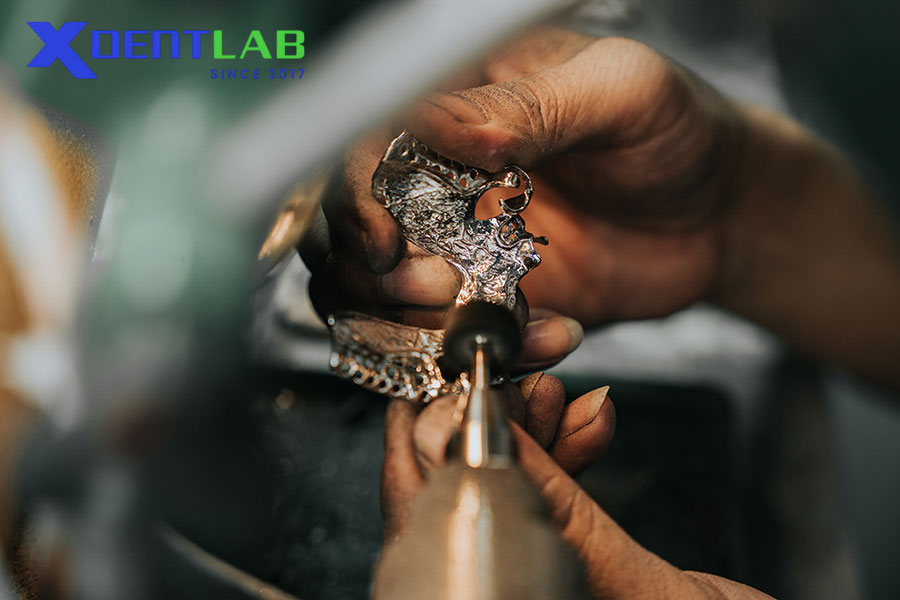
Lost Wax Casting Process
Wax Pattern Formation
Proper spruing technique (8-10 mm diameter).
Sprue angle: 45-60°.
Investment Procedures
Phosphate-bonded investment for base metals.
Gypsum-bonded investment for noble alloys.
Casting Parameters
Centrifugal casting: Common.
Vacuum-pressure casting: Better density.
CAD/CAM Milling
Pre-sintered Blocks
Softer, easier to mill.
Requires sintering post-milling.
Fully Sintered Blocks
Harder, no post-processing required.
Selective Laser Melting (SLM)
Layer thickness: 20-50 μm.
Laser power: 200-400W.
Clinical Applications
Fixed Prosthodontics
Single crowns and short-span bridges (Type III alloys).
Long-span bridges (Type IV or base metal alloys).
Removable Prosthodontics
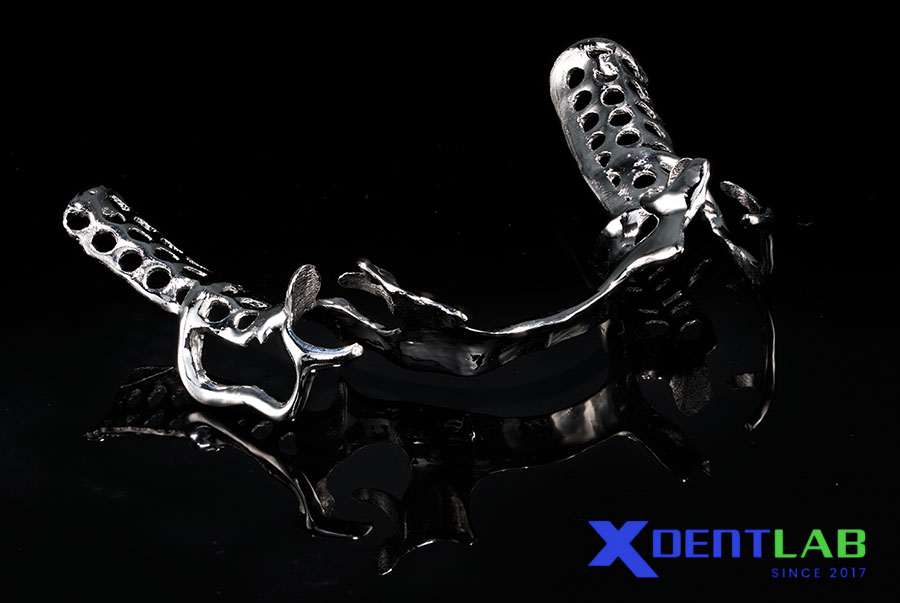
Co-Cr frameworks for partial dentures.
Light weight with high strength.
Implant Prosthodontics
Custom abutments with noble or titanium alloys.
Surface Treatments and Finishing
Mechanical Finishing
Polishing sequence: 600 to 1200 grit, followed by rouge polish.
Electrochemical Treatments
Electropolishing for smooth surfaces.
Passivation for chromium oxide layer formation.
Surface Modifications
Sandblasting (50-110 μm Al₂O₃).
Oxidation for porcelain bonding.
Economic Considerations
Material Costs (2024 Estimates)
High noble alloys: $50-80/g.
Noble alloys: $20-40/g.
Ni-Cr alloys: $0.50-2/g.
Co-Cr alloys: $1-3/g.
Recent Advances and Future Trends

New Alloy Development
Titanium alloys (Ti-6Al-4V, Ti-Zr) for biocompatibility and MRI compatibility.
Digital Manufacturing
Advanced CAD/CAM systems and 3D printing for precision and efficiency.
Surface Engineering
Nano-coatings for wear resistance and antimicrobial surfaces.
Conclusion
Dental metal alloys remain indispensable in dental laboratory technology, offering strength, durability, and versatility across a wide range of prosthetic applications. As materials science and manufacturing technologies advance, dental laboratories must adapt to new techniques and maintain rigorous quality standards to ensure optimal patient outcomes. By combining traditional expertise with emerging digital innovations, the future of dental alloys promises improved efficiency, precision, and biocompatibility.
About XDENT LAB:
We are experts in Lab-to-Lab Full Service from Vietnam, with the signature services of Removable, meet U.S. market standards, FDA-registered, ISO 13485-certified. Founded in 2017, from local root to global reach, we scale with 2 Factories with over 100+ employees.
Our Commitments Built on “Trusted. Commitment. Quality”
- Commit to Large-Scale Manufacturing, high volume, remake rate < 1%.
- Commit to 5-Year Warranty
- Commit to Competitive Price
XDENT LAB | A Trusted Lab-to-Lab Service from Vietnam
Share this post:
Related Posts
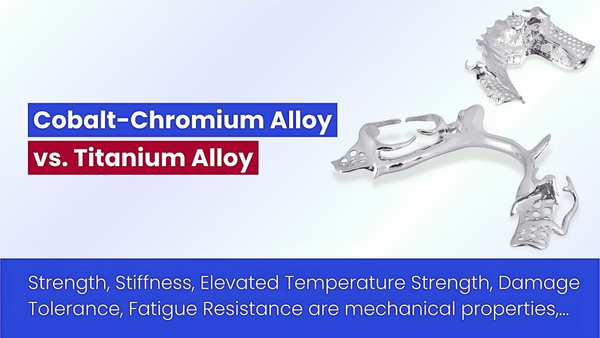
Learn the key differences between titanium and cobalt-chromium alloys used in removable partial denture frameworks, from mechanical properties to production requirements.
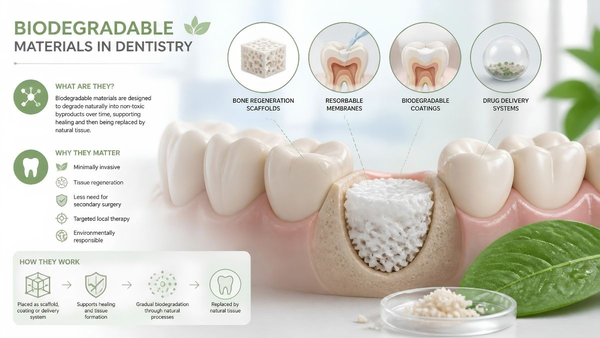
Explore biodegradable materials in dentistry, including their applications, benefits, limitations, and future potential in regenerative and sustainable dental care.
Learn how polyamide dental materials support flexible dentures and removable prosthetics through biocompatibility, aesthetics, comfort, and lightweight performance.

