
A closer look at the U-shaped maxillary major connector: its real indications, its principal drawbacks, and how design choices affect its outcomes.
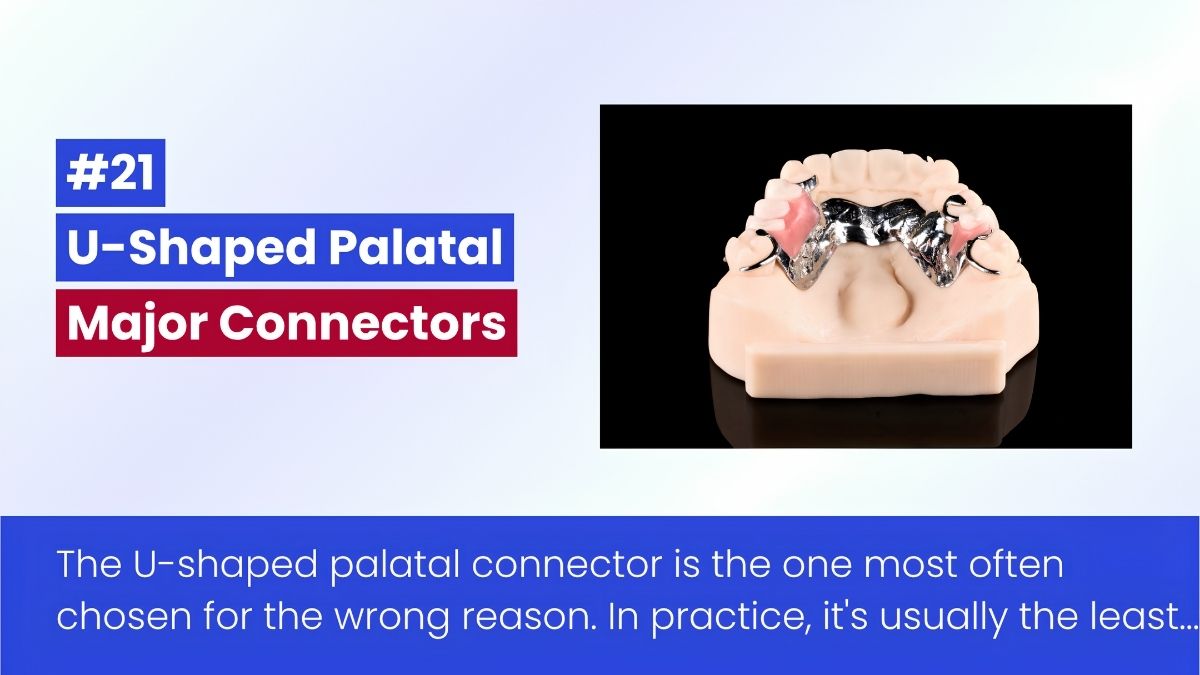
Table of contents [Show]
Introduction
Of the six recognized maxillary major connector types, the U-shaped palatal connector is the one most often chosen for the wrong reason. It gets selected because it looks conservative on paper, less palatal coverage, less bulk, seems easier on the patient. In practice, it's usually the least favorable option both mechanically and clinically.
That doesn't mean it's never the right choice. It has a narrow but legitimate set of indications, and understanding exactly why it underperforms outside of those indications is what makes it possible to use it correctly when it genuinely is the best option available.
Key Points
- The U-shaped connector is generally the least rigid of the six maxillary connector types.
- It's indicated mainly for a large, inoperable palatal torus, and occasionally for select anterior tooth replacement cases.
- Its three main drawbacks: low rigidity, poor tissue support, and bulk that crowds the tongue when made rigid enough.
- Its biggest real-world failure point isn't the open design itself, it's placement too close to the gingival margin without rest support.
- A wider U-shaped design starts to behave like a palatal plate, gaining rigidity at the cost of the coverage it was meant to avoid.
When the U-Shaped Connector Is Actually Indicated
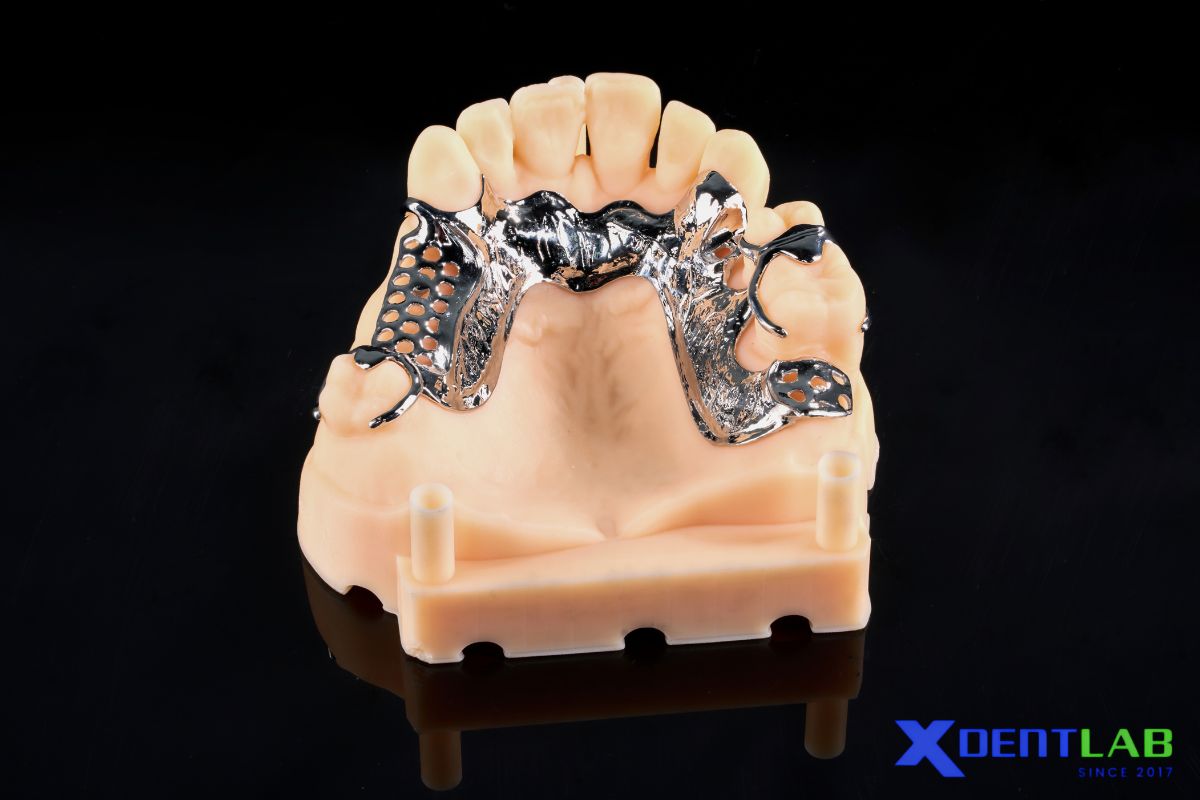
The clearest indication is a large palatal torus that can't reasonably be removed or reduced. When that anatomy is unyielding and sits in the path of any connector that crosses the palate, the U-shaped design is often the only way to route around it. It also comes up occasionally in cases replacing several anterior teeth, where a full anterior-posterior crossing isn't necessary for the support the case requires.
Outside of those two situations, most cases are better served by a different connector type. That's not a matter of preference, it's a direct consequence of how the design performs mechanically.
The Three Principal Drawbacks
1. Limited rigidity
Because the U-shaped connector doesn't cross the palate directly, it lacks the anterior-posterior bracing that gives strap and bar connectors their strength. Under occlusal load, it flexes laterally, and that flex transmits directly as torque to the abutment teeth. A significant share of maxillary RPD failures trace back to nothing more than a U-shaped connector that wasn't rigid enough for the case it was placed in.
2. Weak support characteristics
The open design doesn't distribute occlusal load the way a strap or plate does, which leaves the underlying tissue more exposed to impingement under function. This is especially pronounced in distal extension cases with no posterior tooth support, where movement at the open ends of the connector is both noticeable and traumatic to the residual ridge, regardless of how well the extension base itself is supported.
3. The bulk-versus-tongue-space trade-off
Making the connector rigid enough requires added thickness, and that thickness has to go somewhere. The most effective place to add it, mechanically, is the rugae area, which is exactly where the tongue needs the most freedom. So the connector faces a direct trade-off: enough bulk to be rigid, or enough space to be comfortable, rarely both.
Where the Real Failures Come From
The flexibility issue is well known, but a subtler and more common design error is placement. Major connector borders are supposed to sit in prepared rest seats or stay well clear of gingival tissue. U-shaped connectors frequently do neither, ending up close to or in direct contact with the gingival margin. The result is gingival irritation and periodontal damage to the tissue adjacent to the remaining teeth, a failure mode that has nothing to do with the connector's inherent lack of rigidity and everything to do with how it was outlined on the cast.
Definite rest support at multiple teeth can meaningfully improve rigidity without adding bulk everywhere. It's one of the few practical ways to make a U-shaped design perform closer to its potential.
The Trade-Off in One Line
The wider a U-shaped connector gets, the more it starts to behave like a palatal plate, picking up the rigidity and support characteristics that come with broader coverage. That's the honest way to think about this connector type: its advantages exist mainly at the anatomical edge cases where nothing else fits, and every improvement made to its mechanical performance moves it closer to being the fuller-coverage design it was chosen to avoid in the first place.
Conclusion
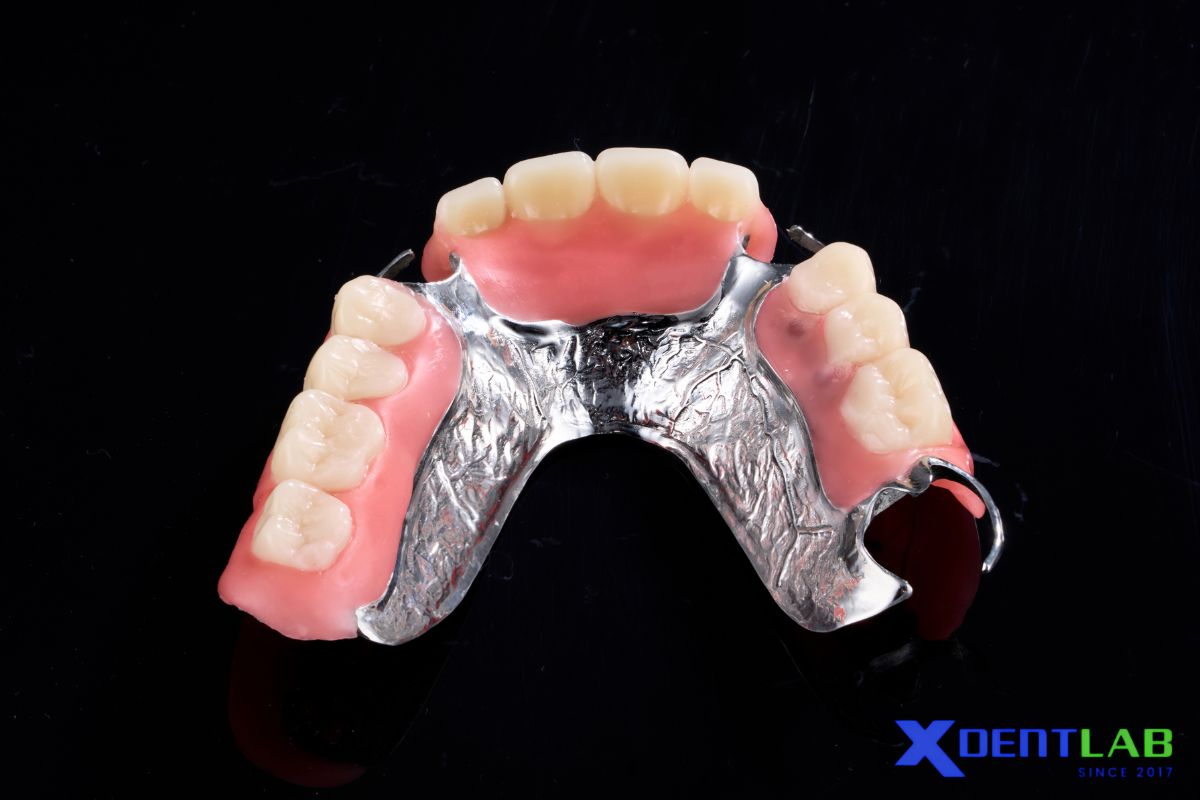
The U-shaped palatal connector isn't a poor design so much as a narrowly scoped one. It exists for a specific problem, an unrelievable palatal torus or a limited anterior span, and within that problem it's genuinely the right tool. Used outside of it, on the assumption that less coverage is automatically kinder to the patient, it tends to fail in the same predictable ways: flexure under load, tissue impingement at the open ends, and gingival damage from borders placed without proper rest support.
The takeaway for treatment planning is straightforward: reach for the U-shaped connector when the anatomy genuinely rules out anything else, build in rest support wherever teeth allow it, and don't mistake a smaller footprint for a safer one. When the indication is real, it holds up. When it isn't, a strap, bar, or plate connector will almost always serve the case, and the patient better.
References
Carr AB, BrownDT (2011) McCracken’s Removable partial prosthodontics. (12th edn), Mosby, 45.
Share this post:
Related Posts
See a real case produced by XDENT LAB, a dental lab outsourcing in Vietnam that serves US customers with high quality and optimized cost.
See 5 completed Acrylic RPD cases from XDENT LAB, a Vietnam dental laboratory serving US, Europe, and Australia. Reliable lab to lab subcontract partner since 2017.
Learn how fixed prosthodontics supports dental lab outsourcing with scalable production, precise workflows, material consistency, and reliable restorative quality.

