
Light‑activated UDMA denture bases: flexural strength evidence, cure parameters, and QA. XDENT LAB’s FDA/ISO lab‑to‑lab workflow delivers consistent results.
Table of contents [Show]
- Overview
- Composition & Polymerization Essentials
- Processing Methods & Advanced Curing
- Physical, Mechanical & Aesthetic Properties
- Clinical & Laboratory Considerations
- Comparative Overview
- QA, Validation & Risk Control
- Implementation Playbook for Practices & Labs
- Research Trends & Future Directions
- Key Takeaways
Overview
Light-activated acrylic resins, typically based on UDMA chemistry, offer a modern alternative to conventional PMMA denture bases. They polymerize under visible light (≈400–500 nm), enabling controlled cure, reduced shrinkage, improved throughput, and strong cross-linked networks. For DSOs and high-volume practices in the dental industry, these resins can compress turnaround times and standardize quality—especially when paired with a lab-to-lab partner like XDENT LAB that meets FDA/ISO expectations.
Composition & Polymerization Essentials
Chemistry Highlights
Understanding the chemistry clarifies why these systems behave differently in the dental industry.
- Base monomer: Urethane dimethacrylate (UDMA) or related dimethacrylates with higher molecular weight than MMA for lower shrinkage and volatility.
- Photoinitiators: Camphorquinone with tertiary amines tuned to blue light for reliable radical formation.
- Cross-linkers: TEGDMA/HDMA and co-monomers to densify the network and elevate flexural performance.
- Fillers: Inorganic particles to modulate shrinkage, stiffness, and handling in the dental industry.
Polymerization Sequence
- Initiation: Blue light excites CQ; amines generate radicals.
- Propagation: Radical addition across methacrylate double bonds builds chains.
- Cross-linking: Multifunctional monomers form 3D networks for stiffness and solvent resistance.
- Termination: Radical quenching or mobility limits; post-cure deepens conversion in the dental industry.
Key upside: on-demand cure control, lower processing heat, and typically lower residual monomer than many self-cure systems used in the dental industry.
Processing Methods & Advanced Curing
Conventional Light-Cure Workflow
- Adapt sheets or putty to the master cast; control base thickness.
- Stage-light to lock margins; complete full light cycle per IFU (often 2–10 minutes).
- Post-cure for mass/opaque areas; then finish and polish.
Net effect: fewer flasking variables and leaner handling overhead in the dental industry.
Advanced Approaches
- Argon ion laser cure: Higher irradiance and depth of cure for thick sections; evaluate heat management and equipment ROI in the dental industry.
- Variable exposure protocols: Intensity and time tuning to optimize degree of conversion and flexural strength.
- DLP/LCD 3D printing: Digital light processing enables additively manufactured bases and hybrid flows, broadening indications in the dental industry.
Physical, Mechanical & Aesthetic Properties
Flexural Behavior
- Many studies report higher flexural strength and modulus vs. some PMMAs and polycarbonate-reinforced options when cure is optimized.
- Exposure time, irradiance, and post-cure strongly affect outcomes in the dental industry.
Dimensional Stability
- Lower polymerization shrinkage than MMA systems supports better base adaptation and retention.
- Water sorption and thermal cycling still influence long-term fit; monitor with QA checks in the dental industry.
Color Stability
- Eclipse-type systems often show better resistance to staining vs. traditional heat-cure resins, though tea and chromogens still challenge surfaces over time in the dental industry.
Other Performance Factors
- Impact strength: Frequently improved with optimized cross-linking and fillers.
- Surface hardness: Generally higher; enhances wear resistance and polishing outcomes.
- Fatigue resistance: Cross-linked networks support cyclic durability for high-function patients in the dental industry.
- Bond to teeth: Surface treatments and compatible bonding resins are crucial for tooth–base integrity.
Clinical & Laboratory Considerations
Advantages
- Processing efficiency: No water-bath cycles; predictable, on-demand curing.
- Reduced residual monomer: Potentially lower irritation risk.
- Strong, cross-linked network: Better mechanical resilience in daily use across the dental industry.
- Aesthetic longevity: Improved chromatic stability for many systems.
Limitations
- Equipment costs: Specialized light boxes or curing chambers and, where used, laser units.
- Thickness constraints: Ensure sufficient light energy for deep sections in the dental industry.
- Repairs and relines: Cross-linked matrices may need primers, surface conditioning, or specialized kits.
- Learning curve and IFU discipline: Small deviations can undercut conversion.
Clinical Applications
- Complete dentures: Efficient base fabrication with reliable adaptation.
- Partial dentures and hybrid frameworks: Selective reinforcement and controlled cure in the dental industry.
- Implant-supported overdentures: Precision fit and stable occlusion schemes; verify conversion around housings.
- Repairs and modifications: Protocol-dependent success; follow manufacturer chemistry.
Comparative Overview
Material Selection at a Glance
| Material | Processing | Strength/Fit | Color Stability | Repairability |
|---|---|---|---|---|
| Heat-cure PMMA | Flask, pack, heat | Good; shrinkage control depends on cycle | Moderate | Straightforward |
| Self-cure PMMA | Cold cure | Moderate; higher residual monomer | Lower | Easy; porosity risk |
| Light-activated UDMA | Visible-light cure | High when fully cured; low shrinkage | Often higher | Protocol-sensitive |
| DLP-printed resins | Layered light cure | Improving; high design precision | Improving | System-specific |
Light-activated UDMA balances speed, fit, and mechanical performance for many labs in the dental industry, provided curing protocols are validated.
QA, Validation & Risk Control
Checklist for Regulated Workflows
- Verify radiometer output: Match device irradiance to IFU; re-check quarterly.
- Build cure maps: Record exposure vs. base thickness and shade for your unit.
- Degree of conversion checks: FTIR where available or proxy rub tests in the dental industry.
- Water sorption and thermal cycling: Internal controls to forecast fit drift.
- Bonding protocol SOP: Standardize tooth surface treatment and resin compatibility.
- MDR/FDA alignment: Track lots, IFUs, and batch records; retain device history.
Implementation Playbook for Practices & Labs
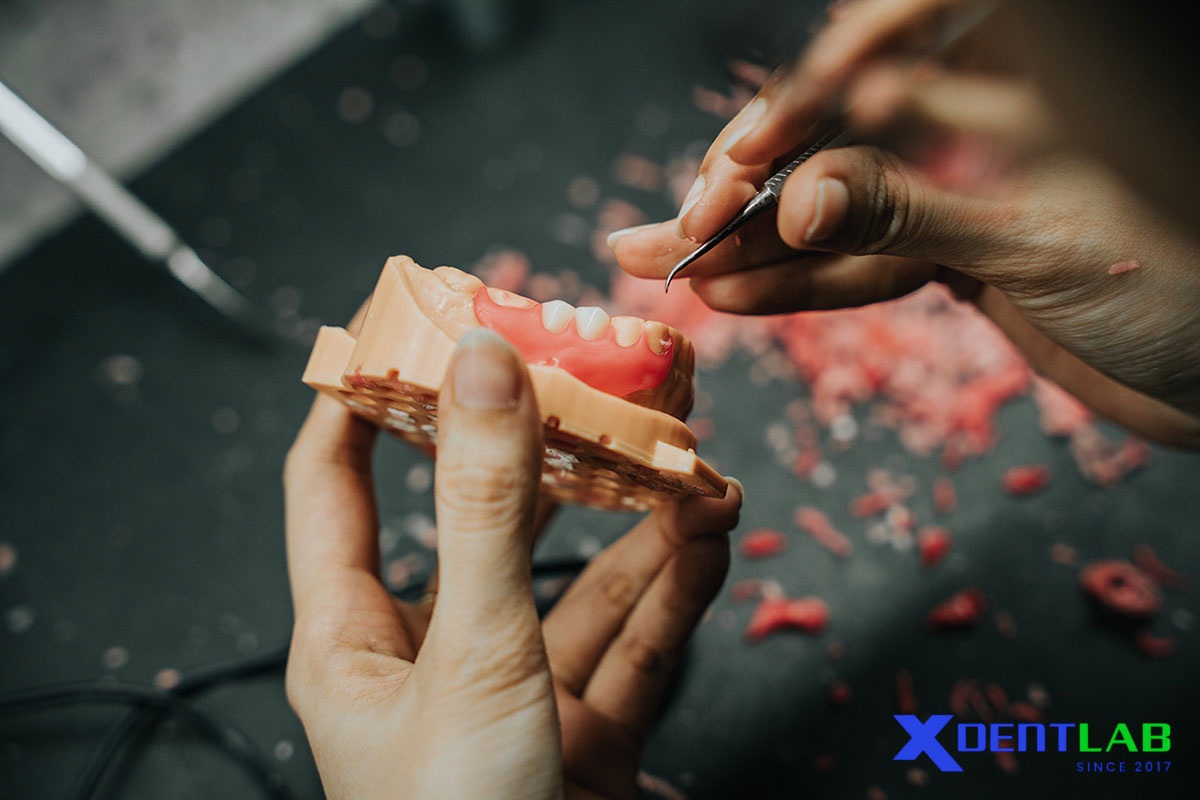
Workflow Design
- Digital intake: Scan verification and base thickness planning.
- Staged light: Margin lock, full cure, and mandatory post-cure windows.
- Finishing SOPs: Uniform polishing sequence to control gloss and stain pickup in the dental industry.
When to Choose Light-Activated Systems
- Tight turnaround cases where flasking overhead is a bottleneck.
- Patients with previous tissue sensitivity related to residual monomer.
- Implant overdentures needing precise adaptation and resilient bases in the dental industry.
- Aesthetic longevity prioritized for tea or coffee-heavy diets.
XDENT LAB Positioning
XDENT LAB delivers FDA/ISO-aligned lab-to-lab capacity from Vietnam with U.S. standardization. Our Removable and Implant specialization, documented QC, and validated curing profiles provide the consistency demanded by the dental industry.
Research Trends & Future Directions
Material Innovations
- Monomer innovation for toughness without brittleness and lower eluables.
- Antimicrobial integration to modulate biofilm without compromising biocompatibility.
- Self-healing chemistries to resist crack propagation and extend service life in the dental industry.
Processing Advancements
- Optimized light-curing units with wavelength distribution, intensity, and beam homogeneity for complete conversion.
- Digital workflow integration: Impression, design, and manufacturing alignment.
- DLP chemistry tuning: Higher conversion at lower dose for faster, deeper cures in the dental industry.
- Hybrid lines: Subtractive–additive blends with automated QA and in-line dosimetry.
Research Needs
- Long-term clinical trials comparing light-activated and conventional alternatives.
- Aging and degradation mechanisms in the oral environment.
- Validated repair and reline protocols for cross-linked matrices.
- Biofilm formation studies and sustainable formulations relevant to the dental industry.
Key Takeaways
Summary for Decision-Makers
- Light-activated UDMA systems deliver controlled cure, lower shrinkage, and robust mechanicals—a strong fit for standardized, time-sensitive workflows in the dental industry.
- Outcomes depend on irradiance, exposure time, post-cure, and disciplined bonding protocols.
- For practices seeking predictable quality at scale, partnering with an FDA/ISO-aligned lab like XDENT LAB reduces variance and speeds delivery while meeting documentation expectations in the dental industry.
About XDENT LAB:
We are experts in Lab-to-Lab Full Service from Vietnam, with the signature services of Removable, meet U.S. market standards, FDA-registered, ISO 13485-certified. Founded in 2017, from local root to global reach, we scale with 2 Factories with over 100+ employees.
Our Commitments Built on “Trusted. Commitment. Quality”
- Commit to Large-Scale Manufacturing, high volume, remake rate < 1%.
- Commit to 5-Year Warranty
- Commit to Competitive Price
XDENT LAB | A Trusted Lab-to-Lab Service from Vietnam
Share this post:
Related Posts
Learn the key differences between titanium and cobalt-chromium alloys used in removable partial denture frameworks, from mechanical properties to production requirements.
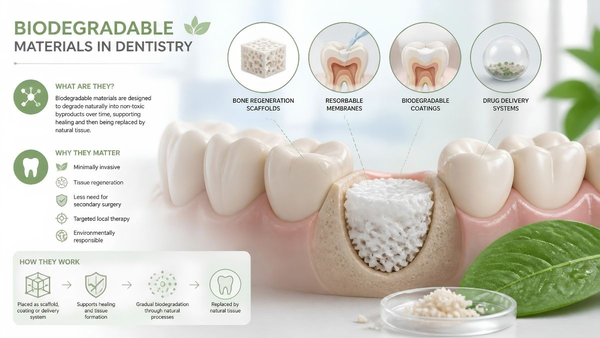
Explore biodegradable materials in dentistry, including their applications, benefits, limitations, and future potential in regenerative and sustainable dental care.
Learn how polyamide dental materials support flexible dentures and removable prosthetics through biocompatibility, aesthetics, comfort, and lightweight performance.

