Explore how AI transforms dental labs in 2025 – from scanning and CAD design to 3D production and lab operations – with real product examples.
Table of contents [Show]
Introduction
As artificial intelligence (AI) continues to grow rapidly and expand into various fields, dental labs are no exception. AI technologies are gradually being integrated into multiple steps of the workflow, enhancing efficiency and improving consistency. This report outlines the key AI application trends in dental labs in 2025, with a focus on four essential stages of the digital lab workflow: scanning, designing, production, and operations.
Methodology
This report is based on secondary research. The analysis draws on a combination of publicly available sources published mainly in 2024 - 2025, including:
Product announcements, press releases and technical brochures from vendors (especially new launches and updates showcased at IDS 2025 in Cologne).
Trade-press coverage and event recaps from dental media and industry analysts.
Official product documentation and marketing materials describing AI features in scanners, CAD platforms, production systems and lab-management software.
Only solutions with a clear, described AI component and a direct or strong indirect impact on dental lab workflows were included. The goal is not to provide an exhaustive catalogue of every AI product on the market, but to highlight representative examples that illustrate broader trends across four stages: scanning, designing, production and operations.
Because the report relies on vendor and media sources, it reflects how AI is presented and positioned by manufacturers and commentators rather than independently audited performance data. No interviews, surveys or adoption metrics from labs were collected. As a result, the findings should be interpreted as a snapshot of 2025 market offerings and narratives, not as a guarantee that each technology is widely implemented or effective in every local context.
AI in Scanning in 2025
In 2025, AI in the scanning stage moves well beyond simple soft-tissue filtering. The dominant trend is to turn intraoral scanning into an intelligent quality gate that guarantees a “lab-ready” digital impression before the file ever leaves the clinic. Instead of waiting for the lab to report that margin data are missing or the bite is inaccurate, AI now performs real-time quality checks: it detects incomplete meshes, saliva or blood artefacts, hidden margins, and incorrect bite registration while the operator is still scanning. At major events such as IDS 2025 in Cologne, intraoral scanner vendors repeatedly framed this as “AI at the centre of digital dentistry”, emphasising that quality assurance and clinical analytics are becoming built-in scanner capabilities rather than separate add-ons.
Within this broader shift, several 2025 product launches and updates illustrate how different companies are using AI to upgrade scanning from simple data capture to intelligent data preparation.
3DISC – OVO3
At IDS 2025, 3DISC introduced OVO3 which is the latest evolution of its intraoral scanner line. What makes OVO3 particularly relevant to AI trends is its “Fly AI” technology. These algorithms work in the background to eliminate stitching errors and enhance overall scanning accuracy by automatically recognising and removing unwanted soft tissue and foreign objects such as cheeks, gloves or the patient’s tongue.
For dental labs, this kind of real-time clean-up at the point of capture reduces artefacts, gaps and unusable areas in the mesh, which in turn lowers the risk of remakes and back-and-forth clarification with clinicians. More consistent, “clean” input data also means less manual patching and guesswork during CAD, allowing technicians to spend their time on design quality rather than repairing basic impression problems.
3Shape – TRIOS 6
A flagship example of AI reshaping scanning is 3Shape – TRIOS 6. Rather than treating TRIOS 6 as just a digital impression tool, 3Shape now presents it as part of a diagnostic ecosystem built around the AI-assistive Dx Plus software. TRIOS Dx Plus analyses scan data to help objectively detect surface and proximal caries, plaque, tooth wear and gingival recession.
Dandy – AI Scan Review
A uniquely 2025 development at the clinic–lab boundary is Dandy – AI Scan Review, launched on 18 November 2025 and described as “dentistry’s first chairside AI assistant for real-time crown preparation analysis”. Built directly into Dandy’s chairside scanning software, AI Scan Review evaluates the preparation in real-time to identify undercuts, insufficient occlusal clearance and obscured margins. If issues are detected, the system immediately provides step-by-step visual guidance on how to refine the preparation.
Crucially, Dandy emphasises that AI Scan Review is the first AI that explicitly confirms a crown preparation’s “lab-readiness”, aiming to reduce remakes, chairside adjustments and rescan appointments. This places AI exactly where dental labs feel the most pain: ensuring that what arrives from the clinic meets technical requirements the first time.
ModJaw – Sphere Platform Advances 4D Dentistry
ModJaw is an advanced digital dentistry system that uses 4D motion capture to record a patient’s jaw movements in real time. Instead of capturing only static anatomy, clinicians use the TWIM unit to “scan” how the jaw actually functions during chewing, speaking and closing.
On top of this motion data, the Sphere platform adds a suite of AI-powered tools. Features such as “Crop Motion” (which selects the most relevant movement sequences for design), “One Click Motion Generation” (which creates patient-specific jaw movements) and “Mock-up Virtual Testing” (which evaluates proposed treatments) are described as transforming raw jaw-movement recordings into practical design information. The workflow is straightforward: clinicians capture jaw motion with TWIM and send it to Sphere, where dental technicians can access and process the functional data through a web browser, use AI to simulate new vertical dimensions, and then export the refined information into CAD software such as exocad or 3Shape Dental System for further design work.
For dental labs, this means that AI at the scanning stage is no longer limited to producing a clean static model; it now also processes functional 4D input, giving technicians richer, patient-specific guidance that CAD software and human designers can use to create more precise and physiologically realistic restorations in the subsequent design step.
AI in Designing in 2025
In 2025, many CAD solutions are positioned as moving from AI being a simple suggestion engine to AI doing most of the routine design work, with technicians increasingly stepping into the role of reviewers and problem-solvers.
Atomica.ai – Crown AI and AI-powered Smile Design
Within this broader shift, Atomica.AI is a clear example of how vendors are using AI to take over routine design steps while keeping humans in a supervisory role. Its Crown AI Module takes intraoral scan data and automatically generates full crown designs, producing CAD files that are already structured to feed smoothly into both milling and 3D-printing workflows. In parallel, a new AI-powered Smile Design module enables clinicians to create printable veneers and aesthetic mock-ups directly from intraoral scans, providing an AI-generated proposal for the final smile that can be discussed with the patient.
For dental labs, this means that more cases arrive with pre-structured, AI-generated design intent. Technicians are still essential, but their role shifts toward refinement, material selection and handling complex or highly aesthetic cases, rather than building every design from scratch.
3Shape – Dental System 2025
On the lab side, 3Shape – Dental System 2025 illustrates how established CAD platforms are weaving AI deeper into everyday workflows rather than launching separate “AI products”. In 2025, 3Shape highlights AI-supported features such as faster, more reliable bite alignment and automated tooth outlining for indications like copy dentures and prosthetic setups. Instead of technicians manually aligning upper and lower arches or tracing every tooth contour, the software now generates an initial proposal that can be accepted or refined in a few clicks.
For dental labs, this shifts Dental System from being a purely manual design environment to a hybrid AI–human workspace: the software handles repetitive alignment and anatomy-detection tasks, while technicians concentrate on occlusion, aesthetics and case-specific problem-solving. This aligns with the broader 2025 trend in CAD where AI does most of the routine groundwork and human expertise is reserved for judgement and refinement rather than basic construction.
AI in Production in 2025
In the production phase—CAM, milling and 3D printing—2025 trends focus on turning what used to be a loose collection of hardware and presets into AI-coordinated production ecosystems. Reports and product announcements around IDS 2025 consistently pair 3D printing with AI-enabled workflow tools, particularly in nesting optimisation, automated file checking and real-time process monitoring. The central idea is to minimise manual preparation and supervision so that dental labs can push more work through the same equipment with fewer interruptions and more predictable outcomes.
BenQ – DentCare Aligner Production System
BenQ – DentCare Aligner Production System is a good example of this direction. Their ecosystem links a DLP DentCare BQP-D15 3D printer, DentCare BQT-P01 Pressure Forming Machine and DentCare BQM-T4X Aligner Trimming Machine. Here, AI is used to detect trimming lines on models, generate cutting paths, and then reuse those paths across the entire aligner series, while QR codes connect each physical model to its correct cloud-stored data. Instead of technicians manually marking and trimming every aligner, AI defines and repeats the process with high precision, turning aligner production into a mostly automated pipeline where humans supervise quality rather than perform every mechanical step.
UNIZ – UNIZ DENTAL
By 2025, UNIZ Dental, the print-preparation software for UNIZ’s dental 3D printers, already includes AI-based smart orientation and nesting for dental models. Originally introduced in earlier software releases, this feature allows the software to automatically orient models, arrange them on the build platform and optimize nesting with minimal manual input. In practice, this shifts a traditionally time-consuming CAM task, deciding how to place multiple models on a build plate and how to support them, into an AI-assisted background process. For dental labs, the result is faster job setup, more consistent use of build volume and fewer trial-and-error adjustments, reinforcing the broader 2025 trend in production where software, rather than the technician, increasingly decides how prints are prepared while humans focus on supervising quality and throughput.
AI in Lab Operations in 2025
In 2025, one of the most important but less visible shifts in digital dentistry happens not in scanners or printers, but in how labs are run. AI is increasingly applied to lab operations and workflow orchestration rather than just to design or production tools. The dominant trend is to use AI to tackle chronic operational pain points: staff shortages, unstable turnaround times, fragmented case information and the constant risk of miscommunication between clinics and labs.
Instead of optimising a single step, such as CAD design or 3D printing, new platforms aim to monitor and coordinate the entire digital pipeline, from the moment a scan and prescription arrive to case creation, scheduling, quality control and final delivery. Across vendors, this takes the form of cloud-based, AI-assisted platforms that centralise data, automate repetitive admin tasks and flag problems early. The value proposition moves away from “this scanner/this printer is advanced” toward “this platform connects everything and keeps the lab flowing”, with AI acting as the decision-support layer that keeps cases moving smoothly through the system.
Evident – EvisSmart QC
Within lab operations, EviSmart QC is a clear example of how AI is being used as a quality gate rather than just a reporting tool. Instead of technicians manually opening each incoming case to check whether the scan is usable and the prescription is complete, EviSmart QC uses AI to analyse the files as they arrive. It flags poor-quality or incomplete cases, for example, scans with missing areas, obvious artefacts or prescriptions lacking key information, before they enter production.
For dental labs, this turns first-line quality control from a slow, manual screening task into an automated background process: technicians can focus on solving the problematic cases that have been flagged, rather than spending time checking every single file just to find out which ones are unusable.
Epiklab – AI-Powered Cloud CRM
Alongside dedicated workflow engines like EviSmart, new players are also bringing AI into the more traditional “front office” side of lab management. Epiklab positions itself as a smart, cloud-based CRM for dental labs, designed to streamline lab orders, technician workflows, clinic communication and inventory through AI-powered automation.
From an operational perspective, platforms like Epiklab sit on top of the entire case flow: they centralise incoming orders from multiple clinics, track case status across technicians and shifts, and keep communication and inventory in one place rather than scattered across emails and spreadsheets. The “AI-powered automation” component is marketed around reducing repetitive coordination work—for example, automatically updating order status, routing tasks to the right technician group, and generating reminders or alerts when cases risk missing their turnaround time or when key materials run low.
For dental labs, this type of AI-assisted CRM does not design or manufacture restorations directly, but it shapes how work moves through the organisation. By making order intake, task assignment, communication and stock monitoring more automated and data-driven, systems like Epiklab aim to help labs handle higher case volumes and multi-site operations without proportionally increasing administrative overhead.
Conclusion
By 2025, AI in dental labs has clearly moved beyond experimental pilots and isolated “smart” features. For labs, these developments collectively signal a shift in where value is created: competitive advantage is less about owning the fastest printer or the sharpest scanner, and more about how well a lab can integrate AI-driven systems, manage data quality and upskill its people. At the same time, the human role does not disappear; it evolves. Technicians and lab managers are increasingly needed as curators, decision-makers and collaborators, responsible for overseeing AI outputs, handling complex and aesthetic cases, and maintaining strong clinical relationships.
Looking ahead, the most successful labs will be the ones that treat AI not as a single purchase but as a long-term platform strategy. That means choosing technologies that interoperate, investing in data and training, and being selective about where AI genuinely reduces friction rather than adding complexity. As these systems mature, AI is likely to become an invisible but indispensable layer of the modern dental lab, quietly coordinating processes in the background while humans focus on the clinical, creative and relational work that machines cannot replace.
References
IDS Cologne 2025: A landmark in global dental innovation
IDS 2025 Highlights – The Latest Releases in Digital Dentistry
About XDENT LAB:
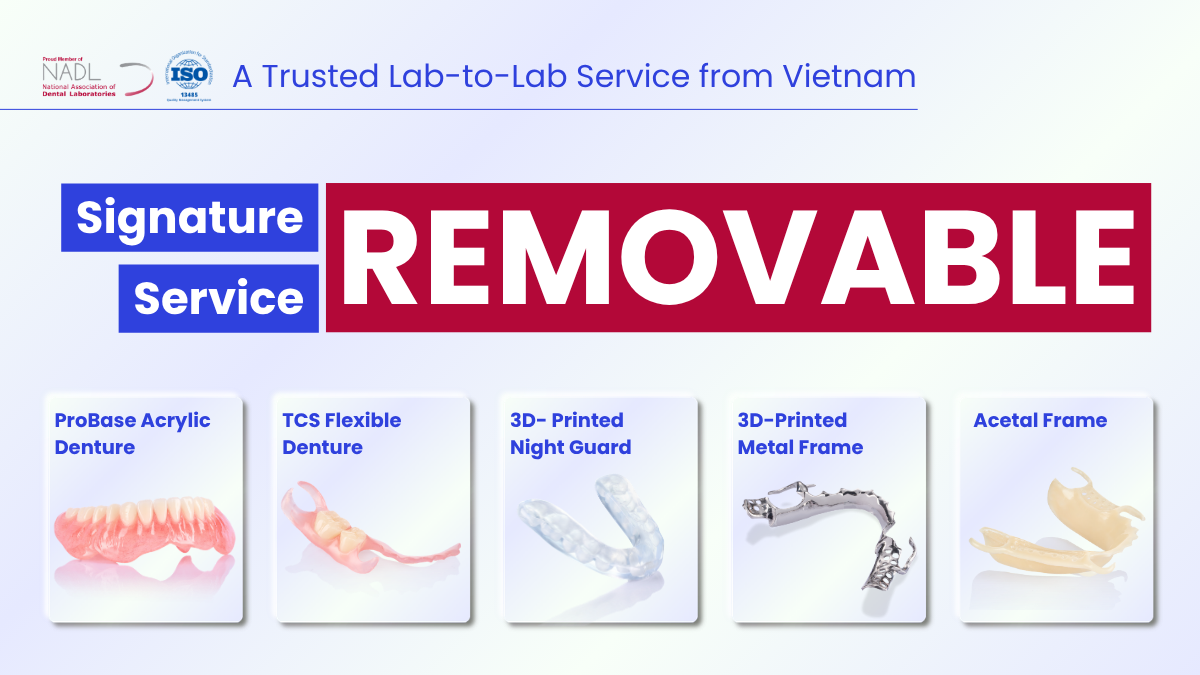
We are experts in Lab-to-Lab Full Service from Vietnam, with the signature services of Removable, meet U.S. market standards, FDA-registered, ISO 13485-certified. Founded in 2017, from local root to global reach, we scale with 2 Factories with over 100+ employees.
Our Commitments Built on “Trusted. Commitment. Quality”
- Commit to Large-Scale Manufacturing, high volume, remake rate < 1%.
- Commit to 5-Year Warranty
- Commit to Competitive Price
XDENT LAB | A Trusted Lab-to-Lab Service from Vietnam
Share this post:
Related Posts
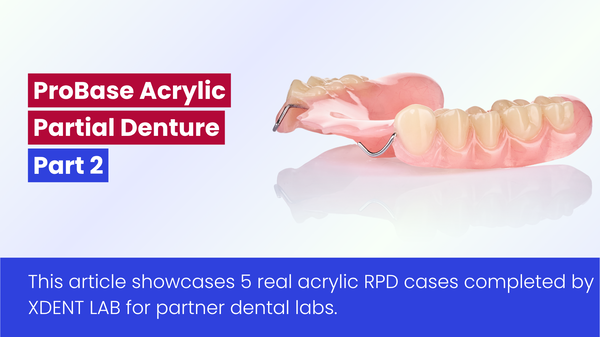
See 5 completed Acrylic Partial Denture cases (Case 6 ~ Case 10) from XDENT LAB, a Vietnamese dental laboratory that is FDA registered and ISO 13485 certified. A trusted overseas outsourcing dental la...
Discover how critical laboratory checks reduce remakes and improve restoration quality in dental lab outsourcing for fixed and implant cases.
Understanding and applying the correct Layer Thickness settings not only saves labs time and production cost, but also ensures stable output quality for each specific type of dental product.

