
A continuous overview of 3D printing technologies in prosthodontics using ISO/ASTM classification, including material jetting, binder jetting, DED and sheet lamination.
Table of contents [Show]
Key Points
Beyond the three core technologies discussed in Part 1, several ISO/ASTM additive manufacturing categories play specialized or indirect roles in prosthodontics.
Material jetting is used for high-accuracy visualization, surgical planning, and casting workflows, rather than definitive intraoral restorations.
Binder jetting and directed energy deposition (DED) remain largely confined to research, experimental manufacturing, or component repair, due to limitations in accuracy, density, and workflow complexity.
Sheet lamination is now considered obsolete for modern prosthodontic fabrication, retaining relevance mainly for educational or historical reference.
Together, these technologies highlight that not all additive manufacturing methods are intended for routine clinical production, reinforcing the importance of application-driven technology selection.
Introduction
In Part 1, we examined the most commonly used additive manufacturing technologies in prosthodontics, vat polymerization, material extrusion, and powder bed fusion, focusing on how each category supports everyday laboratory and clinical workflows. These three groups account for the majority of current dental 3D printing applications, from diagnostic models to definitive metal restorations.
In Part 2, the discussion continues with the remaining ISO/ASTM additive manufacturing categories: Material Jetting, Binder Jetting, Directed Energy Deposition, and Sheet Lamination.
By separating widely adopted technologies from more specialized ones, this two-part structure aims to provide a clearer, more practical understanding of how additive manufacturing fits into modern prosthodontic practice, without overwhelming the reader or overstating the clinical role of emerging systems.
Comparison Table (ASTM overview)
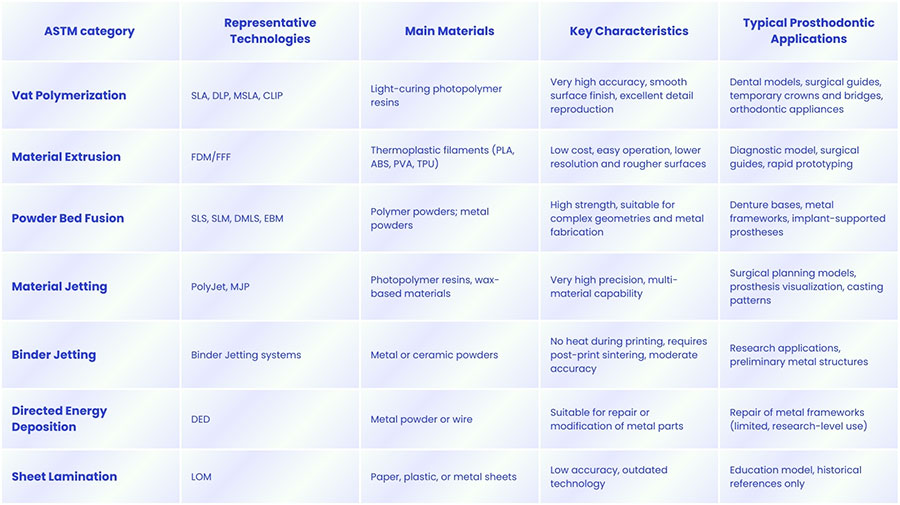
If you want a quick overview before exploring each technology in detail, the table below summarizes the seven ISO/ASTM additive manufacturing categories and highlights their main materials and typical prosthodontic relevance.
4. Material Jetting Technologies
Material jetting technologies offer very high accuracy and multi-material capability, making them particularly suitable for visualization, treatment planning, and casting workflows rather than direct intraoral use. According to LMT’s November/December 2025 survey, 16% of dental laboratories reported having material jetting systems in-house.
Photopolymer jetting (also known as inkjet printing or material jetting) resembles a traditional inkjet printer. Instead of ink on paper, micrometer-sized droplets of liquid photopolymer or wax are selectively jetted from hundreds of nozzles and immediately polymerized using ultraviolet (UV) light, enabling highly detailed and multi-material builds.
Main materials
Photopolymer resins
Wax-based materials
Typical prosthodontic applications
Dental models
Surgical planning
Casting patterns
Common technologies
PolyJet
MJP (MultiJet Printing)
Disclaimer: The descriptions above reflect general characteristics of material jetting technologies; actual performance and suitability may vary depending on system design, material selection, and laboratory workflow.
4.1. PolyJet
Overview
PolyJet is a material jetting technology capable of printing multiple materials simultaneously, allowing the simulation of different tissue properties, such as hard and soft structures, within a single model.
In prosthodontics, PolyJet is primarily used for high-fidelity dental models, surgical planning, and prosthetic visualization. Although its high cost limits routine laboratory use, PolyJet remains valuable for complex interdisciplinary cases and educational purposes where realism and accuracy are critical.
Materials
Photopolymer resins (rigid and flexible formulations)
Energy source
Ultraviolet (UV) light
Technique
Microscopic droplets of photopolymer are jetted and UV-cured layer by layer.
Advantages
Very high accuracy and surface quality
Multi-material and multi-color printing capability
Effective simulation of different tissue properties
Disadvantages
High equipment and material cost
Not suitable for definitive intraoral restorations
Requires post-processing and material handling
Examples
4.2. MJP (MultiJet Printing)
Overview
MJP is a material jetting technology optimized for printing wax or resin patterns with extremely fine detail. It is particularly well suited for applications where surface smoothness and dimensional accuracy are critical.
In prosthodontics, MJP is mainly used to fabricate casting patterns for crowns, bridges, and other precision components, supporting indirect manufacturing workflows rather than final prostheses.
Materials
Powder, Plastics
Wax-based materials
Photopolymer resins (pattern materials)
Energy source
Ultraviolet (UV) light and material solidification by cooling
Technique
Inkjet-style printheads deposit wax or resin droplets that solidify layer by layer.
Advantages
Exceptional detail resolution
Smooth surface finish ideal for casting
High dimensional accuracy
Disadvantages
Limited material options
Primarily indirect use (patterns, not final prostheses)
Equipment and consumable costs can be high
Examples
5. Binder Jetting
Binder jetting is primarily used in research and experimental settings rather than routine clinical workflows in prosthodontics. Unlike laser- or electron-beam–based powder bed fusion, binder jetting does not use high heat during the printing step, which limits residual stress but also reduces part density before post-processing.
In dentistry, the need for extensive post-print sintering and infiltration, along with challenges in achieving consistent dimensional accuracy, has restricted binder jetting mainly to research, material development, and preliminary structural studies rather than definitive prosthodontic fabrication.
Binder Jetting
Main materials
Metal powders
Ceramic powders
Typical prosthodontic applications
Preliminary metal structures
Research and development models
Energy source
None during printing (binding occurs without thermal fusion)
Technique
A liquid binding agent selectively bonds powder layers, followed by post-print sintering to achieve final density.
Advantages
Can work with metal and ceramic powders
Useful for research and early-stage prototyping
No high heat during the printing step
Disadvantages
Accuracy and density depend heavily on sintering
Significant post-processing required
Limited clinical adoption for definitive prosthodontic components
Examples
Desktop Metal – Shop System (used in dental materials research and pilot studies)
ExOne – Innovent+ (commonly cited in academic binder jetting research)
Note: At present, there are no widely adopted binder jetting systems dedicated specifically to routine prosthodontic laboratory production. Existing platforms are primarily used in research or experimental dental manufacturing workflows.
6. DED (Direct Energy Deposition)
Directed Energy Deposition (DED) is an additive manufacturing process in which material is melted by a focused energy source as it is deposited, allowing new material to fuse directly with an existing substrate. This technique is also commonly referred to as laser solid forming (LSF) in the literature.
In prosthodontics, DED is not intended for fabricating new prostheses from scratch. Instead, it is primarily designed for repairing, reinforcing, or modifying existing metal components. Due to its relatively low resolution and high system complexity, DED remains rarely used in routine dental laboratory workflows.
DED
Main materials
Metal powders or wires
Commonly processed materials include titanium, stainless steel, and metal alloys
Typical prosthodontic applications
Repair of metal frameworks (very limited use)
Research-level and experimental applications
Energy source
High-energy laser (or electron beam in some industrial systems)
Technique
A focused energy source melts metal as powder or wire is deposited, building or repairing the part.
Advantages
Fast build/repair process
Suitable for larger parts and component repair
Can add material to existing metal structures
Disadvantages
Higher surface roughness
Limited accuracy
Expensive equipment.
Examples
7. Sheet Lamination
Sheet lamination represents one of the earliest approaches to additive manufacturing and is now largely outdated in dental applications. While historically important in the development of 3D printing, sheet lamination technologies do not meet the accuracy, material, or workflow requirements of modern prosthodontics.
Sheet lamination builds objects by stacking and bonding sheets of material, which are then cut to shape. Compared to contemporary additive manufacturing methods, this approach offers limited resolution and geometric control, restricting its relevance to educational or historical contexts.
Main materials
Paper sheets
Plastic sheets
Metal sheets
Typical prosthodontic applications
Educational models
Historical reference only
Common technology
LOM (Laminated Object Manufacturing)
Disclaimer: The descriptions above reflect general characteristics of sheet lamination technologies; these methods are no longer considered suitable for routine prosthodontic fabrication.
7.1. Laminated Object Manufacturing (LOM)
Overview
Laminated Object Manufacturing (LOM) is an additive manufacturing technique in which layers of sheet material are bonded together and then cut to shape, historically using laser or blade-based cutting systems. As one of the first commercially available additive manufacturing methods, LOM played a foundational role in early rapid prototyping.
In dentistry, however, LOM lacks the resolution, material compatibility, and precision required for prosthodontic applications and is therefore no longer used in clinical or laboratory production.
Materials
Paper-based laminates
Plastic sheets
Metal sheets
Energy source
Laser or mechanical cutting systems (system-dependent)
Technique
Sheets of material are bonded layer by layer and cut to shape to form the final object.
Advantages
Economical
Suitable for large models
Diverse materials can be used
Disadvantages
Inferior resolution and surface quality
Not suitable for intricate geometries or fine margins
Obsolete for modern prosthodontic workflows
Examples
No dental-dedicated LOM systems are currently used in prosthodontics
Conclusion
While vat polymerization, material extrusion, and powder bed fusion dominate routine prosthodontic workflows, the remaining ISO/ASTM additive manufacturing categories play more specialized and indirect roles in dental fabrication. As discussed in this part, Material Jetting, Binder Jetting, Directed Energy Deposition, and Sheet Lamination each contribute to prosthodontics in distinct but limited contexts.
Taken together, these technologies highlight an important principle in digital prosthodontics: not every additive manufacturing method is intended for clinical production. Understanding where a technology excels, and where its limitations lie, is essential for making informed decisions that balance accuracy, material behavior, workflow complexity, and clinical relevance.
References
Trends and future perspectives of 3D printing in prosthodontics
Review on 3D printing in dentistry: conventional to personalized dental care
About XDENT LAB:
We are experts in Lab-to-Lab Full Service from Vietnam, with the signature services of Removable, meet U.S. market standards, FDA-registered, ISO 13485-certified. Founded in 2017, from local root to global reach, we scale with 2 Factories with over 100+ employees.
Our Commitments Built on “Trusted. Commitment. Quality”
- Commit to Large-Scale Manufacturing, high volume, remake rate < 1%.
- Commit to 5-Year Warranty
- Commit to Competitive Price
XDENT LAB | A Trusted Lab-to-Lab Service from Vietnam
Share this post:
Related Posts
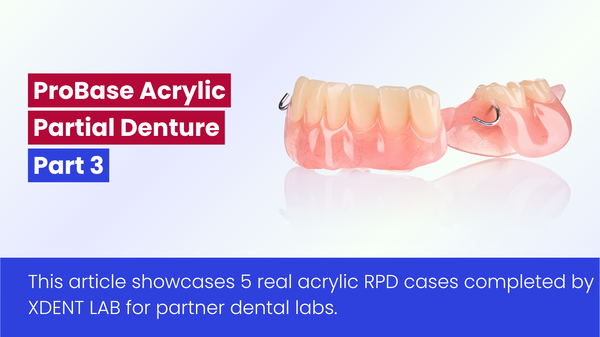
See 5 Acrylic Partial Denture cases (cases 11 to 15) from XDENT LAB, a Vietnamese dental laboratory that is a member of the National Association of Dental Laboratories (NADL). XDENT LAB is an expert i...
See 5 completed Acrylic Partial Denture cases (Case 6 ~ Case 10) from XDENT LAB, a Vietnamese dental laboratory that is FDA registered and ISO 13485 certified. A trusted overseas outsourcing dental la...
Discover how critical laboratory checks reduce remakes and improve restoration quality in dental lab outsourcing for fixed and implant cases.

