
An overview of 3D printing technologies in prosthodontics using ISO/ASTM classification, including vat polymerization, material extrusion, and powder bed fusion.
Table of contents [Show]
- Key Points
- Introduction
- Comparison Table (ASTM overview)
- 1. Vat Polymerization Technologies (Resin-based 3D Printing)
- 2. Material Extrusion Technologies
- 3. Powder Bed Fusion Technologies
- Conclusion
- References
Key Points
3D printing technologies in prosthodontics differ significantly in materials, accuracy, cost, and clinical suitability.
Vat polymerization dominates resin-based workflows due to high precision, smooth surfaces, and fine detail reproduction.
Material extrusion is a cost-effective, accessible option for diagnostic models, basic guides, and rapid prototyping, but with lower resolution than resin printing.
Powder bed fusion supports durable polymer and metal fabrication, making it essential for denture bases, metal frameworks, and implant-supported prostheses.
There is no single best technology: optimal selection depends on clinical purpose, material requirements, accuracy targets, post-processing capacity, and lab resources.
Introduction
In daily prosthodontic practice, 3D printing is no longer limited to experimental use or large dental laboratories. It has become a practical tool for clinicians and technicians who need predictable results, shorter turnaround times, and patient-specific solutions.
Despite its widespread adoption, 3D printing in prosthodontics is often discussed in a fragmented way. Technologies such as SLA, DLP, SLS, and DMLS are frequently mentioned without a clear framework, which can lead to confusion, especially when different methods use similar materials or are applied to overlapping clinical tasks. In practice, these technologies differ significantly in terms of manufacturing principles, compatible materials, accuracy, cost, and clinical suitability.
To address this issue, this article presents an overview of 3D printing technologies used in prosthodontics based on the ISO/ASTM 52900 classification, which defines 7 main categories of additive manufacturing. By organizing current dental 3D printing methods into these seven groups and explaining their main materials, key characteristics, and typical prosthodontic applications, this guide aims to help clinicians, dental technicians, and students better understand how to select and apply 3D printing technologies in real clinical workflows.
Comparison Table (ASTM overview)
If you want a quick overview before exploring each technology in detail, the table below summarizes the seven ISO/ASTM additive manufacturing categories and highlights their main materials and typical prosthodontic relevance.

1. Vat Polymerization Technologies (Resin-based 3D Printing)
Vat polymerization is currently the most widely used group of 3D printing technologies in prosthodontics. According to a November/December 2025 LMT Magazine report, 84% of labs surveyed have in-house vat polymerization units. These methods are favored for their high accuracy, smooth surface finish, and excellent detail reproduction, which are critical for many prosthodontic applications.
Vat polymerization involves curing liquid resin layer by layer to create objects. This method uses a resin vat containing liquid photopolymer that selectively hardens when exposed to controlled light.
Main materials
Light-curing photopolymer resins
Dental-grade resin composites
Typical prosthodontic applications
Dental models
Surgical guides
Temporary crowns and bridges
Orthodontic appliances
Common technologies
SLA (Stereolithography Apparatus)
DLP (Digital Light Processing)
MSLA (Masked SLA)
CLIP (Continuous Liquid Interface Production)
Disclaimer: The descriptions above reflect general characteristics of vat polymerization technologies; actual performance may vary based on system design, material formulation, and clinical or laboratory conditions.
1.1. SLA (Stereolithography)
Overview
SLA (Stereolithography) is a 3D printing method in which a scanning laser selectively cures a light-sensitive photopolymer layer by layer within a vat of liquid resin. The process enables the fabrication of complex structures with high resolution and excellent surface quality.
Materials
Acrylate-based photopolymer resins
Energy source
Ultraviolet laser
Technique
UV laser polymerizes liquid resin layer by layer in a resin vat.
Advantages
Superior precision
Smooth finish
Can print complex details
Disadvantages
Costly equipment
Limited materials
Post-processing mandatory
Examples
1.2. DLP (Digital Light Processing)
Overview
DLP uses a projector-based light source to cure liquid resin layer by layer. By curing an entire layer at once, DLP enables faster production while maintaining high accuracy and smooth surface quality.
In prosthodontics, DLP is commonly used for applications requiring efficient production with consistent accuracy, such as dental models, surgical guides, and temporary restorations.
Materials
Photopolymer resins
Dental-grade resin composites (e.g., PMMA-based resins)
Energy source
Visible light projector
Technique
A projector flashes each layer image to cure the whole layer at once.
Advantages
Rapid printing
Economical
Superior resolution
Disadvantages
Limited materials; some resins may emit noticeable odors
Slightly lower precision than SLA in certain fine-detail applications
Post-processing required
Examples
1.3. MSLA (Masked SLA)
Overview
MSLA is a resin-based 3D printing technology that uses an LCD screen as a mask to selectively block or transmit light during curing. By exposing an entire layer at once through a pixelated mask, MSLA offers good resolution at a lower system cost compared to laser- and projector-based systems.
In prosthodontics, MSLA is commonly adopted for diagnostic models and training purposes, especially by clinics and laboratories entering digital dentistry where affordability is a priority.
Materials
Photopolymer resins
Dental-grade light-curing resins
Energy source
Ultraviolet (UV) light source with LCD masking
Technique
UV light passes through an LCD mask to cure each resin layer in one exposure.
Advantages
Lower cost than SLA/DLP
Good resolution for models
Accessible entry point for digital dentistry
Disadvantages
Less consistent/durable than higher-end systems
LCD screen has limited lifespan
Not ideal for high-load or definitive restorations
Examples (entry-level platforms commonly used for dental models and training)
1.4. CLIP (Continuous Liquid Interface Production)
Overview
CLIP (or DLS – Digital Light Synthesis) enables continuous printing with improved mechanical uniformity, mainly used in advanced or high-end applications.
Materials
Proprietary photopolymer resins
High-performance resin formulations
Energy source
Ultraviolet (UV) light with controlled oxygen exposure
Technique
Uses UV light and oxygen to polymerize resin.
Advantages
Fast
Good finish
Disadvantages
Restricted to specific resins
Initial investment is expensive
Rarely used in routine labs
Examples (high-end commercial platforms with dental applications)
2. Material Extrusion Technologies
Material extrusion technologies are valued for their accessibility and cost-effectiveness, making them suitable for basic prosthodontic tasks rather than definitive restorations. According to LMT’s November/December 2025 survey, 8% of lab owners reported having material extrusion printers in-house.
Material extrusion builds objects by extruding softened thermoplastic material through a nozzle and depositing it layer by layer until the final shape is formed. Compared to resin-based systems, material extrusion typically produces rougher surfaces and lower fine-detail accuracy, but it remains useful for low-cost modeling and prototyping.
Main materials
Thermoplastic filaments (PLA, ABS, PVA, TPU)
Typical prosthodontic applications
Diagnostic models
Surgical guides
Rapid prototyping
Common technology
FDM / FFF (Fused Deposition Modeling / Filament Fabrication) (also called FFM in some sources)
Disclaimer: The descriptions above reflect general characteristics of material extrusion technologies; actual performance may vary based on printer design, material selection, build settings, and post-processing.
2.1. FDM / FFF (Fused Deposition Modeling / Fused Filament Fabrication)
Overview
FDM/FFF is a material extrusion method where melted thermoplastic filament is deposited layer by layer. While resolution and surface quality are generally lower than vat polymerization, FDM/FFF is widely used for early-stage planning, basic models, and educational workflows due to its affordability and ease of operation.
Materials
Polycarbonate, ABS
Polypropylene
Polyesters
Energy source
Thermal extrusion (heated nozzle)
Technique
Heated thermoplastic filament is extruded through a nozzle and solidifies layer by layer to form the object.
Advantages
Economical and fast
Versatile materials
Easy to use
Disadvantages
Lower resolution than vat polymerization methods
Noticeable layer lines
Restricted with intricate designs.
Examples
3. Powder Bed Fusion Technologies
Powder bed fusion (PBF) technologies are essential when high strength, durability, and metal fabrication are required. In prosthodontics, these technologies are most commonly used for definitive components, where long-term mechanical performance and precise fit are critical.
PBF processes fabricate objects by selectively fusing powdered materials layer by layer using a high-energy source. Compared to resin-based and material extrusion methods, PBF enables the production of dense polymer or metal parts suitable for functional and load-bearing prosthodontic applications.
Main materials
Polymer powders
Metal powders (cobalt–chromium, titanium alloys)
Typical prosthodontic applications
Denture bases
Metal frameworks
Implant-supported prostheses
Common technologies
Laser-based PBF (SLS, SLM, DMLS): A laser selectively fuses powder particles. SLS is typically used for polymers, while SLM and DMLS are used for metal frameworks and implant components.
Electron beam–based PBF (EBM): Uses an electron beam to melt titanium powders, enabling porous structures that support bone ingrowth, particularly useful in implant and maxillofacial prosthetics.
Disclaimer: The descriptions above reflect general characteristics of powder bed fusion technologies; actual outcomes may vary depending on system design, material selection, processing parameters, and post-processing.
3.1. SLS (Selective Laser Sintering)
Overview
SLS is a laser-based powder bed fusion technology that selectively sinters polymer powder to form solid structures without the need for support materials. This allows the fabrication of complex geometries with good structural integrity.
In prosthodontics, SLS is primarily used to fabricate denture bases and polymer-based dental frameworks. While surface finish is generally rougher than resin-based printing, SLS offers acceptable accuracy for complex polymer components.
Materials
Thermoplastics, powder plastics, metal ceramics
Energy source
High-power laser
Technique
A laser selectively sinters polymer powder layers to build the object.
Advantages
Multi-material choices
Can print intricate geometries
Disadvantages
Expensive
Uneven surface finish
Powder handing
Examples
3.2. SLM (Selective Laser Melting)
Overview
SLM is a laser-based powder bed fusion technology used to fabricate fully dense metal components by completely melting metal powder. In prosthodontics, SLM is widely applied for metal frameworks, crowns and bridges, and implant-supported prostheses.
Compared to conventional casting, SLM enables high precision, reproducibility, and digital workflow integration, making it a key technology for modern dental laboratories.
Materials
Cobalt–chromium alloys
Titanium alloys
Energy source
High-power laser
Technique
A high-powered laser melts or sinters metal powder layer by layer.
Advantages
High mechanical strength and durability
Excellent fit and consistency
Suitable for definitive metal restorations
Disadvantages
Expensive equipment and maintenance
Complex post-processing required
Not cost-effective for small-scale labs
Examples
Overview
DMLS is closely related to SLM and uses a laser to fuse metal powder particles into dense structures. In dental manufacturing, DMLS is commonly used to produce cobalt–chromium and titanium prosthodontic components with high dimensional accuracy.
Although the terms SLM and DMLS are often used interchangeably in dentistry, DMLS typically refers to systems optimized for dental alloy processing and laboratory-scale production.
Materials
Ti, Co, Al, Bronze alloy
Steel
Stainless steel
Nickel alloy
Energy source
Laser
Technique
Laser energy fuses metal powder particles layer by layer.
Advantages
High accuracy and reproducibility
Good surface integrity after post-processing
Suitable for complex metal frameworks
Disadvantages
High system and operational cost
Requires extensive post-processing
Skilled technical operation required
Examples
3.4. EBM (Electron Beam Melting)
Overview
EBM is an electron beam–based powder bed fusion technology that melts metal powder, most commonly titanium alloys, in a vacuum environment. The process enables the fabrication of components with excellent purity and controlled porosity.
In dental and maxillofacial applications, EBM is used for dental implants, customized abutments, and patient-specific prostheses, particularly where bone ingrowth and structural integration are required. Due to its high cost and complexity, EBM is mainly reserved for advanced or specialized treatments.
Materials
Metal power
Titanium alloys
Energy source
Electron beam
Technique
An electron beam melts metal powder layers in a vacuum environment.
Advantages
Robust metal printing
Controlled porosity for bone integration
Marginal material waste
Disadvantages
Narrow choice of choice
Costly equipment
Complex procedure
Examples
Conclusion
3D printing has become an integral part of modern prosthodontic workflows, but its value lies not in the technology itself, rather in choosing the right manufacturing category for the right clinical purpose. Through the first three ISO/ASTM-classified groups discussed in this article, a clear pattern emerges: different additive manufacturing technologies serve fundamentally different roles in prosthodontics.
Understanding these distinctions helps clinicians and dental technicians move beyond brand-driven decisions and focus instead on process capability, material behavior, and clinical indication. Rather than asking which printer is “best,” the more meaningful question becomes which technology aligns with the functional requirements of a specific prosthodontic task.
The remaining ISO/ASTM additive manufacturing categories, Material Jetting, Binder Jetting, Directed Energy Deposition, and Sheet Lamination, will be explored in Part 2.
References
Trends and future perspectives of 3D printing in prosthodontics
Review on 3D printing in dentistry: conventional to personalized dental care
About XDENT LAB:
We are experts in Lab-to-Lab Full Service from Vietnam, with the signature services of Removable, meet U.S. market standards, FDA-registered, ISO 13485-certified. Founded in 2017, from local root to global reach, we scale with 2 Factories with over 100+ employees.
Our Commitments Built on “Trusted. Commitment. Quality”
- Commit to Large-Scale Manufacturing, high volume, remake rate < 1%.
- Commit to 5-Year Warranty
- Commit to Competitive Price
XDENT LAB | A Trusted Lab-to-Lab Service from Vietnam
Share this post:
Related Posts
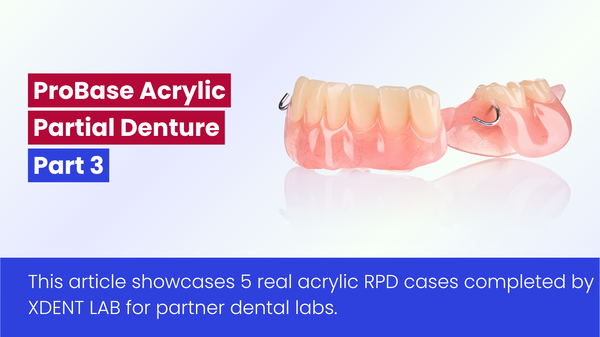
See 5 Acrylic Partial Denture cases (cases 11 to 15) from XDENT LAB, a Vietnamese dental laboratory that is a member of the National Association of Dental Laboratories (NADL). XDENT LAB is an expert i...
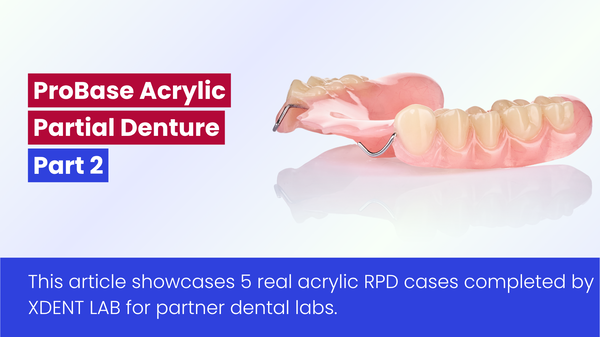
See 5 completed Acrylic Partial Denture cases (Case 6 ~ Case 10) from XDENT LAB, a Vietnamese dental laboratory that is FDA registered and ISO 13485 certified. A trusted overseas outsourcing dental la...
Discover how critical laboratory checks reduce remakes and improve restoration quality in dental lab outsourcing for fixed and implant cases.

