PolyJet 3D printing for dental labs: precise models, surgical guides, and orthodontic tools. Compare to SLA/DLP, see costs, QA protocols, and clinical impact.
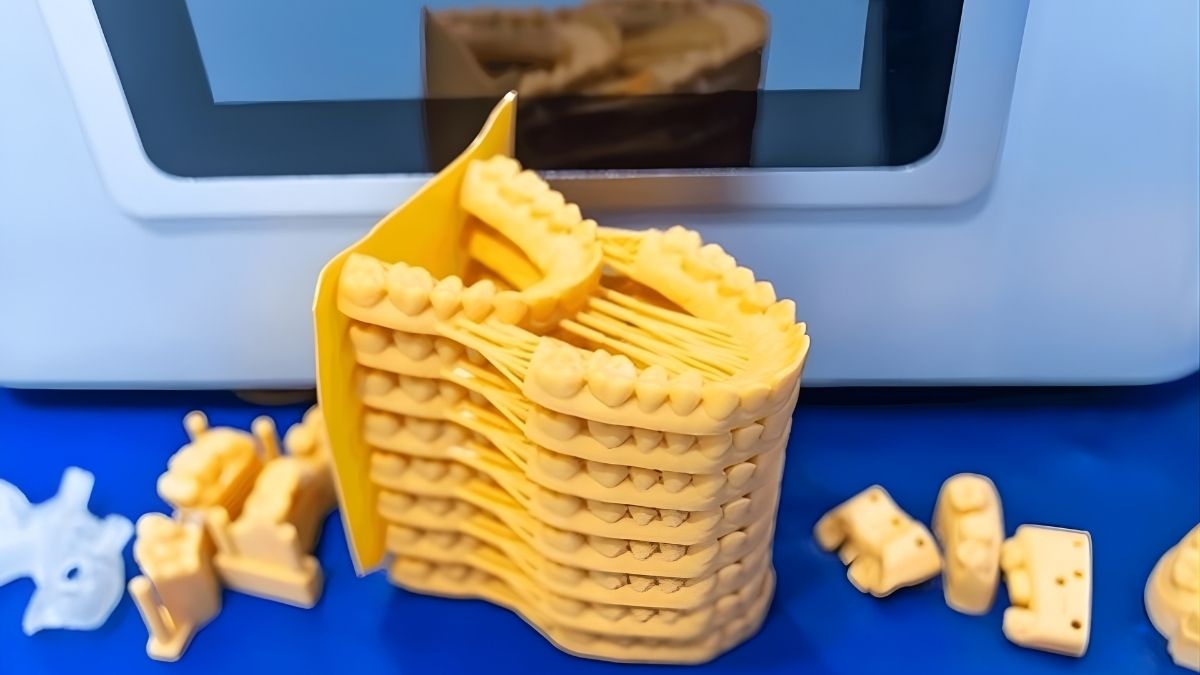
Table of contents [Show]
Overview
PolyJet is a material-jetting 3D-printing technology known for exceptional accuracy, smooth surfaces, and true multi-material capability. In dentistry, it enables fast, precise production of diagnostic models, surgical guides, prosthetic mock-ups, and orthodontic tools. Compared to SLA and DLP, PolyJet’s strength lies in fine detail, Shore hardness gradients, and complex geometries—ideal for digital workflows and advanced treatment planning.
Technical Principles of PolyJet
PolyJet works by jetting photopolymer droplets and curing them with UV light, layer by layer.
Core System Components
Print heads: multiple inkjet-style heads for fine resolution.
UV lamps: immediate photopolymer curing.
Build platform: precision Z-axis control.
Material delivery: heated reservoirs ensure viscosity stability.
Support system: gel-like, removable supports for complex geometries.
Process Flow
Digital preparation: STL/OBJ import, slicing, support generation, material assignment.
Jetting and curing: droplet deposition, layer formation, UV curing, platform lowering.
Post-processing: support removal, cleaning, final curing, QA inspection, finishing.
Materials & Properties
Material choice determines mechanical behavior, biocompatibility, and clinical suitability.
Material Categories
Rigid resins (e.g., Vero family): high dimensional stability; biocompatible variants available.
Flexible resins (e.g., Tango family): Shore 27–95A; elongation and tear resistance for soft-tissue simulation.
Transparent resins (e.g., VeroClear): optical clarity for visualization; compatible with sterilization protocols.
Key Mechanical Metrics
Tensile strength: rigid 50–65 MPa; flexible 2–5 MPa; biocompatible grades 40–60 MPa.
Flexural strength: 75–110 MPa; modulus: 2000–3000 MPa.
Layer thickness: 16–32 microns; repeatability ≈ ±0.05 mm.
Temperature resistance: 45–80°C; elongation at break: 10–220%.
Biocompatibility
Certifications: USP Class VI, ISO 10993 (material-dependent).
Clinical use: surgical guides often Class II (FDA 510(k)), models typically Class I.
Safety: strict post-processing, sterilization compatibility, limited intraoral exposure depending on resin.
Dental Applications
PolyJet’s precision and multi-material capability accelerate planning and fabrication across specialties.
Diagnostic & Planning
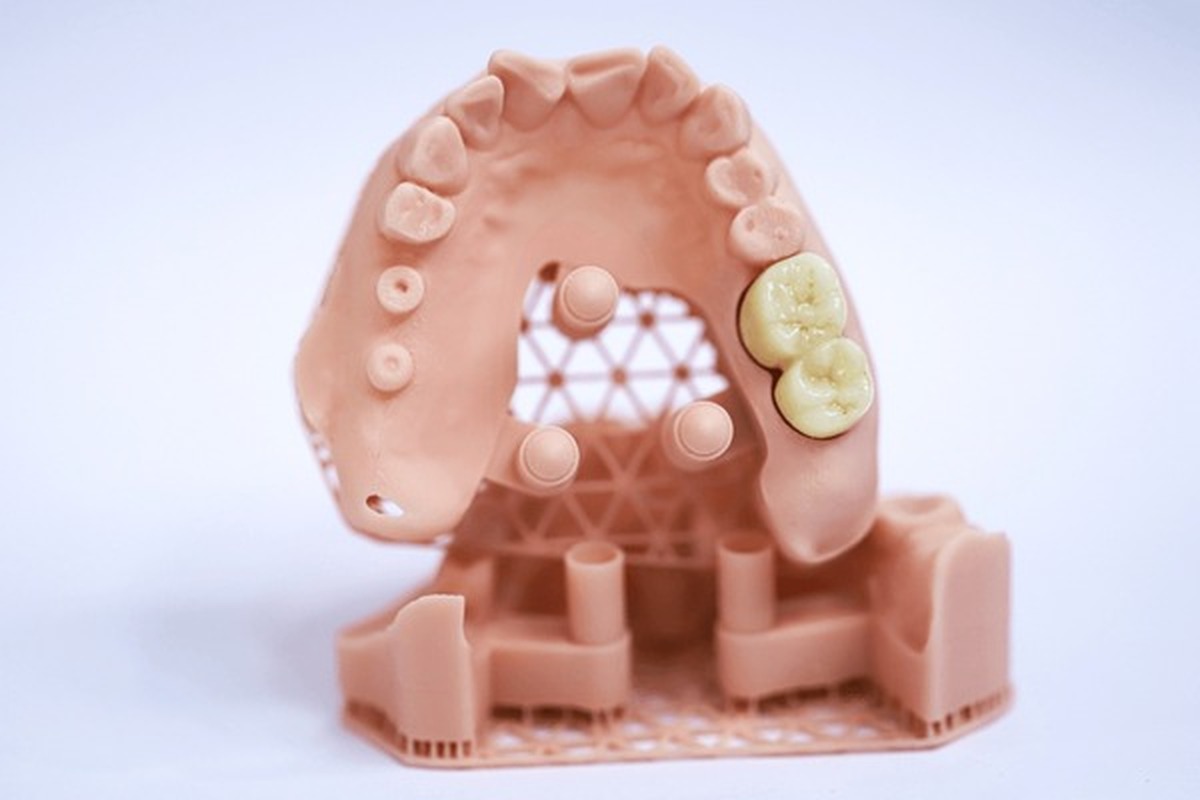
Study models: full-arch accuracy ±0.1–0.2 mm; occlusal analysis and patient communication.
Surgical guides: implants, orthognathic, endodontic; accuracy up to ±0.05 mm.
Mock-up models: aesthetic previews and functional testing for patient approval.
Prosthetics
Temporary restorations: crowns and bridges for aesthetics and functional evaluation.
Denture workflows: try-ins, custom trays, immediate dentures with improved fit.
Crown/bridge models: dies, articulation accuracy, sharp margin definition.
Orthodontics
Clear aligner models: sequential staging; accuracy ±0.05 mm; batch production.
Bracket placement guides: indirect bonding trays reduce chair time.
Retainers: rapid, consistent, patient-specific fit via vacuum-formed models.
Accuracy & Surface Quality
PolyJet’s fine droplet jetting produces smooth, high-resolution surfaces.
Dimensional Accuracy
X–Y: ±0.042–0.084 mm; Z: ±0.016 mm per layer.
Feature reproduction: ≈0.1 mm minimum.
Surface deviation: <0.1 mm; repeatability: ±0.05 mm.
Comparative Notes
Versus SLA: comparable accuracy; PolyJet often better surface finish; SLA can be faster.
Versus DLP: PolyJet higher resolution and multi-material; DLP often higher throughput and lower waste.
Clinical Workflow Integration
Digital-to-physical workflows are streamlined with PolyJet.
Workflow Components
Data acquisition: intraoral scans, CBCT, photogrammetry; STL/OBJ with color mapping.
Design phase: CAD compatibility, support optimization, nesting for batch efficiency.
Production planning: build rates 20–35 mm/h vertical; model prep 10–30 minutes; post-processing 30–60 minutes; total turnaround 2–6 hours.
Quality Assurance
Pre-production: file integrity, material confirmation, printer calibration.
In-process: layer adhesion, platform stability, UV curing checks, temperature control.
Post-production: dimensional verification, surface assessment, mechanical/fit testing, biocompatibility confirmation where applicable.
Advanced Capabilities
PolyJet supports complex, patient-specific fabrication.
Multi-Material
Gradient Shore hardness, color and transparency transitions.
Composite builds: rigid-flex combinations, embedded components, functional integration.
Bioprinting Potential
Experimental cell-laden constructs and tissue scaffolds.
Drug delivery forms and regenerative templates (research phase).
Economics: Cost & ROI
Adoption depends on balancing capital, materials, and operational gains.
Cost Components
Equipment: $50,000–250,000; maintenance $5,000–15,000/year.
Software and training: licenses $3,000–10,000; training $2,000–5,000.
Materials: photopolymer $200–500/kg; supports $150–300/kg; consumables $2,000–5,000/year.
ROI Drivers
Production efficiency gains: 40–60%.
Labor reduction: 30–50% versus manual workflows.
Turnaround improvement: 50–70%.
Patient satisfaction and competitive differentiation: strong.
Limitations & Challenges
Consider constraints before clinical scaling.

Technical
Material durability and color stability limits.
Support removal and post-processing overhead.
Build size constraints; internal surface finish limits.
Material waste higher than some platforms.
Clinical
Regulatory approvals for intraoral use.
Standardization and training requirements.
Batch-to-batch consistency; limited long-term data for certain applications.
Future Trends
PolyJet continues to evolve with materials and automation.
Technology Roadmap
Biocompatible permanent materials and smart/nanocomposite resins.
Faster builds, larger volumes, automated post-processing.
AI-driven nesting and parameter optimization, real-time QA.
Clinical Integration
Point-of-care manufacturing setups.
Distributed production networks and cloud workflows.
Clearer regulatory pathways and harmonization.
Best Practices & Implementation
A structured rollout improves consistency and compliance.
Implementation Guidelines
Match technology to application, volume, accuracy, and budget.
Build SOPs for calibration, maintenance, material management, documentation.
Train staff on CAD/CAM, critical tolerances, and QA checkpoints.
Clinical Protocols
Patient consent and documentation.
Verification: fit checks, deviation maps, batch records.
Infection control and storage/handling standards.
XDENT LAB Perspective
XDENT LAB integrates PolyJet within FDA- and ISO-aligned workflows, emphasizing documented materials, traceability, and rigorous QA. Our Lab-to-Lab model leverages PolyJet for high-precision guides, models, and try-ins, accelerating turnaround while maintaining clinical fit and consistency. Dental practices benefit from predictable quality, digital compatibility, and cost-effective scaling.
Conclusion
PolyJet material jetting delivers high-resolution, multi-material, and fast-turnaround manufacturing for dentistry. Its strengths in accuracy, surface quality, and complex geometries make it ideal for diagnostic models, surgical guides, prosthetic mock-ups, and orthodontic tools. With proper material selection, validated workflows, and regulatory alignment, PolyJet elevates digital dentistry—improving fit, speed, and patient-specific care while supporting robust QA and traceability.
About XDENT LAB:
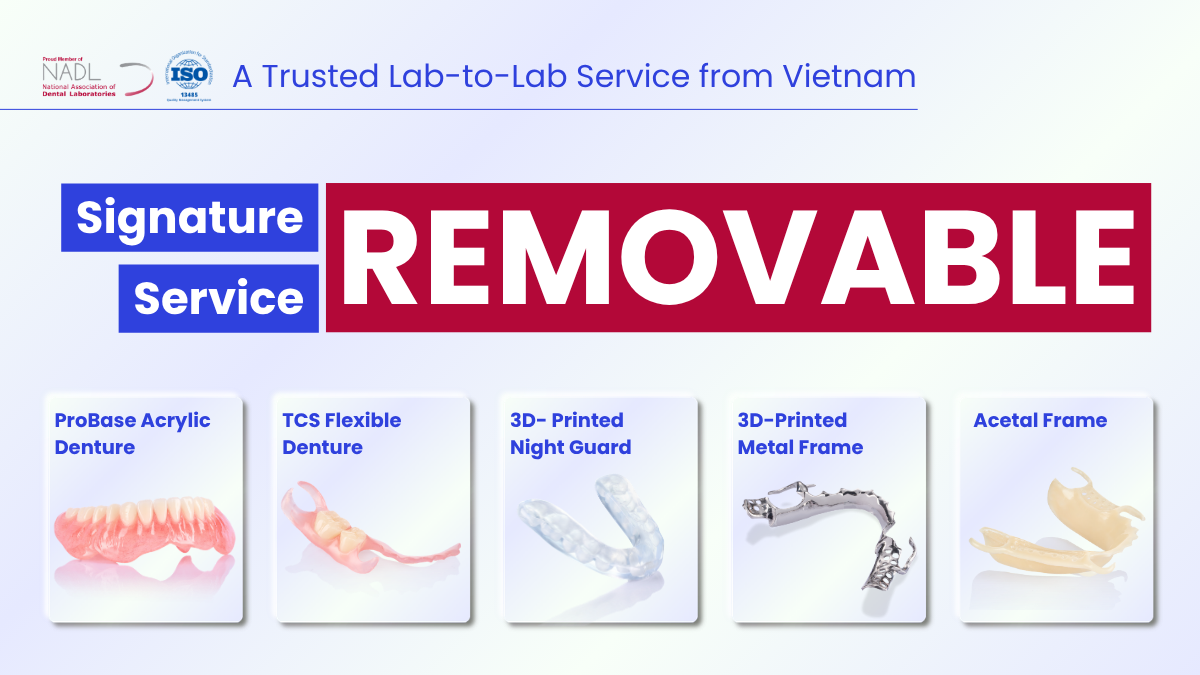
We are experts in Lab-to-Lab Full Service from Vietnam, with the signature services of Removable, meet U.S. market standards, FDA-registered, ISO 13485-certified. Founded in 2017, from local root to global reach, we scale with 2 Factories with over 100+ employees.
Our Commitments Built on “Trusted. Commitment. Quality”
- Commit to Large-Scale Manufacturing, high volume, remake rate < 1%.
- Commit to 5-Year Warranty
- Commit to Competitive Price
XDENT LAB | A Trusted Lab-to-Lab Service from Vietnam
Share this post:
Related Posts
See 5 Acrylic Partial Denture cases (cases 11 to 15) from XDENT LAB, a Vietnamese dental laboratory that is a member of the National Association of Dental Laboratories (NADL). XDENT LAB is an expert i...
See 5 completed Acrylic Partial Denture cases (Case 6 ~ Case 10) from XDENT LAB, a Vietnamese dental laboratory that is FDA registered and ISO 13485 certified. A trusted overseas outsourcing dental la...
Discover how critical laboratory checks reduce remakes and improve restoration quality in dental lab outsourcing for fixed and implant cases.

