
An overview of 3D printing technologies used in clear aligner manufacturing, covering market overview, indirect and direct workflows in producing aligners, pros & cons, as well as emerging trends in this field.
Table of contents [Show]
- Key Points
- Introduction
- Clear Aligners Market Overview
- From Conventional Methods to 3D Printing in Aligner Manufacturing
- Advantages of 3D Printing in Clear Aligner Production
- 3D Printing Technologies Used in Clear Aligners
- Indirect Aligner Manufacturing
- Direct Aligner Manufacturing
- The Role of AI in 3D-Printed Clear Aligners
- Limitations and Ongoing Challenges
- Conclusion
- References
Key Points
Clear aligner manufacturing relies on digital manufacturing, where 3D printing enables high levels of customization, accuracy, and workflow efficiency.
In current clinical practice, most clear aligners are produced using indirect 3D printing workflows, in which high-precision printed models are used for thermoforming aligner materials.
Vat polymerization technologies, particularly SLA and DLP, are the dominant printing methods for aligner-related applications due to their surface quality, dimensional accuracy, and reliability.
Direct 3D printing of clear aligners is an emerging technology with potential advantages in thickness control and force delivery, but it remains limited by material validation, regulatory requirements, and post-processing complexity.
Advances in AI are accelerating aligner design, and manufacturing automation.
Disclaimers: This article is intended for educational purposes and reflects current research and clinical workflows. Clinical decisions should always be made based on individual patient needs, material approvals, and local regulatory requirements.
Introduction
Clear aligners have become a widely accepted alternative to traditional orthodontic braces, particularly for adult patients seeking a more esthetic and lifestyle-friendly treatment option. Compared with fixed appliances, clear aligners offer lower impact on daily activities, easier oral hygiene maintenance, and predictable outcomes for mild to moderate malocclusions. Most importantly, aligner therapy is patient-specific since each appliance is designed to fit an individual dentition and deliver controlled tooth movement over time.
Behind this personalization lies a rapidly evolving manufacturing ecosystem. While early aligner systems relied on manual vacuum forming over plaster models, modern aligner production has shifted almost entirely toward digital workflows. Among these, 3D printing has emerged as a core enabling technology, transforming how aligners are designed, and produced.
This article explores the role of 3D printing technologies in clear aligner manufacturing, with a focus on how different printing methods support indirect and direct aligner workflows, what advantages they bring compared to conventional techniques, and what challenges remain. By grounding the discussion in current research and clinical practice, this guide aims to help orthodontists, dental technicians, and laboratory owners better understand where 3D printing truly adds value, and where caution is still required.
Clear Aligners Market Overview
The global clear aligners market reflects the growing clinical and commercial importance of this treatment modality. According to Grand View Research, the market was valued at USD 8.29 billion in 2025 and is projected to reach USD 56.81 billion by 2033, with a CAGR of 26.95% from 2026 to 2033. A key driver behind this growth is the increasing demand for adult orthodontic treatment, where esthetics, comfort, and convenience are critical factors.
As case volumes increase, so does pressure on manufacturing efficiency, scalability, and consistency. Traditional aligner production methods, such as plaster model fabrication and manual thermoforming, struggle to meet these demands without significant labor, time, and material waste. This is where additive manufacturing, commonly known as 3D printing, becomes a strategic solution rather than a technological novelty.
From Conventional Methods to 3D Printing in Aligner Manufacturing
Historically, clear aligners were manufactured using a multi-step analog process: impressions were taken, plaster models were poured, and thermoplastic sheets were vacuum-formed over these models. While effective, this approach was labor-intensive, prone to variability, and difficult to scale.
The introduction of 3D printing into dentistry marked a turning point. Initially used for implants and prosthetics, 3D printing quickly expanded into orthodontics once digital intraoral scanning and CAD software became widely available.
Today, aligner manufacturing typically follows a digital workflow:
Intraoral data acquisition (scanner-based)
Digital treatment planning and tooth movement simulation
STL file generation
Model preparation
3D printing
Post-processing
This workflow allows aligners to be produced with greater precision, consistency, and speed than conventional methods, especially when combined with automated planning software and artificial intelligence.
Advantages of 3D Printing in Clear Aligner Production
Precision and Fit
High-resolution scanning and printing enable aligners and related appliances to match patient anatomy with exceptional accuracy, improving comfort and reducing chairside adjustments.
Speed and Efficiency
In-office or near-lab production significantly reduces turnaround time, enabling same-day or rapid-delivery appliances in some workflows.
Customization and Flexibility
Digital design allows fully individualized appliances, including complex attachments, distalizers, and indirect bonding trays.
Cost and Sustainability
Reduced material waste and labor costs make 3D printing especially suitable for small-batch, personalized production, an inherent characteristic of aligner therapy.
3D Printing Technologies Used in Clear Aligners
Vat Polymerization Technologies
Most aligner-related 3D printing relies on vat polymerization technologies, which cure liquid photopolymer resin using controlled light exposure. Among these, Stereolithography (SLA) and Digital Light Processing (DLP) are the most widely adopted in orthodontic laboratories. In clinical and laboratory workflows, SLA/DLP printers are typically chosen for their predictable surface accuracy in high-volume aligner model production.
SLA uses a scanning laser to cure resin point by point, offering high resolution and smooth surface quality.
DLP cures entire layers at once using a projector, enabling faster production with consistent accuracy.
These technologies are most commonly used for indirect aligner workflows, where printed models serve as molds for thermoforming clear plastic sheets.
Want to know more about types of 3D printing technologies used in prosthodontics, kindly visit this article.
Indirect Aligner Manufacturing
How the Indirect Method Works
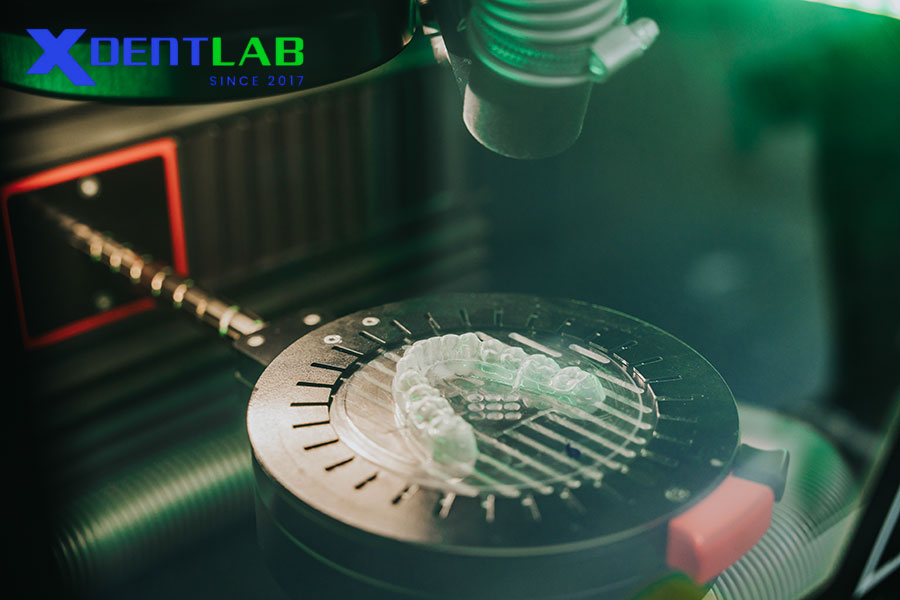
The indirect workflow remains the dominant manufacturing method for clear aligners:
Scan: An intraoral scanner captures a 3D digital model of the patient’s dentition.
Design: Orthodontic software plans tooth movements and generates a series of staged aligner models.
Print Models: High-resolution 3D printers produce physical models for each treatment stage.
Thermoform: Clear thermoplastic sheets are vacuum-formed over the printed models.
Post-processing: Aligners are trimmed, polished, and prepared for clinical delivery.
Why This Method Works Well
This approach balances precision and material safety. The printed object never enters the oral cavity; instead, it acts as a mold. As a result, regulatory requirements for direct intraoral use are easier to manage, and a wider range of printing resins can be used without biocompatibility concerns.
Examples of Indirect workflow printers (printing models for thermoforming)
From a lab perspective, the indirect method remains the standard: print a high-accuracy dental model for each stage, then thermoform aligner sheets over the model. These workflows typically rely on vat polymerization printers (SLA or DLP) because they offer the surface quality and dimensional stability needed for predictable aligner fit.
Examples of commonly used dental 3D printers for indirect aligner model production include:
Formlabs – Form 4B (SLA)
SprintRay – Pro / Pro S (DLP)
Dentsply Sirona – Primeprint (DLP, integrated dental workflow)
These systems are typically paired with dental model resins optimized for accuracy, surface smoothness, and high-throughput production.
Direct Aligner Manufacturing
While indirect workflows dominate current practice, direct 3D printing of clear aligners is an active area of research and early commercial development. In this approach, the aligner itself is printed directly using specialized, biocompatible resins.
Potential Advantages
Eliminates thermoforming steps
Enables more precise control over aligner thickness and force delivery
Reduces material waste
Allows novel mechanical properties through advanced resin chemistry
Key Challenges
Ensuring long-term biocompatibility and intraoral safety
Achieving sufficient durability and transparency
Managing oxygen inhibition during printing
Requiring extensive post-processing (washing, UV curing, polishing)
Recent peer-reviewed studies highlight strong potential but also emphasize that material safety, regulatory approval, and clinical validation remain critical barriers before widespread adoption.
Examples of direct workflow printers (printing aligners directly)
Direct 3D printing of clear aligners is an emerging approach, where the aligner is printed using specialized, biocompatible materials designed to achieve the necessary transparency, elasticity, and fatigue resistance for intraoral performance. Compared with printing models, direct printing requires stricter control of printing parameters and post-processing, and availability depends heavily on material validation and regulatory readiness.
Examples of platforms commonly discussed in direct aligner printing contexts include:
Carbon – M2 / M3 / M3 Max (CLIP/DLS-based resin printing; often cited in direct aligner workflows)
In practice, direct printing is still more limited than indirect model printing, but it continues to develop rapidly alongside advances in printable orthodontic polymers and validation standards.
The Role of AI in 3D-Printed Clear Aligners
Artificial intelligence is increasingly integrated into aligner workflows, enhancing both design and manufacturing:
Automated treatment planning and staging
Generative design optimization
Error detection during printing
Predictive maintenance of equipment
Quality assurance through real-time monitoring
AI-driven platforms improve consistency, reduce human error, and support scalable production, key factors for growing aligner providers.
Want to know more about the AI application trend in 2025, kindly visit this link.
Limitations and Ongoing Challenges
Despite its advantages, 3D printing in clear aligners faces several unresolved challenges:
Material longevity: Many printed resins are suitable for short-term use but lack long-term clinical validation.
Regulatory compliance: Biocompatibility, sterilization, and quality control standards must be strictly followed.
Initial investment: Equipment, training, and workflow integration require upfront costs.
Post-processing dependence: Washing, curing, and finishing remain critical steps affecting final performance.
Conclusion
3D printing is fundamentally reshaping how clear aligners are designed and manufactured. By enabling high-precision, customized, and efficient production, additive manufacturing has moved aligner therapy from labor-intensive analog methods to scalable digital workflows.
At present, indirect aligner manufacturing using 3D-printed models remains the clinical standard, supported primarily by vat polymerization technologies such as SLA and DLP. Meanwhile, direct 3D printing of aligners represents an exciting frontier, with ongoing advances in materials science, AI, and regulatory frameworks paving the way for future adoption.
Ultimately, the success of 3D printing in clear aligners depends not on the technology alone, but on thoughtful integration of materials, workflows, and clinical objectives. As research continues and standards mature, additive manufacturing will play an increasingly central role in delivering precise, predictable, and patient-centered orthodontic care.
References
- Clear Aligners Market (2026 - 2033) by Grand View Research 2025
- Advancements in Clear Aligner Fabrication: A Comprehensive Review of Direct-3D Printing Technologies by Poom Narongdej et al. 2024
- Direct 3D Printing of Clear Orthodontic Aligners: Current State and Future Possibilities by Gianluca M Tartaglia et al. 2021
- Advances in 3D printing for dentistry: clinical applications and future perspectives by Partha Protim Borthakur et al. 2025
About XDENT LAB:
We are experts in Lab-to-Lab Full Service from Vietnam, with the signature services of Removable, meet U.S. market standards, FDA-registered, ISO 13485-certified. Founded in 2017, from local root to global reach, we scale with 2 Factories with over 100+ employees.
Our Commitments Built on “Trusted. Commitment. Quality”
- Commit to Large-Scale Manufacturing, high volume, remake rate < 1%.
- Commit to 5-Year Warranty
- Commit to Competitive Price
XDENT LAB | A Trusted Lab-to-Lab Service from Vietnam
Share this post:
Related Posts
See 5 completed Acrylic Partial Denture cases (Case 6 ~ Case 10) from XDENT LAB, a Vietnamese dental laboratory that is FDA registered and ISO 13485 certified. A trusted overseas outsourcing dental la...
Discover how critical laboratory checks reduce remakes and improve restoration quality in dental lab outsourcing for fixed and implant cases.
Understanding and applying the correct Layer Thickness settings not only saves labs time and production cost, but also ensures stable output quality for each specific type of dental product.

