
A guide for dental practices to implant-supported overdenture planning, attachment selection, digital workflows and long-term care.
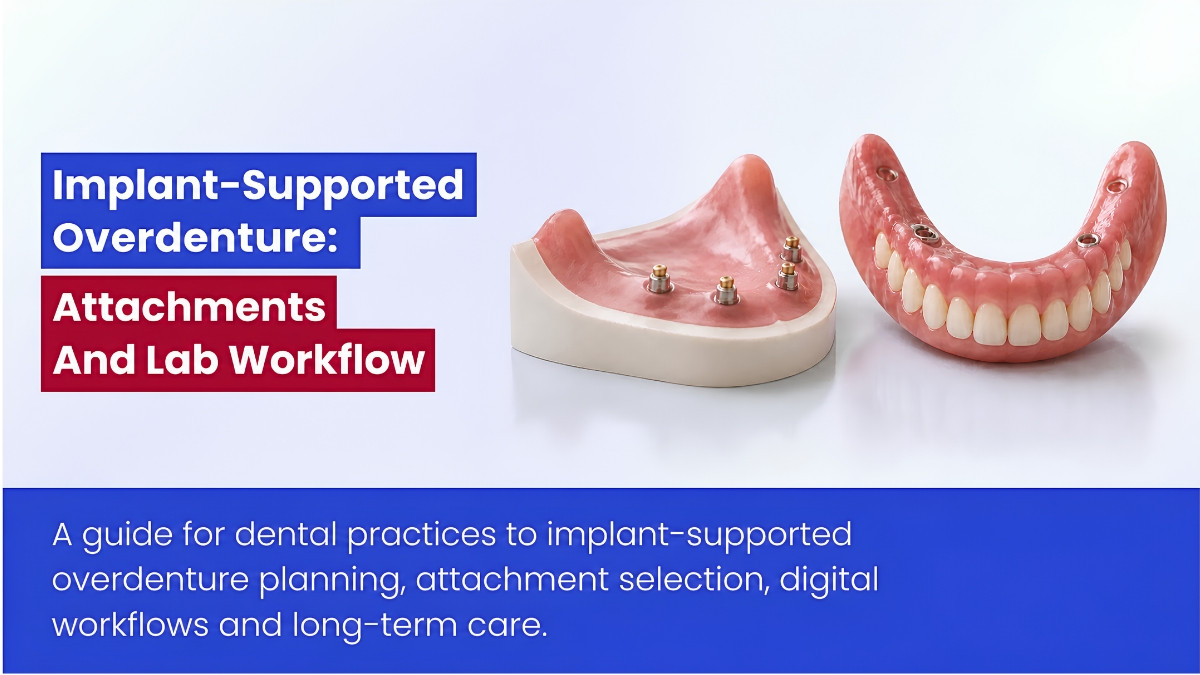
Table of contents [Show]
An implant-supported overdenture combines implant retention with a removable denture. The patient can take it out for cleaning, while the implants help improve stability compared with a conventional complete denture. Depending on its design, chewing forces may be carried mainly by the implants, shared with the soft tissues, or carried substantially by the denture-bearing tissues.
For dental practices and laboratories, the attachment is only one part of the system. Implant distribution, tissue support, restorative space, denture-base strength, component compatibility and maintenance must work together. This guide explains the clinical distinctions and laboratory decisions that shape a serviceable overdenture.
What is an implant-supported overdenture?
An implant overdenture is a removable prosthesis that connects to dental implants through individual attachments, a bar or another retentive structure. Unlike a fixed full-arch prosthesis, the patient removes it routinely for cleaning.
Implant-retained versus implant-supported: What carries the load?
The terms implant-retained and implant-supported are sometimes used interchangeably. For planning, it is more useful to state separately what retains the denture and what supports it under function.
| Design | Main source of support | Laboratory implication |
|---|---|---|
| Implant-retained, tissue-supported | The residual ridge and mucosa carry substantial load; implants improve retention | Base extension, tissue adaptation and future relining remain essential |
| Implant–tissue-supported | Implants and mucosa share support | Attachment movement and denture-base fit must be planned together |
| Predominantly implant-supported | Implants and a suitable superstructure carry most functional load | Requires appropriate distribution, rigid support and verified fit |
Implant number alone does not establish the support type. Four implants with resilient attachments may still permit substantial tissue loading. An ITI clinical discussion of overdenture planning also emphasizes that implant treatment does not replace sound complete-denture principles.
When is an overdenture a useful option?
An overdenture may help a patient who needs more retention than a conventional denture provides but also benefits from a removable flange, tissue replacement or easier cleaning access. It may be considered when a fixed full-arch design would be difficult to clean or would not provide the desired lip support.
Removability can make relining, replacement of worn attachments and some repairs more practical. It also creates a daily task: the patient or caregiver must be able to remove, clean and reseat the prosthesis. Excessive retention is not a benefit if the patient cannot manage it.
An ITI consensus on patient-reported outcomes reports benefits from implant-retained or implant-supported complete prostheses compared with conventional complete dentures. Better reported chewing function, however, does not by itself prove improved nutrition; diet is influenced by many other factors.
How do mandibular and maxillary plans differ?
Mandible: A common approach uses two implants in the anterior mandible to retain an overdenture. In many such designs, the posterior denture base continues to rely on tissue support. The laboratory must therefore give the impression, base extension and adaptation the same attention as the attachments. The ITI consensus reports better patient-reported outcomes for two-implant than single-implant mandibular overdentures, but individual clinical circumstances still matter.
Maxilla: An upper overdenture requires separate assessment of bone anatomy, implant spread, opposing dentition, palatal coverage, speech and framework design. A systematic review of maxillary implant overdentures and a review of maxillary design considerations provide context for multi-implant treatment. Four or more implants and splinted designs have substantial supporting literature, but neither implant count nor attachment configuration is a universal prescription.
Four closely grouped implants do not provide the same distribution as four appropriately spread implants. Likewise, removing palatal coverage should follow an assessment of support, rigidity and loading—not patient preference alone.
Start with the proposed denture, not just the available bone
Tooth position, vertical dimension, lip support, speech and the intended flange should guide implant planning. The team should also assess the opposing arch, parafunction, soft-tissue resilience, patient dexterity, hygiene ability and access to replacement components.
The strongest pull-off force is not necessarily the best clinical choice. An attachment must deliver appropriate retention while allowing the planned support and movement—and while remaining practical to clean and service.
Each attachment family has different space, alignment and maintenance requirements.
| Attachment | Potential advantage | Key consideration |
|---|---|---|
| Ball and O-ring | Familiar design with replaceable retentive elements | Wear, alignment and housing space |
| Low-profile stud | Replaceable inserts and options for selected space limitations | Insert wear and product-specific angulation limits |
| Bar and clip | Splints implants and permits a range of support designs | Bar fit, hygiene clearance, clip wear and restorative space |
| Milled bar or telescopic design | Can provide substantial support in selected cases | Complex fit, insertion path and specialist maintenance |
| Magnetic attachment | May assist seating for selected patients | System-specific retention, sealing and lateral stability |
A Cochrane review of overdenture attachments found insufficient evidence to identify one preferred system across the mandibular comparisons it examined. A newer comparative systematic review adds research, but selection still requires attention to study quality, follow-up and the specific clinical design. No attachment is universally superior.
How do divergence, movement and restorative space affect the design?
Implant divergence must be assessed against the exact attachment manufacturer’s instructions. An individual implant’s permitted angulation is not necessarily the same as the permitted divergence between two implants. Retentive inserts from different systems should not be treated as interchangeable because they look similar.
Resilient attachments may permit controlled denture movement. That movement can be appropriate for a tissue-supported design, but it makes base fit important: a poorly adapted base can change how forces reach the attachments and mucosa.
For a bar, the team must define whether the intended design permits movement or provides more rigid support. Bar cross-section, cantilevers, clip placement and cleaning clearance all affect performance. A milled bar still requires clinical fit verification.
The available restorative space must accommodate the whole assembly: abutments or bar, attachment components, housings, any framework or reinforcement, denture base and prosthetic teeth. There is no single minimum-space number suitable for every combination. Actual component dimensions and material requirements govern the design.
Which denture-base and framework materials are used?
Material choice should consider intended use, processing, fatigue resistance, bonding and repair—not a strength value in isolation.
| Material or process | Useful feature | Control point |
|---|---|---|
| Heat-polymerized PMMA | Established repair and reline methods | Processing accuracy and thickness around housings |
| Milled denture-base PMMA | Reproducible CAD design using manufactured blanks | Material-specific bonding, repair and machining limits |
| 3D-printed denture resin | Digital production and design archiving | Approved intended use, print orientation, washing and post-curing |
| Titanium or cobalt–chromium framework | Reinforcement or bar construction where indicated | Fit, section dimensions, finishing and attachment integration |
| High-performance polymer framework | Low density in selected designs | Product-specific rigidity, bonding and clinical evidence |
A review comparing digital and conventional complete dentures is useful background for denture-base manufacture. Its results should not be assumed to establish long-term equivalence for every implant overdenture, where housing recesses and concentrated loads create additional demands.
Housings reduce the surrounding denture-base thickness. The laboratory should preserve sufficient material, avoid unnecessary sharp internal corners and consider reinforcement when the overall design warrants it. A metal housing is an attachment component, not a substitute for an engineered reinforcing framework.
Dental lab workflow and quality control
A reliable workflow verifies tissue fit, implant position, jaw relation and component identity at different stages. Digital tools can streamline production, but they do not remove the need for clinical checks.
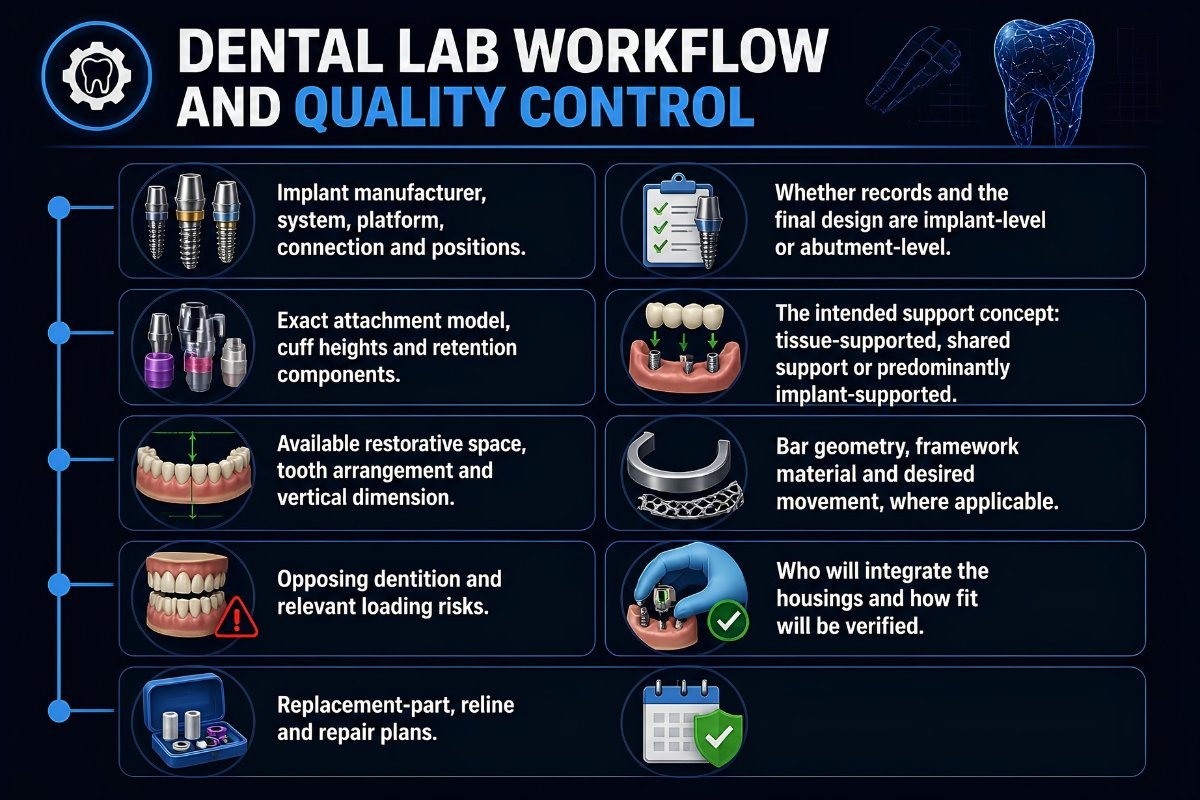
What should the laboratory prescription include?
The prescription should identify:
- Implant manufacturer, system, platform, connection and positions.
- Whether records and the final design are implant-level or abutment-level.
- Exact attachment model, cuff heights and retention components.
- The intended support concept: tissue-supported, shared support or predominantly implant-supported.
- Available restorative space, tooth arrangement and vertical dimension.
- Bar geometry, framework material and desired movement, where applicable.
- Opposing dentition and relevant loading risks.
- Who will integrate the housings and how fit will be verified.
- Replacement-part, reline and repair plans.
Platform and digital-library identification are safety-critical. Similar-looking parts or matching diameters do not establish compatibility.
Conventional, digital and hybrid production
A conventional workflow generally progresses from diagnostic records to a definitive tissue impression and implant transfer, jaw relations, tooth try-in, any bar or framework try-in, denture processing, attachment integration and delivery.
Digital options include scanning impressions or casts, intraoral scans with correctly seated scan bodies, CAD tooth arrangements, printed try-ins, milled or printed bases and archived designs. A professional overview of digital overdenture workflows illustrates these possibilities. It is a workflow resource, not proof that one manufacturing route is best for every patient.
Edentulous scans may not fully capture mobile tissues or functional borders. Hybrid workflows can therefore be valuable: a clinically appropriate tissue impression can be paired with digital design and manufacture. A saved denture file is useful for replacement, but it may need revision if the ridge or soft tissues change.
Whether pickup occurs in the laboratory or clinic, the denture must seat fully without rocking. The operator should verify abutment seating, use the specified processing components, block out undercuts, provide enough recess space and use a compatible pickup material. The finished prosthesis must be checked for voids, interference and accidental locking.
For a tissue-supported overdenture, pressure applied during pickup can alter the relationship between the denture base and attachments. A secure pickup cannot compensate for a poorly fitting base. Tightening instructions must come from the manufacturer of the exact component; a generic torque value is inappropriate.
Which standards and records matter?
Depending on the materials and components used, relevant standards may include ISO 20795-1 for denture-base polymers, ISO 22112 for artificial teeth, ISO 22674 for metallic restorative materials, ISO 7405 and the ISO 10993 series for biological evaluation, and ISO 13485 for quality-management systems. Confirm current editions and exact scopes through the official ISO website.
Standards support defined testing and quality processes; they do not prove that every finished overdenture design is clinically suitable. A useful case record identifies component and material lots, approved design, applicable CAD library, processing or print-and-cure settings, surface treatments, attachment components and delivery instructions.
Complications, maintenance and the role of a lab partner
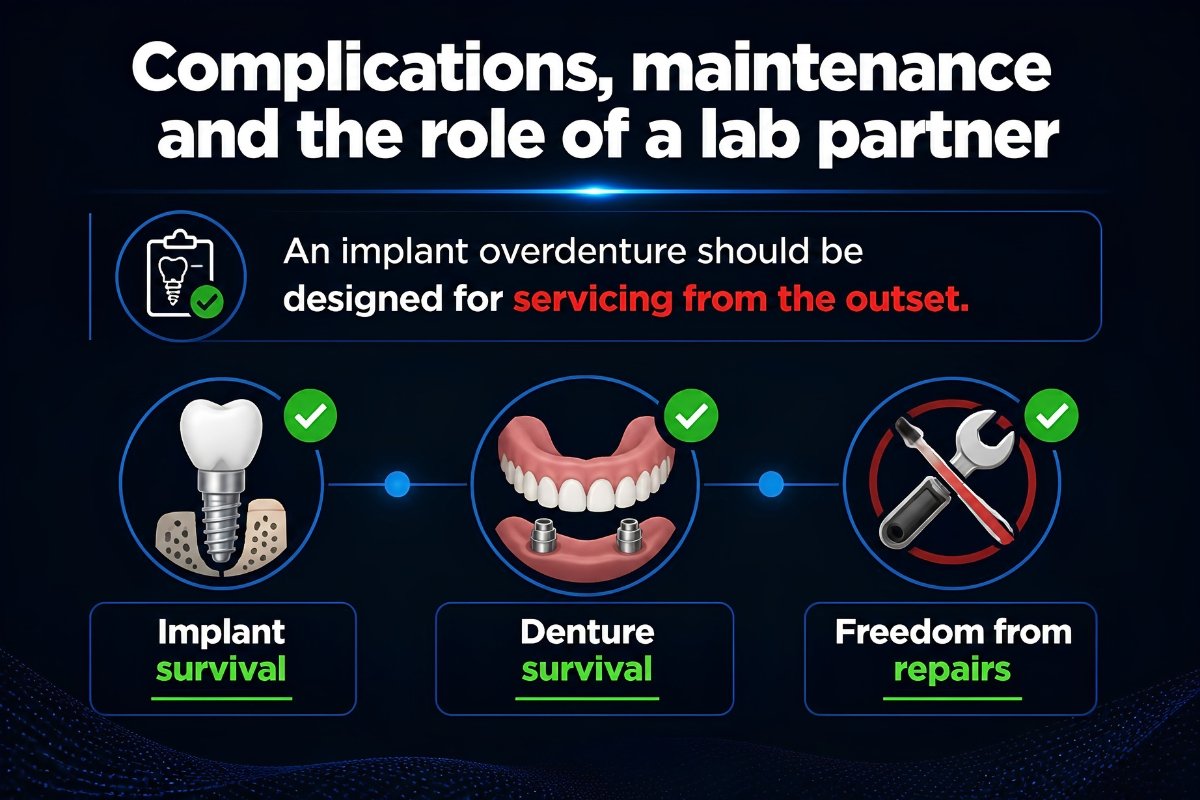
An implant overdenture should be designed for servicing from the outset. Implant survival, denture survival and freedom from repairs are different outcomes.
What problems may require adjustment or repair?
Loss of retention can result from a worn insert or clip, attachment wear, an incorrect insertion path or incomplete seating. Replacing the insert without identifying the cause may leave the problem unresolved.
Denture fracture may be associated with thin material around housings, poor base adaptation, loading or an unfavorable design. Other concerns include tooth fracture, abutment loosening, bar-fit problems, mucosal soreness and peri-implant inflammation. Each calls for diagnosis before a component is replaced or the prosthesis is remade.
What does long-term care involve?
The patient needs instructions for removing and seating the denture, cleaning the base and attachments, and accessing the areas around any bar. At individualized recalls, the clinical team should assess tissue health, base fit, occlusion, attachment wear, screws, frameworks and the possible need for a reline.
For tissue-supported designs, changes in the residual ridge can alter load sharing over time. Relining is not a sign that the implant treatment has failed; it can be a necessary part of maintaining the intended support.
How does XDENT LAB support the workflow?
For dental practices considering a Vietnam dental lab or dental lab outsourcing, a dependable handoff begins with an explicit support concept and exact component identifiers. The laboratory then needs an approved tooth arrangement, a defined attachment or bar design, fit-verification stages and a practical servicing plan.
XDENT LAB provides lab-to-lab services from Vietnam, including removable and implant prosthetic workflows. Its laboratory role is to manufacture to the agreed specifications, maintain traceable production records and communicate design or compatibility concerns. Clinical case selection, component delivery, fit verification and ongoing patient care remain with the treating team.
Key takeaway: An effective implant overdenture is not defined by the most implants or the highest-retention attachment. It is a removable prosthesis whose support, retention, base fit, materials and maintenance plan work together for the patient.
About XDENT LAB:
We are experts in Lab-to-Lab Full Service from Vietnam, with the signature services of Removable, meet U.S. market standards, FDA-registered, ISO 13485-certified. Founded in 2017, from local root to global reach, we scale with 2 Factories with over 100+ employees.
Our Commitments Built on “Trusted. Commitment. Quality”
- Commit to Large-Scale Manufacturing, high volume, remake rate < 1%.
- Commit to 5-Year Warranty
- Commit to Competitive Price
XDENT LAB | A Trusted Lab-to-Lab Service from Vietnam
Share this post:
Related Posts
Explore full-arch fixed prosthesis planning and lab workflows, from implant distribution and framework fit to materials, hygiene and maintenance.
A practical guide to implant-supported bridges for dental practices, covering retention, materials, cleanable contours and lab quality checks.
From digital scan to final glaze, see how a full zirconia crown or bridge is designed, milled, sintered and finished, and what affects quality along the way.

