
Minor connectors in RPDs do more than connect parts. Learn what they are, how they’re classified, and why their role is wider than most expect.
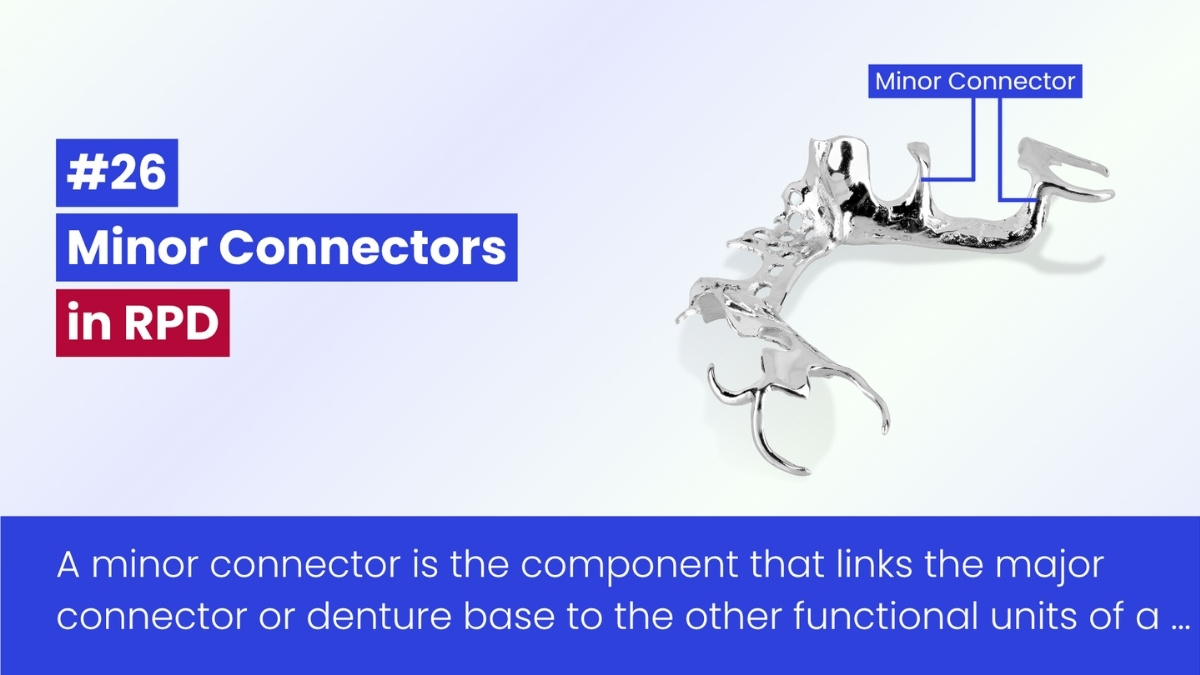
Table of contents [Show]
- Introduction
- What Is a Minor Connector?
- The Scope of Minor Connectors Is Wider Than It Looks
-
The Functions of Minor Connectors
- 1. Transferring functional stress to the abutment teeth
- 2. Transferring the effects of retainers, rests, and stabilizing components throughout the prosthesis
- 3. Providing unification and rigidity to the framework
- 4. Supporting retention and stability
- 5. Bracing through guiding plane contact
- 6. Defining and maintaining the path of insertion and removal
- Four Types of Minor Connectors Based on Location and Function
- Conclusion
- References
Introduction
If you have studied removable partial dentures, you probably learned that a minor connector links the major connector to other parts of the prosthesis. That definition is correct, but it is also incomplete in a way that matters practically.
The minor connector covers more structural territory than that short definition implies, and understanding its full scope is essential before getting into design principles. This post covers what minor connectors are, what they do, and how they are classified by location and function.
What Is a Minor Connector?
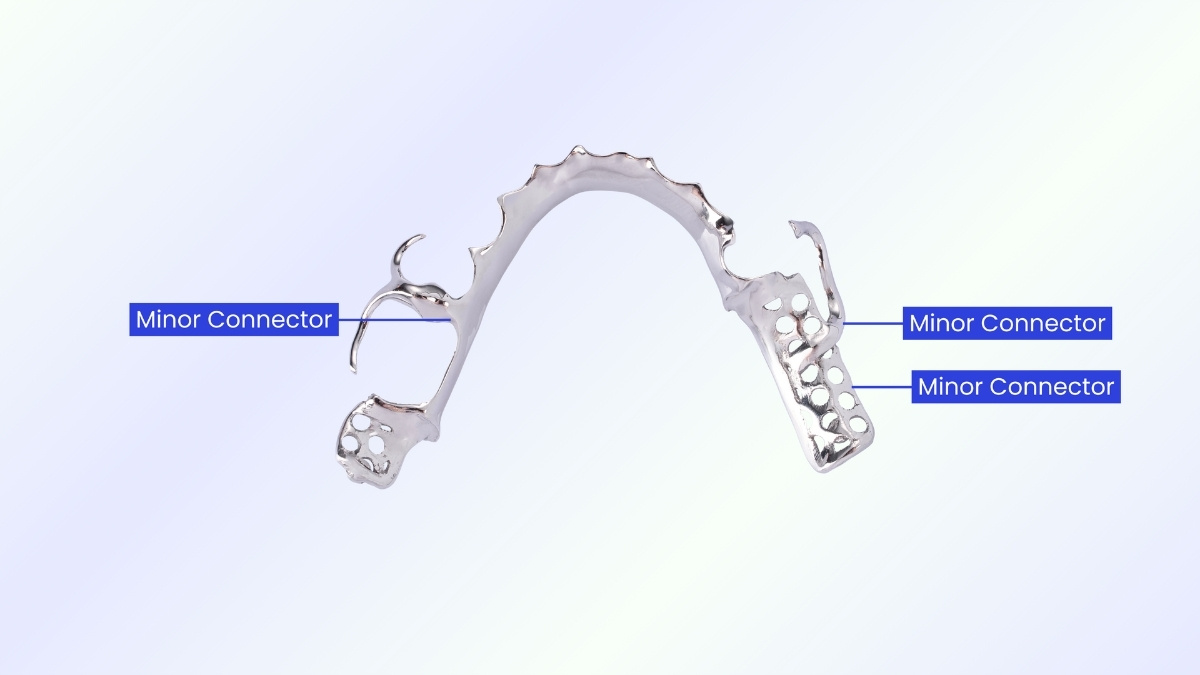
A minor connector is the component that links the major connector or denture base to the other functional units of a removable partial denture (RPD), including the clasp assembly, indirect retainers, occlusal rests, and cingulum rests.
Every minor connector originates from the major connector. It acts as the structural bridge between the central framework and each functional unit attached to it.
That much is standard. But the definition does not stop there.
The Scope of Minor Connectors Is Wider Than It Looks
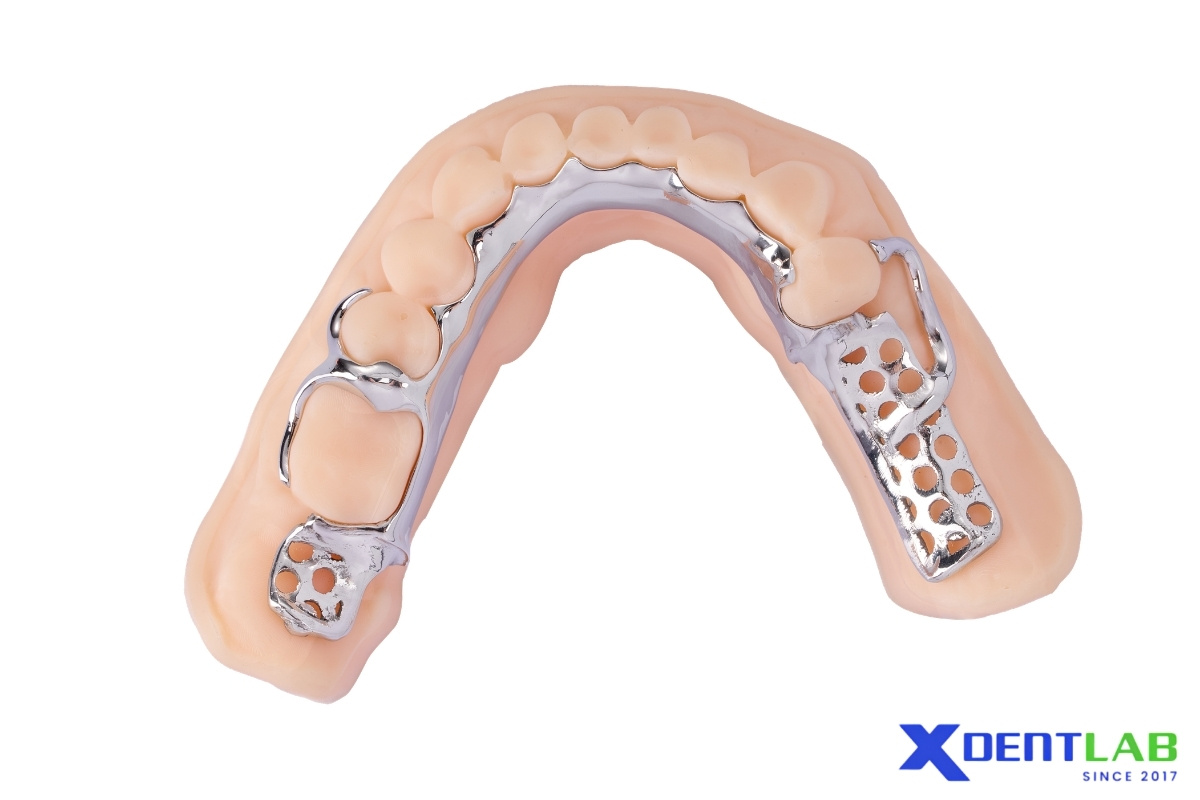
The definition includes any portion of the denture framework used to attach the denture base to the rest of the framework. In practical terms, this means the metal lattice or mesh structure sitting in the edentulous zone of a Cr-Co framework (the part that acrylic resin flows into and bonds with during processing) is a minor connector.
This is an important distinction. A minor connector does not just join components to one another. It also serves as the mechanical anchor point between the metal framework and the plastic denture base. Without it, there is no reliable attachment between the two materials.
Boundaries between components are not always visible
Another complication: in many frameworks, a minor connector is continuous with another part of the denture, making it difficult to identify by shape alone.
McCracken's Removable Partial Prosthodontics offers a clarifying example: an occlusal rest positioned at one end of a linguoplate is, structurally, the terminal point of a minor connector, even though that minor connector blends seamlessly into the linguoplate itself. The two components are anatomically fused, but functionally distinct.
Similarly, the portion of the framework that supports both the clasp arm and the occlusal rest is a minor connector in its own right, joining the major connector to the clasp proper.
The takeaway is that the boundaries between RPD components are functional, not always morphological. Understanding minor connectors requires thinking about what each part does, not just what it looks like.
The Functions of Minor Connectors
Minor connectors are typically described as having a joining function, but there are several additional roles that make them indispensable to the overall biomechanical performance of the prosthesis.
1. Transferring functional stress to the abutment teeth
This is the prosthesis-to-abutment direction of force transfer. When occlusal forces are applied to artificial teeth, those forces travel through the denture base down to the underlying ridge tissue. When rests are involved, those same forces are directed to the abutment teeth through the rest-minor connector pathway.
The minor connector, connected to a rigid major connector, is what makes it possible to distribute this functional stress across the entire dental arch rather than concentrating it at a single point.
2. Transferring the effects of retainers, rests, and stabilizing components throughout the prosthesis
This is the abutment-to-prosthesis direction, and it works in reverse. When forces act on one part of the denture, the minor connector transfers the effects of the stabilizing and retentive components elsewhere in the arch to resist them.
A stabilizing component on one side of the arch can counteract horizontal forces originating from the opposite side but only if the minor connector connecting it to the major connector maintains rigidity and proper form. Remove that rigidity, and the cross-arch stabilization effect disappears.
3. Providing unification and rigidity to the framework
By connecting all separate components into a single rigid unit, minor connectors ensure the framework behaves as one integrated structure rather than a collection of loosely related parts.
4. Supporting retention and stability
Minor connectors that contact guiding plane surfaces on abutment teeth generate frictional retention as the prosthesis is seated. This contact also contributes to lateral stability by resisting horizontal displacement.
5. Bracing through guiding plane contact
When a minor connector contacts the guiding plane of an abutment tooth, it acts as a bracing element resisting lateral and rotational forces during function.
6. Defining and maintaining the path of insertion and removal
The fit of the minor connector against prepared guiding planes on abutment teeth is what gives the prosthesis a defined, repeatable path of insertion. This consistency matters both for the patient's ability to seat the denture correctly and for the long-term predictability of clasp function.
Four Types of Minor Connectors Based on Location and Function
Classification by location and function produces four distinct types. Each serves a different role in the framework and presents its own design requirements.
1. Proximal minor connectors
These contact an abutment tooth on the surface adjacent to an edentulous space. They are most commonly referred to as proximal plates or, when their primary role is guiding insertion and removal, as guiding plates.
Proximal minor connectors are critical for controlling the path of placement. Their contact with the prepared proximal guiding plane surface defines and limits how the prosthesis moves in and out of the mouth.
2. Embrasure minor connectors
These are positioned between two teeth, occupying the interproximal embrasure space. They are among the most functionally complex of the four types, performing multiple roles simultaneously:
- Connecting rests and clasp arms to the major connector
- Contacting interproximal guiding planes to help define the path of placement
- Providing frictional retention through guiding plane contact
- Reciprocating forces generated by direct retainers
- Substituting for lost proximal tooth contacts, effectively unifying the dental arch
- Distributing lateral forces (bracing function)
Design of embrasure minor connectors requires careful attention to bulk and taper. The connector must pass vertically through the embrasure, be thickest toward the lingual aspect, and taper toward the contact area to minimize tongue interference and food trapping.
3. Surface minor connectors
These are located on the lingual surfaces of anterior teeth such as incisors and canines. Their primary function is to connect lingual rests to the major connector.
At the junction with the major connector, the angle is a rounded right angle. Moving occlusally (or incisally), the connector tapers to reduce bulk. The lateral borders extend into proximal embrasures so that the connector edges are not felt by the tongue.
4. Denture base retention minor connectors
This type is the structural means by which the acrylic resin denture base is mechanically attached to the metal framework. Without it, there is no reliable bond between the plastic base and the cast framework, a debonded denture base is one of the more common clinical failures in RPD therapy.
There are five recognized design subtypes:
- Retentive mesh: a woven or perforated metal sheet; most commonly used and provides strong acrylic retention through mechanical interlocking
- Retentive lattice: an open ladder or grid pattern; preferred over mesh in many cases because it facilitates acrylic resin packing and allows easier relining
- Retentive loops: formed metal loops extending from the framework; used in select applications where mesh or lattice is impractical
- Retentive beads: small spherical projections; suitable for short-span, tooth-supported cases with well-healed ridges
- Retentive posts: small post-and-head projections; commonly used as part of the denture base minor connector to attach individualized impression trays to the framework when a corrected impression technique is planned
The design choice among these subtypes depends on the span of the edentulous area, whether the case is tooth-supported or tissue-supported, the planned impression technique, and the need for future relining.
Conclusion
The word "minor" is misleading. These components are not minor in importance, only in size relative to the major connector.
Every force that moves through an RPD framework passes through a minor connector at some point. The transfer of occlusal load to supporting teeth, the resistance of horizontal displacement by stabilizing components, the secure attachment of the denture base, the definition of the path of insertion. All of these depend on minor connectors being correctly designed and fabricated.
In the next post, we go deeper into form and location: where to position minor connectors relative to the embrasure, how to design the lattice structure for optimal acrylic retention, what tissue stops and finishing lines are and why they are frequently overlooked in fabrication.
References
- Carr AB, Brown DT (2011) McCracken's Removable Partial Prosthodontics. 12th edn, Mosby, 45.
- https://codental.uobaghdad.edu.iq/wp-content/uploads/sites/14/2018/11/Lec-10-Minor-connectors.pdf
Share this post:
Related Posts
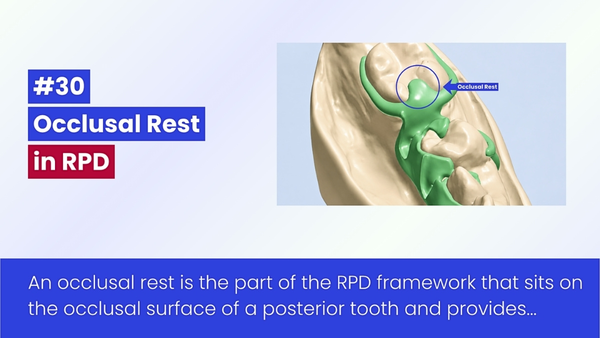
Not all occlusal rests are the same. Here is what distinguishes the extended, interproximal, internal types, and the clinical situations each one is designed for.
Explore lab-to-lab workflow and QC for implant-supported fixed prostheses, from fit and materials to retrievability, hygiene design, and consistency.
Explore lab workflow and quality standards for inlays, onlays, and overlays to improve fit, occlusion, durability, and restorative consistency.

