
Learn how Vietnamese dental laboratories support full-arch rehabilitation with implant solutions, CAD/CAM workflows, quality materials, and cost efficiency.
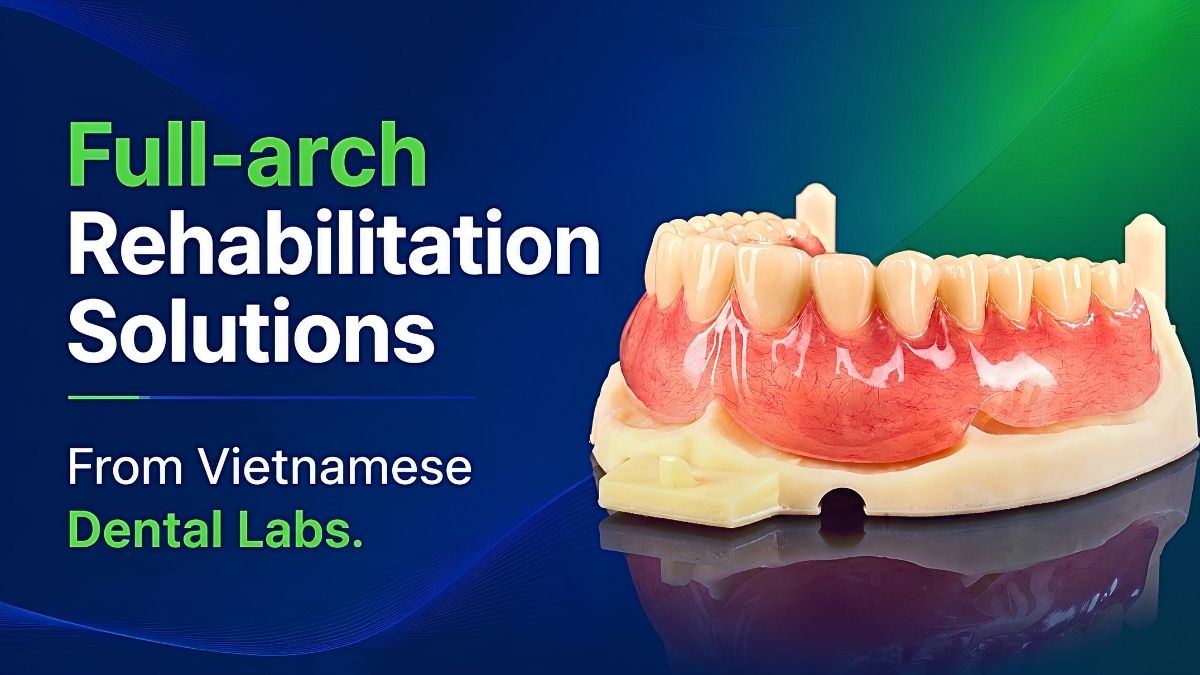
Table of contents [Show]
- What is full-arch rehabilitation?
- Main full-arch rehabilitation solutions
- Why Vietnamese dental laboratories are relevant in full-arch cases
- Materials used in full-arch rehabilitation solutions
- Digital workflow in full-arch rehabilitation
- Advantages of full-arch rehabilitation solutions from Vietnamese labs
- Challenges and limitations
- Future direction of full-arch rehabilitation from Vietnamese labs
- Why this matters for XDENT LAB
- Key takeaways
- References
Full-arch rehabilitation has become one of the most transformative treatment categories in modern restorative dentistry. For edentulous patients and those with terminal dentition, full-arch treatment offers a way to restore function, facial support, speech, comfort, and aesthetics through a coordinated prosthetic and surgical approach. As treatment protocols become more digital and material options become more advanced, dental laboratories now play a central role in the predictability of full-arch outcomes.
Vietnamese dental laboratories are gaining attention in this space because they combine skilled technical labor, competitive production economics, and increasingly sophisticated digital workflows. For dental practices and lab partners seeking reliable full-arch support, Vietnamese laboratories can offer a compelling mix of customization, turnaround efficiency, material flexibility, and quality-focused manufacturing. This article explores what full-arch rehabilitation means, how Vietnamese dental laboratories contribute to it, the materials and workflows involved, and why this model is becoming increasingly relevant in global dental outsourcing.
What is full-arch rehabilitation?
Full-arch rehabilitation refers to the restoration of an entire maxillary or mandibular arch for patients who are fully edentulous or whose remaining dentition is no longer restorable.
Clinical purpose
The objective of full-arch rehabilitation is to restore masticatory efficiency, phonetics, facial support, occlusal stability, aesthetic appearance, and long-term oral function.
This can be achieved through removable or fixed prosthetic solutions, though modern treatment planning often emphasizes implant-supported full-arch restorations.
Common indications
Full-arch rehabilitation is commonly indicated for complete edentulism, terminal dentition, severe periodontal destruction, extensive caries or structural breakdown, failing dentition after trauma or long-term wear, and patients seeking fixed alternatives to removable dentures.
Main full-arch rehabilitation solutions
Full-arch rehabilitation is not a single treatment type. It includes several prosthetic and implant-based approaches depending on anatomy, treatment goals, budget, and clinical risk profile.
All-on-4 and All-on-6 restorations
These are among the most widely used implant-supported full-arch concepts.
They involve placing four or six implants to support a complete arch prosthesis. Their benefits often include reduced need for extensive implant numbers, efficient use of available bone, possibility of immediate provisionalization, and improved stability compared with conventional dentures.
Zygomatic and advanced implant concepts
For patients with severe maxillary bone loss, zygomatic implants or other advanced anchorage concepts may be considered.
These are more complex cases that require detailed planning, precise framework design, strong coordination between clinician and laboratory, and highly accurate prosthetic execution.
Immediate load provisional full-arch prostheses
In many full-arch workflows, an immediate temporary prosthesis is delivered soon after implant placement.
This provides faster functional restoration, better patient acceptance, guided soft tissue shaping, and a bridge toward the definitive prosthesis.
Final fixed full-arch prostheses
Once healing and integration are complete, the definitive restoration may be fabricated using a range of materials and framework strategies, depending on case goals and clinical preference.
Why Vietnamese dental laboratories are relevant in full-arch cases
Vietnamese dental laboratories are increasingly recognized in global outsourcing because they offer a practical balance of cost efficiency, technical capability, and evolving digital infrastructure.
Skilled craftsmanship
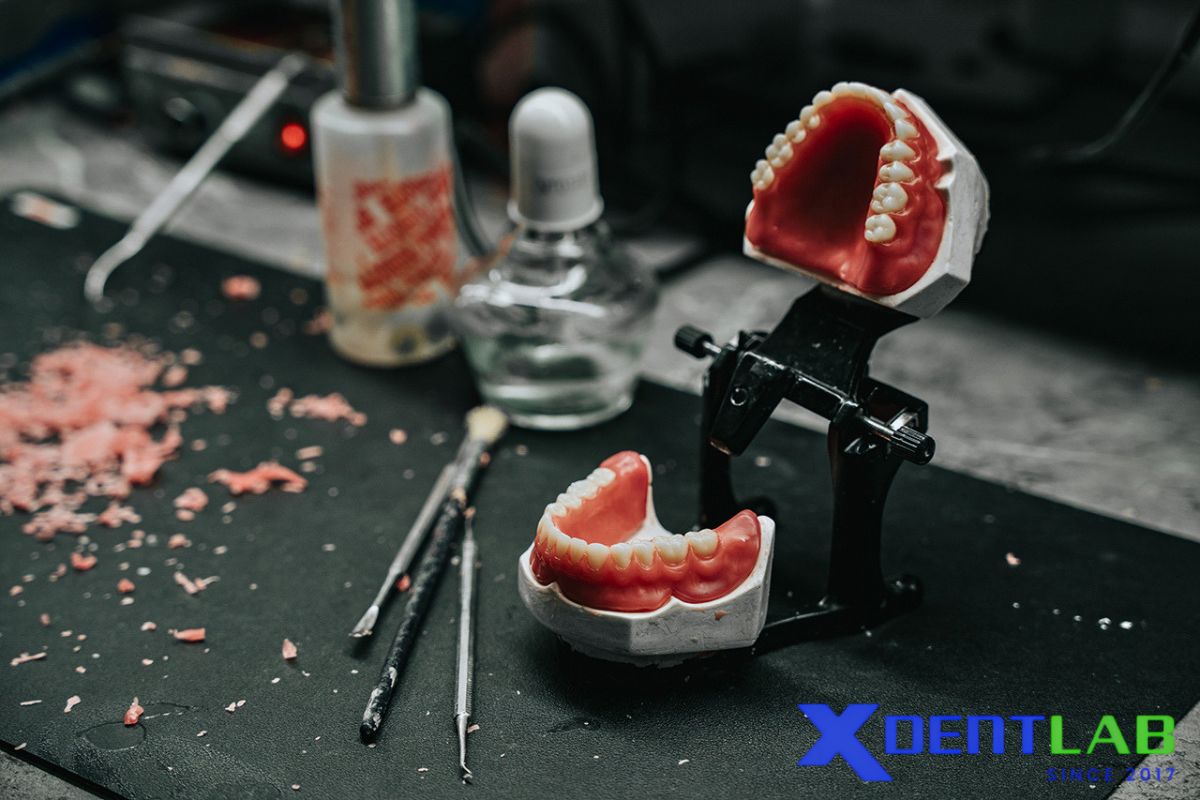
Full-arch cases require more than standard crown-and-bridge execution. They demand accurate framework design, occlusal understanding, aesthetic layering or contouring skill, experience in implant prosthetics, and attention to passive fit and tissue adaptation.
Vietnamese labs with strong implant and removable departments are well positioned to support these requirements.
Competitive production economics
One of the clearest advantages is cost-effectiveness.
Vietnamese dental labs can often deliver high-value prosthetic manufacturing at more competitive pricing than many domestic production environments, without automatically meaning lower quality. For practices balancing margin pressure and case complexity, this becomes highly relevant.
Growing digital capabilities
Many Vietnamese laboratories now operate with CAD/CAM design systems, digital model workflows, implant planning collaboration, milling and printed prototype support, and digital communication with international partners.
This improves consistency, fit verification, and turnaround performance in complex full-arch cases.
International collaboration readiness
Vietnamese labs serving overseas practices increasingly understand the operational needs of global partners, including case communication, prescription clarity, implant compatibility, quality control documentation, shipping coordination, and repeatable production standards.
Materials used in full-arch rehabilitation solutions
Material selection is one of the most important variables in full-arch treatment because it affects strength, weight, aesthetics, wear behavior, repairability, and patient comfort.
Zirconia
Zirconia is a leading material for final full-arch restorations because it offers high strength, excellent durability, favorable aesthetics, good biocompatibility, and monolithic design possibilities.
It is often selected when long-term durability and a premium fixed prosthetic solution are priorities.
Titanium
Titanium is widely used for implant bars and framework substructures due to excellent biocompatibility, lightweight properties, corrosion resistance, and reliable implant interface compatibility.
Titanium is especially valuable where framework precision and passive fit are critical.
PEEK
PEEK is increasingly discussed in full-arch prosthetics for its lightweight feel, shock-absorbing qualities, metal-free character, and patient comfort potential.
Its use depends on case design, restorative philosophy, and laboratory capability.
Hybrid material concepts
Some full-arch solutions combine materials, such as titanium framework with layered prosthetic components, zirconia with aesthetic staining and characterization, and polymer-ceramic combinations for weight reduction and repair flexibility.
These hybrid approaches aim to balance function, aesthetics, and long-term manageability.
Digital workflow in full-arch rehabilitation
Digital workflow has become one of the defining factors in modern full-arch treatment. In many cases, it is the difference between a stressful process and a controlled one.
Digital impressions and records
Where clinically appropriate, digital records can improve communication accuracy, design repeatability, bite relationship verification, prototype planning, and cross-team collaboration.
CAD/CAM design
CAD/CAM allows laboratories to design full-arch frameworks, bars, provisional restorations, final prosthetic structures, and surgical or prosthetic planning elements.
This supports precision, reproducibility, and efficient modification when needed.
Prototype verification
Digital or printed prototypes help verify vertical dimension, midline and smile line, phonetics, lip support, occlusal scheme, and framework design intent.
This is especially useful in full-arch cases where small design errors can become very large patient complaints.
Milling and 3D printing
Modern full-arch workflows may involve zirconia milling, titanium milling, printed try-ins, printed patterns, prototype bars, and interim prosthetic production.
The laboratory’s ability to manage these steps consistently matters as much as the material itself.
Advantages of full-arch rehabilitation solutions from Vietnamese labs
For dental practices, working with a capable Vietnamese dental laboratory on full-arch cases can offer several meaningful advantages.
Quality and value balance
The strongest advantage is often the combination of competitive pricing, skilled technical execution, good material options, and scalable production support.
That balance is especially attractive in full-arch treatment, where prosthetic costs can significantly influence case acceptance and practice profitability.
Customization
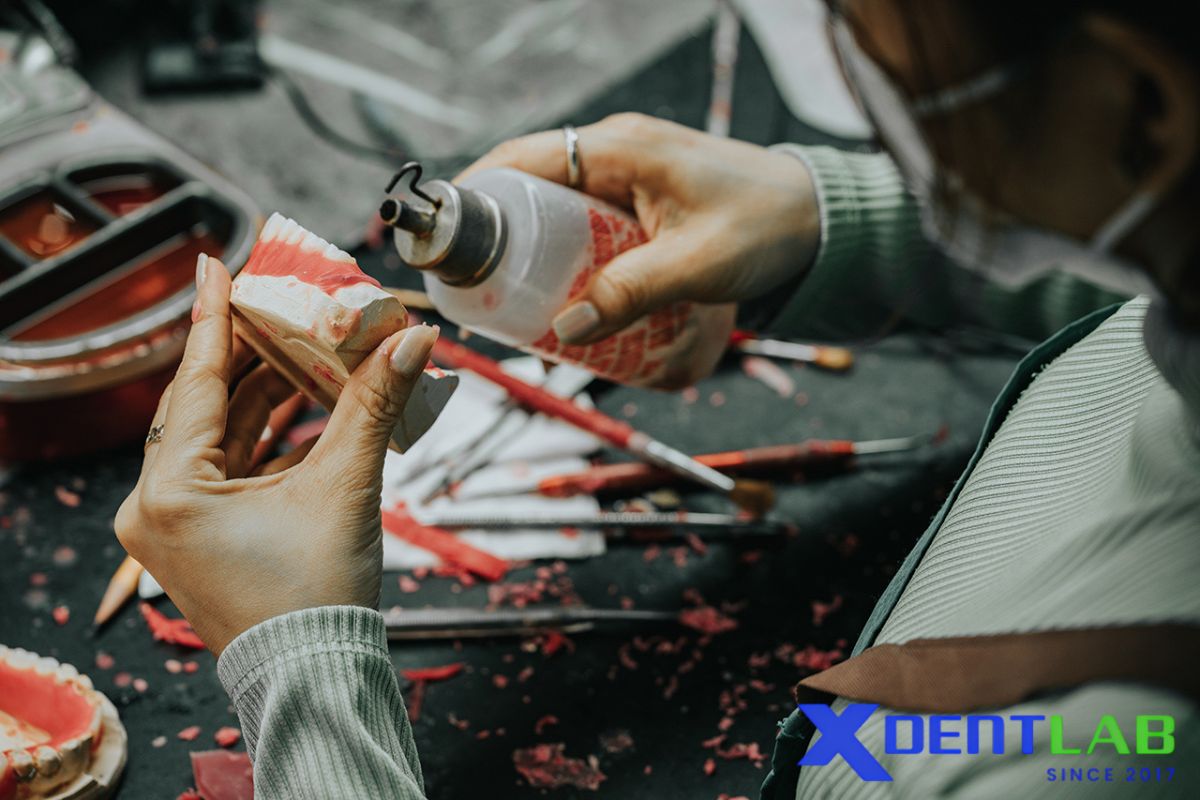
Full-arch cases require individualized planning. Vietnamese labs with strong digital and technical teams can support custom framework design, implant-specific restorative planning, personalized contouring, aesthetic adaptation, and material selection based on case goals.
Turnaround efficiency
When workflows are organized well, Vietnamese labs can provide strong turnaround performance through dedicated production teams, efficient internal coordination, digital file transfer, and structured case handling systems.
Access to broad prosthetic expertise
Labs that work across removable and implant prosthetics are often better equipped to handle transitional and complex full-arch cases, including immediate provisional arches, conversion prostheses, implant-supported hybrids, final fixed restorations, and maintenance and remake workflows.
Challenges and limitations
Full-arch rehabilitation is one of the most demanding areas in dentistry, so no outsourcing model is free of challenges.
Case complexity
These restorations require close integration of surgery, prosthetics, occlusion, materials, and patient-specific factors. A technically capable lab can help, but it cannot replace sound diagnosis and treatment planning.
Communication demands
Because full-arch cases are multi-stage and highly customized, poor communication can create major problems in implant orientation interpretation, vertical dimension, aesthetic expectations, framework design, occlusal scheme, and final delivery timing.
Material selection trade-offs
No single material is ideal for every case. Each option introduces trade-offs in weight, strength, aesthetics, repairability, cost, and manufacturing requirements.
Maintenance expectations
Patients still need follow-up care, hygiene instruction, occlusal monitoring, and maintenance. Full-arch rehabilitation is life-changing, not maintenance-free.
Future direction of full-arch rehabilitation from Vietnamese labs
The trajectory is clear: Vietnamese dental laboratories are becoming more integrated into advanced prosthetic manufacturing, including full-arch rehabilitation.
More digital integration
Expect continued expansion in scan-based workflows, AI-assisted design support, more precise prototype verification, better implant library integration, and faster cross-border collaboration.
Better materials and hybrid systems
Future growth will likely include broader use of improved zirconia systems, advanced polymers, hybrid frameworks, and more repair-conscious material designs.
Stronger global outsourcing presence
As international practices look for trusted lab partners that can deliver both quality and scalability, Vietnamese labs are likely to become more visible in complex restorative outsourcing.
Sustainability and manufacturing efficiency
Production environments are also moving toward better material utilization, lower waste workflows, smarter digital planning, and more efficient remakes reduction.
Why this matters for XDENT LAB
For XDENT LAB, full-arch rehabilitation fits directly within its strength in removable and implant prosthetics, lab-to-lab production, and international outsourcing support.
What dental practices need
Practices handling full-arch cases need a laboratory partner that can support implant prosthetic expertise, material guidance, consistent quality, digital case coordination, reliable turnaround, and manufacturing scalability.
Relevance to XDENT LAB
As a Vietnam dental lab with FDA and ISO-aligned standards, skilled technicians, two factories, and over 100 employees, XDENT LAB is positioned to support dental practices seeking quality-focused full-arch outsourcing solutions.
Its relevance is not just geographic cost advantage. It lies in the combination of lab-to-lab operational experience, removable and implant specialization, digital and conventional workflow capability, consistency across complex prosthetic cases, and scalable production for growing partners.
Key takeaways
Full-arch rehabilitation restores an entire dental arch for edentulous or terminal-dentition patients through advanced prosthetic and often implant-supported treatment. Vietnamese dental laboratories are increasingly relevant in this field because they combine technical craftsmanship, competitive pricing, digital workflow integration, and expanding global collaboration capability.
For dental practices, the value of a Vietnamese full-arch lab partner depends on more than cost. It depends on communication, material knowledge, framework precision, digital coordination, and the ability to deliver restorations that are functional, aesthetic, and consistent. In that equation, the laboratory is not just a manufacturer. It is a structural part of treatment success.
References
- Full-arch rehabilitation solutions
- Full arch implant rehabilitation - Oral Health Group
- Fixed full arch dental implants - Biodent Laboratory
- 3-hour transformation for full-arch cases - Vietnamese labs
About XDENT LAB:
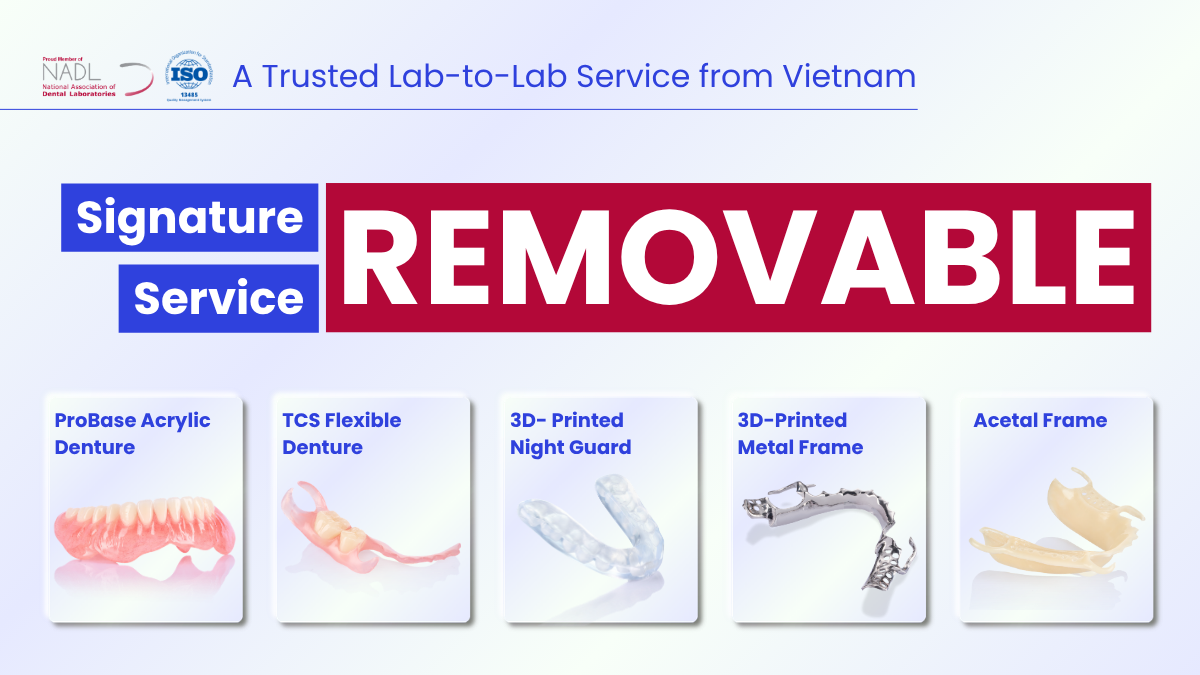
We are experts in Lab-to-Lab Full Service from Vietnam, with the signature services of Removable, meet U.S. market standards, FDA-registered, ISO 13485-certified. Founded in 2017, from local root to global reach, we scale with 2 Factories with over 100+ employees.
Our Commitments Built on “Trusted. Commitment. Quality”
- Commit to Large-Scale Manufacturing, high volume, remake rate < 1%.
- Commit to 5-Year Warranty
- Commit to Competitive Price
XDENT LAB | A Trusted Lab-to-Lab Service from Vietnam
Share this post:
Related Posts
Explore how independent dental labs support dentistry through custom restorations, digital workflows, quality control, and material traceability.
Learn how B2B dental labs improve quality and consistency for dental practices through digital workflows, material control, expert QC, and reliable turnaround.
Learn how the dental lab subcontract model helps labs expand capacity, manage workloads, access technology, and maintain quality in outsourced production.

