
An indirect retainer is a component of an RPD that helps prevent displacement of the denture base away from the supporting tissues by counteracting rotational forces around the fulcrum line.
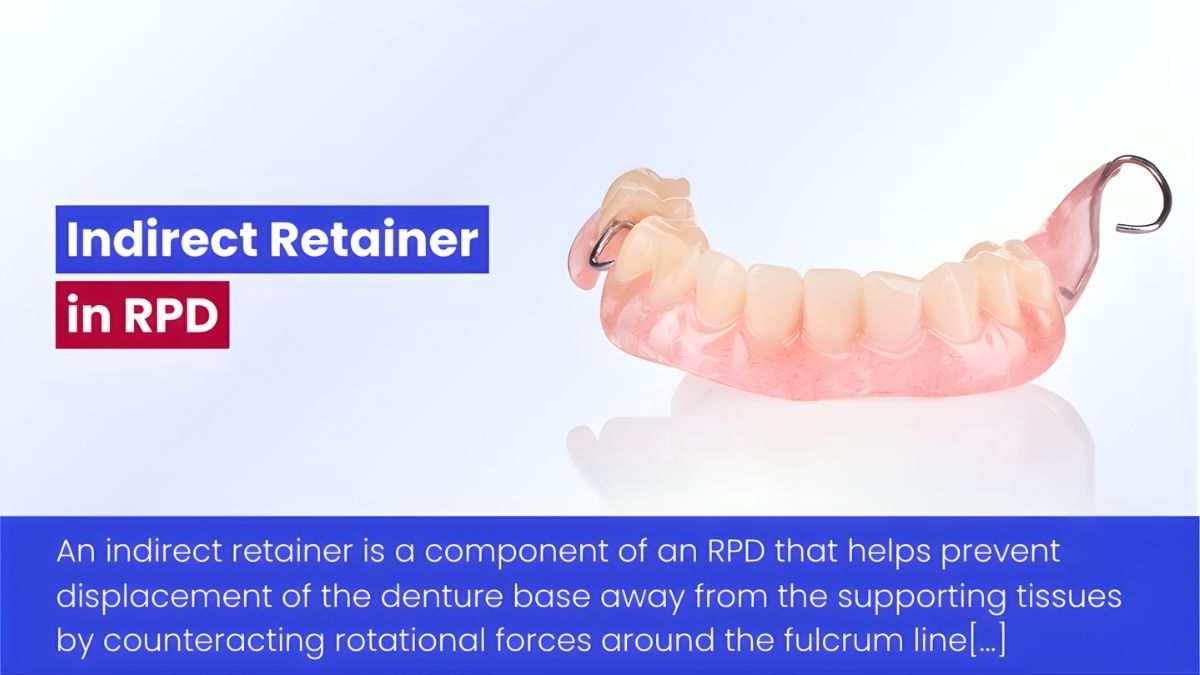
Table of contents [Show]
In removable partial denture (RPD) design, indirect retention plays a critical role in ensuring denture stability, especially in distal extension cases. An indirect retainer is a component of an RPD that helps prevent displacement of the denture base away from the supporting tissues by counteracting rotational forces around the fulcrum line.
Understanding the concept of indirect retainers is essential for clinicians and dental technicians to achieve long-term comfort, function, and biomechanical success of RPDs.
What Is an Indirect Retainer?
An indirect retainer is defined as:
A component of a removable partial denture that assists direct retainers by preventing rotational displacement of the distal extension denture base through lever action on the opposite side of the fulcrum line.
Unlike direct retainers, which engage undercuts to resist removal of the denture, indirect retainers function by mechanical leverage rather than clasp retention.
Why Is Indirect Retention Important in RPDs?
Indirect retention is particularly important in Kennedy Class I and Class II RPDs, where part of the denture base is supported by soft tissue rather than teeth.
During mastication or function:
Occlusal forces may depress the distal extension base.
Sticky foods, gravity, or muscular activity may lift the denture base.
The denture tends to rotate around an imaginary axis called the fulcrum line.
Without indirect retention, this rotational movement can lead to:
Loss of stability.
Tissue irritation.
Increased stress on abutment teeth.
Poor patient comfort.
Mechanism of Action of Indirect Retainers
The denture behaves like a lever system:
Fulcrum line: An imaginary line passing through the most posterior abutment teeth.
Dislodging force: Acts on the distal extension base.
Indirect retainer: Placed anterior to and as far as possible from the fulcrum line.
By increasing the distance from the fulcrum line, the indirect retainer provides a mechanical advantage, resisting rotational displacement and stabilizing the denture.
Common Types of Indirect Retainers in RPD Design
Several RPD components can serve as indirect retainers when properly positioned:
1. Auxiliary Occlusal Rest
Most commonly used indirect retainer.
Placed on premolars or anterior teeth.
Highly effective when located far from the fulcrum line.
2. Canine Rest (Cingulum or Lingual Rest)
Used when premolar rests are close to the fulcrum line.
Provides better leverage when positioned anteriorly.
3. Canine Extension from Occlusal Rest
Finger-like extension from premolar rest to canine.
Reduces tipping forces compared to a single canine rest.
4. Incisal Rest
Less desirable due to esthetic concerns and tipping tendency.
5. Indirect Retention from Major Connectors
Lingual plates and palatal plates can provide indirect retention through rigidity.
Less effective than tooth-supported rests.
6. Rugae Support
Utilizes palatal rugae resistance.
Considered the least effective form of indirect retention.
Principles for Effective Indirect Retainer Placement
To maximize effectiveness, indirect retainers should follow these principles:
Positioned as far as possible from the fulcrum line.
Located perpendicular to the midpoint of the fulcrum line.
Supported by a definite and prepared rest seat.
Connected with rigid minor and major connectors.
Avoid placement on weak, inclined, or periodontally compromised teeth.
Clinical Significance of Indirect Retainers
Proper use of indirect retainers:
Enhances denture stability.
Reduces stress on abutment teeth.
Improves patient comfort and confidence.
Increases longevity of the RPD.
Minimizes tissue trauma and denture movement.
For dental laboratories and clinicians, understanding indirect retention is crucial for designing biomechanically sound removable partial dentures.
Conclusion
An indirect retainer in RPD is a fundamental design element that prevents rotational displacement of the denture base by counteracting lifting forces around the fulcrum line. Though often overlooked, it significantly contributes to denture stability, comfort, and long-term success—especially in distal extension cases.
A well-designed RPD always combines effective direct retention with strategically placed indirect retention.
References
[1] Stewart, K. L., Rudd, K. D., & Kuebker, W. A.
Clinical Removable Partial Prosthodontics (2nd Edition).
Mosby, St. Louis.
[2] McCracken, W. L.
McCracken’s Removable Partial Prosthodontics (12th–13th Edition).
Elsevier.
[3] Carr, A. B., & Brown, D. T.
McCracken’s Removable Partial Prosthodontics (13th Edition).
Elsevier Health Sciences.
[4] The Glossary of Prosthodontic Terms
Journal of Prosthetic Dentistry.
[5] Nallaswamy, D.
Textbook of Prosthodontics.
Jaypee Brothers Medical Publishers.
About XDENT LAB:
We are experts in Lab-to-Lab Full Service from Vietnam, with the signature services of Removable, meet U.S. market standards, FDA-registered, ISO 13485-certified. Founded in 2017, from local root to global reach, we scale with 2 Factories with over 100+ employees.
Our Commitments Built on “Trusted. Commitment. Quality”
- Commit to Large-Scale Manufacturing, high volume, remake rate < 1%.
- Commit to 5-Year Warranty
- Commit to Competitive Price
XDENT LAB | A Trusted Lab-to-Lab Service from Vietnam
Share this post:
Related Posts
Learn the key differences between titanium and cobalt-chromium alloys used in removable partial denture frameworks, from mechanical properties to production requirements.
Explore biodegradable materials in dentistry, including their applications, benefits, limitations, and future potential in regenerative and sustainable dental care.
Learn how polyamide dental materials support flexible dentures and removable prosthetics through biocompatibility, aesthetics, comfort, and lightweight performance.

