
Learn mandibular connectors in RPD, including functions, types, design principles, and a practical step-by-step framework approach.

Table of contents [Show]
- Introduction
- Key points
- What Is a Major Connector in RPD?
- What Are the Main Functions of a Major Connector?
- Location of Major Connectors: 5 Basic Guidelines
- Why the Mandible Is More Demanding
- Types of Mandibular Major Connectors in RPD
- Lingual Bar vs Linguoplate: Why This Choice Matters
- How to Design a Mandibular Major Connector
- Practical Summary Table
- Conclusion
- FAQ
- References
Introduction
In removable partial denture (RPD) design, the mandibular major connector is one of the most important structural elements of the framework. It does more than connect the right and left sides of the arch. It helps unify the prosthesis, distribute functional loads, and resist unwanted movement during mastication.
This topic is best understood through function and design principles, not by memorizing connector names alone. The choice of connector affects rigidity, tissue response, patient comfort, and the long-term behavior of the prosthesis under function. This article explains what a major connector in RPD is, what it does, the basic location guidelines, and the main types of mandibular major connectors in RPD. It also introduces a practical four-step approach to design.
Key points
- A major connector joins the parts of an RPD across the arch and creates cross-arch stability.
- Rigidity is essential because a flexible connector reduces the effectiveness of other framework components.
- In the mandible, connector design is strongly influenced by the floor of the mouth, lingual frenum, and available vertical space.
- Lingual bar and linguoplate are the most commonly used mandibular major connectors.
- Connector selection should be based on anatomy, function, and biomechanical demands, not preference alone.
What Is a Major Connector in RPD?
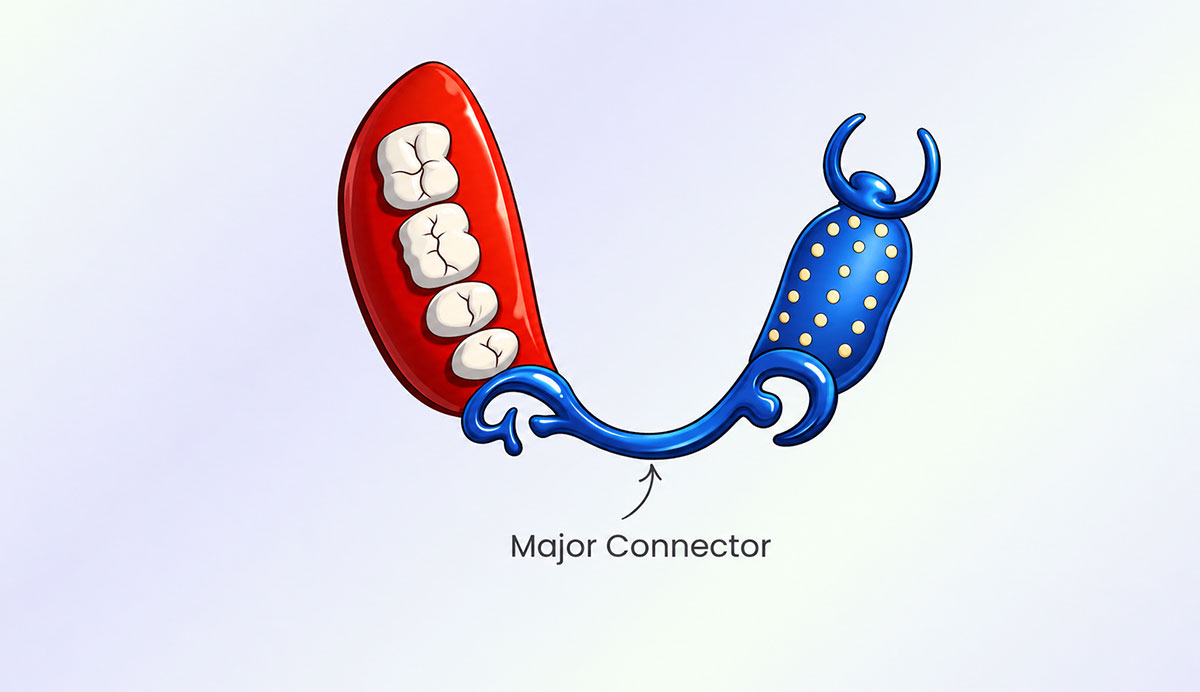
A major connector is the component of the removable partial denture that connects the parts of the prosthesis located on one side of the arch with those on the opposite side. It is the part to which the other components are directly or indirectly attached.
A simple analogy is to think of it as the frame of a car or the foundation of a building. The frame does not replace the other parts, but it allows them to work together effectively. In the same way, the major connector is what helps turn separate components into one functional prosthesis.
What Are the Main Functions of a Major Connector?
The major connector has several important functions, but three are especially important in practice.
The major connector joins the major parts of the prosthesis into one unit. Without this unification, the framework behaves less efficiently.
2. Distributing force across the arch
A well-designed rigid connector helps distribute occlusal force to selected teeth and tissues across the arch. Instead of overloading one area, the prosthesis shares load more efficiently.
3. Minimizing torque on teeth
In this context, torque refers to a force that tends to rotate a tooth around a point or axis. When a denture base moves under function, especially in distal extension situations, that movement may create a twisting effect on abutment teeth. A rigid major connector helps reduce that harmful rotational stress by limiting prosthesis movement and spreading force more broadly.
Location of Major Connectors: 5 Basic Guidelines
The location of a major connector should follow biological and mechanical principles. Five core guidelines are especially useful.
1. It should be free of movable tissue
The connector should not lie on tissue that moves significantly during normal function.
2. Gingival impingement should be avoided
The connector should be positioned far enough from the gingival tissues to avoid pressure and maintain soft tissue health.
3. Avoid bony and soft tissue prominences
Placement and removal should not be complicated by anatomic prominences that create interference or pressure.
4. Provide relief where needed
Relief should be planned beneath a major connector when it crosses areas likely to interfere, such as inoperable tori or prominent anatomical structures.
5. Design for functional rotation
In distal extension prostheses, the denture may rotate during function. The connector should be placed and relieved in a way that avoids tissue impingement caused by that movement.
These points matter because inadequate design may lead to tissue injury, impingement, and later adjustment. Grinding a connector after delivery to create relief is not ideal, because it can weaken the framework and reduce rigidity.
Why the Mandible Is More Demanding
Both maxillary and mandibular major connectors serve the same broad purpose, but mandibular design is often more challenging. In the maxilla, the palate provides a broad and relatively firm area for support. In the mandible, the available space is more limited because the design must respect the floor of the mouth, lingual frenum, tongue movement, and the distance from the gingival margin. That is why mandibular major connectors in RPD require particularly careful planning.
Types of Mandibular Major Connectors in RPD
Six classic types of mandibular major connectors are described in removable partial prosthodontics.
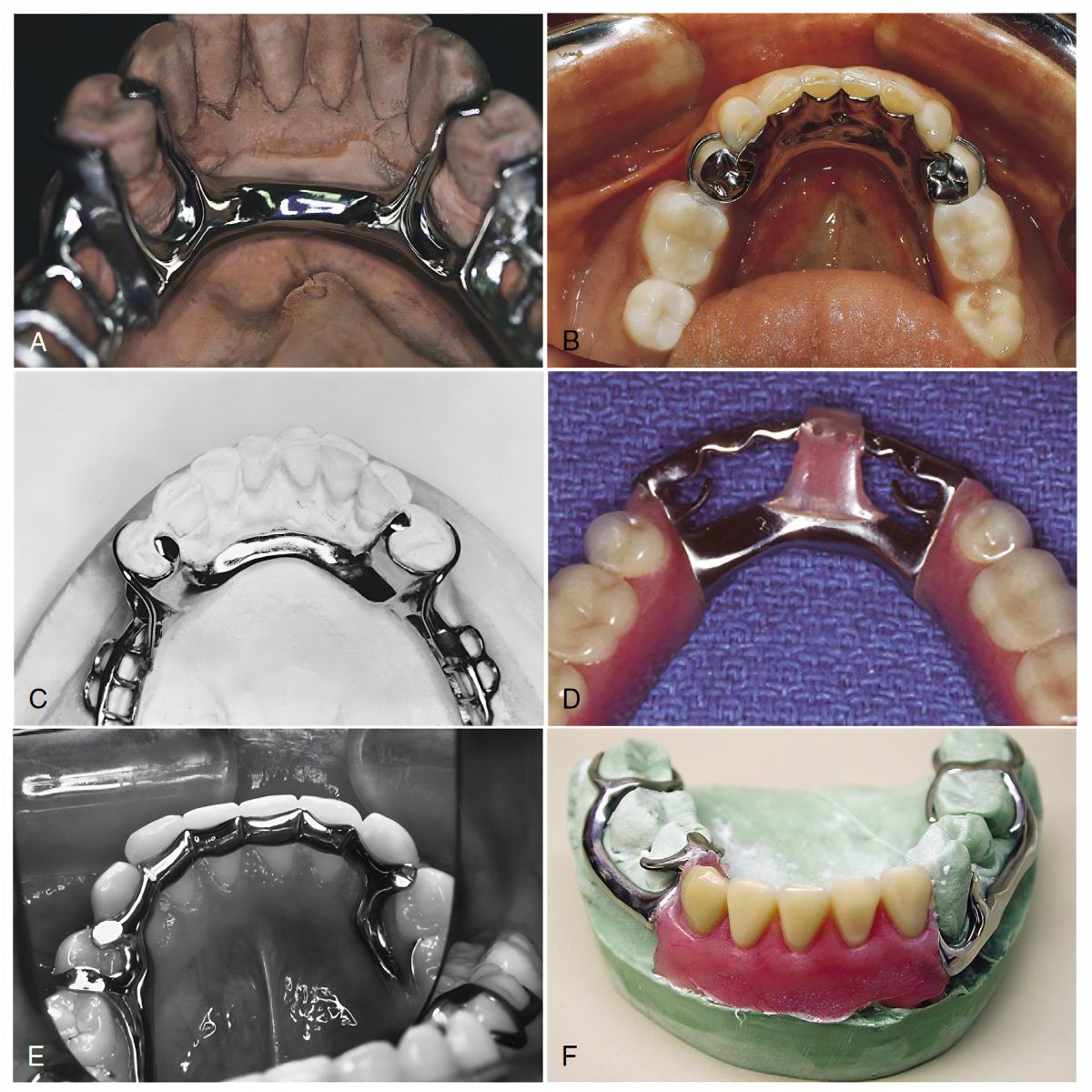
The lingual bar (A) is the most common mandibular major connector and is usually considered the basic design when space is adequate. Its typical form is half-pear shaped, with the greatest bulk at the inferior border to provide rigidity. The superior border should taper toward the gingiva and remain as far below the gingival tissues as possible without interfering with movable tissue.
2. Linguoplate
The linguoplate (B) is commonly selected when a lingual bar cannot be used with proper clearance or when additional stabilization is desirable. It extends onto the lingual surfaces of the anterior teeth and follows their contours. It may be indicated in cases with a high lingual frenum, limited space for a lingual bar, excessive ridge resorption, or periodontally weakened teeth requiring added stabilization.
The sublingual bar (C) is a modification of the lingual bar placed more inferiorly and posteriorly. It lies over and parallel to the anterior floor of the mouth. It may be used when floor-of-mouth anatomy does not permit ideal placement of a conventional lingual bar, provided that the lingual frenum and functional movements do not interfere.
This design combines a lingual bar with an additional cingulum bar (D). It provides more contact and support than a lingual bar alone while avoiding the full coverage of a linguoplate.
The cingulum bar (E), also called a continuous bar, is positioned on or slightly above the cingula of the anterior teeth. It may be considered when a linguoplate would require excessive blockout or when wide diastemata make a full linguoplate less desirable.
The labial bar (F) is rarely indicated. It is usually reserved for unusual cases in which severe lingual inclination of remaining teeth or other anatomic factors prevent a lingual connector design. In most situations, corrective mouth preparation remains preferable when possible.
Among mandibular connectors, the most common practical decision is often lingual bar vs linguoplate.
A lingual bar is generally preferred when sufficient space exists and tissue conditions are favorable. It is simpler and keeps metal coverage more limited. A linguoplate becomes more appropriate when vertical space is insufficient, when added stabilization is needed, or when future tooth loss is a realistic concern.
This distinction matters because connector design is not only about fitting the arch. It is also about preserving gingival health, maintaining rigidity, and managing future functional demands.
How to Design a Mandibular Major Connector
A simple design sequence helps organize planning on diagnostic casts.
Step 1: Outline the basal seat areas
Start by outlining the edentulous areas that will support the denture bases.
Step 2: Outline the inferior border of the major connector
In mandibular design, this border is influenced by the floor of the mouth and the available functional depth of the lingual sulcus.
Step 3: Outline the superior border of the major connector
For a lingual bar, the superior border should generally be at least 4 mm below the gingival margin. When that clearance is not available, a linguoplate is often the better choice.
Step 4: Connect the basal seat areas to the major connector and add minor connectors
Once the superior and inferior borders are defined, the basal seat areas are connected to the major connector, and minor connectors are added to retain the acrylic resin denture base material.
This sequence is useful because it forces the clinician or technician to begin with anatomy and support rather than jumping directly to a connector type.
Practical Summary Table
| Connector type | Main use | Main limitation |
| Lingual bar | Standard option when space is adequate | Requires sufficient vertical space |
| Linguoplate | Limited space, added stabilization, future tooth loss | More tooth coverage |
| Sublingual bar | Alternative when conventional lingual bar placement is limited | Sensitive to frenum and floor-of-mouth movement |
| Lingual bar with cingulum bar | Added stabilization without full plate coverage | More complex design |
| Cingulum bar | Useful when a linguoplate is less suitable | May be less comfortable and may trap food |
| Labial bar | Rare special situations | Usually less desirable than correcting the lingual condition |
Conclusion
A mandibular major connector is not merely a connecting bar within an RPD framework. It is a key structural component that affects rigidity, force distribution, prosthesis movement, and tissue health. Understanding its role helps clinicians and technicians move beyond memorizing connector names and toward more rational design decisions.
In practice, the choice among mandibular major connectors in RPD depends on available space, floor-of-mouth anatomy, gingival clearance, periodontal considerations, and the biomechanical demands of the case. For most cases, the decision often comes down to choosing appropriately between a lingual bar and a linguoplate, but the other connector types remain important in selected clinical situations.
As a foundation topic, this subject also supports deeper study. Each mandibular connector type deserves its own detailed discussion of indications, contraindications, design features, and common errors.
FAQ
What is the most common mandibular major connector?
The lingual bar is generally the most common mandibular major connector when sufficient space is available.
When is a linguoplate preferred over a lingual bar?
A linguoplate is preferred when vertical space is inadequate for a lingual bar or when additional stabilization is needed.
Why must a major connector be rigid?
Rigidity allows the connector to unify the framework, distribute forces effectively, and reduce harmful prosthesis movement under function.
What is cross-arch stability in RPD design?
Cross-arch stability refers to the resistance to displacement achieved by connecting both sides of the arch into one functional unit.
References
McCracken's Removable Partial Prosthodontics.
About XDENT LAB:
We are experts in Lab-to-Lab Full Service from Vietnam, with the signature services of Removable, meet U.S. market standards - approved FDA & ISO. Founded in 2017, from local root to global reach, we scale with 2 Factories with over 100+ employees.
Our 5 Commitments Built on “Trusted. Commitment. Quality”
- Commit to 100% FDA-Approved Materials
- Commit to Large-Scale Manufacturing, high volume, remake rate < 1%.
- Commit to 2~3 days in lab (*digital file)
- Commit to Cost Savings 30%
- Commit to Best Price
XDENT LAB | A Trusted Lab-to-Lab Service from Vietnam
Share this post:
Related Posts
See 5 completed Acrylic RPD cases from XDENT LAB, a Vietnam dental laboratory serving US, Europe, and Australia. Reliable lab to lab subcontract partner since 2017.

Learn how fixed prosthodontics supports dental lab outsourcing with scalable production, precise workflows, material consistency, and reliable restorative quality.
Minor connector placement in RPD frameworks is governed by specific rules for each connector type. Here is what determines correct form, position, and junction design.

