
Explore orthodontic appliances and technologies in dentistry, from braces and aligners to digital workflows, materials, and modern lab-supported treatment solutions.
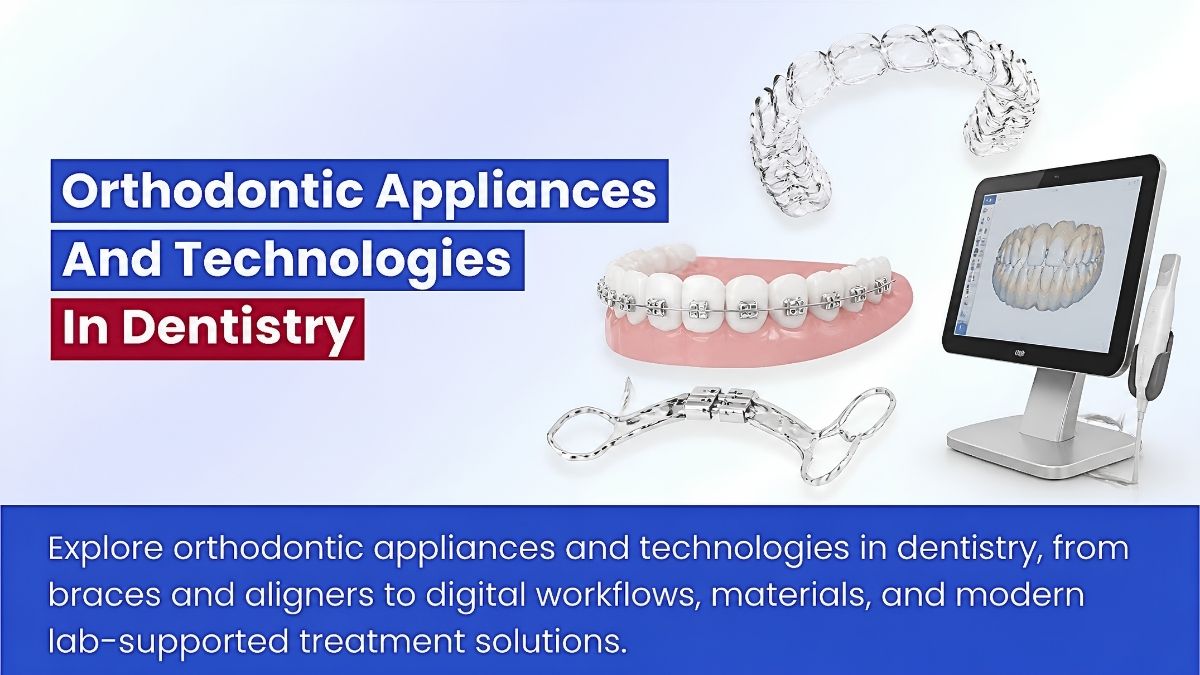
Table of contents [Show]
- What is orthodontics?
- Main orthodontic appliances
- Materials used in orthodontics
- Technologies shaping orthodontics
- Clinical applications of orthodontics
- Benefits of modern orthodontics
- Challenges and limitations
- Future direction of orthodontics
- Why orthodontics matters for lab-to-lab outsourcing
- Key takeaways
- References
Orthodontics is one of the most important disciplines in dentistry because it addresses the alignment of teeth and jaws in ways that affect function, aesthetics, oral health, and long-term restorative planning. While many people associate orthodontics only with braces, the field is much broader. It includes diagnosis of malocclusion, management of dental and skeletal discrepancies, appliance design, growth modification, retention, and increasingly digital treatment workflows that improve precision and efficiency.
For dental practices, orthodontics is not only a clinical specialty. It is also a workflow-driven discipline that depends on accurate records, appliance fabrication, material performance, and reliable laboratory collaboration. From fixed braces and clear aligners to retainers, expanders, space maintainers, and functional appliances, orthodontic treatment involves a wide range of devices that must be carefully designed and consistently manufactured. This article explores orthodontics in depth, including its purpose, major appliances, materials, technologies, clinical applications, benefits, challenges, future direction, and the role of laboratory outsourcing.
What is orthodontics?
Orthodontics is the branch of dentistry focused on diagnosing, preventing, and treating irregularities of the teeth, bite, and jaw relationship.
Core purpose
Its main goals include correcting tooth alignment, improving occlusion, enhancing facial and dental aesthetics, supporting oral hygiene through better tooth positioning, and improving function, speech, and long-term dental stability.
Orthodontics may address purely dental problems, skeletal discrepancies, or a combination of both.
Why orthodontics matters
Orthodontic treatment is important because malocclusion can contribute to difficulty cleaning teeth, uneven wear, functional inefficiency, aesthetic concerns, restorative challenges, and jaw development issues in some patients.
In many cases, orthodontics also supports other dental treatments by preparing the mouth for prosthetic, implant, or multidisciplinary rehabilitation.
Main orthodontic appliances
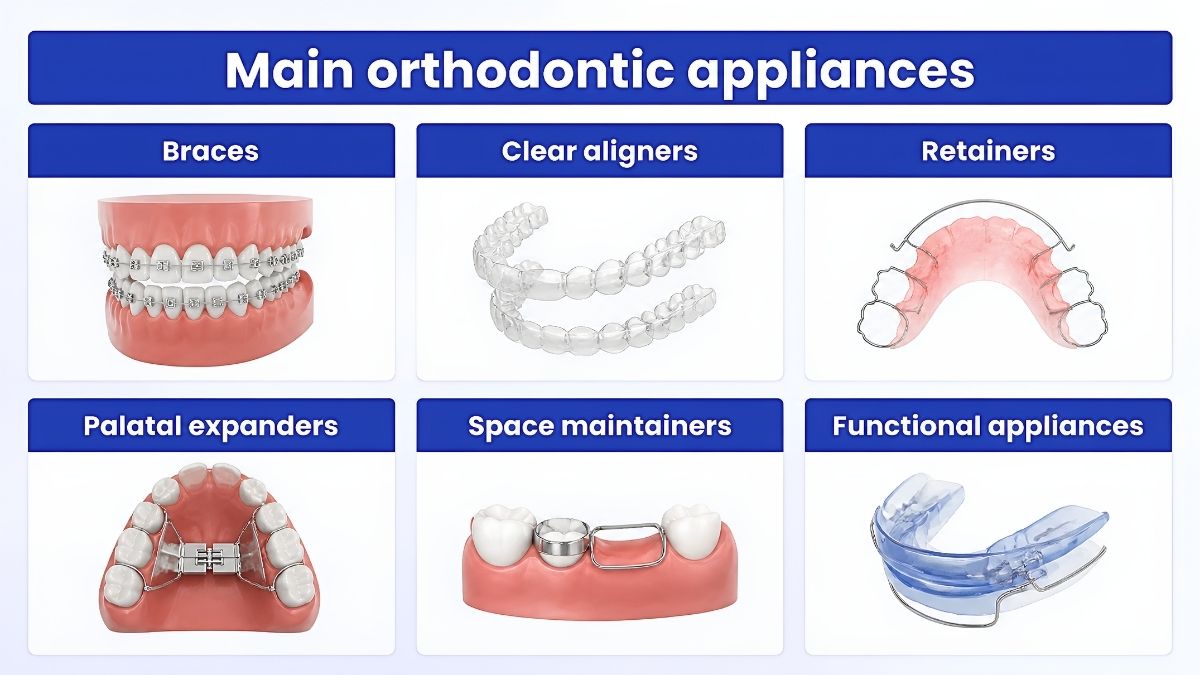
Orthodontic treatment uses a wide range of fixed and removable appliances depending on age, diagnosis, treatment goals, and patient compliance.
Braces
Braces are among the most recognized orthodontic appliances.
Common types
They may include traditional metal braces, ceramic braces, self-ligating systems, and lingual braces.
Braces use brackets, wires, and auxiliary components to apply controlled force and move teeth into planned positions.
Clear aligners
Clear aligners are removable orthodontic trays used to reposition teeth through a series of staged movements.
Why they are widely used
Their popularity is driven by transparent appearance, removability, patient convenience, and digital planning compatibility.
They are typically made from thermoplastic materials and are produced through highly digital workflows.
Retainers
Retainers are used after active orthodontic treatment to help maintain tooth position.
Common types
Retainers may be fixed or bonded retainers, Hawley retainers, or Essix-style clear retainers.
Retention is a critical phase of orthodontics because teeth tend to relapse without stabilization.
Palatal expanders are used to widen the upper arch, particularly in growing patients.
Clinical purposes
They can help address narrow maxillary arches, posterior crossbites, space limitations, and certain airway-related structural concerns in selected cases.
Space maintainers
Space maintainers preserve arch space after premature tooth loss, especially in pediatric patients.
Main purpose
Their goal is to prevent adjacent teeth from drifting into the empty space and interfering with eruption patterns.
Functional appliances
Functional appliances help guide jaw growth and improve jaw relationships in selected developing patients.
Examples
Examples may include twin block, Herbst appliance, and Bionator-type designs.
These appliances are often used in treatment of skeletal Class II relationships or other developmental discrepancies.
Materials used in orthodontics
Orthodontic success depends not only on diagnosis and mechanics, but also on the properties of the materials used in appliance fabrication.
Stainless steel
Stainless steel remains one of the most widely used orthodontic materials.
Common uses
It is commonly used for brackets, bands, archwires, space maintainers, and retainer components.
Its value comes from strength, corrosion resistance, and reliable clinical performance.
Nickel-titanium
Nickel-titanium, or NiTi, is especially important for orthodontic archwires.
Key benefits
Its benefits include shape memory, superelasticity, and gentle continuous force delivery.
These properties make it highly useful in early alignment phases.
Ceramics
Ceramic materials are commonly used in aesthetic orthodontic brackets.
Aesthetic advantage
Their key advantage is improved appearance compared with traditional metal brackets, especially for adult patients seeking less visible treatment.
Thermoplastics and polyurethane
Thermoplastic materials are central to clear aligners, Essix retainers, and certain vacuum-formed appliances.
Why these materials matter
These materials support transparent, removable orthodontic solutions and are strongly linked to digital production methods.
Acrylic resins
Acrylic is often used in removable orthodontic appliances such as Hawley retainers, functional appliances, expanders, and bite plates.
Laboratory relevance
It remains an important material for laboratory-fabricated orthodontic devices.
Technologies shaping orthodontics
Orthodontics has been significantly transformed by digital technologies that improve record collection, appliance production, and treatment planning.
Digital impressions
Intraoral scanners allow clinicians to capture detailed digital impressions without conventional tray-based materials.
Clinical value
This helps improve patient comfort, record accuracy, and data transfer speed.
CAD/CAM design
CAD/CAM systems are increasingly used in orthodontics for appliance design, retainer production, splint fabrication, digital setup planning, and aligner workflow coordination.
Why CAD/CAM matters
This allows greater precision and repeatability in laboratory manufacturing.
3D printing
3D printing plays a major role in orthodontics, especially for aligner models, retainers, indirect bonding trays, study models, splints, and prototype appliances.
Production advantages
Its value lies in production speed, digital consistency, and scalable customization.
Robotic wire bending
Automated wire bending systems can produce orthodontic archwires with high accuracy and consistent force design.
Workflow benefits
These systems support efficiency and reduce variability in selected workflows.
AI-driven treatment planning
Artificial intelligence is increasingly being integrated into orthodontic systems for tooth movement simulation, treatment staging, case analysis, outcome prediction, and workflow optimization.
Future significance
This trend is likely to expand as digital orthodontics matures further.
Clinical applications of orthodontics
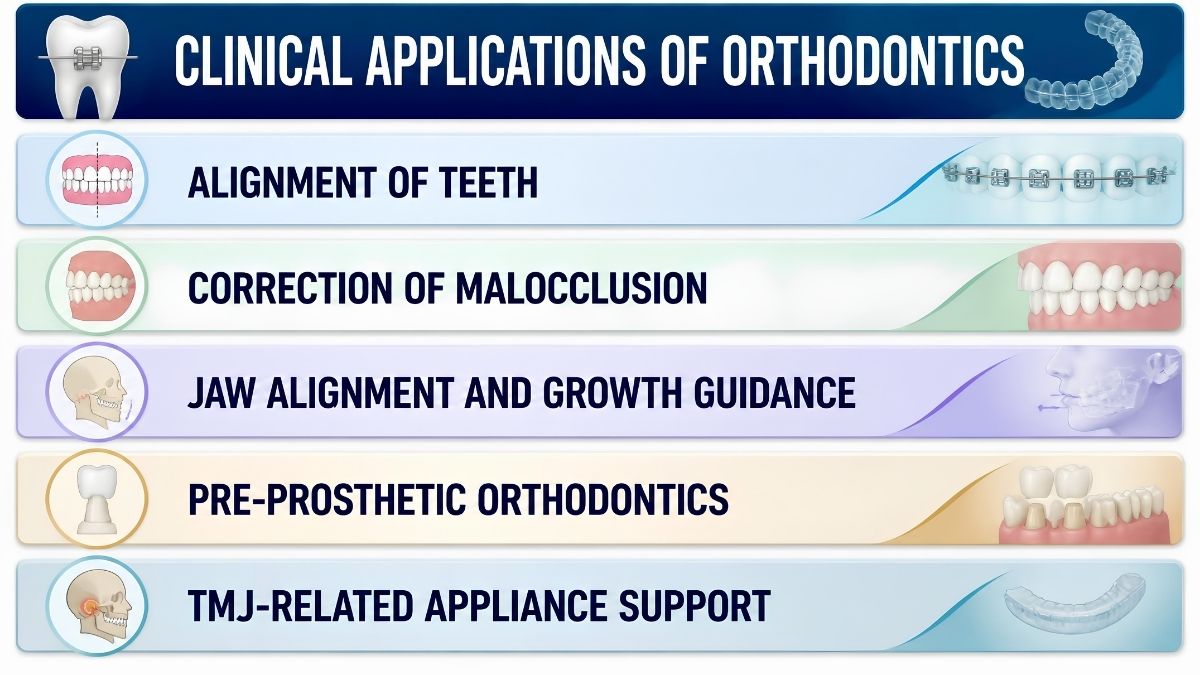
Orthodontics is used across a wide range of preventive, interceptive, corrective, and multidisciplinary treatment scenarios.
Alignment of teeth
Orthodontics corrects crowding, spacing, rotations, proclination or retroclination, and eruption irregularities.
These changes improve both function and aesthetics.
Correction of malocclusion
Orthodontic treatment addresses conditions such as overbite, underbite, crossbite, open bite, deep bite, and Class II and Class III relationships.
Jaw alignment and growth guidance
In growing patients, orthodontics may guide skeletal development with functional or orthopedic appliances.
Why timing matters
This is especially important when treatment timing can influence the outcome of jaw-related correction.
Pre-prosthetic orthodontics
Orthodontics often supports restorative and implant dentistry by creating better tooth position and space distribution before prosthetic treatment.
Benefits for restorative planning
This may improve implant site planning, pontic space design, occlusal balance, and overall restorative predictability.
Although TMJ disorders are multifactorial and not purely orthodontic, laboratory-fabricated appliances such as splints and bite guards may play a role in supportive management.
Benefits of modern orthodontics
Modern orthodontic treatment offers important benefits for patients and dental providers alike.
Better precision
Digital workflows improve diagnosis, planning, and fabrication accuracy, which can support more predictable treatment outcomes.
Improved aesthetics
Ceramic brackets, lingual systems, and clear aligners offer more discreet treatment options, especially valued by adult patients.
Enhanced patient comfort
Custom-designed appliances and more advanced materials often improve fit and reduce unnecessary bulk.
Broader treatment accessibility
Orthodontic care now includes a wider range of options suited to different ages, preferences, and case types.
Better interdisciplinary care
Orthodontics increasingly works alongside prosthodontics, oral surgery, pediatric dentistry, and implant dentistry in integrated treatment planning.
Challenges and limitations
Orthodontics also presents challenges that practices must manage carefully.
Cost considerations
Advanced systems, digital platforms, and custom appliance fabrication can increase treatment cost and laboratory requirements.
Patient compliance
Removable appliances such as aligners and retainers depend heavily on patient cooperation for effectiveness.
Material and biomechanical limitations
Every orthodontic system has limitations related to force control, material durability, case suitability, and biological response variability.
Training and workflow demands
Digital orthodontics requires both clinicians and laboratories to maintain updated skills in scanning, design, appliance fabrication, and treatment planning.
Future direction of orthodontics
Orthodontics continues to evolve toward more intelligent, connected, and patient-specific care.
Smart orthodontic appliances
Emerging systems may include sensors that monitor wear time, force delivery, or treatment progress in real time.
AI-enhanced diagnostics
Artificial intelligence is expected to improve cephalometric analysis, movement prediction, and treatment decision support.
Sustainable materials and workflows
The field is also moving toward lower-waste production, more efficient appliance design, and potentially greener material options.
Teleorthodontics and remote monitoring
Remote review systems and digital follow-up tools are expanding access and improving convenience in selected orthodontic workflows.
Why orthodontics matters for lab-to-lab outsourcing
Orthodontics is one of the dental fields most dependent on reliable appliance fabrication, material consistency, and fast laboratory turnaround.
What practices need from a lab partner
Practices need orthodontic lab partners who can provide accurate appliance fabrication, reliable digital workflow compatibility, consistent material standards, case-specific customization, efficient communication, and dependable turnaround times.
Relevance to XDENT LAB
For XDENT LAB, orthodontic workflows align naturally with its broader lab-to-lab service model for dental practices seeking quality consistency and scalable support. As a Vietnam dental lab serving international clients, XDENT LAB is positioned to support removable and appliance-based dental production with advanced manufacturing systems, certified technicians, and compliance-oriented quality processes.
With FDA and ISO-oriented standards, growing production capacity, and strong technical capability, XDENT LAB can support practices looking for dependable outsourcing solutions across increasingly digital dental workflows.
Key takeaways
Orthodontics is a core dental discipline focused on aligning teeth and jaws to improve oral health, function, aesthetics, and long-term treatment stability. It includes a broad range of appliances such as braces, clear aligners, retainers, expanders, and functional devices, all supported by evolving materials and digital production technologies.
For dental practices, the modern orthodontic landscape depends not only on diagnosis and mechanics, but also on high-quality laboratory execution. As digital impressions, CAD/CAM, 3D printing, and AI-driven planning become more central to care, the value of a reliable dental laboratory partner continues to grow.
References
- Orthodontic dental lab - DDS Lab
- Precision-made orthodontic appliances and splints - Confident Lab
- The role and function of an orthodontic laboratory - Stricker Dental Care
- Innovations in dental lab equipment and technology - Pan Am Dental Lab
About XDENT LAB:
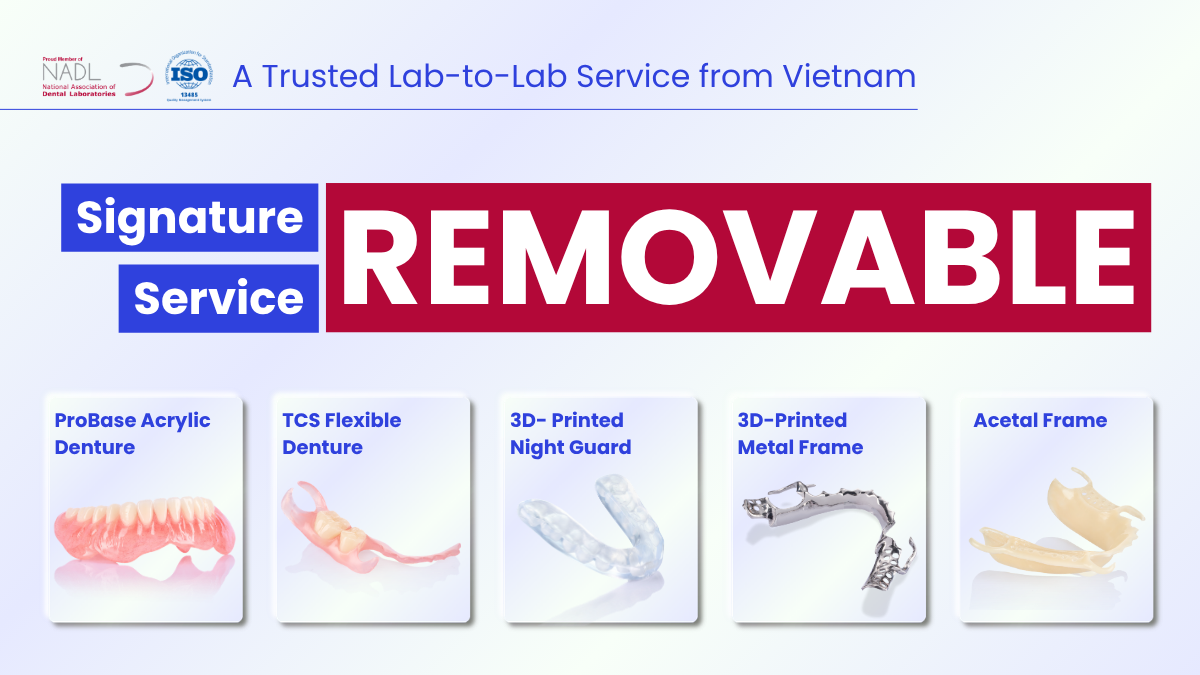
We are experts in Lab-to-Lab Full Service from Vietnam, with the signature services of Removable, meet U.S. market standards, FDA-registered, ISO 13485-certified. Founded in 2017, from local root to global reach, we scale with 2 Factories with over 100+ employees.
Our Commitments Built on “Trusted. Commitment. Quality”
- Commit to Large-Scale Manufacturing, high volume, remake rate < 1%.
- Commit to 5-Year Warranty
- Commit to Competitive Price
XDENT LAB | A Trusted Lab-to-Lab Service from Vietnam
Share this post:
Related Posts
Explore lab-to-lab workflow and QC for implant-supported fixed prostheses, from fit and materials to retrievability, hygiene design, and consistency.
Explore lab workflow and quality standards for inlays, onlays, and overlays to improve fit, occlusion, durability, and restorative consistency.
Explore veneer laboratory workflow, shade control, and quality checks in prosthodontics for predictable esthetics, fit, bonding, and long-term results.

