
Discover the QA/QC criteria behind consistent Zirconia Crown & Bridge quality, and what to look for when choosing an outsourcing dental lab.
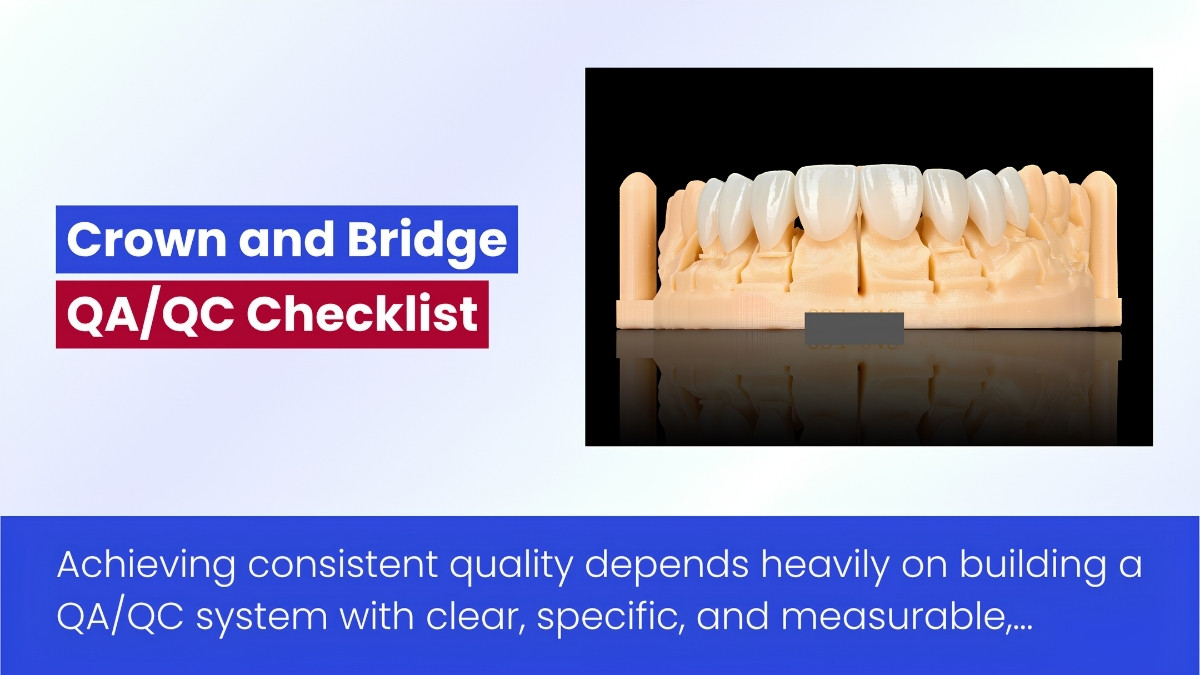
Table of contents [Show]
In a dental lab-to-clinic or lab-to-lab workflow, maintaining consistent, stable quality is one of the most important factors in evaluating a dental lab's capability and service quality.
Achieving this consistency depends heavily on building a QA/QC system with clear, specific, and measurable inspection criteria. A standardized set of criteria not only makes the production process more systematic and easier to control, but also creates a common language between all parties, making communication, evaluation, and issue resolution around quality more transparent and effective.
In this article, we'll walk through a QA/QC criteria set for the Zirconia Crown & Bridge manufacturing process, organized by a functional group and the specific characteristics each one covers.
This can serve as a reference guideline for dental labs building or standardizing their own QA/QC systems, with the goal of achieving a production process that is stable, consistent, and measurable.
1. Fit and Mechanical Accuracy
This is the foundation of a properly fitting restoration, directly affecting its longevity and the health of the surrounding periodontal tissue.
- Marginal integrity: the finish line must seal tightly, with no gaps that could allow plaque buildup or microleakage.
- Internal fit: the inner surface of the crown must sit closely against the prepared tooth, avoiding both binding and looseness that could create uneven stress on the abutment tooth.
- Occlusal contacts: chewing forces must be distributed correctly, avoiding premature contact points that cause pain or porcelain fracture.
- Proximal contacts: tight enough to prevent food impaction between teeth, but not so tight that flossing becomes difficult.
2. Shape and Natural Aesthetics
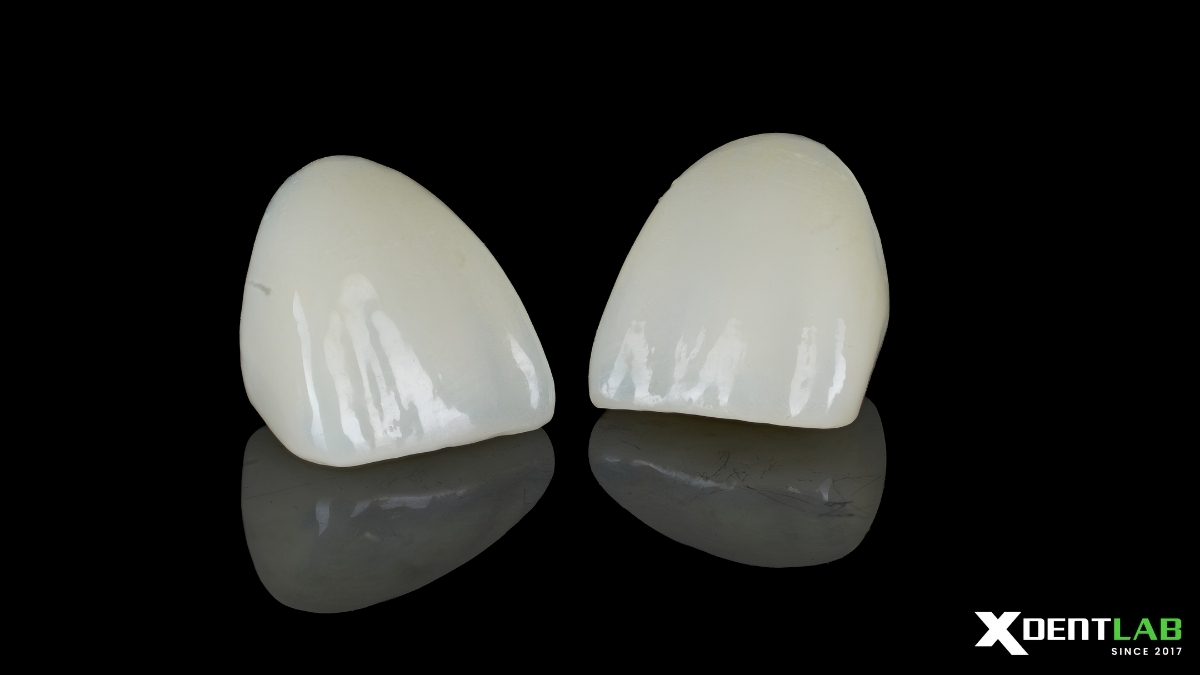
A beautiful restoration isn't just "white and shiny", it must accurately replicate real tooth anatomy.
- Anatomical shape: cusp outlines, grooves, and ridges must correctly follow the original tooth data or the contralateral tooth.
- Natural morphology: fine details like enamel texture lines and surface undulations that create a lifelike appearance.
- Symmetry: especially critical in the anterior region, where asymmetry is easily noticeable to the naked eye.
3. Shade: A Key Factor in Patient Satisfaction
Shade mismatch is one of the most common reasons restorations get sent back for remake.
- Shade accuracy: matching the specified shade guide (VITA Classical, VITA 3D-Master, etc.).
- Brightness, chroma, and value: three factors that must be balanced simultaneously, not just matched to the general tone.
- Translucency: accurately replicating light transmission across different zones of the tooth (more translucent at the incisal edge, more opaque at the body).
- Characterisation: details such as staining, micro-cracks, and color gradients that create a natural look rather than a flat, uniform color.
4. Surface Finish
- Surface texture: replicating natural enamel surface texture, avoiding a flat, lifeless finish.
- Polishing and gloss: glossy enough to resist plaque buildup and wear on the opposing dentition, without creating abnormal light reflection.
5. Design Quality and Clinical Effectiveness
This group of criteria reflects the true value a good lab delivers: reducing chairside adjustment time and cost for the clinic.
- Design quality: the CAD design file must be optimized for wall thickness, finish line placement, and cement gap before moving into production.
- Clinical first-time fit: the ultimate goal of the entire QC process, the restoration seats properly at the chair on the first try, with minimal adjustment needed.
- Amount of adjustment required in clinic: the less adjustment needed, the tighter the lab's production process and quality control.
6. Managing Aesthetic Expectations: Turning "Aesthetic" Into a Controllable Criterion
One of the biggest challenges in controlling aesthetic quality is that "beautiful" is inherently subjective. The same restoration might be seen as natural by one customer, while another expects a higher level of characterization or translucency.
On top of that, aesthetic level is usually tied to material choice, production time, technician skill, and cost. So expecting every restoration to achieve the highest possible aesthetic level isn't always realistic.
The solution isn't to chase a "perfect esthetic" standard for every case, but to clearly define the expected aesthetic level upfront and ensure the entire workflow adheres to it.
A dental lab can build an Aesthetic Expectation Management system consisting of the following steps:
6.1. Define aesthetic levels
- The lab should divide aesthetic quality into clear tiers, for example, Standard, Enhanced, and Premium. Each tier needs a specific description covering morphology, shade, translucency, characterization, and surface texture.
6.2. Build an Aesthetic Reference Library
- Instead of relying on vague descriptions like "natural," "beautiful," or "high esthetic," the lab should prepare a standardized library of reference images. Customers can then select the image or aesthetic level they want before the case goes into production.
6.3. Confirm aesthetic expectations before production
- For cases with high aesthetic demands, the case intake team or account manager needs to confirm details such as shade, aesthetic level, reference images, and any special requests before production begins.
6.4. Translate expectations into a production brief
- Information agreed upon with the customer needs to be converted into a clear production brief and communicated to the technician. This helps prevent information from being altered or misinterpreted as it passes between customer, manager, technician, and QC team.
6.5. QC based on agreed-upon standards
- At the final QC stage, a restoration shouldn't be evaluated purely on the inspector's subjective impression. Instead, it should be checked against the aesthetic level and reference agreed upon before production.
The goal of aesthetic QC, then, isn't necessarily "100% perfection", it's producing a result that is consistent, predictable, and aligned with customer expectations.
When aesthetic expectations are defined through concrete references and communicated consistently from customer → management → technician → QC, aesthetics shift from a subjective criterion into something that can be communicated, controlled, and evaluated consistently.
Why These Standards Matter
A QA/QC system only delivers real value when everyone involved understands why it matters and applies it seriously as a genuine evaluation tool, not as a checklist built for appearances and then left unused in day-to-day production.

Historically, quality standards in dental restorations have been judged largely by feel words like "beautiful," "natural," or "good enough" carry no clear boundaries, and the final outcome depends heavily on the experience and personal taste of whoever happens to be evaluating it at that moment. Shifting this evaluation toward measurable, clearly described criteria makes production management significantly easier: every case is checked against a shared reference standard, rather than each inspection depending on one person's individual judgment.
More importantly, this system reduces a lab's dependence on one or a few highly skilled technicians. When quality is defined by explicit criteria rather than living inside an individual's "feel" for the work, that knowledge and experience can be standardized, taught, and scaled across the entire team. This is precisely what makes scaling a dental lab a realistic goal, rather than one permanently capped by the capacity of a small group of key personnel.
About XDENT LAB:
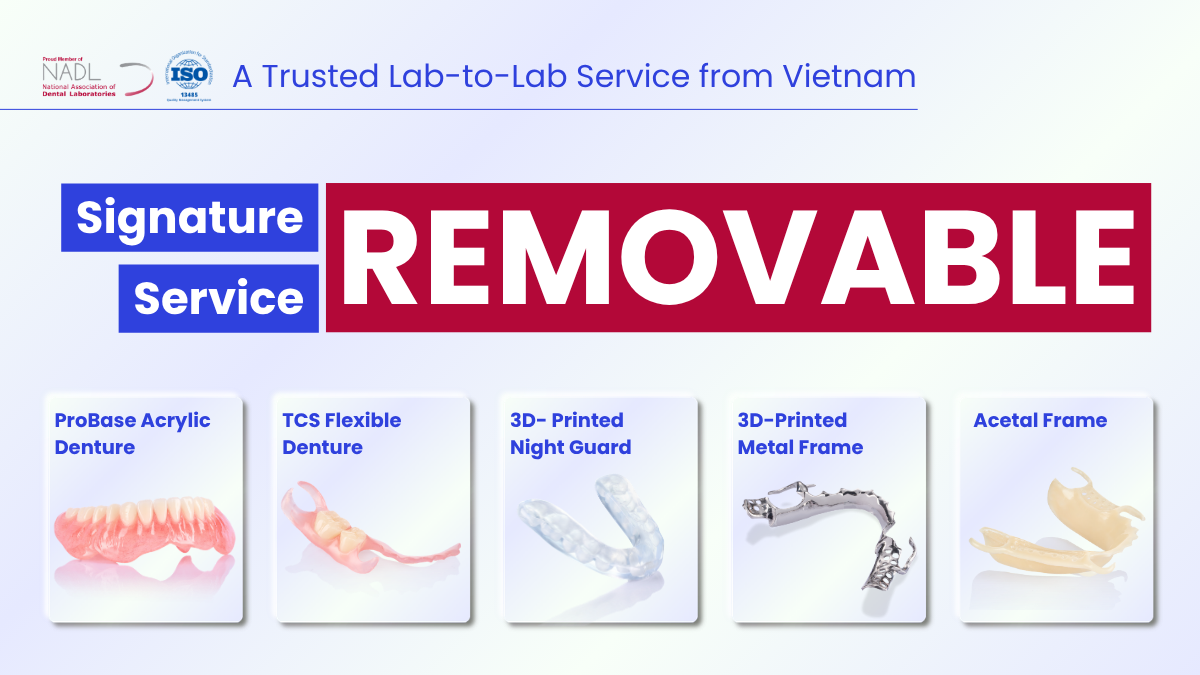
We are experts in Lab-to-Lab Full Service from Vietnam, with the signature services of Removable, meet U.S. market standards, FDA-registered, ISO 13485-certified. Founded in 2017, from local root to global reach, we scale with 2 Factories with over 100+ employees.
Our Commitments Built on “Trusted. Commitment. Quality”
- Commit to Large-Scale Manufacturing, high volume, remake rate < 1%.
- Commit to 5-Year Warranty
- Commit to Competitive Price
XDENT LAB | A Trusted Lab-to-Lab Service from Vietnam
Share this post:
Related Posts

Comprehensive guide to ISO 20795-1 for dental base polymers: material types (Types 1–5), key requirements, flexural testing methods, FDA/EN compliance, water sorption/solubility limits, and lab QA pra...
Ensure reliable dental outsourcing with ISO 9001/13485, FDA 21 CFR 820, and MDR. Vendor qualification, traceability, QA protocols, and CAPA for consistent quality.

Concise, practical guide to Good Manufacturing Practices (GMP). Covers regulatory frameworks (21 CFR), quality systems, documentation, validation, inspections, data integrity (ALCOA+), and best practi...

