
Explore veneer laboratory workflow, shade control, and quality checks in prosthodontics for predictable esthetics, fit, bonding, and long-term results.
Table of contents [Show]
- What are veneers in prosthodontics
- Veneers vs crowns: The core difference
- Indications for veneers
- Contraindications and high-risk cases
- Types of veneers
- Veneer preparation designs
- Tooth reduction guidelines
- Diagnostic wax-up and smile design
- Mock-up and trial smile
- Laboratory workflow for veneers
- Veneer material selection
- Shade selection for veneers
- Veneer bonding and cementation
- Occlusion and veneers
- Periodontal and gingival considerations
- Veneers for specific clinical problems
- Complications of veneers
- Survival and longevity of veneers
- Laboratory quality control for veneers
- Digital veneers and CAD/CAM
- Maintenance of veneers
- Standards and veneer manufacturing
- Why this matters for XDENT LAB
- Key takeaways
Veneers are among the most conservative and esthetically demanding restorations in prosthodontics. From a dental laboratory perspective, a veneer is not just a thin ceramic shell. It is a highly controlled restoration in which material thickness, tooth preparation, enamel bonding, shade management, emergence profile, incisal design, surface texture, and adhesive protocol all influence long-term success.
For dental practices looking to ensure quality and consistency, veneers require more than attractive design. They demand disciplined case selection, precise communication between clinic and laboratory, appropriate material choice, and careful control of bonding and occlusion. In other words, veneers are small restorations with very little tolerance for big mistakes.
What are veneers in prosthodontics
A dental veneer is a thin indirect restoration bonded to the facial, labial, or visible surface of a tooth to improve esthetics, contour, color, alignment, and sometimes minor functional defects.
Common prosthodontic uses
- Esthetic smile enhancement
- Tooth discoloration
- Enamel defects
- Minor malposition
- Diastema closure
- Worn incisal edges
- Peg-shaped laterals
- Mild tooth shape correction
- Replacement of old composite bonding
- Conservative anterior rehabilitation
Porcelain laminate veneers are widely used because they provide excellent esthetics and favorable clinical longevity when bonded primarily to enamel.
Veneers vs crowns: The core difference
Veneers and crowns are both indirect restorations, but they differ significantly in tooth coverage, invasiveness, and restorative purpose.
| Feature | Veneer | Crown |
|---|---|---|
| Tooth coverage | Mainly facial or labial surface | Covers most or all clinical crown |
| Tooth reduction | Minimal to moderate | Moderate to extensive |
| Retention | Adhesive bonding | Mechanical retention plus cementation or bonding |
| Best substrate | Enamel | Enamel, dentin, core, or abutment |
| Main purpose | Esthetic correction | Protection, function, structure restoration |
| Common location | Anterior teeth and some premolars | Anterior and posterior teeth |
| Esthetic potential | Very high | High, depending on material |
| Biological cost | Lower if enamel-preserving | Higher due to fuller coverage |
Practical interpretation
A veneer is usually preferred when the tooth is structurally sound and the main goal is esthetic correction. A crown is more appropriate when the tooth is heavily restored, structurally weakened, endodontically treated with limited remaining tooth structure, or requires full-coverage protection.
Good prosthodontics is not about turning every anterior tooth into a crown. It is about preserving as much healthy tooth structure as possible while delivering a stable result.
Indications for veneers
Veneers are indicated when esthetic improvement can be achieved conservatively and adequate bonding substrate is available.
Common clinical indications
| Indication | Why veneers may be suitable |
|---|---|
| Tooth discoloration | Masks intrinsic or extrinsic stains |
| Fluorosis | Improves color and surface uniformity |
| Tetracycline staining | May improve appearance depending on severity |
| Enamel hypoplasia | Restores surface and shape |
| Peg lateral incisors | Corrects size and contour |
| Diastema | Closes spaces conservatively |
| Minor rotations | Improves apparent alignment |
| Small teeth | Increases visible tooth volume |
| Worn incisal edges | Restores length and esthetics |
| Old composite bonding | Replaces stained or failing resin |
| Smile design cases | Harmonizes shape, shade, and proportion |
Veneers are most predictable when they are used as part of a conservative, well-planned esthetic strategy rather than as a shortcut for every cosmetic problem.
Contraindications and high-risk cases
Veneers are not ideal for every patient, and careful case selection is essential.
Contraindications
- Insufficient enamel for bonding
- Severe bruxism without protection
- Edge-to-edge traumatic occlusion
- Poor oral hygiene
- High caries activity
- Active periodontal disease
- Severe malposition requiring orthodontics
- Large existing restorations
- Very short clinical crowns
- Deep bite with heavy anterior guidance
- Unrealistic esthetic expectations
- Poor isolation for bonding
- Severe discoloration requiring more masking than a veneer can predictably provide
Relative contraindications
| Condition | Concern |
|---|---|
| Large Class III or IV restorations | Reduced bonding area and higher fracture risk |
| Exposed dentin | Less predictable bonding than enamel |
| Severe dark stump shade | Thin veneer may not mask discoloration |
| Parafunction | Chipping, debonding, or fracture risk |
| Thin gingival biotype | Margin visibility and tissue sensitivity |
| Poor compliance | Higher failure and maintenance risk |
A veneer bonded mostly to enamel is a very different restoration from a veneer bonded mostly to dentin. Same restoration category, very different prognosis.
Types of veneers
Veneers can be classified by material, preparation design, and fabrication method.
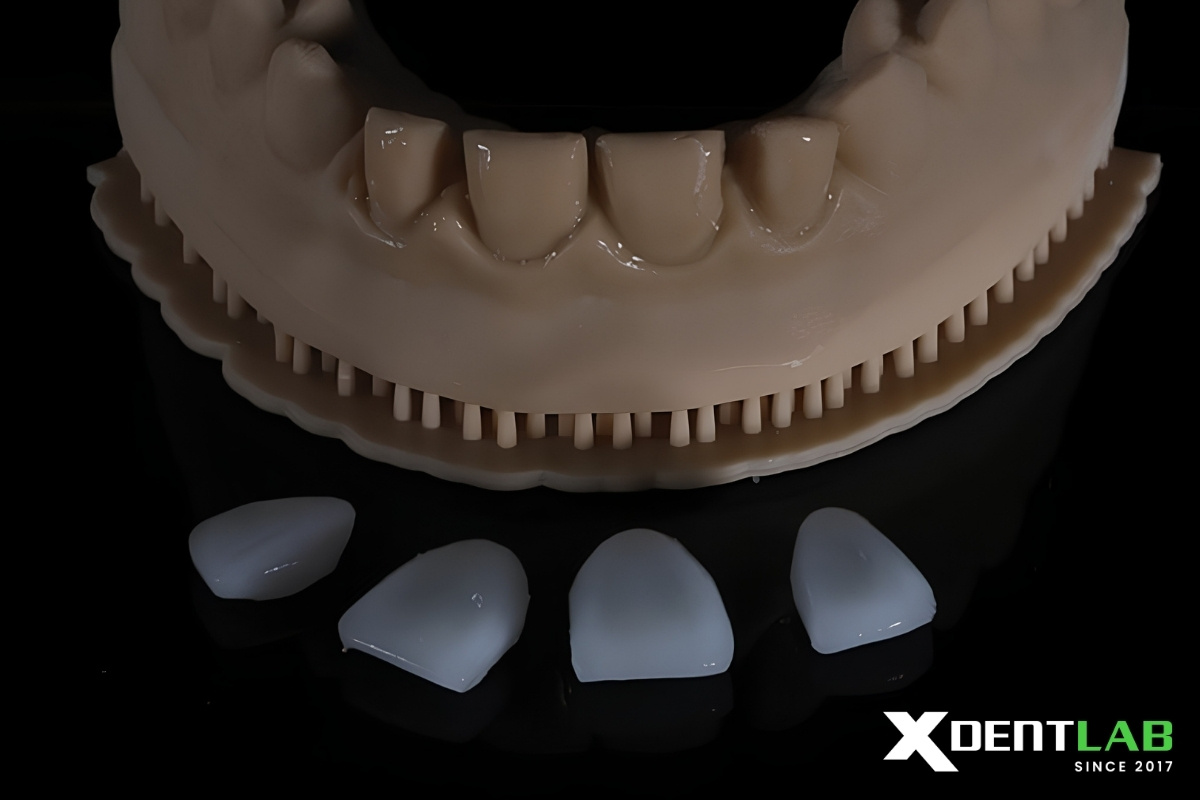
Porcelain laminate veneers
Porcelain laminate veneers are thin ceramic restorations bonded to the facial surface of teeth.
Advantages
- Excellent esthetics
- Color stability
- High translucency
- Strong enamel bond when bonded properly
- Good stain resistance
- Natural surface texture
- Long clinical survival in selected cases
Limitations
- Brittle before bonding
- Technique-sensitive
- Requires excellent isolation
- More difficult to repair than composite
- Shade correction depends on thickness and opacity
- Usually more expensive than direct composite veneers
Composite veneers
Composite veneers may be direct or indirect.
Direct composite veneers
These are placed chairside using composite resin.
Advantages include:
- Lower cost
- Conservative treatment
- Repairability
- One-visit completion
- Useful for younger patients
- Useful as transitional restorations
Limitations include:
- Lower color stability than ceramic
- Greater tendency to stain
- More wear over time
- Technique-sensitive contouring
- Maintenance polishing may be needed
Indirect composite veneers
These are fabricated in the lab and bonded later.
Advantages include:
- Better contour control than direct composite
- Improved polymerization compared with direct placement
- Repairability
- More affordable than ceramic in some cases
Limitations include:
- Less color stability than porcelain
- Potential wear and surface degradation
- Bonding remains critical
Feldspathic porcelain veneers
Feldspathic porcelain is a classic high-esthetic veneer material.
Advantages
- Excellent translucency
- Highly natural appearance
- Strong layering potential
- Very thin fabrication possible
- Ideal for high-end anterior esthetics
Limitations
- Lower strength than lithium disilicate
- Highly technique-sensitive
- Requires excellent ceramic artistry
- Best when bonded to enamel
- Less ideal for high-load or poor bonding cases
Lithium disilicate veneers
Lithium disilicate is a glass-ceramic widely used for veneers and other esthetic restorations.
Advantages
- Higher strength than feldspathic porcelain
- Good translucency
- Can be pressed or CAD/CAM milled
- Excellent bonding potential after etching and silanization
- Available in different translucencies and opacities
- Suitable for many anterior veneer cases
Limitations
- May require slightly more thickness than feldspathic porcelain
- Very translucent versions may not mask dark tooth structure
- Esthetic layering may still be needed for complex cases
- Bonding remains technique-sensitive
No-prep and minimal-prep veneers
No-prep or minimal-prep veneers are extremely conservative restorations.
Indications
- Small teeth
- Lingually positioned teeth
- Diastema closure
- Slight increase in facial volume
- Enamel defects with minimal contour correction
- Additive smile design cases
Risks
- Over-contouring
- Bulky emergence profile
- Poor gingival harmony
- Limited masking ability
- Unnatural thickness
- Marginal overhang if not designed carefully
No-prep veneers are not magic. They work best when the case truly needs addition, not disguise.
Veneer preparation designs
Preparation design is one of the most important factors affecting veneer success.
Common preparation designs
| Preparation design | Description | Use case |
|---|---|---|
| No-prep | No tooth reduction | Additive cases, small teeth |
| Window preparation | Facial reduction without incisal coverage | Color and contour correction |
| Feather-edge incisal | Facial reduction ending at the incisal edge | Conservative esthetic cases |
| Butt-joint incisal | Incisal edge reduced, veneer ends at butt joint | Common for length and edge control |
| Palatal overlap | Veneer wraps over incisal edge onto palatal | Cases needing incisal length or guidance change |
| Proximal extension | Preparation extends interproximally | Diastema closure, shape correction |
Enamel preservation
The most important preparation principle is preserving enamel whenever possible.
Why enamel matters:
- Stronger and more predictable bonding
- Better marginal seal
- Lower risk of debonding
- More conservative biology
- Improved long-term retention
Tooth reduction guidelines
Veneer reduction depends on material, tooth position, desired shade change, and final contour.
Typical reduction ranges
| Area | Common reduction range |
|---|---|
| Cervical third | 0.3–0.5 mm |
| Middle third | 0.5–0.7 mm |
| Incisal third | 0.5–0.7 mm |
| Incisal reduction if needed | 1.0–1.5 mm |
| Proximal extension | Case-dependent |
Factors that increase required thickness
- Dark tooth shade
- Severe discoloration
- Major shade change
- Need for shape correction
- Existing restoration replacement
- Malpositioned teeth
- Opaque ceramic selection
- Need to mask tetracycline staining
Factors that allow minimal thickness
- Minor shade change
- Additive cases
- Small teeth
- Existing spacing
- Enamel defects only
- Feldspathic porcelain use
- High-value translucent result desired
Reduction should follow the planned final tooth position, not simply facial reduction by habit. That is why diagnostic wax-ups and reduction guides matter so much.
Diagnostic wax-up and smile design
Veneer cases should be planned before preparation begins.
Diagnostic planning tools
- Clinical photos
- Facebow or digital articulator records
- Intraoral scan
- Study models
- Digital smile design
- Diagnostic wax-up
- Mock-up
- Silicone reduction guides
- Putty matrix
- Provisional templates
- Shade mapping
Why wax-up matters
A wax-up helps define:
- Tooth length
- Width-to-height ratio
- Incisal edge position
- Midline
- Smile curve
- Buccal corridor
- Emergence profile
- Gingival harmony
- Occlusal envelope
- Required preparation depth
- Final ceramic thickness
A veneer case without a wax-up is a bit like tailoring a suit without measurements. Brave, perhaps, but not a winning plan.
Mock-up and trial smile
A mock-up transfers the wax-up into the patient’s mouth before definitive treatment.
Mock-up benefits
- Allows patient preview
- Tests esthetic design
- Helps evaluate phonetics
- Guides preparation depth
- Supports enamel preservation
- Improves communication with the lab
- Reduces uncertainty
- Helps informed consent
Mock-up materials
- Bis-acryl provisional material
- Flowable composite
- Printed try-in shells
- Milled PMMA prototype
- Digital mock-up overlays
When mock-ups are especially useful
- Multiple veneers
- Smile makeovers
- Diastema closure
- Incisal length changes
- Worn dentition
- Esthetic rehabilitation
- Patients with high expectations
Laboratory workflow for veneers
Veneer fabrication is one of the most technique-sensitive laboratory procedures in prosthodontics.
Conventional veneer workflow
Prescription and photos received
→ Impression or model fabrication
→ Die trimming
→ Margin marking
→ Refractory die or pressed technique
→ Ceramic layering or pressing
→ Contour refinement
→ Texture creation
→ Stain, glaze, or polish
→ Fit verification
→ Final QC
→ Delivery
Digital veneer workflow
Digital scan received
→ Photo and shade review
→ CAD design
→ Digital wax-up or mock-up
→ Milling or printing pattern
→ Pressing or milling ceramic
→ Crystallization if needed
→ Stain, glaze, polish
→ Final fit and esthetic QC
→ Delivery
Hybrid workflow
Many labs combine digital design with analog finishing.
Example:
Intraoral scan
→ CAD wax-up
→ 3D printed model
→ Pressed lithium disilicate veneer
→ Hand-layered characterization
→ Final polishing
This hybrid approach is common because digital design improves consistency, while hand finishing creates more natural texture and character.
Veneer material selection
Material selection depends on esthetic demand, tooth color, preparation depth, occlusion, and lab capability.
Veneer material comparison
| Material | Best for | Strengths | Limitations |
|---|---|---|---|
| Feldspathic porcelain | Maximum esthetics, very thin veneers | Natural translucency, layering artistry | Lower strength, technique-sensitive |
| Lithium disilicate | Strength plus esthetics | Stronger glass ceramic, press and CAD options | Requires thickness and shade planning |
| Leucite-reinforced ceramic | Esthetic veneers | Good translucency and bondability | Less common than lithium disilicate |
| Composite resin | Conservative, temporary, or lower-cost cases | Repairable, affordable | Staining and wear |
| Hybrid ceramic | CAD/CAM cases | Millable, resilient | Long-term veneer evidence less established |
| Zirconia | Rare veneer use | Can help mask dark substrate | Bonding and translucency limitations |
Best material by clinical situation
| Clinical situation | Preferred material |
|---|---|
| Thin enamel-preserving veneer | Feldspathic porcelain |
| Moderate shade change | Lithium disilicate |
| Dark tooth masking | More opaque lithium disilicate or alternative full-coverage design |
| Diastema closure | Feldspathic or lithium disilicate |
| Young patient transitional case | Composite veneer |
| Bruxism risk | Careful case selection; lithium disilicate may be preferred, night guard required |
| Severe discoloration | Veneer only if enough thickness and masking are possible; crown may be better |
Shade selection for veneers
Shade matching veneers is complex because veneers are thin and influenced by the underlying tooth.
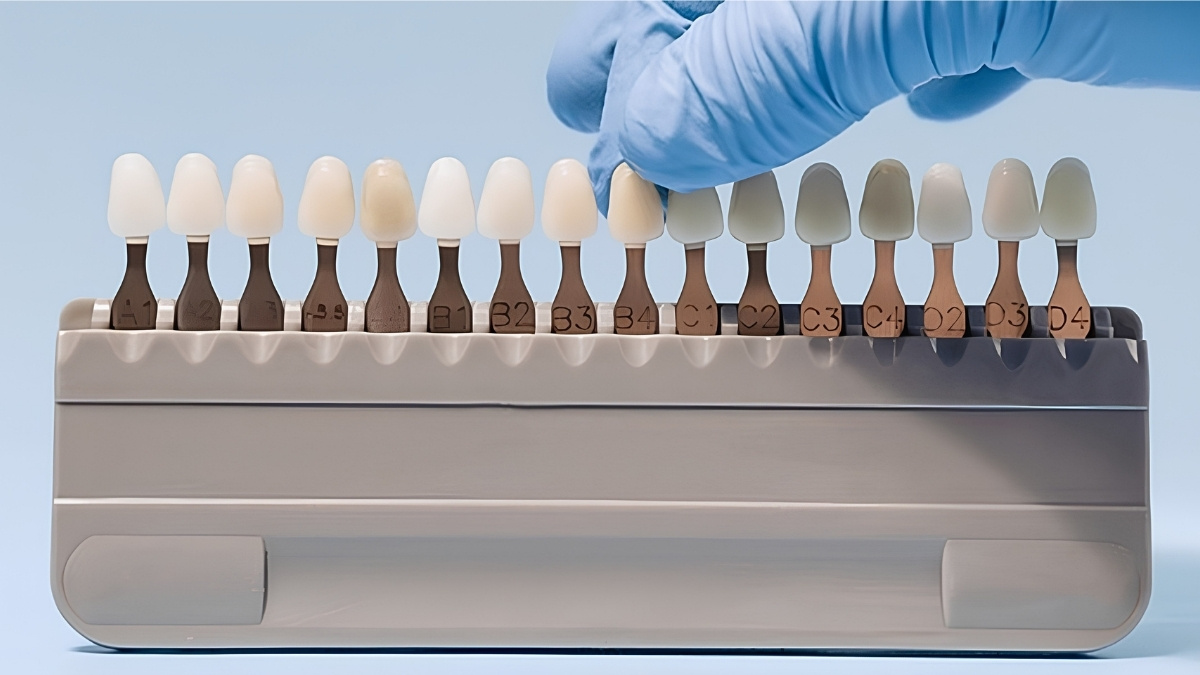
Shade is influenced by
- Ceramic material
- Ceramic thickness
- Ceramic translucency
- Stump shade
- Resin cement shade
- Surface texture
- Incisal translucency
- Tooth hydration
- Lighting conditions
- Adjacent tooth color
- Background contrast
Essential shade records
For veneer cases, the lab should receive:
- Preoperative photos
- Shade tab photos
- Stump shade
- Desired final shade
- Smile photos
- Retracted anterior photos
- Lateral or protrusive views when relevant
- Photos after preparation
- Opposing arch information
Cement shade try-in
Because veneers are thin, resin cement shade can influence final value and chroma. Try-in pastes help preview the final result before definitive bonding.
Veneer bonding and cementation
Bonding is critical to veneer success.
Enamel bonding
Enamel bonding is highly predictable when properly isolated and etched.
Common steps include:
- Try-in and verify fit
- Clean veneer and tooth
- Isolate the field
- Etch enamel
- Apply adhesive system
- Treat ceramic internal surface
- Apply resin cement
- Seat veneer
- Remove excess cement
- Light cure properly
- Finish margins
- Check occlusion
Ceramic surface treatment
| Material | Typical internal treatment |
|---|---|
| Feldspathic porcelain | Hydrofluoric acid etch plus silane |
| Lithium disilicate | Hydrofluoric acid etch plus silane |
| Leucite ceramic | Hydrofluoric acid etch plus silane |
| Composite veneer | Air abrasion or etch and primer per manufacturer |
| Zirconia | Air abrasion plus MDP primer; not a typical veneer material |
Cement selection
Veneers are commonly bonded with light-cure resin cement because it offers:
- Better color stability than many dual-cure cements
- Longer working time
- Shade selection options
- Predictable polymerization for thin veneers
Dual-cure resin cement may be considered when restoration thickness or opacity limits light transmission, but shade stability and compatibility must be considered carefully.
Occlusion and veneers
Occlusion can make or break veneer treatment.
Occlusal risk factors
- Bruxism
- Clenching
- Deep bite
- Edge-to-edge bite
- Heavy anterior guidance
- Parafunction
- Lack of posterior support
- Class III occlusion
- Excessive overbite
- Restoring worn dentition without occlusal planning
Occlusal design principles
- Avoid heavy centric contacts on veneer margins
- Avoid traumatic protrusive contacts
- Maintain smooth anterior guidance
- Protect incisal ceramic thickness
- Consider canine guidance or group function carefully
- Provide a night guard for parafunction
- Evaluate posterior support
Veneers are elegant, conservative, and strong when bonded properly. They are not, however, tiny ceramic superheroes designed for enthusiastic grinding.
Periodontal and gingival considerations
Veneers must respect gingival tissues and emergence profile.
Tissue-friendly veneer design
- Smooth margins
- Supragingival or equigingival margins when possible
- Proper emergence profile
- No over-contouring
- Cleanable proximal areas
- Polished ceramic surfaces
- Accurate marginal fit
- No residual cement
- Harmonious gingival architecture
Margin location
| Margin location | Advantage | Risk |
|---|---|---|
| Supragingival | Easy bonding, cleaning, finishing | Margin may be visible |
| Equigingival | Good esthetic and access balance | Technique-sensitive |
| Slight subgingival | Hides margin in esthetic zone | Harder isolation and cement cleanup |
Subgingival veneer margins may compromise bonding isolation and increase the risk of excess cement retention. They should be used only when clinically justified.
Veneers for specific clinical problems
Different clinical situations change how veneers should be planned and fabricated.
Discolored teeth
Veneers can mask discoloration depending on severity.
- Mild discoloration: Thin feldspathic or lithium disilicate veneers may work well.
- Moderate discoloration: More opaque ceramic and greater thickness may be required.
- Severe discoloration: Veneers may appear gray if too thin; crowns or internal bleaching may be more appropriate.
Diastema closure
Veneers can close spaces by adding proximal ceramic.
Key considerations include:
- Tooth width proportion
- Emergence profile
- Papilla support
- Symmetry
- Contact length
- Phonetics
Peg lateral incisors
Veneers are often ideal for peg laterals because treatment is usually additive and conservative.
Worn anterior teeth
Veneers can restore incisal length, but occlusion must be managed carefully.
Important planning factors:
- Determine cause of wear
- Evaluate vertical dimension
- Restore posterior support if needed
- Use mock-up or provisionals
- Provide a protective splint
Fluorosis and enamel defects
Veneers can restore uniform shade and surface texture. In mild cases, microabrasion or resin infiltration may be considered before restorative treatment.
Complications of veneers
Veneer complications may be biological, mechanical, esthetic, or adhesive.
| Complication | Possible cause |
|---|---|
| Debonding | Poor enamel bonding, contamination, dentin exposure |
| Ceramic fracture | Thin ceramic, occlusal overload, parafunction |
| Chipping | Incisal stress, unsupported ceramic |
| Marginal discoloration | Microleakage, cement degradation, poor finishing |
| Secondary caries | Poor margins, hygiene, high caries risk |
| Sensitivity | Overpreparation, dentin exposure, bonding issues |
| Shade mismatch | Poor shade records, cement mismatch, stump shade influence |
| Over-contour | No-prep misuse, poor design |
| Gingival inflammation | Rough margin, excess cement, over-contour |
| Patient dissatisfaction | Unrealistic expectations, inadequate mock-up |
Complications are not random. Most can be traced back to case selection, preparation design, bonding protocol, occlusal planning, or communication failures.
Survival and longevity of veneers
Porcelain veneers have strong long-term evidence when properly indicated and bonded.
Factors that improve survival
- Bonding primarily to enamel
- Good isolation
- Proper ceramic thickness
- Smooth preparation
- Correct material choice
- Controlled occlusion
- Accurate fit
- Proper cementation
- Excellent oral hygiene
- Regular maintenance
- Night guard for bruxism
- Clear lab communication
Factors that reduce survival
- Dentin-dominant bonding
- Bruxism
- Poor preparation design
- Heavy incisal contacts
- Large existing restorations
- Poor marginal fit
- Contamination during bonding
- Severe discoloration with thin ceramic
- Poor patient compliance
- Inadequate finishing and polishing
Porcelain laminate veneers are predictable restorations when clinical and technical protocols are respected. Skip the fundamentals and even beautiful ceramics become expensive optimism.
Laboratory quality control for veneers
Veneers require meticulous quality control because they are thin, delicate, and highly visible.
Veneer QC checklist
| QC area | What to verify |
|---|---|
| Case identity | Patient or case ID, tooth numbers |
| Prescription | Material, shade, number of veneers |
| Margin | Smooth, intact, no chips |
| Fit | Passive fit on die or model |
| Contact | Correct proximal contact strength |
| Thickness | Adequate but not bulky |
| Incisal design | Matches prescription and wax-up |
| Surface texture | Natural and symmetrical |
| Shade | Matches desired value and chroma |
| Translucency | Correct incisal and body effects |
| Internal surface | Clean and properly prepared as specified |
| Emergence profile | Not over-contoured |
| Symmetry | Central, lateral, and canine proportions |
| Polish or glaze | Smooth and plaque-resistant |
| Packaging | Protected from fracture |
Common lab errors
- Over-contoured cervical area
- Thick margins
- Inadequate incisal translucency
- Poor midline symmetry
- Contacts too tight
- Surface texture mismatch
- Incorrect value
- Fragile thin edges
- Poor internal cleanliness
- Margin chipping during finishing
For veneers, half a millimeter is not a tiny detail. It can be the difference between elegant and bulky.
Digital veneers and CAD/CAM
Digital veneers are increasingly common, especially with lithium disilicate and hybrid production workflows.
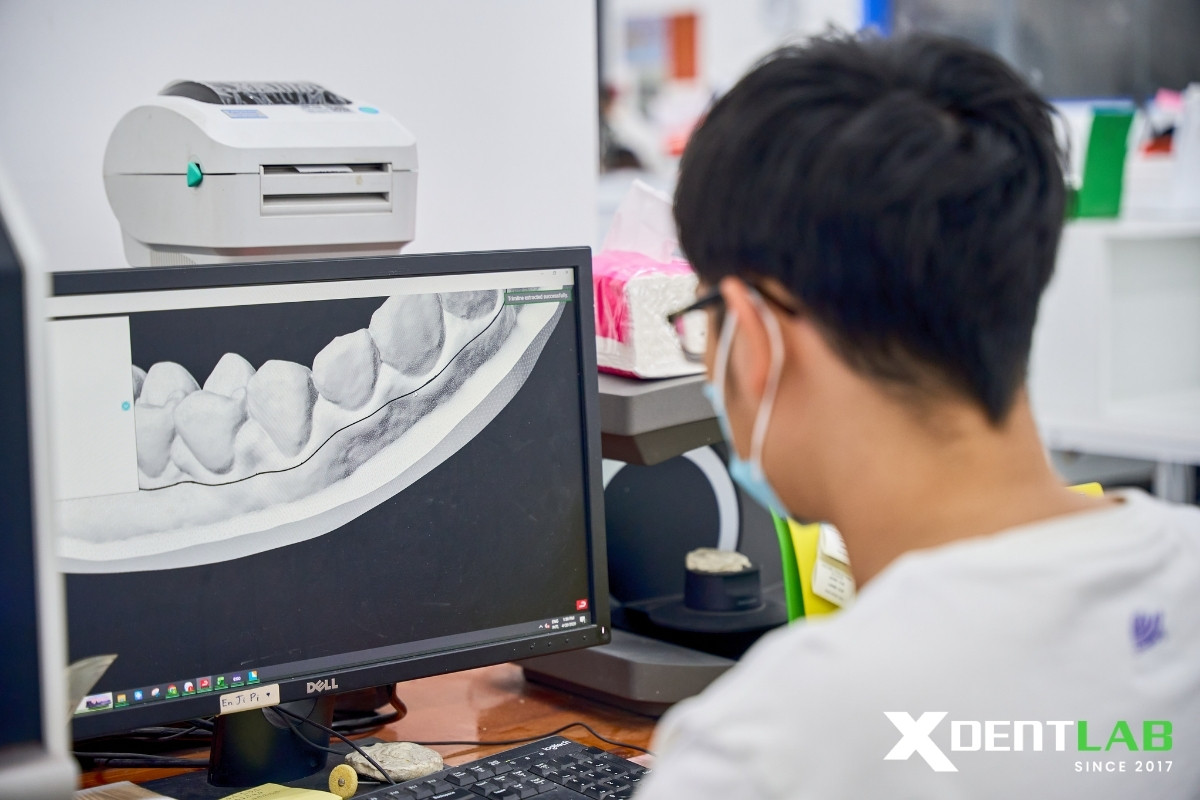
Digital advantages
- Precise smile design transfer
- Repeatable design
- Efficient mock-up fabrication
- Milled ceramic options
- Printed models
- Digital wax-up storage
- Easier communication with dentist
- Faster remake if needed
Digital limitations
- Thin margins are difficult to mill
- Surface texture may require hand finishing
- Esthetic layering may still require artistry
- Scan accuracy is critical
- Color reproduction depends on material selection
- No-prep margins can be difficult to define digitally
Common digital veneer workflow
Photos and intraoral scan
→ Digital smile design
→ CAD wax-up
→ Printed mock-up model
→ Preparation guide
→ Final scan
→ CAD veneer design
→ Milling or pressing
→ Characterization and polishing
→ Final QC
Maintenance of veneers
Veneers need ongoing maintenance from both patient and dentist.
Patient maintenance recommendations
- Brush and floss daily
- Use non-abrasive toothpaste
- Avoid biting hard objects
- Avoid using teeth as tools
- Wear a night guard if bruxism risk exists
- Attend regular hygiene visits
- Monitor margins and gingiva
- Polish professionally when needed
- Avoid aggressive scaling at veneer margins
Dentist maintenance checks
At recall visits, evaluate:
- Marginal integrity
- Gingival health
- Occlusal wear
- Chipping
- Debonding
- Staining
- Secondary caries
- Patient hygiene
- Splint compliance
Standards and veneer manufacturing
Veneers are custom dental devices and should be fabricated with controlled materials and documented processes.
Relevant standards and frameworks
| Standard / framework | Relevance to veneers |
|---|---|
| ISO 13485 | Quality management system for medical devices |
| ISO 6872 | Dental ceramic materials |
| ISO 10993 series | Biological evaluation of medical devices |
| ISO 7405 | Biocompatibility evaluation of dental materials |
| FDA medical device framework | U.S. regulatory relevance for dental devices |
| Manufacturer IFU | Required processing, etching, firing, and bonding guidance |
| Local dental lab regulations | Market-specific compliance and documentation |
Documentation should include
- Dentist prescription
- Patient or case ID
- Tooth numbers
- Material brand
- Lot or batch number
- Shade and stump shade
- Design file
- Production method
- Firing or crystallization cycle
- Technician name
- Final QC record
- Delivery date
Why this matters for XDENT LAB
Veneers are a strong example of how high-esthetic dentistry depends on laboratory discipline, material control, and communication. For a B2B partner like XDENT LAB, this matters because practices and partner labs do not just need restorations that look good on a tray. They need restorations that fit predictably, bond reliably, and perform well over time.
Strategic relevance for XDENT LAB
- Controlled digital workflows
- Material traceability
- Consistent QC systems
- Skilled ceramic and esthetic finishing
- Implant and removable expertise that complements full-smile rehabilitation cases
- FDA and ISO-aligned standards for international lab partnerships
- Lab-to-lab support for practices and independent labs needing scalable production
For dental practices looking to ensure quality and consistency, veneer work is one of the clearest tests of a lab’s esthetic discipline. Tiny restorations, huge reputation impact.
Key takeaways
Veneers are conservative, highly esthetic prosthodontic restorations used to improve tooth color, shape, size, alignment, and smile harmony. Their long-term success depends on much more than appearance. The key variables include case selection, enamel preservation, preparation design, material choice, shade planning, bonding protocol, occlusion, and meticulous laboratory quality control.
The most important principles are
- Preserve enamel whenever possible because enamel bonding offers the strongest foundation
- Select cases carefully because veneers are not ideal for severe bruxism, poor hygiene, major structural loss, or severe malposition
- Choose material based on clinical need because feldspathic porcelain, lithium disilicate, and composite each have different indications
- Use diagnostic wax-ups and mock-ups to guide preparation, communication, and expectations
- Control ceramic thickness and shade because veneer esthetics depend on translucency, stump shade, and cement shade
- Follow a strict bonding protocol because veneers rely primarily on adhesive retention
- Manage occlusion carefully to reduce chipping, debonding, and fracture
- Apply meticulous lab QC because veneers are thin, fragile before bonding, and highly visible
- Recognize that porcelain veneers are predictable long-term restorations when preparation, bonding, material selection, and occlusion are properly controlled
A successful veneer is not just a beautiful facial surface. It is a precise adhesive restoration that preserves tooth structure, harmonizes with the smile, respects the gingiva, and survives function over time.
About XDENT LAB:
We are experts in Lab-to-Lab Full Service from Vietnam, with the signature services of Removable, meet U.S. market standards, FDA-registered, ISO 13485-certified. Founded in 2017, from local root to global reach, we scale with 2 Factories with over 100+ employees.
Our Commitments Built on “Trusted. Commitment. Quality”
- Commit to Large-Scale Manufacturing, high volume, remake rate < 1%.
- Commit to 5-Year Warranty
- Commit to Competitive Price
XDENT LAB | A Trusted Lab-to-Lab Service from Vietnam
Share this post:
Related Posts
Rest seat geometry controls how force enters the abutment tooth. Here are the design rules every RPD technician needs to know, with the reasoning behind each one.
Rests in removable partial dentures prevent settling, protect soft tissue, and keep clasps functional. Here is how they work and why their design matters.

Learn how lab quality affects fixed partial dentures and bridges through fit, materials, connector design, occlusion, and long-term clinical performance.

