
Learn linguoplate in RPD design, including definition, indications, design principles, positioning, and clinical considerations in mandibular major connectors.
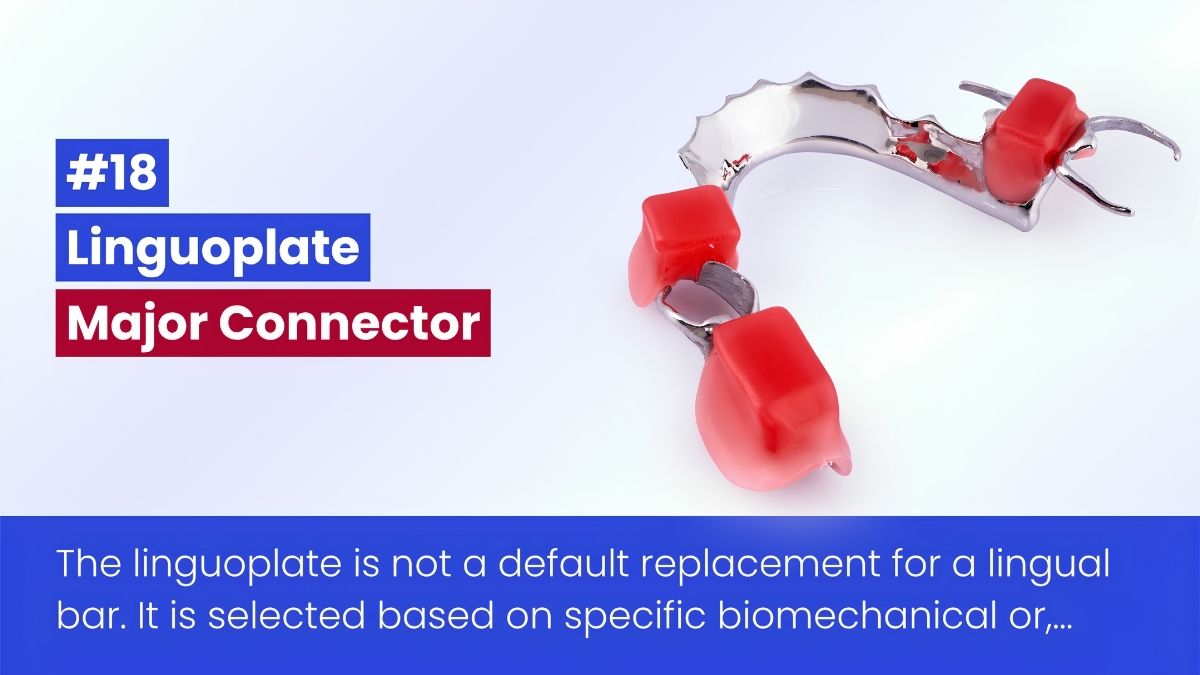
Table of contents [Show]
- Introduction
- Key Points
- What Is A Linguoplate in RPD?
- Why Is The Linguoplate Used?
- Basic Form And Structural Design Of the Linguoplate
- Where Should a Linguoplate Be Positioned?
- When Is a Linguoplate Indicated?
- When Is a Linguoplate Not the Best Choice?
- The Decision Between Lingual Bar vs Linguoplate
- Conclusion
- FAQ
- References
Introduction
In mandibular removable partial denture (RPD) design, the linguoplate in RPD is a major connector that extends onto the lingual surfaces of anterior teeth and the adjacent gingival tissues. It is often considered when a lingual bar cannot be used due to limited space or when additional stabilization of remaining teeth is required.
Unlike the lingual bar, which primarily functions as a simple cross-arch connector, the linguoplate provides both structural connection and an added stabilizing effect on anterior teeth. However, this increased coverage also introduces design challenges related to tissue health, hygiene, and patient comfort.
For clinicians and dental technicians, understanding when and why to use a linguoplate is essential for achieving both mechanical stability and biologic compatibility in RPD design.
Key Points
- The linguoplate is a mandibular major connector that extends over lingual tooth surfaces and embrasures.
- It is indicated when a lingual bar is not feasible due to limited space or high floor of mouth.
- It provides additional stabilization of anterior teeth and resistance to horizontal rotation.
- It must be made as thin as technically feasible and closely adapted to tooth contours.
What Is A Linguoplate in RPD?
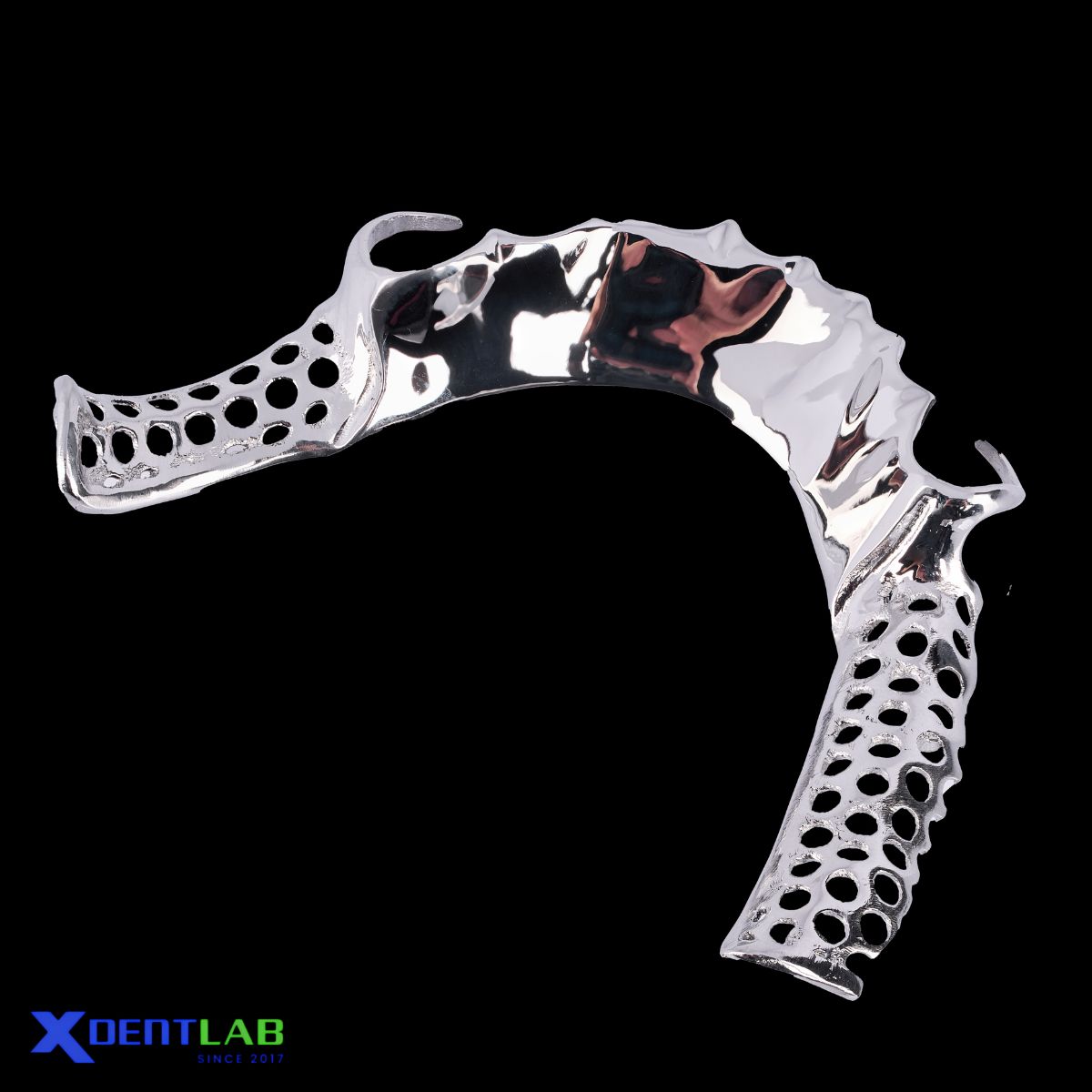
A linguoplate is a mandibular major connector that is formed when the space bounded by the lingual bar inferiorly, the cingula of anterior teeth superiorly, and the anterior tooth contacts is filled by a metal plate connecting minor connectors. This creates a continuous lingual coverage over the anterior segment.
In essence, the linguoplate can be understood as a lingual bar plus a contoured metal apron that adapts closely to the lingual surfaces and interproximal embrasures of anterior teeth. The inferior border still follows the classic half-pear contour of a lingual bar, providing rigidity, while the superior extension engages tooth contours for added stability.
Why Is The Linguoplate Used?
The linguoplate is not a default replacement for a lingual bar. It is selected based on specific biomechanical or anatomical conditions where additional control is required.
The most common indication for a linguoplate is inadequate vertical clearance for proper lingual bar placement.
When the distance between the free gingival margins and the functional floor of the mouth is reduced, positioning a lingual bar may place its superior border too close to the gingival tissues. This can lead to soft tissue irritation, excessive relief requirements, and potential food entrapment.
By extending coronally onto the lingual surfaces of the anterior teeth, a linguoplate maintains framework rigidity while accommodating limited anatomical space.
2. Control of Rotational Forces in Distal Extension Cases
In Kennedy Class I distal extension cases, residual ridges often provide limited resistance to functional loading, particularly when significant ridge resorption is present.
As occlusal forces are applied, the prosthesis may exhibit rotational tendencies around its support structures. Because a linguoplate contacts multiple anterior teeth, it contributes additional resistance to horizontal rotation and improves overall cross-arch stability.
This enhanced stabilization can be particularly beneficial in patients with severely resorbed residual ridges.
3. Need for Additional Anterior Stabilization
When mandibular anterior teeth have reduced periodontal support, additional stabilization may be desirable.
A linguoplate establishes contact with multiple teeth and can help distribute functional forces across the anterior segment rather than concentrating them on individual teeth. When combined with properly designed rests and supporting components, it may provide a splinting-like effect that improves overall prosthesis stability.
For this reason, linguoplates are frequently considered when periodontally compromised teeth must be incorporated into the RPD design.
4. Anticipated Future Tooth Loss
In some patients, the long-term prognosis of one or more mandibular incisors may be uncertain.
A linguoplate facilitates future modification of the prosthesis by allowing replacement teeth to be added to the existing framework if tooth loss occurs. This design flexibility can simplify future treatment and reduce the need for complete framework replacement.
As a result, the linguoplate is often selected when future tooth replacement is anticipated during treatment planning.
5. Additional Arch Stabilization and Embrasure Coverage
In selected cases, a linguoplate may be used to provide supplementary stabilization of the remaining dentition or the prosthesis itself.
Its broader area of tooth contact can improve horizontal bracing compared with a lingual bar alone. Additionally, when small interdental spaces or deep embrasures are present, the linguoplate can be designed to bridge these areas, helping reduce food entrapment and minimizing soft tissue irritation.
Although this is generally considered a secondary indication rather than a primary reason for selecting a linguoplate, it can contribute to improved patient comfort and prosthesis performance in appropriately selected cases.
Basic Form And Structural Design Of the Linguoplate
A linguoplate consists of two functional zones that must be balanced carefully.
Inferior structural zone (rigidity zone)
The inferior portion follows the half-pear shaped contour of a lingual bar, providing primary rigidity. This region resists flexure under functional loading and maintains structural integrity of the major connector.
Superior adaptive zone (tooth-contact zone)
The superior portion forms a thin metal apron that adapts closely to:
- Lingual tooth surfaces
- Supracingular anatomy
- Interproximal embrasures up to contact points
This zone must remain thin to reduce tongue interference while maintaining sufficient adaptation for stability.
Important design requirement
All interproximal embrasures and gingival crevices must be blocked out parallel to the path of insertion. Improper blockout may lead to wedging forces, gingival trauma, or difficulty in seating.
Where Should a Linguoplate Be Positioned?
Proper positioning of a linguoplate must balance biologic safety and mechanical stability.
Inferior border position
The inferior border follows the same principle as a lingual bar:
- Positioned above movable floor-of-mouth tissue
- Placed as far below gingival margins as possible
- Designed to maintain rigidity without impinging functional tissues
Superior border position
The superior border:
- Follows the natural curvature of supracingular surfaces
- Generally does not extend beyond the middle third of lingual tooth surface
- May extend into embrasures only up to contact points when needed
Design principle
The goal is not maximal coverage, but controlled and functional adaptation. Excess coverage increases plaque retention risk, while insufficient adaptation reduces stability.
When Is a Linguoplate Indicated?
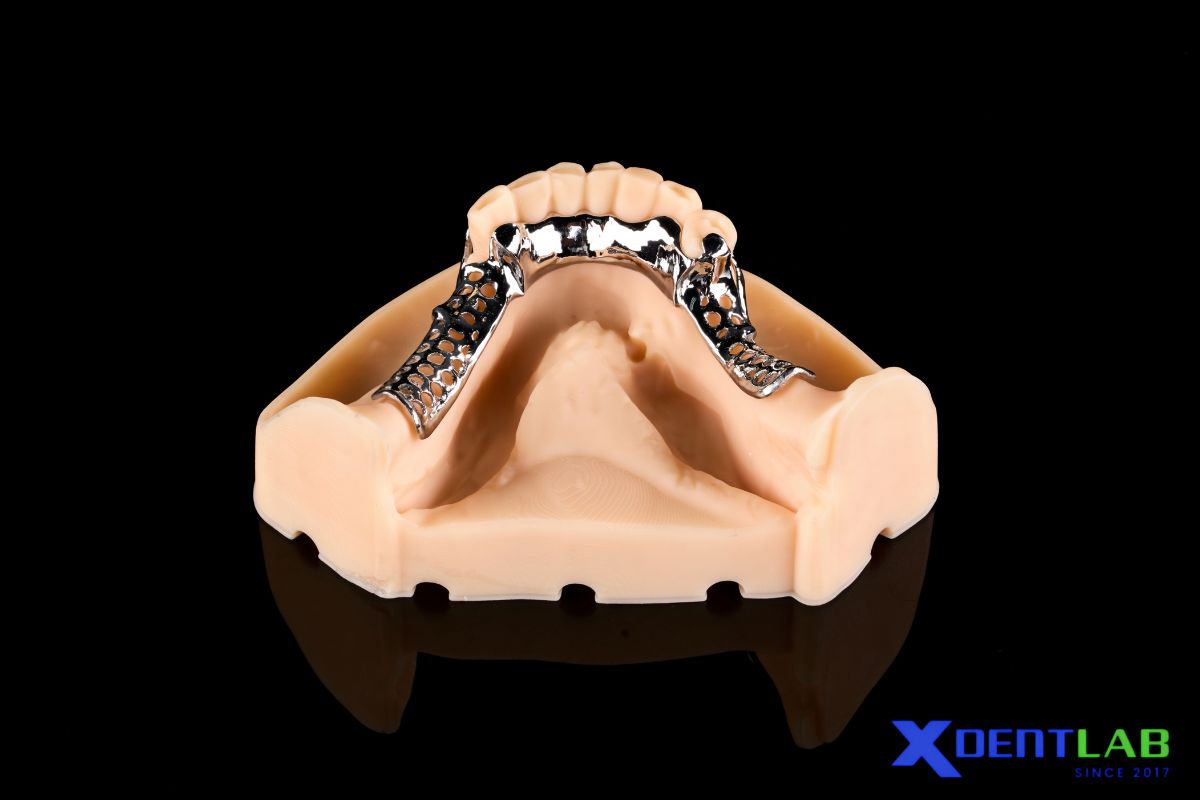
When vertical space is limited
If the distance from gingival margin to functional floor of mouth is insufficient for a lingual bar, a linguoplate is preferred to avoid gingival impingement and excessive relief.
When anterior stabilization is required
In cases with reduced periodontal support of anterior teeth, a linguoplate combined with proper rest design can provide a splinting effect by distributing forces across multiple teeth.
In Class I distal extension RPD
When posterior support is tissue-based, anterior teeth play a key role in resisting rotational movement. A linguoplate improves resistance to these forces.
When embrasure coverage is required
Small anterior embrasures that create food traps or instability can be bridged using a linguoplate when properly designed.
When future modification is anticipated
If anterior tooth prognosis is uncertain, a linguoplate allows easier future addition of teeth without major framework redesign.
When Is a Linguoplate Not the Best Choice?
If sufficient vertical space exists, a lingual bar provides similar stability with less tooth coverage and improved patient comfort.
High esthetic or hygiene sensitivity
In patients with high esthetic demands or difficulty maintaining hygiene, increased metal coverage may lead to dissatisfaction or plaque retention.
No need for anterior stabilization
If anterior teeth are periodontally stable and no splinting effect is required, adding a linguoplate becomes unnecessary and violates the principle of minimal necessary design.
Risk of food entrapment
Improperly contoured linguoplates may increase food retention in embrasure areas, especially if not accurately blocked out.
The choice between lingual bar and linguoplate is not preference-based but condition-based:
- Lingual bar → when space is adequate and minimal coverage is sufficient
- Linguoplate → when stabilization, limited space, or rotational control is required
In clinical practice, this decision is primarily driven by:
- Floor of mouth position
- Gingival clearance
- Periodontal status
- Distal extension biomechanics
Conclusion
The linguoplate in RPD is a mandibular major connector designed for situations where a lingual bar cannot adequately satisfy anatomical or biomechanical requirements.
Its value lies in its ability to combine rigid structural support with controlled engagement of anterior teeth. This allows improved stabilization, better control of rotational forces, and functional adaptability in complex mandibular cases.
However, its use must always be justified. A linguoplate is not an upgrade over a lingual bar but a response to specific clinical limitations. Proper indication depends on space, tissue behavior, periodontal status, and overall prosthesis mechanics.
Understanding this distinction is essential for rational RPD design, especially when managing cases with distal extension bases or compromised anterior support.
FAQ
What is the main difference between linguoplate and lingual bar?
A lingual bar is a simple connector below the gingiva, while a linguoplate extends onto lingual tooth surfaces for additional stabilization.
Does linguoplate act as an indirect retainer?
No. It does not function as an indirect retainer unless specific rest support is designed separately.
When should a linguoplate be used instead of a lingual bar?
It is used when there is insufficient space, need for anterior stabilization, or control of rotational forces in distal extension cases.
Is linguoplate more rigid than lingual bar?
The inferior structural component provides rigidity similar to a lingual bar, but overall stability depends on correct design and support.
References
McCracken's Removable Partial Prosthodontics.
About XDENT LAB:
We are experts in Lab-to-Lab Full Service from Vietnam, with the signature services of Removable, meet U.S. market standards, FDA-registered, ISO 13485-certified. Founded in 2017, from local root to global reach, we scale with 2 Factories with over 100+ employees.
Our Commitments Built on “Trusted. Commitment. Quality”
- Commit to Large-Scale Manufacturing, high volume, remake rate < 1%.
- Commit to 5-Year Warranty
- Commit to Competitive Price
XDENT LAB | A Trusted Lab-to-Lab Service from Vietnam
Share this post:
Related Posts
Learn how dental crown manufacturing supports prosthodontics through material selection, digital workflow, precise fit, and laboratory quality control.

See a real case produced by XDENT LAB, a dental lab outsourcing in Vietnam that serves US customers with high quality and optimized cost.
See 5 completed Acrylic RPD cases from XDENT LAB, a Vietnam dental laboratory serving US, Europe, and Australia. Reliable lab to lab subcontract partner since 2017.

