
Explore lab-to-lab workflow and QC for implant-supported fixed prostheses, from fit and materials to retrievability, hygiene design, and consistency.
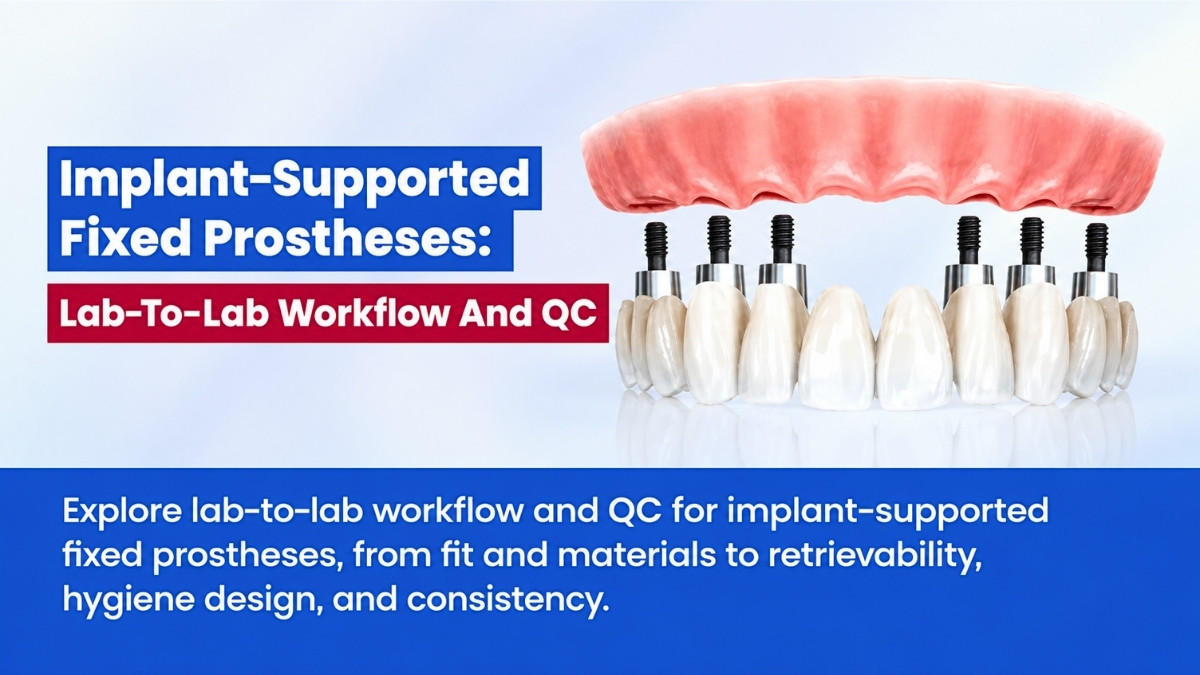
Table of contents [Show]
- What are implant-supported fixed prostheses?
- Why implant-supported fixed prostheses matter
- Classification of implant-supported fixed prostheses
- Indications
- Contraindications and risk factors
- Treatment planning principles
- Single implant crowns
- Implant-supported fixed dental prostheses and bridges
- Full-arch implant-supported fixed prostheses
- Screw-retained vs cement-retained prostheses
- Passive fit
- Implant impression and digital scanning
- Laboratory workflow
- Provisionalization
- Materials used in implant-supported fixed prostheses
- Occlusion in implant-supported fixed prostheses
- Cantilevers
- Emergence profile and soft tissue design
- Biological complications
- Mechanical and technical complications
- Maintenance
- Laboratory quality control
- Standards and documentation
- Why this matters for XDENT LAB
- Key takeaways
Implant-supported fixed prostheses are one of the most important treatment categories in modern prosthodontics because they restore missing teeth without relying on removable denture movement or natural-tooth abutments. From a dental laboratory perspective, these prostheses are precision-engineered implant restorations where passive fit, emergence profile, screw-access design, material selection, occlusion, framework architecture, implant component compatibility, and long-term retrievability determine clinical success.
For dental practices looking to ensure quality and consistency, implant-supported fixed restorations demand far more than esthetic fabrication. They require prosthetically driven planning, exact component management, verified fit, material-specific design, and long-term maintenance support. In short, this is where restorative dentistry meets engineering, and both sides need to get along.
What are implant-supported fixed prostheses?
An implant-supported fixed prosthesis is a non-removable dental restoration supported by one or more dental implants. It may replace a single tooth, multiple teeth, or an entire edentulous arch.
Unlike conventional bridges, which are supported by natural teeth, implant-supported fixed prostheses transfer functional load through implant fixtures integrated into bone.
Common forms
| Type | Description | Typical use |
|---|---|---|
| Single implant crown | One crown supported by one implant | Single missing tooth |
| Implant-supported fixed dental prosthesis | Multiple-unit bridge supported by implants | Several missing teeth |
| Full-arch fixed implant prosthesis | Complete arch prosthesis fixed to implants | Edentulous maxilla or mandible |
| Hybrid prosthesis | Acrylic or composite teeth and gingiva over metal or titanium framework | Full-arch rehabilitation |
| Monolithic zirconia full-arch prosthesis | Full-arch zirconia restoration supported by implants | Esthetic and durable full-arch cases |
| Segmental implant bridge | Short-span implant bridge in one region | Posterior or anterior partial edentulism |
Implant-supported fixed dental prostheses are widely used in both partially and completely edentulous patients because they provide stable function and predictable restorative support.
Why implant-supported fixed prostheses matter
Implant-supported fixed prostheses matter because they restore function, esthetics, comfort, and patient confidence without removable prosthesis instability.
Main benefits
- Fixed tooth replacement
- Improved chewing ability
- Improved speech compared with unstable dentures
- Improved esthetics
- No preparation of adjacent natural teeth for bridge abutments
- Functional support through osseointegrated implants
- Better comfort than removable dentures in many cases
- High patient satisfaction
- Improved oral-health-related quality of life
- Useful for partial or complete edentulism
These restorations are especially important when practices want long-term restorative solutions that are stable, retrievable, and maintainable rather than merely presentable on delivery day.
Classification of implant-supported fixed prostheses
Implant-supported fixed prostheses can be classified by extent, retention method, and material system.
By extent
| Classification | Example |
|---|---|
| Single-unit | Single implant crown |
| Short-span | 2–4 unit implant bridge |
| Long-span | Multiple missing teeth restored across a quadrant |
| Full-arch | Complete maxillary or mandibular fixed prosthesis |
| Full-mouth | Both arches restored with implant-supported fixed prostheses |
By retention
| Retention type | Description |
|---|---|
| Screw-retained | Prosthesis fixed directly with prosthetic screws |
| Cement-retained | Crown or bridge cemented onto implant abutment |
| Screwmentable | Crown cemented extraorally to abutment, then screw-retained intraorally |
| Friction-fit or cementless | Mechanical fixation concepts, less common and system-specific |
By material
| Material system | Common use |
|---|---|
| Titanium framework plus acrylic | Full-arch hybrid prostheses |
| Titanium framework plus composite | Full-arch or long-span prostheses |
| Cobalt-chromium framework plus ceramic | Fixed implant bridges |
| Zirconia framework plus veneering ceramic | Esthetic fixed prostheses |
| Monolithic zirconia | Full-arch and posterior implant prostheses |
| Lithium disilicate | Single crowns or selected short-span restorations |
| PFM | Traditional implant crowns and bridges |
| PMMA | Provisional or prototype prostheses |
Indications
Implant-supported fixed prostheses are indicated when missing teeth can be restored with implant support and the patient is suitable for implant therapy.
Common indications
- Single missing tooth
- Multiple missing teeth
- Distal-extension edentulism
- Completely edentulous arch
- Poor tolerance of removable dentures
- Unstable complete dentures
- Desire for fixed rehabilitation
- Congenitally missing teeth
- Failed conventional bridges
- Tooth loss due to caries, trauma, periodontal disease, or endodontic failure
- Severe tooth wear requiring extraction and implant rehabilitation
- Need to avoid preparing adjacent teeth
- Full-arch rehabilitation after terminal dentition
Ideal case factors
- Adequate bone volume or grafting plan
- Good systemic health or controlled medical conditions
- Good oral hygiene
- Stable periodontal condition
- Favorable interarch space
- Favorable smile line
- Realistic expectations
- Sufficient restorative space
- Controlled parafunction
- Ability to attend maintenance visits
Contraindications and risk factors
Implant-supported fixed prostheses are not suitable for every patient or every site.
Absolute or major contraindications
- Uncontrolled systemic disease
- Uncontrolled diabetes
- Active infection
- Untreated periodontal disease
- Poor oral hygiene
- Heavy smoking without risk acceptance
- Severe parafunction without protection
- Insufficient restorative space
- Inability to maintain prosthesis hygiene
- Unrealistic expectations
- Poor compliance
- Active antiresorptive-related risk scenarios requiring medical assessment
- Inadequate bone without feasible augmentation
- Severe xerostomia or high caries risk for remaining dentition
Prosthetic risk factors
| Risk factor | Potential consequence |
|---|---|
| Poor implant position | Compromised esthetics, screw access problems |
| Insufficient interarch space | Weak framework or bulky prosthesis |
| Long cantilever | Screw loosening, fracture, bone overload |
| Poor passive fit | Mechanical complications and peri-implant stress |
| Cement excess | Peri-implant inflammation |
| Thin prosthetic material | Chipping or fracture |
| Poor hygiene access | Peri-implant mucositis or peri-implantitis |
| Bruxism | Screw loosening, ceramic fracture, prosthesis fracture |
| High smile line | Gingival transition visibility |
| Angled implants | Complex abutment and screw-channel management |
Treatment planning principles
Successful implant-supported fixed prostheses begin with a prosthetically driven plan.
Key planning sequence
Diagnosis
→ Esthetic and functional goals
→ Diagnostic wax-up or digital setup
→ Prosthetic design
→ Implant position planning
→ Surgical guide planning
→ Implant placement
→ Healing and osseointegration
→ Impression or scan
→ Provisionalization
→ Definitive prosthesis
→ Maintenance
Prosthetically driven implant placement
Implants should be placed according to the final tooth position, not simply where bone is easiest to access.
The restorative plan determines:
- Implant number
- Implant position
- Implant angulation
- Prosthesis type
- Screw-access location
- Emergence profile
- Need for grafting
- Need for angled screw-channel components
- Prosthetic material
- Hygiene access
- Occlusal scheme
A well-positioned implant makes the laboratory look brilliant. A poorly positioned implant makes everyone inventive, which is not always the compliment it sounds like.
Single implant crowns
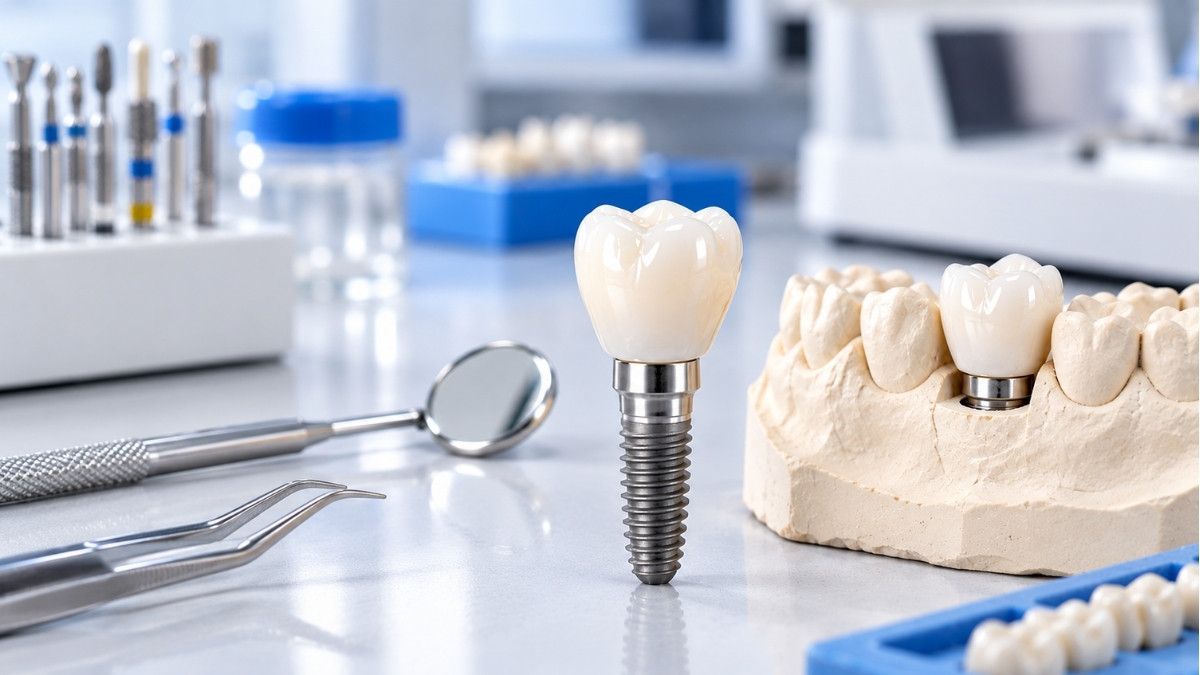
A single implant crown replaces one missing tooth using one implant.
Common designs
- Screw-retained implant crown
- Cement-retained crown on custom abutment
- Screwmentable crown
- Stock abutment crown
- Custom titanium abutment plus ceramic crown
- Ti-base hybrid abutment crown
- Zirconia abutment plus ceramic crown
Key design factors
- Emergence profile
- Contact strength
- Screw access position
- Occlusion
- Abutment height
- Soft tissue support
- Interproximal papilla support
- Cement margin location
- Material selection
- Retrieval access
Common materials
| Component | Material options |
|---|---|
| Abutment | Titanium, zirconia, hybrid Ti-base |
| Crown | Zirconia, lithium disilicate, PFM, layered ceramic |
| Screw | Titanium or gold alloy depending on system |
| Cement | Resin cement, glass ionomer, temporary cement depending on design |
Implant-supported fixed dental prostheses and bridges
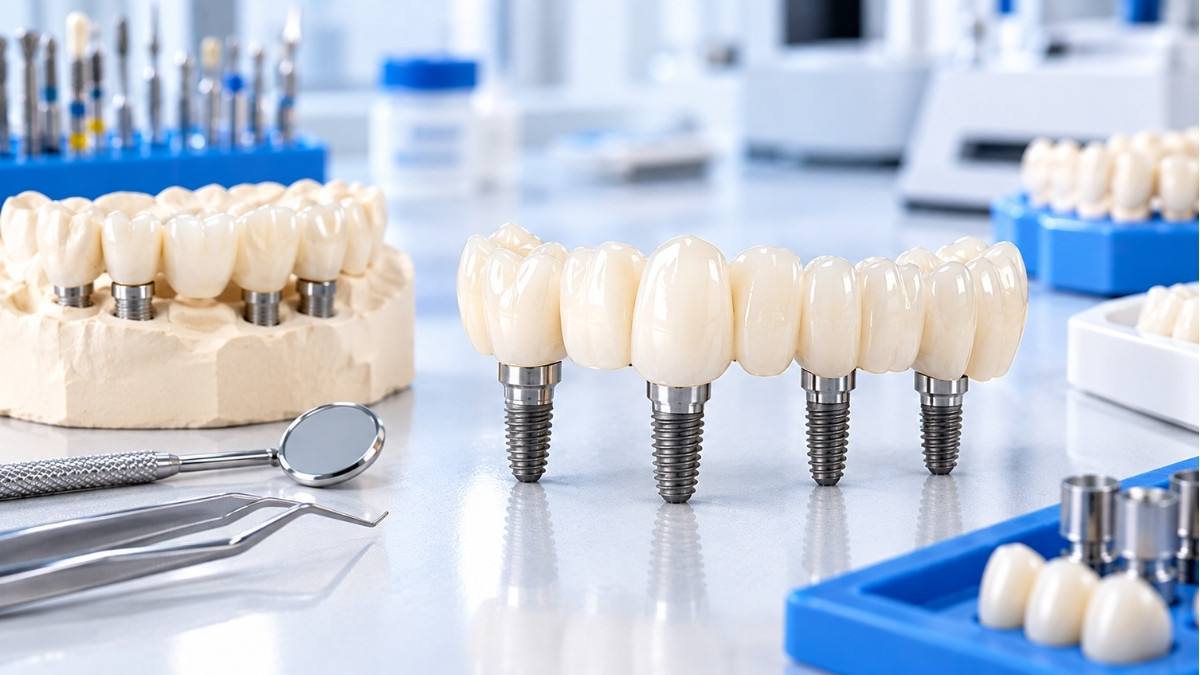
An implant-supported fixed dental prosthesis replaces multiple missing teeth using two or more implants.
Design considerations
- Number of implants
- Span length
- Implant distribution
- Pontic design
- Framework rigidity
- Connector dimensions
- Occlusal load
- Screw access
- Passive fit
- Hygiene space
- Material strength
- Esthetic zone requirements
Pontic designs
| Pontic type | Use |
|---|---|
| Modified ridge lap | Esthetic anterior region with cleanability |
| Ovate pontic | High-esthetic tissue emergence, requires tissue shaping |
| Hygienic pontic | Posterior region, easy cleaning |
| Conical pontic | Narrow ridge, easier hygiene |
| Convex tissue contact | Preferred for cleansability |
For implant prostheses, pontic tissue surfaces must be smooth, convex, and cleanable. Concave tissue surfaces are plaque hotels, and the check-out policy is terrible.
Full-arch implant-supported fixed prostheses
Full-arch fixed prostheses replace all teeth in one arch and are supported by multiple implants.
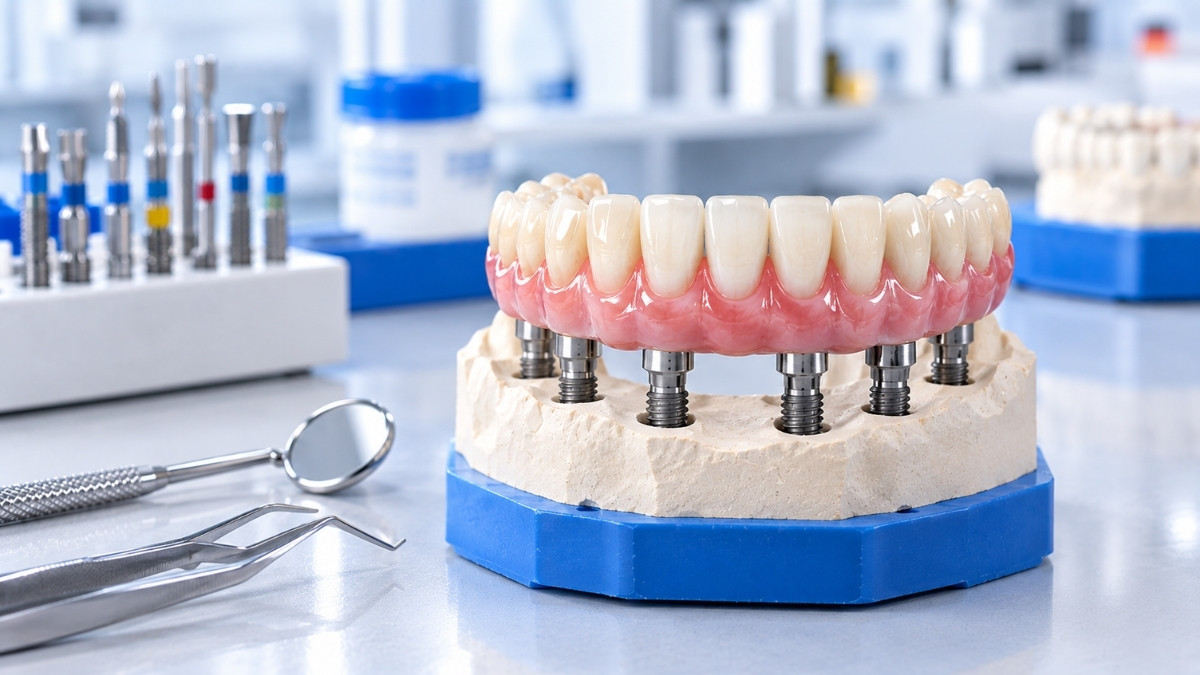
Common names
- Full-arch fixed implant bridge
- Implant-supported hybrid prosthesis
- Fixed complete denture
- All-on-4 style prosthesis
- All-on-X prosthesis
- Full-arch zirconia bridge
- Fixed detachable prosthesis
Common implant configurations
| Configuration | Description |
|---|---|
| 4 implants | Often used with tilted posterior implants |
| 5 implants | Common mandibular option |
| 6 implants | Common maxillary option |
| 6–8 implants | Used for improved distribution or segmental designs |
| Zygomatic implants | Used in severely resorbed maxilla in advanced cases |
| Design | Framework / teeth | Advantages | Limitations |
|---|---|---|---|
| Titanium-acrylic hybrid | Titanium bar plus acrylic teeth | Repairable, lighter, cost-effective | Acrylic wear, tooth debonding |
| Titanium-composite | Titanium bar plus composite | Repairable, esthetic | Wear and staining |
| Monolithic zirconia | Zirconia framework or prosthesis | Strong, esthetic, low wear if polished | Heavy, harder to repair |
| Zirconia with porcelain | Zirconia framework plus veneering porcelain | High esthetics | Chipping risk |
| PFM full arch | Metal framework plus porcelain | Traditional strength | Ceramic chipping, weight |
| PMMA provisional | Milled or printed PMMA | Prototype and interim function | Not definitive long term |
Screw-retained vs cement-retained prostheses
Retention type is one of the most important prosthetic decisions.
| Feature | Screw-retained | Cement-retained |
|---|---|---|
| Retrievability | Excellent | Limited |
| Cement complication risk | None intraorally | Possible excess cement |
| Screw access | Visible or restored with composite | No screw channel visible |
| Passive fit requirement | Very high | Cement layer may compensate slightly |
| Esthetics | May be affected by access hole | Often better facial esthetics |
| Maintenance | Easier removal | Harder to retrieve |
| Implant angulation tolerance | Needs good screw access or angled channel | More forgiving |
| Preferred in full-arch cases | Commonly yes | Less common |
Screw-retained advantages
- Retrievable
- Easier maintenance
- No residual cement risk
- Preferred for full-arch prostheses
- Useful when tissue-level access is manageable
- Allows screw replacement and prosthesis repair
Cement-retained advantages
- No screw-access hole through occlusal or facial surface
- May improve esthetics in some anterior cases
- Can compensate for implant angulation
- Familiar crown-and-bridge workflow
Cement-retained risks
- Residual cement
- Peri-implant inflammation
- Difficult retrieval
- Cement margin too deep
- Uncontrolled cement thickness
- Abutment loosening hidden under crown
In many modern workflows, screw-retained or screwmentable designs are favored where feasible because retrievability is a major long-term advantage.
Passive fit
Passive fit is a foundational requirement in implant prosthodontics.
Natural teeth have periodontal ligament mobility. Implants do not. This means implant prostheses tolerate misfit poorly.
Why passive fit matters
Poor fit can contribute to:
- Screw loosening
- Screw fracture
- Framework fracture
- Ceramic chipping
- Biological stress
- Marginal gaps
- Difficulty seating
- Patient discomfort
- Prosthesis failure
How labs improve passive fit
- Accurate impression or scan
- Verification jig for full-arch cases
- Splinted impression copings in conventional workflow
- Validated scan body libraries
- Photogrammetry for full-arch digital workflows
- Section-and-laser-weld or CAD/CAM-milled frameworks
- One-screw test
- Sheffield test
- Fit verification on model
- Use of genuine implant components
- Avoiding uncontrolled casting distortion
Implant impression and digital scanning
Both conventional and digital workflows can be highly effective if accuracy is controlled.
Conventional implant impression
Common techniques include:
- Open-tray impression
- Closed-tray impression
- Splinted impression copings
- Verification jig
- Implant-level impression
- Abutment-level impression
Digital implant impression
Digital workflows use scan bodies to capture implant position.
Key requirements include:
- Correct scan body
- Fully seated scan body
- Correct torque
- Clean scan body surface
- Accurate implant library
- Adequate soft tissue capture
- Proper scan strategy
- Verification for multi-implant cases
Digital accuracy factors
| Factor | Why it matters |
|---|---|
| Scan body seating | Determines implant position accuracy |
| Scan body design | Affects scan recognition |
| Implant library | Must match system and platform |
| Scan path | Influences stitching accuracy |
| Arch length | Full-arch scans are more challenging |
| Soft tissue mobility | Can distort emergence design |
| Blood or saliva | Reduces scan accuracy |
| Interimplant distance | Longer spans increase accuracy demands |
Laboratory workflow
The lab workflow depends on whether the case is conventional, digital, or full-arch hybrid.
Conventional workflow
Prescription received
→ Impression disinfection
→ Implant analog model fabrication
→ Soft tissue model fabrication
→ Verification jig if needed
→ Wax-up/prosthetic setup
→ Framework design
→ Framework fabrication
→ Framework try-in
→ Ceramic/acrylic/composite application
→ Occlusal adjustment
→ Final finishing
→ Screw access management
→ Final QC
→ Delivery
Digital workflow
Digital scan received
→ Scan body/library verification
→ Case review
→ CAD design
→ Framework/prosthesis design
→ CAM milling or printing
→ Sintering/crystallization/curing
→ Ti-base bonding if applicable
→ Characterization and finishing
→ Model or printed verification
→ Final QC
→ Delivery
Full-arch digital workflow
Diagnostic records
→ Digital wax-up
→ Surgical guide
→ Implant placement
→ Immediate provisional if indicated
→ Healing
→ Definitive scan/photogrammetry
→ Prototype PMMA try-in
→ Verification of esthetics, phonetics, occlusion
→ Definitive prosthesis fabrication
→ Final insertion
→ Maintenance protocol
Provisionalization
Provisional restorations are especially important in implant prosthodontics.
Functions of provisional prostheses
- Shape soft tissue
- Test esthetics
- Test phonetics
- Test vertical dimension
- Verify occlusion
- Confirm hygiene access
- Evaluate patient comfort
- Serve as prototype for final prosthesis
- Protect implants during healing when appropriate
- Guide final CAD design
Materials
- PMMA
- Bis-acryl
- Printed resin
- Composite
- Titanium-reinforced PMMA for full arch
- Milled PMMA
Immediate loading considerations
Immediate loading requires:
- Adequate primary stability
- Cross-arch stabilization for full arch
- Controlled occlusion
- Proper implant distribution
- Rigid provisional
- Patient compliance
- Soft diet
- Close follow-up
Materials used in implant-supported fixed prostheses
Material selection should match the case design, load, esthetic zone, and maintenance needs.
| Material | Use | Advantages | Limitations |
|---|---|---|---|
| Titanium | Frameworks, abutments, bars | Biocompatible, strong, lightweight | Gray color, technique-sensitive bonding |
| Zirconia | Crowns, bridges, full arches | Strong, esthetic, CAD/CAM | Heavy, bonding and repair challenges |
| Lithium disilicate | Single crowns, anterior esthetics | Esthetic, bondable | Not ideal for long-span high-load implant bridges |
| PFM | Crowns and bridges | Proven history, strong | Porcelain chipping, metal display |
| Acrylic resin | Hybrid teeth and base | Repairable, shock absorbing | Wear, fracture, staining |
| Composite resin | Veneering or provisional | Repairable, adjustable | Wear and discoloration |
| PMMA | Provisionals and prototypes | Fast, economical, millable | Not definitive |
| Cobalt-chromium | Frameworks | Rigid, strong | Heavier, casting or milling complexity |
Monolithic zirconia full-arch prostheses
Advantages
- High strength
- Good esthetics
- Reduced veneer chipping compared with layered ceramics
- Smooth polished tissue surfaces
- Digital reproducibility
- Stain and glaze characterization possible
Limitations
- Difficult repair
- Weight
- Opposing wear if rough
- Requires precise fit
- Screw access design must be carefully managed
- Gingival characterization may be challenging
Occlusion in implant-supported fixed prostheses
Implant occlusion differs from natural tooth occlusion because implants lack periodontal ligament cushioning.
Occlusal principles
- Light centric contacts where appropriate
- Avoid premature contacts
- Minimize lateral overload
- Narrow occlusal table when needed
- Avoid excessive cantilevers
- Provide shallow cusp inclines
- Center forces along implant axes
- Control parafunction
- Provide night guard for bruxers
- Verify occlusion after screw torque and settling
Full-arch occlusion
Full-arch cases require careful control of:
- Vertical dimension
- Centric relation
- Anterior guidance
- Posterior contacts
- Cantilever loading
- Cross-arch balance
- Opposing arch material
- Parafunction risk
- Prosthesis material resilience
Cantilevers
Cantilevers are common in full-arch implant prostheses but must be carefully controlled.
Cantilever risks
- Screw loosening
- Screw fracture
- Framework fracture
- Acrylic fracture
- Bone overload
- Prosthesis rocking
- Distal implant overload
Design factors
- Implant number
- AP spread
- Opposing dentition
- Bone quality
- Framework rigidity
- Patient bite force
- Parafunction
- Prosthetic material
- Occlusal table width
Lab rule of thumb
Shorter cantilevers are safer. If the design depends on a long distal cantilever and a bruxing patient promises to chew carefully, trust the force diagram, not the promise.
Emergence profile and soft tissue design
Emergence profile is critical for both esthetics and hygiene.
Goals
- Natural transition from implant platform to crown
- Support papillae where possible
- Avoid ridge-lap plaque traps
- Allow floss, interdental brush, or water flosser access
- Avoid excessive tissue pressure
- Maintain convex cleanable surfaces
- Match gingival contours
- Avoid over-contoured cervical design
Full-arch tissue surface
The intaglio surface should be:
- Smooth
- Highly polished
- Convex
- Cleanable
- Accessible
- Free of sharp transitions
- Designed with adequate hygiene space
Biological complications
Biological complications affect peri-implant tissues and supporting bone.
Common biological complications
- Peri-implant mucositis
- Peri-implantitis
- Soft tissue inflammation
- Bone loss
- Food impaction
- Poor hygiene access
- Cement-induced inflammation
- Tissue recession
- Papilla loss
- Surgery-related sinus or nerve complications
- Implant failure
- Over-contoured emergence profile
- Rough subgingival surfaces
- Poorly polished intaglio
- Cement-retained margin too deep
- Inaccurate fit
- Excessive tissue pressure
- Non-cleanable pontic design
- Poor material finish
- Open contacts causing food impaction
Mechanical and technical complications
Mechanical and technical complications often reflect fit, design, material, or occlusal issues.
| Complication | Common cause |
|---|---|
| Screw loosening | Misfit, overload, insufficient torque |
| Screw fracture | Overload, repeated loosening, misfit |
| Ceramic chipping | Occlusal overload, veneering ceramic weakness |
| Acrylic tooth debonding | Wear, fatigue, poor bonding |
| Framework fracture | Poor design, long cantilever, insufficient thickness |
| Ti-base debonding | Poor surface treatment, inadequate bonding protocol |
| Prosthesis fracture | Thin material, parafunction |
| Abutment fracture | Overload, poor implant position |
| Access filling loss | Poor composite retention |
| Opposing wear | Rough ceramic or zirconia surface |
Maintenance
Implant-supported fixed prostheses require long-term maintenance. Delivery is not the finish line; it is more like the end of the prologue.
Typical maintenance schedule
- 1–2 weeks after insertion
- 3 months
- 6 months
- Every 6–12 months depending on risk
At maintenance visits, evaluate
- Tissue health
- Plaque and calculus
- Probing depths
- Bleeding on probing
- Radiographic bone levels
- Screw stability
- Occlusion
- Prosthesis mobility
- Chipping or fracture
- Hygiene access
- Patient cleaning technique
- Night guard wear
- Food impaction
Hygiene tools
- Superfloss
- Interdental brushes
- Water flosser
- Implant-safe scalers
- Soft toothbrush
- End-tuft brush
- Low-abrasive cleaning aids
- Professional maintenance instruments
Laboratory quality control
Implant prostheses require rigorous QC because component mismatch or poor fit can cause major failures.
Implant prosthesis QC checklist
| QC area | What to verify |
|---|---|
| Case identity | Patient or case ID |
| Implant system | Brand, platform, connection |
| Component compatibility | Original or approved compatible parts |
| Screw type | Correct screw included |
| Fit | Passive fit verified |
| Contacts | Proximal contacts correct |
| Occlusion | Controlled contacts |
| Screw access | Correct position and clean channel |
| Emergence profile | Cleanable and anatomical |
| Tissue surface | Smooth and polished |
| Framework | Adequate thickness and support |
| Material | Correct shade, translucency, strength |
| Ti-base bonding | Proper surface treatment and cement cleanup |
| Torque instructions | Included for dentist |
| Radiographic seatability | Design allows verification |
| Documentation | Lot numbers, material records, QC record |
Standards and documentation
Implant-supported fixed prostheses are custom medical devices and should be produced under controlled quality systems.
Relevant standards and frameworks
| Standard / framework | Relevance |
|---|---|
| ISO 13485 | Quality management system for medical device production |
| ISO 10993 Series | Biological evaluation of medical devices |
| ISO 7405 | Biological evaluation of dental materials |
| ISO 6872 | Dental ceramic materials |
| ISO 22674 | Metallic materials for dental restorations |
| ISO 5832 Series | Metallic materials for surgical implants |
| FDA medical device framework | U.S. dental device regulatory relevance |
| Manufacturer IFU | Implant component, torque, bonding, and processing instructions |
| Local dental laboratory regulations | Market-specific compliance |
Documentation should include
- Dentist prescription
- Patient or case identifier
- Implant system and platform
- Implant positions
- Scan body or impression component used
- CAD library used
- Abutment or Ti-base lot numbers
- Screw lot numbers
- Framework material lot
- Ceramic or resin material lot
- Torque recommendations
- Design files
- Manufacturing method
- Sintering, milling, or printing records
- Surface treatment protocol
- Final QC record
- Delivery date
Why this matters for XDENT LAB
Implant-supported fixed prostheses fit naturally within XDENT LAB’s positioning because they require the exact capabilities that high-performing dental practices and partner labs value most: precision, repeatability, compliance, digital competency, and strict production control.
Strategic relevance for XDENT LAB
- Lab-to-lab full-service workflows
- Digital design consistency
- Implant component verification
- Material traceability
- FDA and ISO-aligned quality systems
- Skilled technician finishing for esthetics and hygiene surfaces
- Full-arch and implant case production support
- Vietnam dental lab scalability with international standards
For practices seeking quality and consistency, implant prostheses are one of the clearest categories where laboratory discipline directly shapes clinical success, maintenance burden, and remake risk.
Key takeaways
Implant-supported fixed prostheses are fixed restorations supported by dental implants and used for single-tooth, partial-arch, and full-arch rehabilitation.
The most important principles are
- Plan prosthetically first because implant position should support the final tooth design.
- Choose retention carefully because screw-retained designs improve retrievability while cement-retained designs require strict cement control.
- Passive fit is critical because implants lack periodontal ligament mobility.
- Material selection must match the case because titanium-acrylic, monolithic zirconia, PFM, lithium disilicate, PMMA, and composite all have different roles.
- Occlusion must be controlled because overload, cantilevers, bruxism, and poor force direction increase failure risk.
- Digital workflows are powerful but still require verification because scan body seating, implant library selection, and full-arch accuracy can determine fit.
- Emergence profile and hygiene access determine long-term tissue health because a beautiful prosthesis that cannot be cleaned is not a successful one.
- Maintenance is mandatory because implant prostheses require periodic professional evaluation, screw checks, hygiene support, and radiographic monitoring.
- Laboratory QC must be rigorous because component compatibility, fit, screw access, material thickness, polish, torque information, and traceability all matter.
- Clinical evidence supports implant-supported restorations as effective rehabilitative options for partially and completely edentulous patients.
A successful implant-supported fixed prosthesis is not just teeth on implants. It is a biomechanical system that must be cleanable, retrievable, passive, esthetic, and strong enough to survive years of function.
About XDENT LAB:
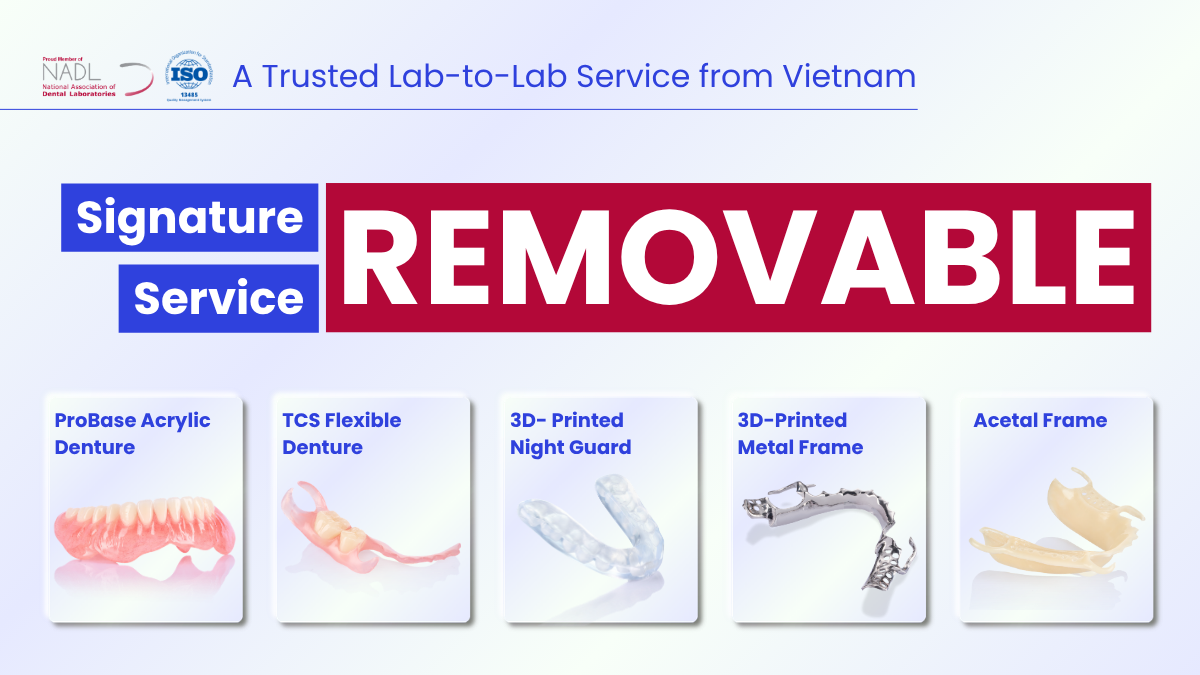
We are experts in Lab-to-Lab Full Service from Vietnam, with the signature services of Removable, meet U.S. market standards, FDA-registered, ISO 13485-certified. Founded in 2017, from local root to global reach, we scale with 2 Factories with over 100+ employees.
Our Commitments Built on “Trusted. Commitment. Quality”
- Commit to Large-Scale Manufacturing, high volume, remake rate < 1%.
- Commit to 5-Year Warranty
- Commit to Competitive Price
XDENT LAB | A Trusted Lab-to-Lab Service from Vietnam
Share this post:
Related Posts
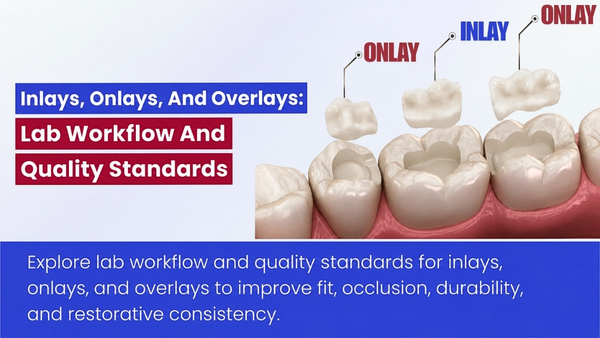
Explore lab workflow and quality standards for inlays, onlays, and overlays to improve fit, occlusion, durability, and restorative consistency.
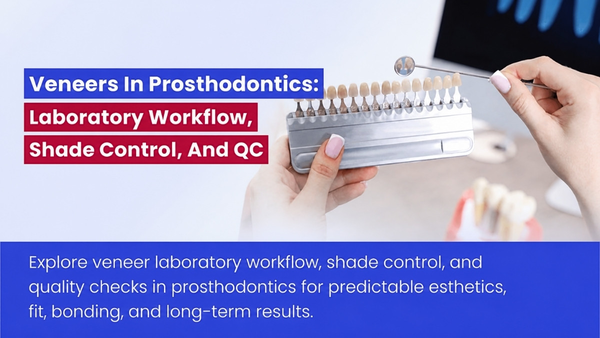
Explore veneer laboratory workflow, shade control, and quality checks in prosthodontics for predictable esthetics, fit, bonding, and long-term results.
Rest seat geometry controls how force enters the abutment tooth. Here are the design rules every RPD technician needs to know, with the reasoning behind each one.

