
Learn sublingual bar in RPD: design concept, indications, contraindications, and clinical positioning as a mandibular major connector alternative to lingual bar and linguoplate.
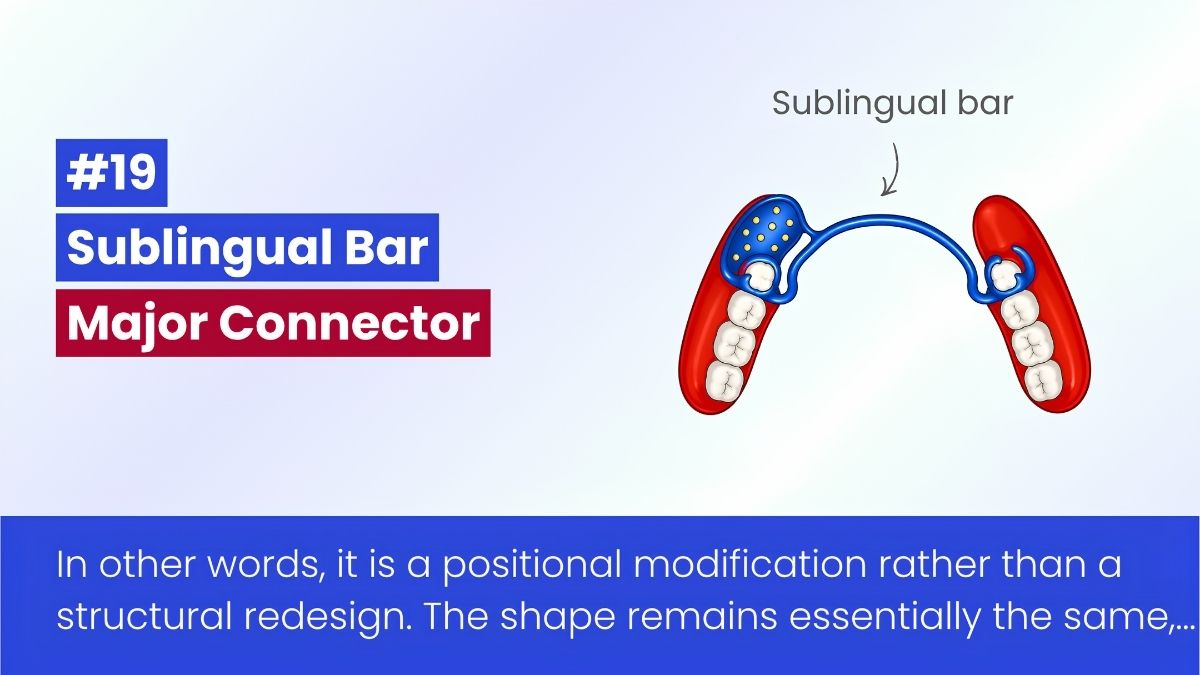
Table of contents [Show]
Introduction
In mandibular removable partial denture (RPD) design, the sublingual bar in RPD is a modification of the conventional lingual bar used in specific anatomical situations where standard placement is not feasible.
Although it follows the same basic cross-sectional form as a lingual bar, its positioning is shifted inferiorly and posteriorly to adapt to a high floor of the mouth or limited vertical space. This adjustment allows the connector to maintain rigidity while avoiding gingival impingement.
The sublingual bar is not a routine alternative. It is a situation-specific design used when conventional lingual bar placement is compromised but a full linguoplate is not required.
Key points
- Sublingual bar is a modified form of the lingual bar
- It is positioned more inferiorly and posteriorly in the anterior floor of the mouth
- It is used when standard lingual bar placement cannot achieve adequate gingival clearance
- It may substitute a linguoplate in selected cases without lingual frenum interference
- It has clear contraindications related to tori, frenum position, and functional floor-of-mouth movement
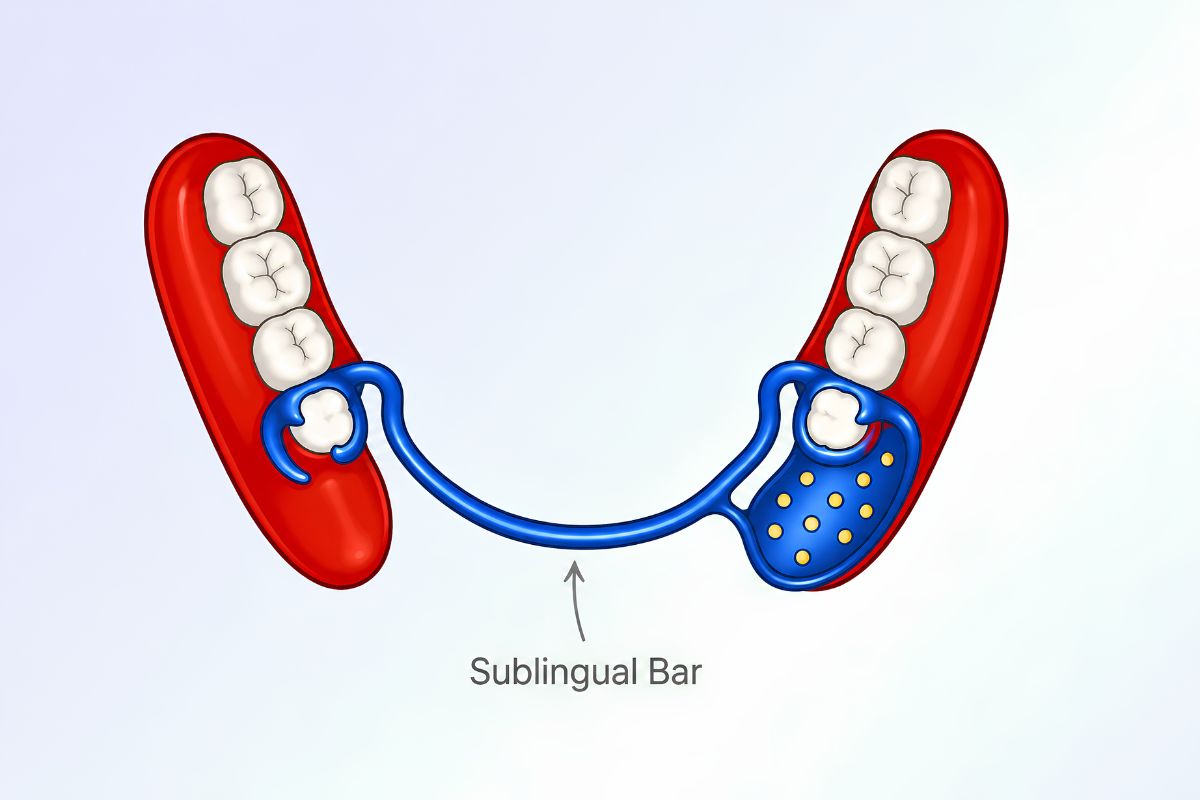
A sublingual bar is a mandibular major connector that maintains the general shape of a lingual bar but is positioned lower and more posteriorly, lying over and parallel to the anterior floor of the mouth.
Its main purpose is to solve a specific spatial problem: when the height of the floor of the mouth does not allow the superior border of a conventional lingual bar to be placed at least 4 mm below the free gingival margin.
In other words, it is a positional modification rather than a structural redesign. The shape remains essentially the same, but its location is adjusted to fit functional anatomy.
The sublingual bar is selected when standard lingual bar positioning becomes biologically unsafe or mechanically impractical.
Limited vertical space in mandibular anterior region
When the floor of the mouth is elevated or the functional depth of the lingual sulcus is reduced, a conventional lingual bar may sit too close to gingival tissues. This increases the risk of irritation and reduces biologic clearance.
By shifting the connector inferiorly and posteriorly, the sublingual bar allows better adaptation to available space while maintaining structural rigidity.
Avoidance of excessive blockout
In some cases, a lingual bar would require significant blockout due to anterior lingual undercuts. Excessive blockout may weaken design efficiency or create unfavorable contours.
The sublingual bar reduces the need for aggressive blockout by repositioning the connector rather than forcing adaptation to an unfavorable path.
The sublingual bar retains the same fundamental cross-sectional form as a lingual bar, including the half-pear shaped profile that provides rigidity.
However, its defining feature is not its shape but its location:
- It lies more inferiorly than a conventional lingual bar
- It is positioned more posteriorly along the anterior floor of the mouth
- It follows the functional movement pattern of the floor of the mouth
This positioning must be carefully evaluated because the floor of the mouth is a dynamic structure. It changes position during speaking, swallowing, and mastication.
Therefore, while deeper placement improves gingival clearance, it also increases the risk of functional interference if not properly planned.
If the superior border of a lingual bar cannot be placed at least 4 mm below the free gingival margin, a sublingual bar may be considered to achieve safer positioning.
When lingual frenum does not interfere
The sublingual bar may be used in place of a linguoplate if the lingual frenum does not restrict placement or function. In such cases, it offers a more conservative alternative with less tooth coverage.
When anterior lingual undercuts are present
If anterior lingual anatomy requires extensive blockout for a conventional lingual bar, a sublingual bar may reduce the need for such modification by repositioning the connector inferiorly.
Interfering lingual tori
Prominent lingual tori can obstruct proper placement and create pressure areas. In such cases, a sublingual bar may not be feasible without surgical correction or alternative design selection.
If the lingual frenum has a high attachment or creates functional interference, a sublingual bar may become unstable or irritating during movement of the floor of the mouth.
Interference with functional movement of the floor of the mouth
Because the sublingual bar is positioned closer to dynamic soft tissue structures, it may interfere with elevation of the floor of the mouth during speech, swallowing, or mastication. When such risk exists, alternative major connectors such as a linguoplate should be considered.
Clinical decision perspective
The sublingual bar should be understood as a narrow-indication solution in mandibular RPD design.
It is not intended to replace lingual bars or linguoplates in general. Instead, it fills a specific biomechanical and anatomical gap where:
- Lingual bar placement is too limited by vertical space
- Linguoplate is unnecessary or not indicated
- But structural continuity across the arch is still required
This makes it a highly case-dependent design, requiring careful evaluation of soft tissue dynamics rather than static cast anatomy alone.
Conclusion
The sublingual bar in RPD is a modified mandibular major connector that maintains the structural concept of a lingual bar while adapting its position to challenging anatomical conditions.
Its main value lies in its ability to preserve rigidity while avoiding gingival impingement in cases where conventional lingual bar placement is not feasible. However, its use is limited by functional anatomy, particularly the floor of the mouth, lingual frenum, and lingual tori.
In clinical decision-making, the sublingual bar should be viewed as a selective alternative within the broader framework of mandibular major connector design, rather than a routine replacement for lingual bars or linguoplates.
FAQ
What is a sublingual bar in RPD?
A sublingual bar is a modified lingual bar placed more inferiorly and posteriorly to accommodate limited vertical space in the mandibular anterior region.
When is a sublingual bar used?
It is used when a conventional lingual bar cannot be placed at least 4 mm below the gingival margin without impinging on soft tissues.
Can a sublingual bar replace a linguoplate?
In some cases yes, especially when a linguoplate is not required and the lingual frenum does not interfere.
What are the main contraindications?
Contraindications include lingual tori, high lingual frenum attachment, and interference with floor-of-mouth movement.
References
McCracken's Removable Partial Prosthodontics.
About XDENT LAB:
We are experts in Lab-to-Lab Full Service from Vietnam, with the signature services of Removable, meet U.S. market standards, FDA-registered, ISO 13485-certified. Founded in 2017, from local root to global reach, we scale with 2 Factories with over 100+ employees.
Our Commitments Built on “Trusted. Commitment. Quality”
- Commit to Large-Scale Manufacturing, high volume, remake rate < 1%.
- Commit to 5-Year Warranty
- Commit to Competitive Price
XDENT LAB | A Trusted Lab-to-Lab Service from Vietnam
Share this post:
Related Posts
A practical guide to implant crowns, bridges and overdentures, covering materials, component compatibility and laboratory workflow.

Explore the types, materials, retention methods and lab workflows for maxillofacial removable prostheses, with practical guidance for dental practices.
Explore precision attachment denture types, benefits and limitations, plus key considerations for design, fabrication and maintenance in dental practices.

