
Optimize international dental lab turnaround with FDA/ISO‑aligned workflows. Digital intake, AI scheduling, and robust logistics deliver 95%+ on‑time, consistent results.
Table of contents [Show]
- Why International TAT Demands a Different Playbook?
- Factors That Drive Turnaround Time (TAT)
- Evidence-Based Strategies to Shrink and Stabilize TAT
- Measuring and Benchmarking TAT
- XDENT LAB’s TAT Operating Model (Lab-to-Lab, FDA/ISO-Aligned)
- Practical Clinician Playbook: Accelerate Your TAT
- Risk Management: Keeping Promises When Things Go Sideways
- Future-Facing TAT Improvements
- What This Means for Dental Practices Working with XDENT LAB
- Sample TAT Matrix (Typical Digital Intake, Business Days)
- Conclusion
Turnaround time is the heartbeat of lab-to-clinic trust. In international dental lab services, speed without variance matters more than raw speed alone. The winning strategy is predictable, digitized, and compliant—so clinicians can book seats, set patient expectations, and deliver on time. This article presents a comprehensive framework aligned with XDENT LAB’s FDA/ISO positioning and Lab-to-Lab service model.
Why International TAT Demands a Different Playbook?
International lab services add border friction—shipping, customs, and time zones—on top of clinical complexity. Digital dentistry has removed many physical bottlenecks, but the differentiator is orchestration: standardizing intake, compressing design/production, and hardening logistics to variability. Practices need:
Clear SLAs by product and intake method (digital vs. analog).
Real-time case visibility, proactive alerts, and single-point accountability.
Documented QA that prevents rework rather than inspects it after.
XDENT LAB’s Lab-to-Lab model, dual factories, and FDA/ISO controls combine to deliver speed with repeatability you can schedule around.
Factors That Drive Turnaround Time (TAT)
Digital Workflow Integration
Digital impressions remove courier latency and distortion risk; CAD/CAM compresses design-to-mill time.
Cloud portals enable live clarifications, version control, and automated hold-release logic.
3D printing accelerates splints, try-ins, and provisionals; nesting/queuing optimizes batch runs.
Automated QC (design rule engines, CAM preflight) prevents downstream remakes.
Regulatory Compliance and Documentation
ISO 13485 and 21 CFR 820-aligned documentation ensures traceable materials and validated processes.
Pre-cleared BOMs and HS codes minimize customs stalls.
Country-specific import compliance and material certifications attached to shipments reduce inspection delays.
Geography and Logistics
Time zone-aware SLA windows and cut-off times for design start and dispatch.
Multi-carrier routing with redundancy and disruption reroute rules.
Customs brokerage with digital pre-advice to shorten clearance.
Production Scheduling and Capacity
Finite-capacity planning by modality (milling lanes, 3D printing bays, press units).
Case triage by complexity and appointment date; expedite lanes for “surgical date locked” cases.
Cross-trained technicians to smooth labor peaks; load balancing across factories.
Evidence-Based Strategies to Shrink and Stabilize TAT

Technology Stack That Moves the Needle
Intraoral scanners: 40–60% time savings versus conventional impressions by removing shipping and remake variance.
AI-assisted design and library automation: up to 70% reduction in routine design tasks; faster first-pass approvals.
3D printing for same/next-day appliance builds; hybrid workflows (print try-in then final mill) reduce total cycle time.
Case tracking with immutable audit trails for chain-of-custody and dispute resolution.
Process Standardization
Digital intake checklists: margins, occlusal scheme, shade protocol, attachments, due date.
Standard communication templates for data insufficiency, contradictions, or appointment risk with SLA-bound responses.
Defined QC gates: pre-design validation, pre-manufacture DFM, post-fabrication dimensional checks.
Lean audits to separate wait vs. work time and eliminate bottlenecks.
Communication That Prevents Holds
Regional case managers in the client’s time zone.
Real-time messaging with structured prompts and auto-translate.
Video huddles for complex implant and removable frameworks.
Automated milestone updates: received, design start, proof ready, in fabrication, QA, dispatched, and ETA.
Strategic Network Design
Multi-carrier contracts and premium backup lanes for deadline-critical cases.
Local finishing partners in target markets to reduce last-mile days.
Dual-source materials with buffer stock and expiry rotation.
Measuring and Benchmarking TAT
Case cycle time (submit to deliver): track median and P90/P95 to reflect patient risk.
Stage times: intake-to-design, design-to-approval, production, QA, shipping, customs.
First-time quality (FTQ): percentage shipped without rework or holds.
On-time delivery (OTD): percentage delivered by promised date; segment by modality and route.
Remake/rework rate by cause: impression quality, design ambiguity, manufacturing, shipping.
Appointment risk index: percentage flagged “at risk” 48–72 hours before seat date.
Benchmark targets: OTD ≥ 95% overall (≥ 98% digital); FTQ ≥ 92% digital (≥ 85% analog); P95 international shipping variance ≤ 2 days on express lanes.
Intake and SLA Architecture
Case-ready definition: validated files (margins, shade protocol), opposing and bite, appointment date, special instructions.
Typical SLAs (business days):
Crowns/bridges (monolithic): Digital 3–5; Analog 5–7.
Implant crowns/abutments: Digital 5–7; Analog 7–9.
RPD frameworks: 5–7.
Complete dentures (digital try-in): 3–4; final 5–7.
Splints/night guards (printed): 2–3 digital.
Design and Production Controls
CAD rule engines for minimal thickness, connector cross-sections, emergence profiles, and library constraints.
DFM gates: undercut analysis, path of insertion, print/mill feasibility alerts.
Parallelized production: night-cycle printing, day-cycle milling, with QA buffers.
Quality and Compliance
ISO 13485 QMS with design records, DHRs, and traceability.
21 CFR 820 design controls with verification/validation evidence.
SPC on critical processes (tool wear, resin pot life, calibration drift) with Cpk > 1.33 thresholds.
CAPA loop tied to TAT with defined root-cause taxonomy.
Cross-Border Logistics Playbook
Paperless trade: automated commercial invoices, HS code templates, pre-clearance documentation.
Multi-warehouse dispatch windows aligned to carrier cut-offs.
Proactive exception management: weather alerts, reroute triggers, appointment-risk escalation.
Practical Clinician Playbook: Accelerate Your TAT
Prefer digital impressions with validated presets; include opposing, bite, and photos (shade tab, stump shade).
Use standardized Rx instructions with due and appointment dates.
Approve design proofs within 2–4 business hours; pre-authorize minor adjustments within tolerance.
Select service lanes by criticality: economy for routine, express for fixed seat dates.
For implants: provide scan bodies, lot info, connection platform, and restorative space photos.
Risk Management: Keeping Promises When Things Go Sideways
Build buffer into scheduling: set seat dates after P90 transit for economy routes.
Use appointment-risk alerts to switch carriers or activate local finishing partners.
Maintain backup provisionals for time-critical deliveries.
For analog workflows: align courier pick-ups to carrier cut-offs; avoid Friday dispatch for customs-heavy destinations.
Future-Facing TAT Improvements
AI scheduling that balances machine utilization with due dates, minimizing P95 cycle times.
Distributed manufacturing with localized last-mile printing or milling and centralized QC recipes.
Machine vision QA to detect marginal gaps, connector undersizing, and surface artifacts.
Faster-curing materials and validated “print tonight, seat tomorrow” protocols for select appliances.
What This Means for Dental Practices Working with XDENT LAB
Predictable timelines with SLA-backed delivery windows and proactive alerts reduce appointment risk.
Fewer remakes via digital intake standards and rule-driven design.
Compliance confidence through FDA/ISO processes, material traceability, and audit-ready documentation.
Scalable partnership using dual factories, cross-trained teams, and multi-carrier logistics.
Sample TAT Matrix (Typical Digital Intake, Business Days)
| Product | Standard SLA | Expedited Option | Notes |
|---|---|---|---|
| Zirconia crown (monolithic) | 3–5 | 2–3 | Requires complete digital records |
| Layered zirconia | 5–7 | 4–5 | Shade photos reduce rework |
| Implant crown/abutment | 5–7 | 4–5 | Include scan body and connection data |
| RPD framework | 5–7 | 4–5 | Path of insertion verified in CAD |
| Complete denture (try-in) | 3–4 | 2–3 | Digital try-in accelerates fit |
| Night guard/splint (printed) | 2–3 | 1–2 | Night-cycle print capacity |
Conclusion
TAT optimization in international dental lab services is an orchestration challenge: digitize intake, standardize decisions, validate manufacturing, and harden logistics. Practices gain reliable seat dates; labs gain throughput and fewer escalations. XDENT LAB’s Lab-to-Lab model—rooted in FDA/ISO controls, dual-factory capacity, and multi-carrier logistics—delivers the blend of speed and predictability that modern practices require.
About XDENT LAB:
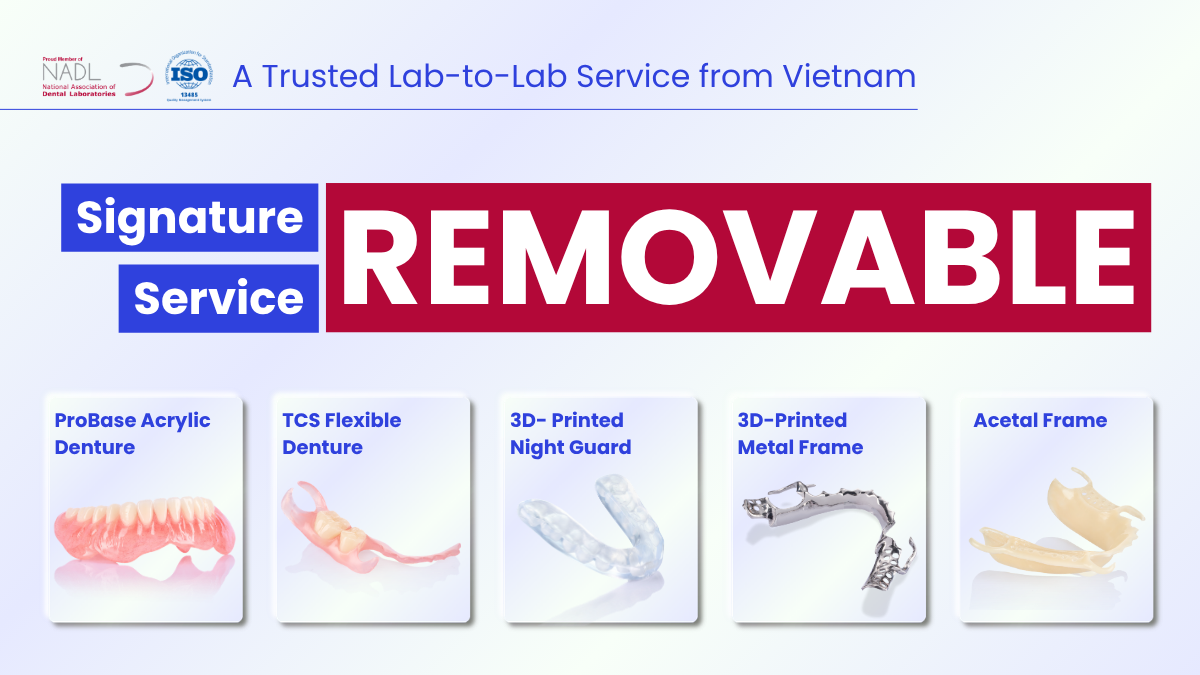
We are experts in Lab-to-Lab Full Service from Vietnam, with the signature services of Removable, meet U.S. market standards, FDA-registered, ISO 13485-certified. Founded in 2017, from local root to global reach, we scale with 2 Factories with over 100+ employees.
Our Commitments Built on “Trusted. Commitment. Quality”
- Commit to Large-Scale Manufacturing, high volume, remake rate < 1%.
- Commit to 5-Year Warranty
- Commit to Competitive Price
XDENT LAB | A Trusted Lab-to-Lab Service from Vietnam
Share this post:
Related Posts
Learn how B2B dental labs improve quality and consistency for dental practices through digital workflows, material control, expert QC, and reliable turnaround.
Learn how the dental lab subcontract model helps labs expand capacity, manage workloads, access technology, and maintain quality in outsourced production.
See 5 completed Acrylic Full Denture cases from XDENT LAB, a Vietnamese dental laboratory serving worldwide, especially US, Europe, and Australia. Trusted oversea outsourcing dental laboratory partner...

