
Explore how light-curing resin is being applied in 3D printed nightguards, from flexible materials and digital workflows to post-processing techniques that improve accuracy, durability, and overall performance in digital dentistry.

Table of contents [Show]
In recent years, 3D printing has become an increasingly common part of digital dentistry, especially in applications such as dental models, surgical guides, aligners, and nightguards. Along with the advancement of printing technology, dental light-curing resins have also evolved to better meet clinical and manufacturing requirements.
For nightguards, the material must provide not only accuracy, but also durability, biocompatibility, and comfort during use. As a result, flexible biocompatible resins are becoming more widely used in digital nightguard workflows.
This article provides an overview of the application of light-curing resin in 3D printed nightguards, while discussing several important considerations related to material properties, post-processing, and practical laboratory workflows.
What is Light-Curing Resin?
Light-curing resin is a material that polymerizes when exposed to UV light or light at a specific wavelength. It is commonly used in 3D printing systems such as SLA, DLP, and LCD. In dentistry, this type of material is widely used for producing digital appliances including models, surgical guides, splints, and nightguards.
From a chemical perspective, most dental light-curing resins are based on methacrylate photopolymer systems. These materials typically contain:
- Methacrylate monomers
- Oligomers
- Photoinitiators
- Additives that help control viscosity, flexibility, color, and mechanical properties
When the resin is exposed to UV light at the appropriate wavelength, usually around 385–405 nm, the photoinitiators activate the polymerization reaction. This process links the monomers and oligomers together, forming a solid polymer structure.
Unlike standard model resin, nightguard resin is often developed as a flexible or semi-flexible material. This allows the appliance to maintain:
- A certain level of elasticity
- Resistance to repeated stress
- Improved comfort during intraoral use
Some manufacturers also design these materials with “thermoplastic-like behavior,” meaning the cured resin can provide limited flexibility while still maintaining dimensional stability.
The chemical characteristics of the resin are especially important in dentistry because the appliance remains in long-term contact with the oral environment. For this reason, many modern materials are developed to be:
- BPA-free
- MMA-free
- Biocompatible according to ISO 10993 standards
These properties help reduce the risk of irritation and minimize concerns related to residual monomer.
However, the final performance of the material depends not only on the resin formulation itself, but also on the entire manufacturing process, including:
- Printing
- Cleaning
- Post-curing
If polymerization is incomplete, residual monomer may remain on the surface of the appliance, potentially affecting:
- Mechanical strength
- Color stability
- Overall biocompatibility
This is why manufacturers of intraoral dental resin materials usually provide strict post-processing guidelines to ensure the final appliance performs as intended.
Applications of Light-Curing Resin in 3D Printed Nightguards
Traditionally, nightguards were produced using vacuum forming or conventional acrylic techniques. While these methods are still widely used, digital workflows are becoming more common due to the advantages of data storage and easy reproduction.
By combining intraoral scanning, CAD software, and 3D printing, dental laboratories can produce nightguards with a more consistent and standardized workflow. Digital files also make remakes more convenient when patients lose or damage their appliances.
It also directly affects:
- Appliance fit
- Mechanical performance
- Long-term durability
- Patient comfort
Newer flexible resins are designed to balance the rigidity needed for occlusal protection with the flexibility required for comfortable wear.
Requirements for Nightguard Resin
Not every resin is suitable for manufacturing intraoral appliances. For nightguards, the material must meet several important requirements simultaneously.
First, biocompatibility is essential. Since the appliance remains in contact with the oral environment for extended periods, the material should comply with appropriate biological safety standards. Many modern dental resins are developed as BPA-free and MMA-free materials to reduce the risk of irritation or adverse reactions.
Mechanical properties are also important. Nightguards must withstand repeated occlusal forces, especially in patients with bruxism. If the material is too brittle, the appliance may crack or fracture over time.
On the other hand, materials that are too soft may reduce occlusal stability. For this reason, many manufacturers are developing resins with moderate flexibility to achieve a balance between durability and patient comfort.

The Importance of Post-Processing in 3D Printed Nightguards
In dental 3D printing workflows, the quality of a nightguard depends not only on CAD design or the resin itself. Post-processing is also a critical step because it directly affects the appliance’s durability, material stability, biocompatibility, and final surface quality.
For flexible light-curing resins, post-processing procedures often require tighter control compared to standard model resins. If the workflow is not performed properly, the appliance may develop issues such as:
- Sticky surfaces
- Warping
- Reduced strength
- Discoloration over time
- Poor fitting accuracy
After printing, the appliance must be cleaned to remove uncured resin using an appropriate concentration of Isopropyl Alcohol (IPA). Cleaning should be performed within a suitable timeframe to prevent residual resin from remaining on the surface. However, excessive soaking in IPA may also affect the mechanical properties of the material, especially for highly flexible resins.
Many current workflows use a two-stage IPA cleaning process. In the first stage, the appliance is washed to remove excess liquid resin after printing. It is then transferred to a cleaner IPA bath to improve the surface quality and reduce remaining contaminants. Some laboratories also use soft brushes or cotton swabs to clean detailed anatomical areas.
The cleaning stage is followed by UV post-curing. This process helps complete polymerization and improve material stability. Proper post-curing contributes to:
- Improved mechanical strength
- Better surface stability
- Safer residual monomer levels
During curing, the appliance should be positioned correctly to minimize distortion. In addition, allowing the appliance to cool completely after curing can help reduce the risk of surface defects or warping.
Finally, the appliance is polished to create a smoother surface and improve patient comfort during use. A well-finished surface not only improves comfort but also makes the appliance easier to clean during daily use.
In practice, many common problems associated with 3D printed nightguards are not caused solely by the resin itself, but are closely related to the post-processing workflow. For this reason, controlling cleaning, curing, and finishing procedures has become an important part of maintaining consistent quality in digital nightguard manufacturing.

Digital Nightguards
The development of light-curing resin continues to expand the role of digital workflows in removable dentistry. Today, many laboratories are moving beyond printing models and are beginning to directly manufacture nightguards and splints using specialized dental resins.
In the future, these workflows may continue evolving toward:
- Shorter production times
- Simplified remake workflows
- Improved patient comfort
- Greater long-term material stability
For digital dental laboratories, understanding resin properties and material processing is becoming an important part of maintaining product quality and workflow consistency.
Light-curing resin plays an important role in the development of digital nightguards. The combination of flexible materials, CAD/CAM technology, and 3D printing allows appliances to be produced with greater consistency and accuracy compared to many traditional workflows.
However, the performance of the final appliance depends not only on the resin itself, but also on the entire workflow, including design, printing, cleaning, and post-curing. For this reason, understanding material behavior and following validated processing procedures remain essential for producing reliable intraoral appliances in clinical practice.
Share this post:
Related Posts
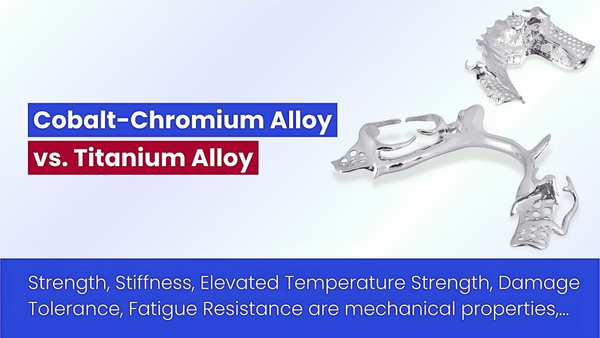
Learn the key differences between titanium and cobalt-chromium alloys used in removable partial denture frameworks, from mechanical properties to production requirements.
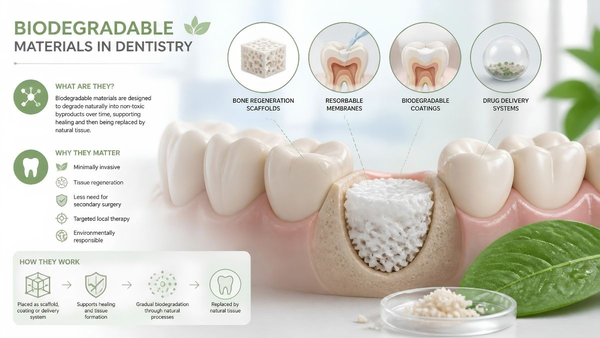
Explore biodegradable materials in dentistry, including their applications, benefits, limitations, and future potential in regenerative and sustainable dental care.
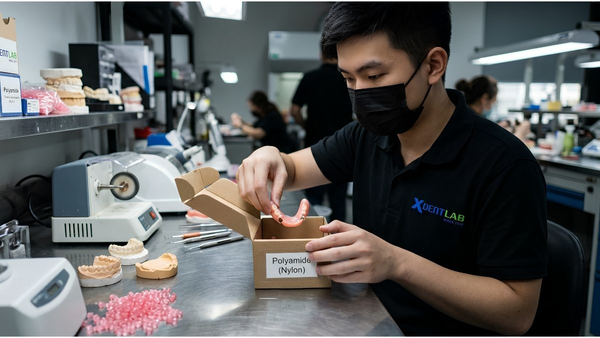
Learn how polyamide dental materials support flexible dentures and removable prosthetics through biocompatibility, aesthetics, comfort, and lightweight performance.

