
Explore how 3D printing is changing dental crown production from temporary crowns to permanent restorations. This article covers technologies, materials, benefits, and clinical limits in this field.
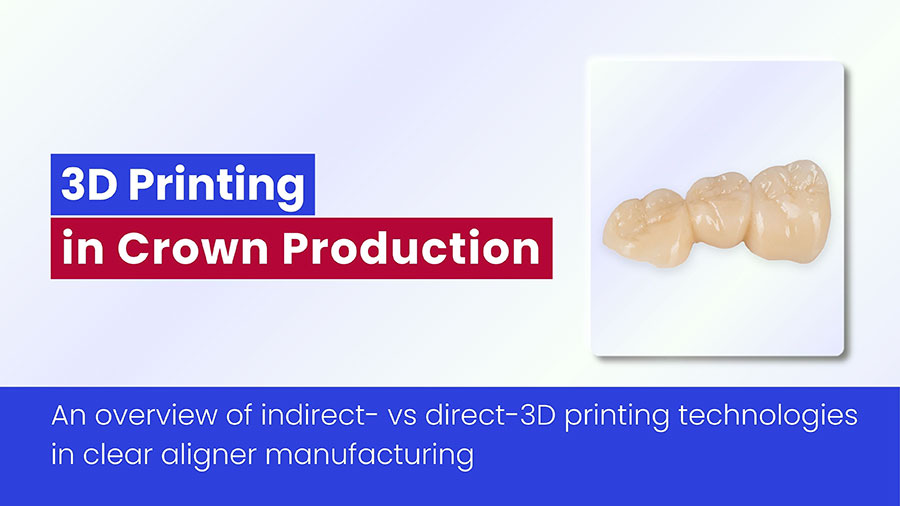
Table of contents [Show]
Key Points
3D printing is widely applied in dental crown production, from temporary to permanent restorations.
Temporary crowns are typically produced using FDM for speed and cost efficiency.
Permanent resin crowns rely mainly on SLA and DLP for accuracy and surface quality.
Metal crowns and frameworks are fabricated using powder bed fusion for strength and durability.
Effective clinical outcomes depend on material choice, post-processing, and case indication.
Introduction
In recent years, 3D printing has become a transformative force in restorative dentistry, particularly in the fabrication of dental crowns. As a core component of fixed prosthodontic treatment, crowns demand high levels of accuracy, material reliability, and patient-specific customization. Traditional manufacturing methods such as casting and CAD/CAM milling have long dominated this space, but they also come with limitations related to material waste, production time, and workflow rigidity.
Additive manufacturing, commonly referred to as 3D printing, offers a fundamentally different approach. By building crowns layer by layer directly from digital designs, 3D printing enables faster production, greater design freedom, and improved integration with digital dental workflows. Today, 3D printing is no longer limited to experimental use; it is actively applied in the production of temporary crowns, provisional restorations, metal frameworks, and increasingly, definitive resin-based crowns.
This article explores the practical applications of 3D printing in dental crown production, examining how different printing technologies support temporary and permanent restorations, their clinical advantages, current limitations, and future directions.
For a broader overview of additive manufacturing technologies in dentistry, see our related guide: 3D Printing Technologies in Prosthodontics .
3D Printing for Temporary Crowns
One of the most established applications of 3D printing in crown production is the fabrication of temporary (provisional) crowns. These restorations are commonly produced using material extrusion technologies, particularly Fused Deposition Modeling (FDM/FFF), combined with biocompatible thermoplastic polymers such as PLA.
FDM-printed temporary crowns offer several practical advantages:
Rapid production, allowing same-day or short-turnaround provisional restorations
Low material and equipment costs, making them accessible for in-office or small-lab use
Adequate mechanical performance for short-term clinical application
However, research consistently reports certain limitations. Temporary crowns produced via FDM often:
exhibit rougher surface texture,
lower translucency,
and reduced esthetic quality compared with conventionally fabricated or milled alternatives.
These characteristics restrict their use primarily to provisional scenarios rather than long-term restorations.
Despite these drawbacks, FDM-based 3D printing remains a valuable solution for temporary crowns where speed, affordability, and workflow efficiency are prioritized over high esthetic demands.
3D Printing for Permanent Crowns
In contrast to temporary restorations, permanent dental crowns require higher dimensional accuracy, superior surface quality, and reliable long-term material performance. As a result, their production relies primarily on vat polymerization technologies, most notably Stereolithography (SLA) and Digital Light Processing (DLP).
Resin-Based Permanent Crowns (SLA & DLP)
SLA and DLP printers cure liquid photopolymer resins using controlled light exposure, producing crowns with:
Exceptional marginal and internal fit
Smooth surface finish
High reproducibility across batches
These technologies also support chairside crown fabrication, significantly reducing treatment timelines and enabling same-day restorative workflows.
However, while resin-based crowns fabricated via SLA or DLP demonstrate promising clinical accuracy, long-term durability and biocompatibility remain active areas of research. Current evidence suggests that printed resin crowns are clinically acceptable in selected indications, but they have not yet fully replaced ceramic materials such as zirconia for all definitive restorations.
For metal-based crowns and substructures, additive manufacturing relies on laser-based powder bed fusion (L-PBF) technologies, including Selective Laser Melting (SLM) and Direct Metal Laser Sintering (DMLS). These processes fuse metal powders, commonly cobalt–chromium alloys, into dense, high-strength components.
When combined with appropriate post-processing steps such as heat treatment, polishing, and surface finishing, L-PBF-manufactured crowns exhibit:
Excellent marginal adaptation
High mechanical strength
Predictable long-term performance
As a result, metal crowns and frameworks produced via powder bed fusion are increasingly accepted in clinical prosthodontics, particularly for posterior restorations and implant-supported applications.
Key Clinical Advantages of 3D-Printed Crowns
Accuracy and Fit
One of the most significant advantages of 3D-printed crowns is their dimensional accuracy. Comparative studies indicate that additive manufacturing can achieve more precise marginal and internal fits than traditional subtractive milling, reducing the risk of cement failure, secondary caries, and patient discomfort.
Customization and CAD/CAM Integration
Because 3D printing is inherently digital and compatible with CAD/CAM workflows, crowns can be fully customized to each patient’s anatomical and occlusal requirements. This level of personalization enhances both functional performance and esthetic outcomes, particularly in complex restorative cases.
Workflow Efficiency
3D printing streamlines crown production through rapid prototyping, minimizing delays associated with conventional laboratory processes. For clinicians, this translates into:
Shorter chair time
Faster delivery of restorations
Improved patient satisfaction
Current Limitations and Challenges
Despite its advantages, 3D printing in crown production is not without limitations.
Material constraints remain a primary concern. Many printable resins do not yet match the long-term mechanical strength and wear resistance of traditional ceramics such as zirconia.
Surface texture issues may arise, particularly with lower-resolution printers, requiring extensive post-processing to achieve clinically acceptable finishes.
Regulatory and biocompatibility validation continues to limit widespread adoption of directly printed definitive crowns in some regions.
These challenges highlight the importance of technology selection based on clinical indication, rather than assuming a one-size-fits-all solution.
Examples of 3D Printing Systems Used in Crown Production
Several commercial platforms have been developed specifically to support crown fabrication:
SprintRay: Offers an integrated ecosystem (e.g., Midas, Pro 2) with ceramic-dominant resins designed for strong, esthetic crowns and same-day restorative workflows.
Formlabs: Known for high-resolution SLA printers such as the Form 4B, providing speed, accuracy, and a growing range of biocompatible dental materials.
Rapid Shape: Provides validated dental printers (e.g., PRO 20) with tightly integrated post-processing solutions to ensure consistency and reliability.
Future Directions in 3D-Printed Crown Development
Ongoing research continues to expand the clinical potential of 3D-printed crowns. Emerging material innovations include:
Nanodiamond-reinforced PMMA
PLA composites with nanohydroxyapatite
Hybrid resin–ceramic formulations
At the same time, advances in print parameter optimization, shape optimization algorithms, and resin chemistry are expected to further improve the mechanical strength, esthetics, and longevity of printed crowns. These developments may ultimately enable broader adoption of 3D printing for definitive restorations across a wider range of clinical scenarios.
Conclusion
3D printing is rapidly becoming an essential tool in dental crown production, offering clear advantages in precision, efficiency, and personalization. From low-cost temporary crowns fabricated via FDM to high-accuracy resin and metal crowns produced using SLA, DLP, and powder bed fusion, additive manufacturing supports a wide spectrum of restorative needs.
While material and durability challenges remain, particularly for long-term definitive crowns, ongoing research and technological refinement continue to push the boundaries of digital dentistry. As evidence grows and materials mature, 3D printing is poised to play an increasingly central role in modern crown fabrication.
Reference
Advances in 3D printing for dentistry: clinical applications and future perspectives by Partha Protim Borthakur et al. 2025
About XDENT LAB:
We are experts in Lab-to-Lab Full Service from Vietnam, with the signature services of Removable, meet U.S. market standards, FDA-registered, ISO 13485-certified. Founded in 2017, from local root to global reach, we scale with 2 Factories with over 100+ employees.
Our Commitments Built on “Trusted. Commitment. Quality”
- Commit to Large-Scale Manufacturing, high volume, remake rate < 1%.
- Commit to 5-Year Warranty
- Commit to Competitive Price
XDENT LAB | A Trusted Lab-to-Lab Service from Vietnam
Share this post:
Related Posts
See 5 Acrylic Partial Denture cases (cases 11 to 15) from XDENT LAB, a Vietnamese dental laboratory that is a member of the National Association of Dental Laboratories (NADL). XDENT LAB is an expert i...
See 5 completed Acrylic Partial Denture cases (Case 6 ~ Case 10) from XDENT LAB, a Vietnamese dental laboratory that is FDA registered and ISO 13485 certified. A trusted overseas outsourcing dental la...
Discover how critical laboratory checks reduce remakes and improve restoration quality in dental lab outsourcing for fixed and implant cases.

